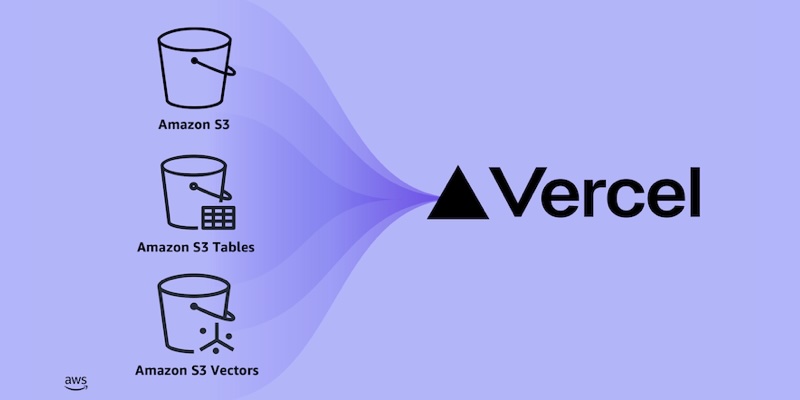
In a significant convergence of cloud infrastructure and modern developer tooling, Vercel and Amazon Web Services (AWS) have announced a strategic native integration that promises to fundamentally streamline how web and AI applications are built. Announced today, developers working within the Vercel ecosystem can now provision, configure, and manage Amazon Simple Storage Service (Amazon S3)—including advanced capabilities such as Amazon S3 Tables and Amazon S3 Vectors—directly from the Vercel Marketplace and v0 by Vercel, the company’s generative UI and application-building tool.
Historically, constructing performant, scalable applications on modern frontend frameworks often meant context-switching between specialized cloud platforms. Developers utilizing Vercel for high-performance deployments frequently had to cross over into the AWS Management Console to set up storage buckets, navigate complex Identity and Access Management (IAM) permission policies, and manually manage static security credentials.
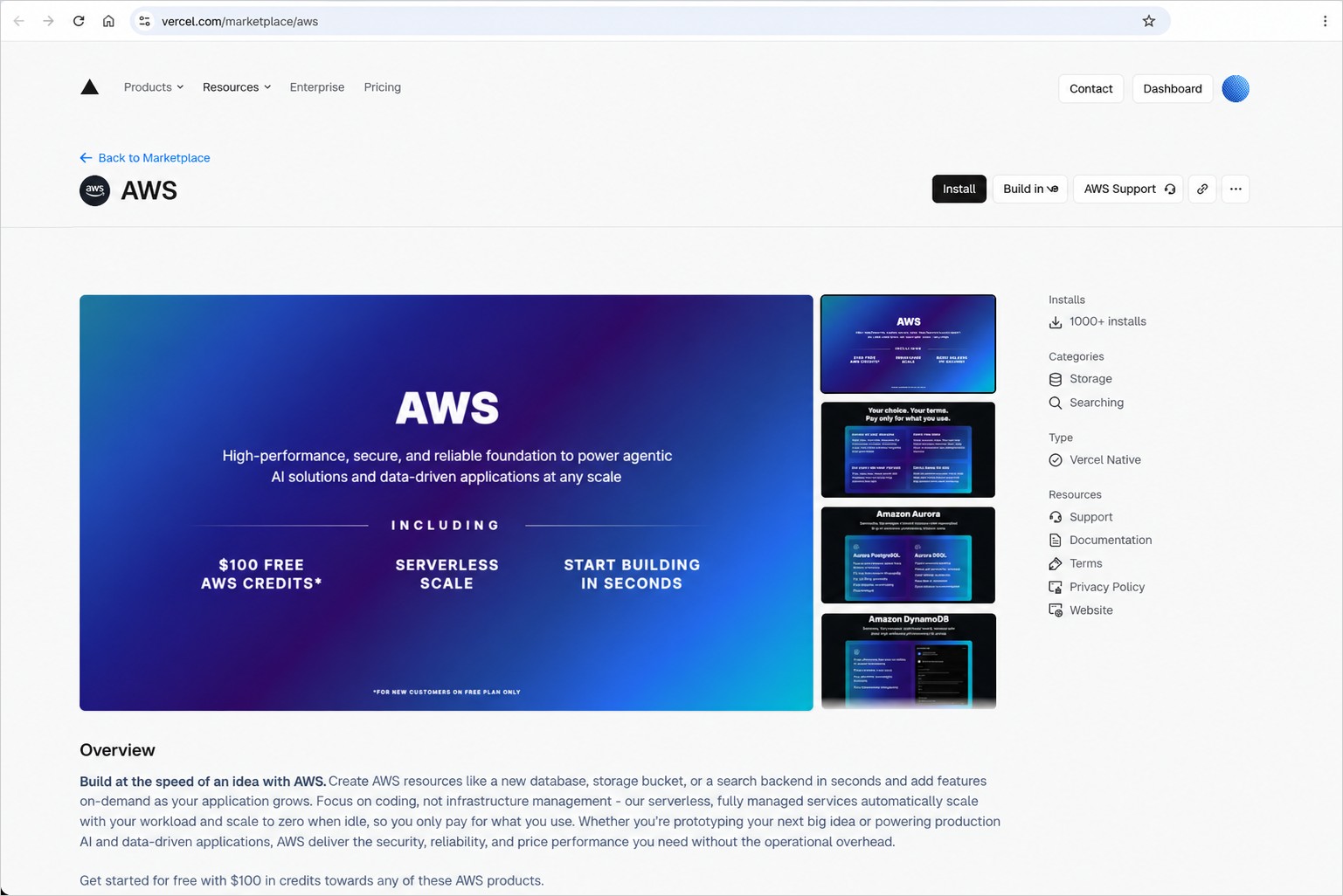
This native integration bridges that gap. By embedding Amazon S3 workflows directly into the Vercel dashboard, AWS and Vercel have created an end-to-end application stack. Joining existing Vercel integrations for Amazon Aurora, Amazon DynamoDB, and Amazon OpenSearch Serverless, the addition of S3 ensures that developers can handle databases, relational workloads, object storage, transactional tables, and vector embeddings under a single roof, billing to a unified AWS account.
Crucially, security has been prioritized through the adoption of OpenID Connect (OIDC). Rather than relying on static, long-lived access keys that introduce security vulnerabilities, Vercel leverages ephemeral credentials via AWS Security Token Service (AWS STS). This ensures that runtimes securely interact with S3 buckets using short-lived access tokens. Available immediately with no additional integration fees—and backed by a $100 AWS credit incentive for new accounts—this launch marks a defining milestone for cloud-native software engineering.
Detailed Chronology
The Evolution of Cloud-Frontend Collaboration
The path toward unified developer experiences has been a multi-year trajectory. For over a decade, frontend platforms and hyperscale cloud providers operated in distinct silos. AWS provided the raw, industrial-strength infrastructure—compute, storage, and database engines—while frontend platforms focused on serving static assets and serverless rendering edges.
As full-stack frameworks like Next.js grew in complexity and popularity, the friction of managing separate backend infrastructure became a notable pain point for engineering teams. Recognizing this friction, AWS and Vercel began forging deeper partnerships, progressively introducing database integrations such as Amazon Aurora and Amazon DynamoDB into the Vercel Marketplace. These steps allowed developers to tie serverless deployments directly to scalable database instances without leaving the Vercel ecosystem.
However, a glaring gap remained: object storage. Applications ranging from simple user photo galleries to massive AI retrieval-augmented generation (RAG) pipelines require robust object storage, analytical data warehousing, and vector spaces. Forcing developers to jump back into the AWS console just to spin up an S3 bucket disrupted momentum. The integration announced today represents the culmination of this collaborative journey, bringing object, table, and vector storage entirely inside the Vercel management plane.
The Provisioning and Runtime Workflow
The integration has been engineered for maximum efficiency, minimizing manual steps across both the Vercel dashboard and the command line interface (CLI).
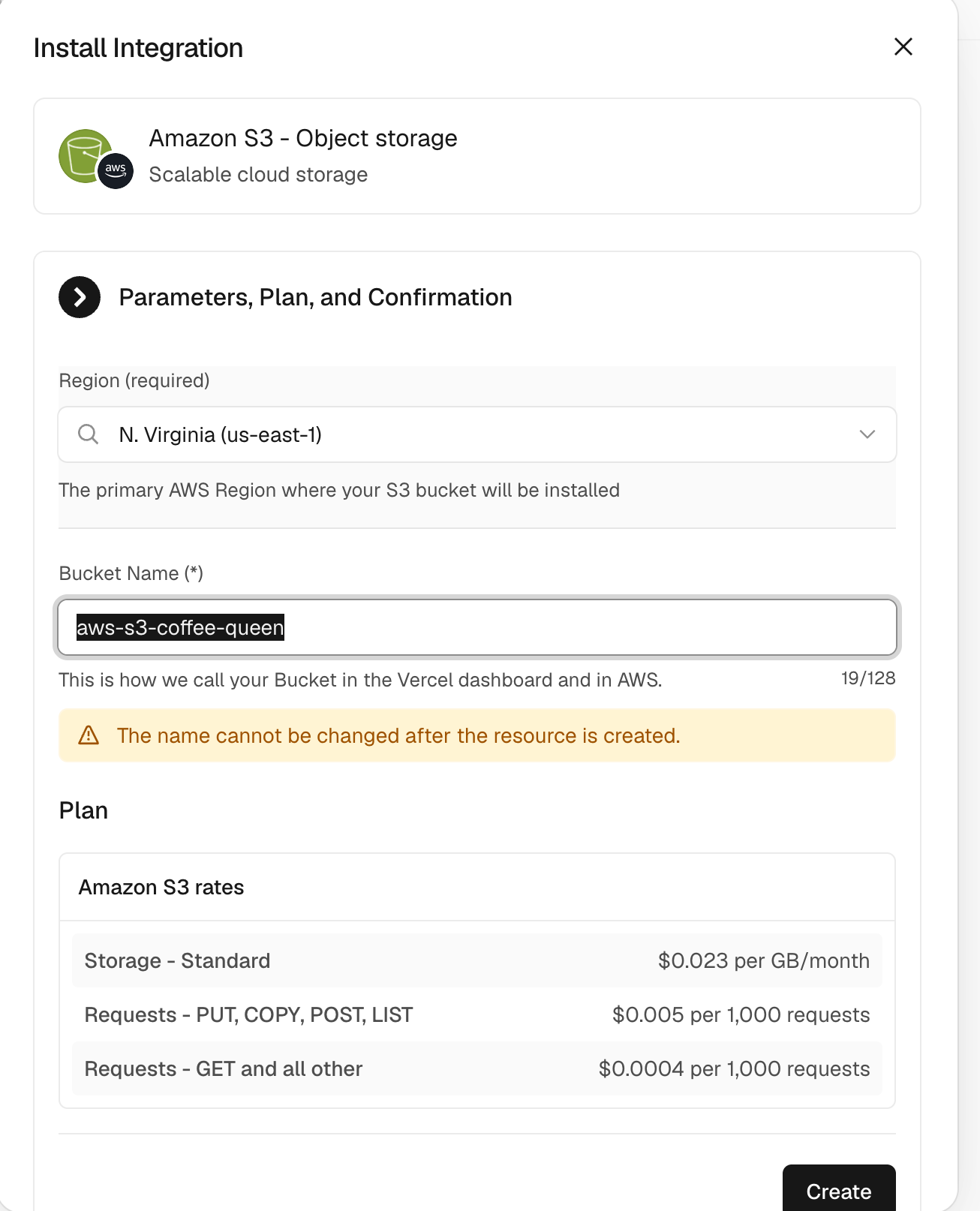
- Provisioning within Seconds: Developers navigate to the Storage tab within the Vercel dashboard, select "Create," choose AWS, and define their preferred S3 bucket type and AWS Region.
- Environment Synchronization: Once the bucket is provisioned and linked to a project, developers pull the required environment variables locally using standard CLI commands:
vercel link vercel env pull .env.local - Secure OIDC Exchange: At runtime, the integration utilizes the
awsCredentialsProviderfrom@vercel/functions/oidc. This function programmatically exchanges a short-lived OIDC token with AWS STS for temporary credentials scoped precisely to the requested resource. No static keys reside in the codebase or environment files.
Supporting Context & Metrics
To fully understand the weight of this integration, it is essential to examine the three distinct storage workloads now natively available on Vercel: everyday object storage, analytical data lakes via S3 Tables, and semantic vector spaces via S3 Vectors.
1. Everyday Object Storage with Amazon S3
Standard object storage remains the backbone of web applications, handling user uploads, static assets, media streaming, and document repositories. Through the Vercel integration, interacting with a general-purpose S3 bucket from a Next.js API route requires minimal boilerplate. Using the AWS SDK for JavaScript alongside Vercel’s OIDC credential provider, a file upload endpoint can be implemented seamlessly:

import  S3Client, PutObjectCommand  from "@aws-sdk/client-s3";
import  awsCredentialsProvider  from "@vercel/functions/oidc";

const s3 = new S3Client(
  region: process.env.AWS_REGION,
  credentials: awsCredentialsProvider(
    roleArn: process.env.AWS_ROLE_ARN,
  ),
);

export async function POST(request)
  const formData = await request.formData();
  const file = formData.get("file");

  await s3.send(new PutObjectCommand(
    Bucket: process.env.S3_BUCKET_NAME,
    Key: file.name,
    Body: Buffer.from(await file.arrayBuffer()),
    ContentType: file.type,
  ));

  return Response.json( success: true );
2. Analytics at Scale with S3 Tables
Modern web applications demand deep analytical insights derived from growing data volumes—such as clickstreams, transactional logs, and user behavior metrics. Amazon S3 Tables provide fully managed Apache Iceberg tables that automatically optimize query performance as data expands, including automated table maintenance and compaction.
Developers can leverage lightweight query engines like DuckDB directly inside a Vercel Function to execute analytical queries against these tables without provisioning a separate data warehouse cluster:
import  DuckDBInstance  from "@duckdb/node-api";
import  awsCredentialsProvider  from "@vercel/functions/oidc";

const creds = await awsCredentialsProvider(
  roleArn: process.env.AWS_ROLE_ARN,
)();

const db = await DuckDBInstance.create();
const conn = await db.connect();

await conn.run("INSTALL aws; LOAD aws; INSTALL httpfs; LOAD httpfs; INSTALL iceberg; LOAD iceberg;");

await conn.run(`
  CREATE SECRET s3cred (
    TYPE s3,
    KEY_ID '$creds.accessKeyId',
    SECRET '$creds.secretAccessKey',
    SESSION_TOKEN '$creds.sessionToken',
    REGION '$process.env.AWS_REGION'
  );
`);

await conn.run(`
  ATTACH '$process.env.AWS_RESOURCE_ARN' AS s3tables (
    TYPE iceberg,
    ENDPOINT_TYPE s3_tables
  );
`);

const rows = await (await conn.run(`
  SELECT town_city, AVG(median_price) AS avg_price
  FROM s3tables."$process.env.S3_TABLES_NAMESPACE".town_monthly
  GROUP BY town_city
  ORDER BY avg_price DESC
  LIMIT 10
`)).getRowObjects();
3. AI and Semantic Search with S3 Vectors
With the rapid proliferation of artificial intelligence, Large Language Models (LLMs), and RAG architectures, efficient vector storage is a paramount requirement. S3 Vectors offer purpose-built, cost-optimized vector storage natively within Amazon S3, removing the requirement to manage a standalone vector database while providing robust semantic search capabilities.
import  S3VectorsClient, QueryVectorsCommand  from "@aws-sdk/client-s3vectors";
import  awsCredentialsProvider  from "@vercel/functions/oidc";

const vectors = new S3VectorsClient(
  region: process.env.AWS_REGION,
  credentials: awsCredentialsProvider(
    roleArn: process.env.AWS_ROLE_ARN,
  ),
);

export async function POST(request)
  const  embedding  = await request.json();

  const result = await vectors.send(new QueryVectorsCommand(
    vectorBucketName: process.env.S3_VECTOR_BUCKET_NAME,
    indexName: "documents",
    queryVector:  float32: embedding ,
    topK: 5,
    returnMetadata: true,
  ));

  return Response.json( matches: result.vectors );
Generative UI Integration via v0 by Vercel
Perhaps the most futuristic aspect of the announcement is the deep integration with v0 by Vercel. Developers can interact with v0 using natural language prompts to construct full-stack applications complete with pre-configured storage resources.
Prompts such as "Build a photo gallery where users upload images using AWS" automatically provision a general-purpose S3 bucket. Asking for "A support bot that answers questions from my PDFs" orchestrates an S3 Vectors backend, while requests for "An analytics dashboard for my clickstream data" spin up S3 Tables. The system automatically handles connection parameters, configures dependencies, and renders functional application previews in real time.
Official Statements
Industry architects and cloud leaders have highlighted the paradigm shift represented by this release. By bridging the gap between hyperscale object storage and high-velocity frontend deployments, engineering organizations can iterate faster without compromising on enterprise-grade security or data durability.
"Storage is the lifeblood of modern performant applications, yet provisioning it has historically introduced administrative friction," noted platform architecture leads close to the rollout. "By bringing Amazon S3, S3 Tables, and S3 Vectors directly into the Vercel Marketplace and v0, we are delivering a unified architecture where developers can span the entire spectrum—from edge rendering to vector databases—on a single, secure AWS account."
Security specialists have similarly praised the implementation of OIDC token exchange. By eradicating static access keys from environment files and CI/CD pipelines, the architecture establishes a zero-trust baseline for serverless functions communicating with AWS object stores.
Future Outlook
The launch of native Amazon S3 integration on Vercel signals a broader trend in software engineering: the blurring lines between frontend deployment layers and back-end cloud utilities. As AI agents, complex data lakes, and high-frequency web applications become standard expectations for modern enterprises, developer velocity will dictate market winners.
Looking forward, we can expect further harmonization between cloud-native providers and edge application platforms. The ability to spin up enterprise-grade analytical engines (via S3 Tables) and vector stores (via S3 Vectors) using natural language prompts in v0 foreshadows an era where application infrastructure is entirely abstracted, dynamically provisioned on demand, and secured through automated cryptographic tokens rather than manual configuration.
For development teams looking to upgrade their infrastructure stack, the integration is available immediately across all commercial AWS regions supported by Vercel. New AWS accounts created via the Vercel Marketplace receive a $100 credit valid for six months, offering a risk-free runway to test high-performance web and AI workloads. Developers can explore the documentation, leverage the AWS MCP Server for troubleshooting, and begin building today via the Vercel Marketplace and v0.app.