Managing containerized workloads at scale has long been heralded as a triumph of modern cloud architecture, yet platform engineers know the hidden operational toll exacted by mundane, repetitive infrastructure tasks. Specifically, configuring ingress networking for every microservice deployed on Amazon Elastic Container Service (Amazon ECS) has historically presented a stubborn bottleneck. For each new service entering production, engineering organizations have had to provision, stitch together, and maintain a sprawling lattice of Application Load Balancers (ALBs), AWS Certificate Manager (ACM) certificates, AWS WAF web access control lists (web ACLs), and intricate security groups.
As applications scale, update, and multiply, keeping these discrete infrastructure resources in sync introduces acute configuration drift, complicates auditing, and slows deployment velocity to a crawl.
To permanently dismantle this structural roadblock, Amazon Web Services (AWS) has announced the general availability of Amazon ECS Gateway, a powerful new account-level resource designed to fundamentally redefine ingress management. ECS Gateway acts as an intelligent orchestration layer, dynamically provisioning and managing the exact networking infrastructure required by containerized workloads directly within the user’s AWS account. By cleanly separating operational responsibilities between platform teams—who govern foundational networking policies—and application teams—who focus entirely on business logic—ECS Gateway eliminates the per-service overhead that has plagued cloud operations for years.
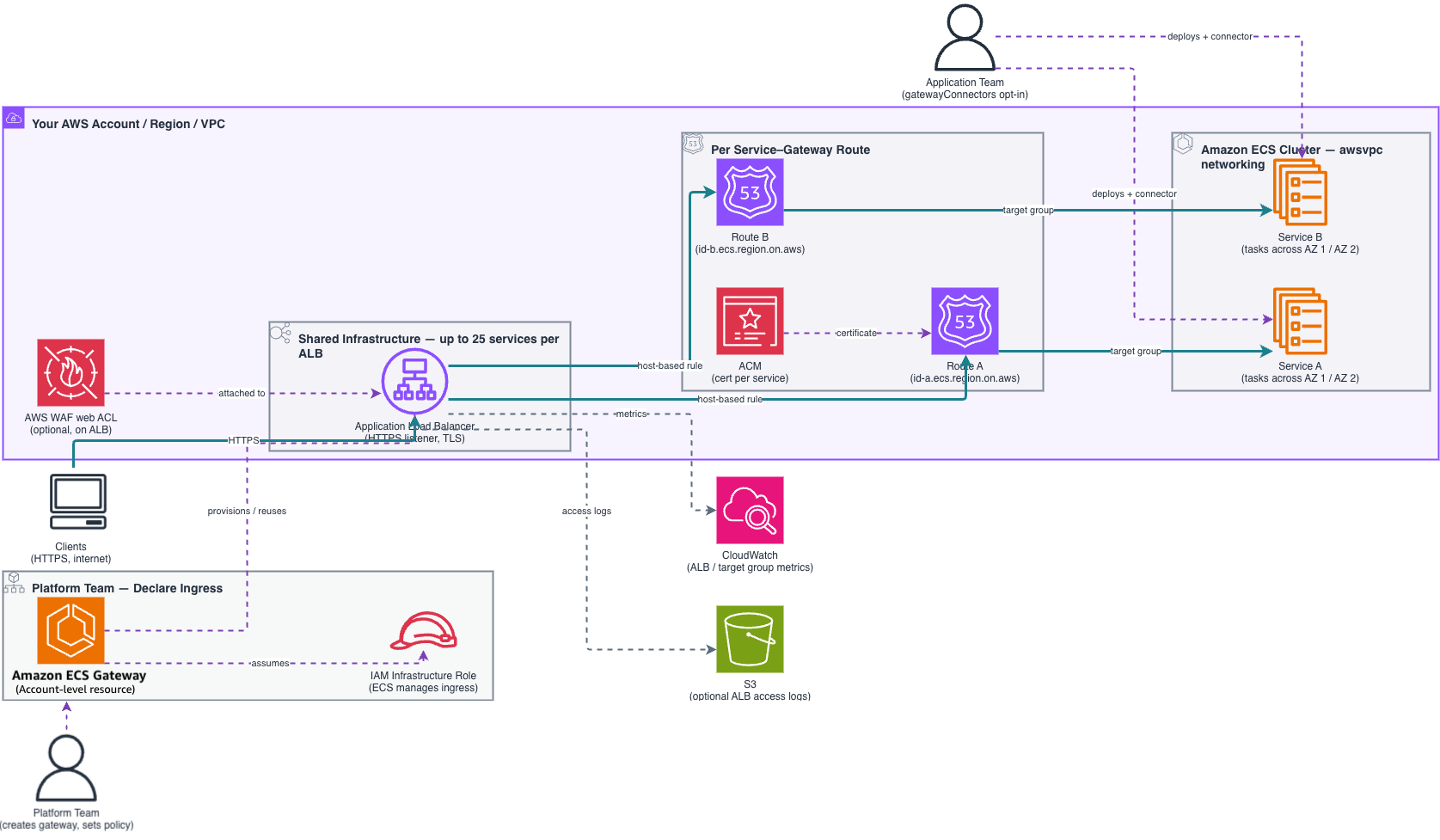
Beyond operational relief, the architectural shift introduced by ECS Gateway delivers profound density and cost efficiencies. By enabling up to 25 distinct services to share a single host-based routing ALB, organizations can slash infrastructure expenditure while allowing Amazon ECS to autonomously handle the lifecycle of underlying hardware. From automatically provisioning the first load balancer upon a service’s arrival to scaling out additional units and decommissioning them when idle, ECS Gateway transforms manual networking routines into a fully automated, frictionless developer experience. Available immediately across all commercial AWS Regions at no additional control-plane charge, this capability marks a watershed moment in how enterprises build, scale, and secure containerized applications on AWS.

Detailed Chronology: The Evolution of ECS Ingress and the Birth of ECS Gateway
The Traditional Burden of Container Networking
To fully appreciate the architectural leap represented by ECS Gateway, one must examine the historical mechanics of deploying containerized services on Amazon ECS. In the early days of microservices, container orchestration solved the challenge of compute density and automated scheduling. However, as organizations transitioned from monolithic architectures to hundreds or thousands of discrete microservices, networking configuration quickly emerged as the primary friction point.
In the conventional paradigm, when an application team created a new service, the deployment workflow looked like an administrative gauntlet:
- Load Balancer Provisioning: A platform engineer had to provision an Application Load Balancer (or attach the service to an existing one, which required manually managing target groups, listener rules, and priority numbers).
- Security & Cryptography: Engineers had to generate or request an AWS Certificate Manager (ACM) certificate for custom domains, attach it to the ALB listener, and configure AWS WAF web ACLs to shield the application from web exploits.
- Network Isolation: Custom security groups had to be meticulously crafted, permitting ingress traffic strictly from the ALB to the container tasks while blocking unauthorized cross-traffic.
- Lifecycle Synchronization: Every time a service scaled in or out, or underwent a rolling deployment, target group health checks, deregistration delays, and DNS mappings required continuous oversight.
For platform teams overseeing dozens of development squads, this per-service manual provisioning formula fostered severe operational toil. Configuration drift—where production environments slowly diverge from infrastructure-as-code (IaC) baselines due to emergency hotfixes or manual adjustments—became an omnipresent risk. Deployment velocity stagnated, and developers spent more time wrestling with networking YAML files than writing application code.
The Architectural Blueprint of ECS Gateway
Recognizing the unsustainable nature of per-service ingress management, AWS engineering teams went back to the drawing board to design a native, platform-level abstraction. The result is Amazon ECS Gateway, an innovative control structure that re-architects how traffic flows from the outside world into ECS tasks.

At its core, ECS Gateway establishes a robust, decoupled relationship between clusters and gateways. A single ECS Gateway can be associated with up to 10,000 distinct clusters, while a single cluster can support up to five individual gateway associations. This many-to-many matrix gives platform architects extraordinary flexibility; organizations can deploy shared multi-tenant gateways across development environments or isolate production workloads by provisioning dedicated public and private gateways on the same cluster.
[ External Traffic / VPC Internal ]
              │
              ▼
     ┌─────────────────┐
     │   ECS Gateway   │ ──(Dynamic Provisioning)──> [ Application Load Balancers ]
     └────────┬────────┘                                         │
              │ (Many-to-Many Association)                       │
              ▼                                                  ▼
     ┌─────────────────┐                                 ┌────────────────┐
     │   ECS Cluster   │ ──(Gateway Connectors)────────> │ ECS Services   │
     └─────────────────┘                                 └────────────────┘
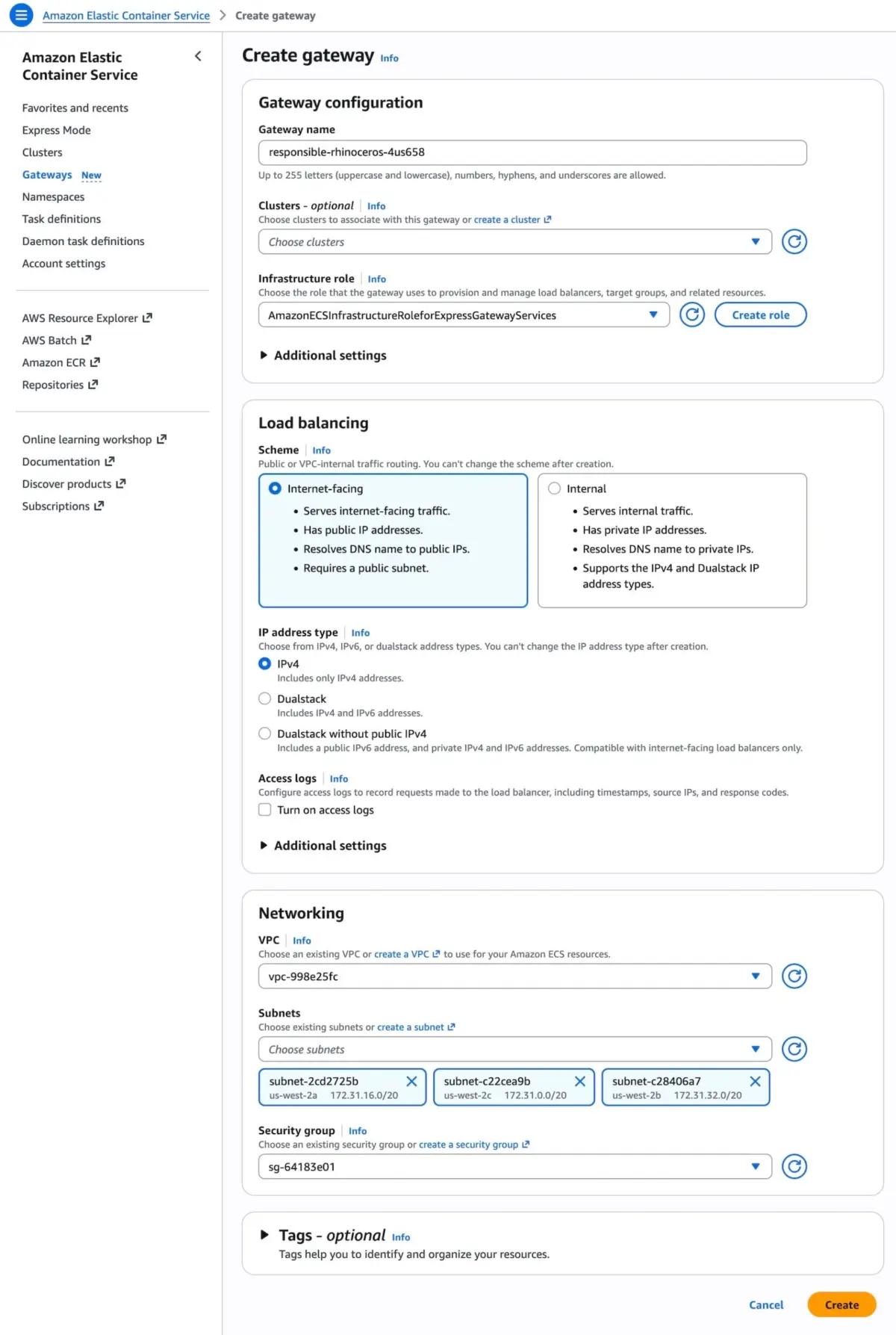
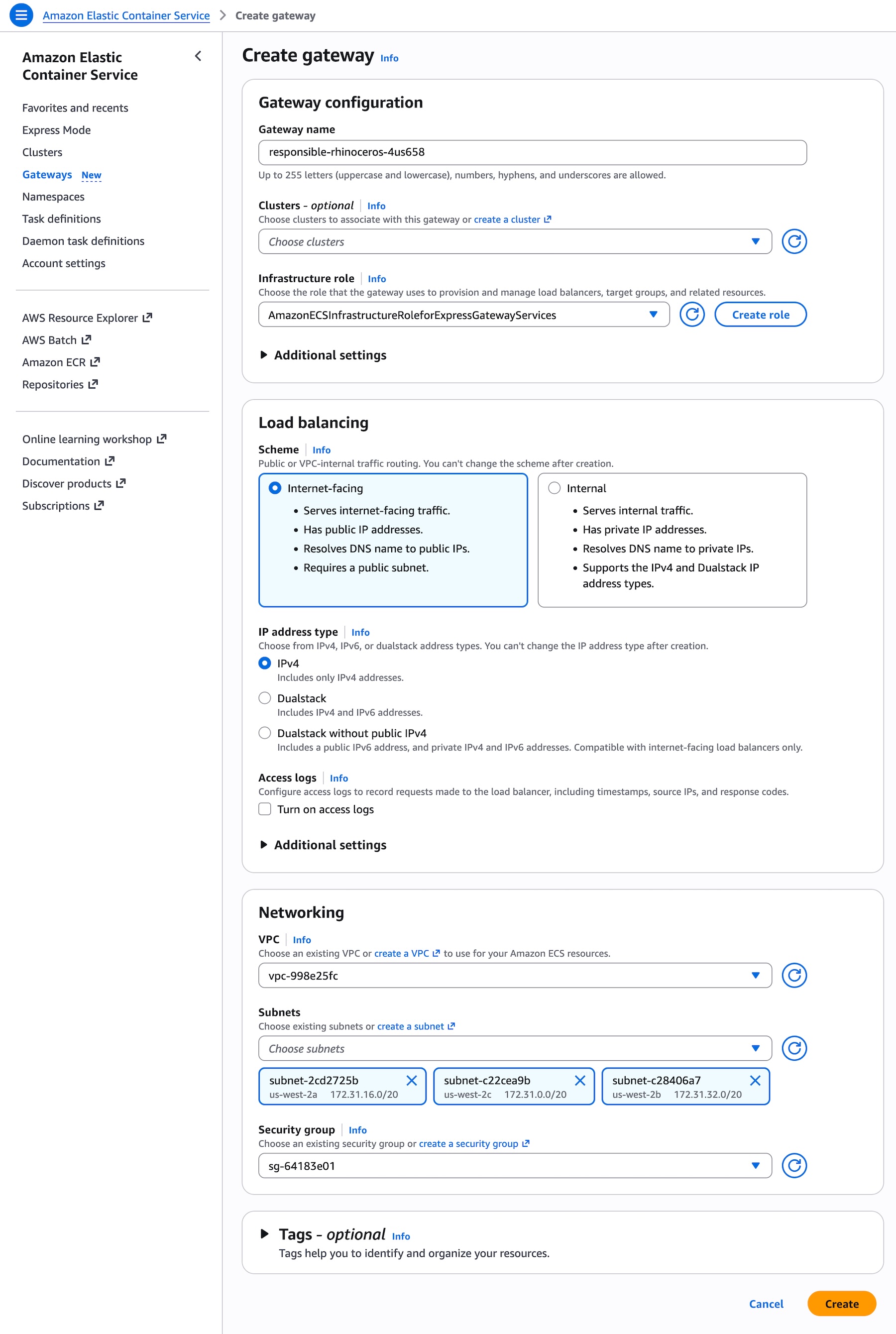
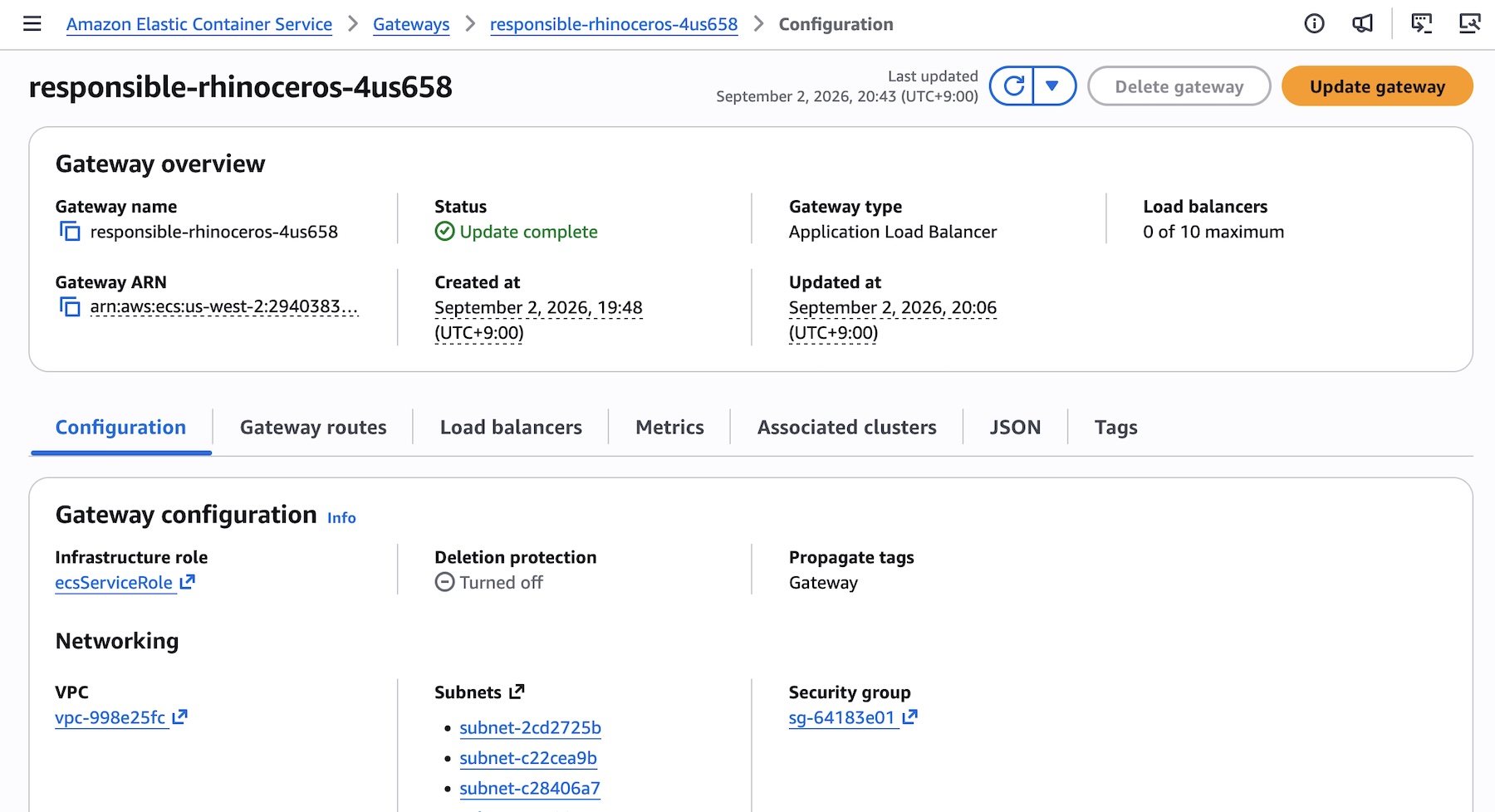
The workflow begins in the AWS Management Console or via the AWS Command Line Interface (CLI), where a platform engineer instantiates a gateway by providing a unique name and assigning an IAM infrastructure role. This infrastructure role grants Amazon ECS the precise permissions required to provision and manage ALBs, security groups, and certificates within the customer’s account.
Once the gateway is established and associated with target ECS clusters, application teams no longer interact with load balancers directly. Instead, developers simply declare a gateway connector inside their service definitions (CreateService or UpdateService). When the service is deployed, Amazon ECS automatically evaluates the cluster’s associated gateways, matches access types (public versus VPC-internal), validates Availability Zone coverage, and provisions all necessary per-service infrastructure items behind the scenes:
- An ACM certificate for secure transport.
- A unique, ready-to-use DNS hostname for instant endpoint accessibility.
- A dedicated listener rule routing incoming traffic for that specific hostname to the appropriate target group.
- A tightly scoped service security group allowing inbound traffic exclusively from the ALB security group.
If an existing ALB reaches its capacity limit—such as the maximum threshold of listener rules or target groups—Amazon ECS autonomously provisions a brand-new ALB up to the user-defined maxAlbCount quota, seamlessly absorbing incoming growth without manual intervention.
Supporting Context & Metrics: Cost Optimization and Operational Scale
The introduction of Amazon ECS Gateway is not merely a cosmetic upgrade to the AWS console; it introduces quantifiable architectural improvements in infrastructure density, cost efficiency, and administrative overhead.
Density and Infrastructure Cost Reduction
In traditional container networking configurations, organizations frequently fell into one of two inefficient traps:
- Dedicated ALB per Service: Provisioning a dedicated Application Load Balancer for every single microservice. While simple to isolate, this approach introduced crushing baseline costs, as each ALB carries a fixed hourly fee regardless of traffic volume, quickly becoming cost-prohibitive for large-scale microservice fleets.
- Manual ALB Sharing: Forcing multiple services to share a single ALB manually. While this saved money, it required platform teams to manually manage complex listener rule priorities, target group routing weights, and certificate handshakes—a brittle process prone to human error and routing collisions.
ECS Gateway solves this dilemma natively through automated host-based routing. By allowing up to 25 distinct services to share a single ALB, the system maximizes resource utilization. Services are intelligently packed onto shared load balancers until capacity is exhausted, at which point ECS seamlessly spins up the next ALB in the pool. For an enterprise running 500 microservices, this density optimization can reduce the required number of ALBs from 500 down to 20, translating into massive recurring monthly savings on infrastructure bills.
Operational Scale and Telemetry Metrics
The scalability parameters engineered into ECS Gateway reflect enterprise-grade requirements:
- Cluster-to-Gateway Ratio: Up to 10,000 clusters per gateway, and up to 5 gateways per cluster, offering unmatched topological flexibility across multi-region or multi-environment enterprise structures.
- Service Adoption Flexibility: Organizations are not forced into a disruptive "big bang" migration. Using incremental adoption patterns via
UpdateService, teams can attach a gateway connector to an existing service that already utilizes its own load balancer. Both ingress paths remain active simultaneously, allowing engineers to thoroughly validate DNS propagation, certificate validity, and traffic routing before gracefully decommissioning the legacy load balancer configuration. - Automated Lifecycle Management: The infrastructure lifecycle is fully closed-loop. When a service is scaled down to zero or deleted entirely, ECS automatically removes its listener rules, target groups, and DNS records, and eventually garbage-collects empty ALBs when they are no longer utilized, preventing "orphan resource" accumulation and eliminating silent cloud waste.
Official Statements and Architectural Guidance
AWS engineering leadership has emphasized that ECS Gateway was forged directly from customer feedback regarding the operational friction of microservice architectures at scale.
During the rollout, principal AWS architects highlighted the critical need for governance separation. In enterprise settings, platform teams bear the responsibility of maintaining security baselines, compliance standards, and foundational networking topologies (such as selecting approved VPC subnets, enforcing WAF web ACLs, and defining IAM trust relationships). Conversely, application developers care exclusively about deploying code rapidly without needing deep domain expertise in Elastic Load Balancing or certificate management.
"With Amazon ECS Gateway, we are bridging the long-standing divide between infrastructure governance and application velocity," noted a senior product manager on the Amazon ECS team. "Platform teams retain absolute control over where traffic enters the network, which security postures are enforced, and how resources are bounded via IAM roles. Meanwhile, application developers are liberated from the networking boilerplate. They simply drop a connector into their service definition, and within moments, they have a fully secured, DNS-resolving, production-ready endpoint."
Furthermore, AWS has ensured that programmatic management is a first-class citizen. Beyond standard AWS CLI commands—such as CreateGateway, AssociateGatewayWithCluster, and service updates—developers and platform engineers can interact with ECS Gateway via advanced AI coding tools and automation frameworks. By leveraging the AWS MCP Server and associated plugins, teams can query documentation, invoke API operations, and author infrastructure orchestration scripts using natural language interfaces integrated directly into their preferred integrated development environments (IDEs).
Future Outlook: The Next Frontier of Container Orchestration
As cloud-native architectures continue to evolve toward higher levels of abstraction, the release of Amazon ECS Gateway signals a broader industry shift away from manual infrastructure orchestration toward intent-based cloud management.
Looking forward, the capabilities introduced by ECS Gateway lay the groundwork for even more advanced intelligent networking features within Amazon ECS. As organizations embrace zero-trust networking principles, automated service-to-service mesh integrations and predictive capacity scaling based on traffic heuristics are expected to build upon this foundational ingress layer. The clean abstraction boundary established between cluster operators and service developers ensures that future networking innovations can be integrated seamlessly without requiring sweeping rewrites of existing application deployment pipelines.
For platform teams drowning in the operational overhead of managing thousands of individual load balancers, security groups, and certificate mappings, ECS Gateway provides an immediate, elegant resolution. By automating the tedious mechanics of ingress networking while preserving rigorous security and compliance controls, AWS has effectively lowered the barrier to entry for hyper-scaled microservice architectures.
Amazon ECS Gateway is available today across all commercial AWS Regions where ECS is supported, incurring no additional control-plane charges—customers pay solely for the underlying AWS resources (such as ALBs, ACM certificates, CloudWatch logs, and data transfer) provisioned within their accounts. Organizations looking to streamline their container operations can begin creating gateways immediately via the AWS Management Console, CLI, or API, marking the dawn of a faster, leaner, and far more automated era for Amazon ECS deployments.