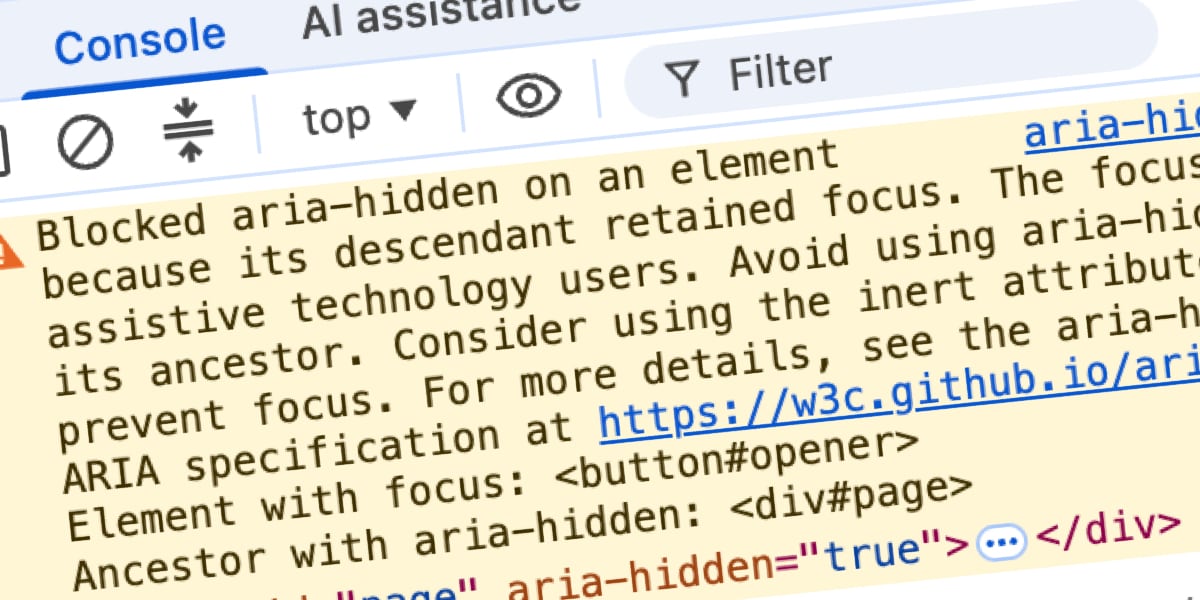
For thousands of front-end developers, a routine deployment hits a familiar, abrasive wall: the browser console flashes an angry mustard-yellow warning. You highlight the error message, copy it into a search box, and find yourself staring at an ocean of identical threads spanning Angular, Bootstrap, Ionic, and phpMyAdmin.
The top-ranking solutions—the blur() one-liner, the setTimeout shim, or the brute-force removal of aria-hidden attributes—all promise the same thing: silence the console warning and get your deployment pipeline moving. But each of these quick fixes comes with a hidden tax. They quiet the console while quietly breaking the browser for screen-reader users, dropping their focus into an invisible void.
This is not a minor stylistic advisory from the browser. When Chrome flags an element as having "retained focus" within a hidden region, it is not merely suggesting a best practice; it is overriding your architecture. By dissecting the lifecycle of modal overlays, we can uncover why these popular patches fail, how accessibility trees diverge from DOM trees, and what a robust, order-correct teardown contract looks like.
Detailed Chronology: The Anatomy of a Console Warning
The tension between modern browser rendering engines and front-end component libraries did not appear overnight. It is the result of an evolving accessibility standard clashing with legacy component design patterns.
The Two Waves of Chromium Enforcement
Chromium began actively policing the mismatch between focus and visibility in two distinct waves. The first wave appeared around Chrome 127 in the summer of 2024, clustering in bug trackers for MUI, Ant Design, and Flowbite. This variant scolded developers about an element that "just received focus" inside a newly hidden subtree.
Months later, the second wave arrived with Chrome 131. This update introduced the "retained focus" warning, catching developers live as modals faded out. Bootstrap and Angular repositories flooded with issues as developers running beta builds encountered the warning for the first time.
However, the behavior underneath these warnings was already years old. Chromium had been quietly exposing focusable aria-hidden nodes as early as 2020. As recorded in W3C ARIA working group discussions, engineers proposed this exception so screen-reader users could at least hear where their tab navigation was taking them, rather than experiencing complete silence.
The Paradox of aria-hidden
The core of the issue lies in a fundamental architectural paradox: aria-hidden removes content from the accessibility tree, but it does not remove that same content from the keyboard focus order.
These two systems operate independently and are rarely kept in sync by component libraries. Consequently, an element can be fully focusable via keyboard navigation while remaining completely imperceptible to assistive technology. The instant a user tabs onto such an element, a phenomenon known as "ghost focus" occurs:
- The screen reader encounters a focused node it has been told does not exist.
- It looks up the node, finds no accessible description, and falls silent.
- The user presses a key, hears nothing, and is left stranded in an application that appears frozen or broken.
When Chrome detects this state, it overrules the developer’s markup, exposing the subtree so the user isn’t left in total silence. The warning is the browser’s way of notifying you that your DOM state and your accessibility tree are fundamentally desynchronized.
Supporting Context & Metrics: The Four Traps of Modal Teardown
If you trace how developers arrive at this broken state, four distinct architectural scenarios emerge. Each requires its own precise diagnostic approach.
+-------------------------------------------------------------------------+
|                        MODAL TEARDOWN PATHWAYS                          |
+-------------------------------------------------------------------------+
  [1. Close-Time Race]        --> Focus trapped inside fading overlay.
  [2. Open-Time Inversion]    --> Background hidden while trigger holds focus.
  [3. Composition Turf War]   --> Nested modals/popovers fighting over inertness.
  [4. External Focus Loss]    --> User Alt-Tabs away while overlay is active.
+-------------------------------------------------------------------------+
1. The Close-Time Race (Hidden Mid-Goodbye)
This accounts for the vast majority of console warnings. A user clicks a close button, and the dialog begins a 200ms CSS fade-out transition. During this animation, focus remains parked on the close button, which sits inside the overlay that the library just marked as hidden. Because the transition hasn’t completed and the focus-restoration code hasn’t executed, Chrome flags the retained focus.
2. The Open-Time Inversion (The Trigger Left Behind)
Running the sequence in reverse, an overlay opens, and the library immediately marks the background as aria-hidden="true". However, the trigger button the user just clicked is still holding focus for a brief beat before the focus trap moves it inside the dialog. The browser flags a hidden region containing a newly focused node.
3. Nested Composition Conflicts (The Turf War)
A developer nests a <select> or a popover inside a <dialog>. Both components attempt to control the modal layer, applying their own background-hiding logic. Under modern rendering engines like React 19, the unmount timing shifts just enough that when an inner component tears down, focus drops briefly to the <body>. The parent dialog reads this as an outside click, re-hiding itself while the user’s focus is trapped, rendering keyboard navigation completely unusable.
4. External Focus Loss
Nothing changes on the page itself, but the user hits Alt+Tab or switches browser tabs while an overlay is open. The focus bookkeeping strands an aria-hidden state upon teardown with no live focus to reconcile against.
Official Statements & Industry Responses
The web development community’s initial response to these warnings relied heavily on quick fixes found on forums and discussion boards. Unfortunately, the most popular remedies introduced severe accessibility regressions.
The Cost of the Popular Antidotes
- The
blur()One-Liner: Callingdocument.activeElement.blur()without assigning a new focus target immediately silences the warning. However, it abandons the user’s focus on the<body>element. Screen readers reset their navigation to the top of the page, forcing keyboard users to tab through the entire header and navigation structure all over again—a direct violation of WCAG 2.4.3 (Focus Order). - Timing Hacks (
setTimeout/requestAnimationFrame): Wrapping focus restoration in a timer bets that the browser paint will finish before the focus call runs. On fast machines, this works; under CPU load or concurrent rendering schedules, it fails intermittently, producing unpredictable behavior for users on lower-end devices. - Stripping
aria-hidden: Removing the attribute via MutationObservers or manual overrides stops the warnings by making the background fully accessible while a modal is open. This breaks the fundamental modal contract, allowing users to tab out of the active dialog and into background content.
The Correct Architectural Solution: The Teardown Contract
To resolve the conflict between browser safety and user experience, developers must enforce a strict order of operations on modal closure:
// THE CORRECT TEARDOWN SEQUENCE
function closeModal(dialog, triggerButton, backgroundElement)
  // Step 1: Un-inert the background FIRST so focus can safely return
  backgroundElement.removeAttribute('inert');

  // Step 2: Move focus OUT synchronously before any hiding state commits
  triggerButton.focus();

  // Step 3: Apply 'inert' (not aria-hidden) to the closing overlay shell
  dialog.setAttribute('inert', '');
  dialog.style.pointerEvents = 'none';
  dialog.classList.add('is-closing');

  // Step 4: Safely unmount after the transition finishes
  const handleTransitionEnd = (e) =>
    if (e.target !== dialog) return;
    dialog.removeEventListener('transitionend', handleTransitionEnd);
    dialog.hidden = true;
    dialog.classList.remove('is-closing');
    dialog.removeAttribute('inert');
    dialog.style.pointerEvents = '';
  ;

  dialog.addEventListener('transitionend', handleTransitionEnd);
By making the fading overlay inert rather than relying solely on aria-hidden, the element is stripped from sequential focus navigation, screen reader trees, and pointer events simultaneously. This eliminates ghost focus entirely without stranding the user.
Future Outlook
As the web platform matures, the architectural friction surrounding modal accessibility is steadily decreasing.
- The Rise of Native
<dialog>: Modern component architectures are increasingly migrating toward the native HTML<dialog>element and the browser’s top layer. Because the browser manages the focus dance and implicit inertness natively, the entire class of custom-modal focus bugs disappears. - Standardization of Heuristics: Discussions within the W3C ARIA Working Group indicate that browser engines will continue tightening heuristics around hidden subtrees and focus management. Silencing errors via console filters or destructive workarounds is no longer a viable long-term maintenance strategy.
- Automated Testing Evolution: Automated accessibility linters are beginning to incorporate timing-aware checks, helping teams catch asynchronous focus races before code reaches production.
Final Takeaway
A clean console log was never the primary goal of web development. The console warnings issued by modern browsers are not arbitrary annoyances; they are automated proxies for real human users navigating your application under assistive technologies.
By replacing quick-fix hacks with a rigorous, order-correct teardown contract, engineering teams can satisfy the browser’s security requirements while ensuring that every user—sighted or otherwise—experiences a seamless, predictable journey through the application interface.