Executive Overview
In the hyper-polarized ecosystem of contemporary internet culture, political discourse rarely relies on nuance or traditional debate. Instead, complex ideological battles are increasingly waged through hyper-stylized caricature, rapid-fire imagery, and viral internet memes. Among the most enduring and controversial visual motifs to emerge from this digital landscape is the "MAGA Wojak"—frequently referred to colloquially as the "MAGAtard."
Originally conceived as a hand-drawn, intentionally grotesque illustration on imageboards in the summer of 2018, the character has recently undergone a major renaissance. Driven by advances in generative artificial intelligence, the caricature has leaped out of its subcultural origins into mainstream social media feeds, transforming into a photorealistic, animated archetype that lampoons right-wing political talking points and conservative internet commentators.
This deep dive examines the origin, evolution, and cultural resonance of the MAGA Wojak phenomenon. By tracing its trajectory from an anonymous 4chan post to an AI-powered viral staple, this article analyzes how political satire adapts to new technological mediums, the ways online subcultures weaponize humor, and what the proliferation of such archetypes reveals about the current state of digital political discourse.
Detailed Chronology: From Hand-Drawn Caricature to AI Renaissance
The 2018 Genesis: The Imageboard Roots
The foundational roots of the MAGA Wojak trace back to July 11th, 2018, deep within the volatile environment of 4chan’s notorious /pol/ (Politically Incorrect) board. During an ideological debate in which one user attempted to draw a direct equivalence between the Democratic Party and traditional socialism, an anonymous contributor entered the fray with a newly minted visual response.
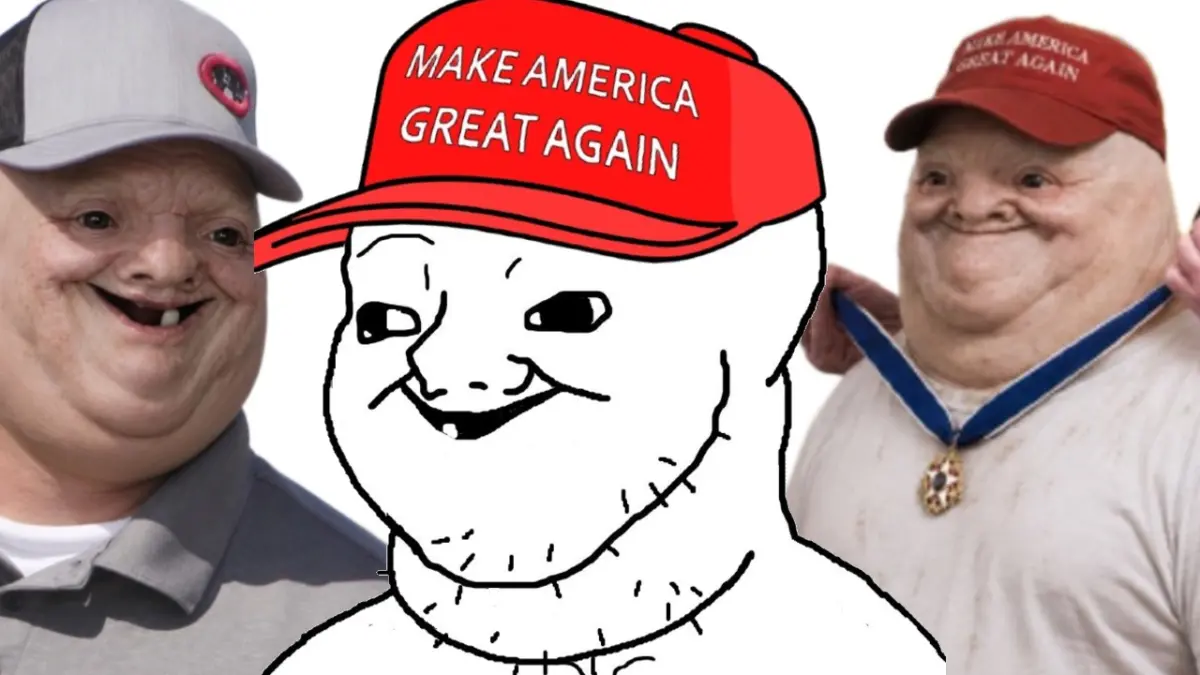
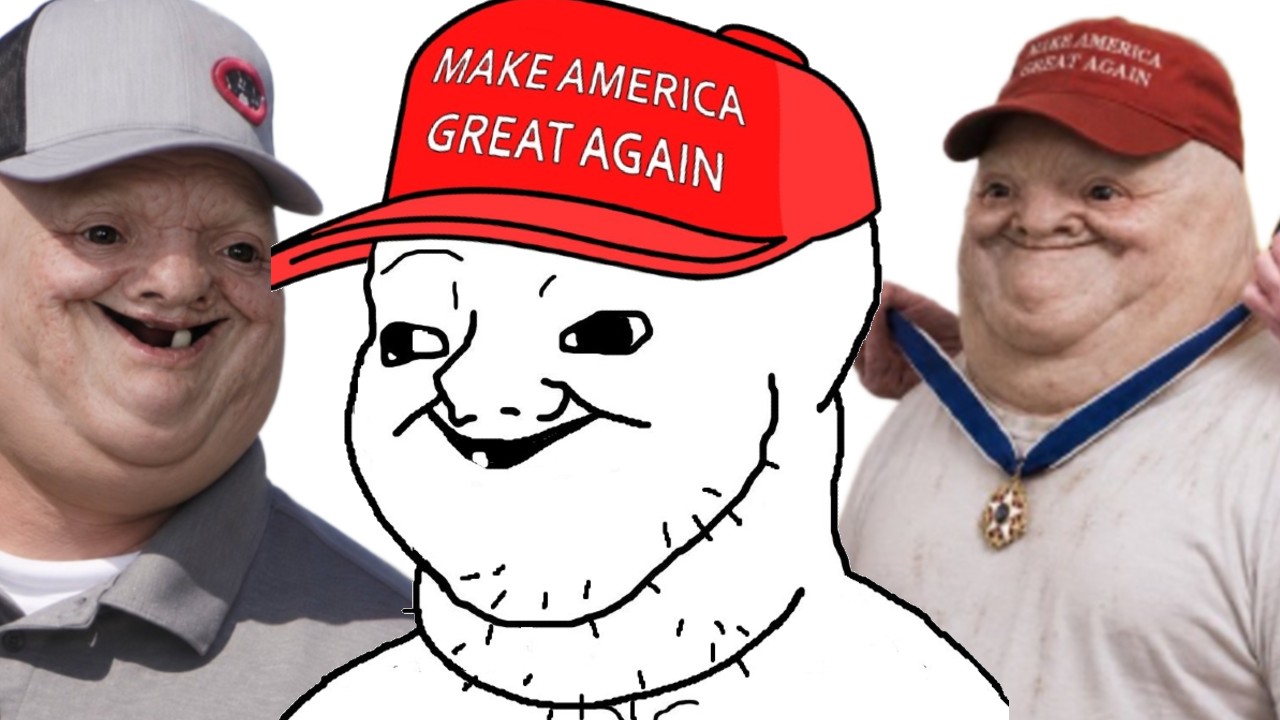
The image featured a variation of the classic "Wojak" (or "Feels Guy") template—a minimalist, melancholic line drawing that has served as a foundational building block of internet expression for over a decade. In this specific iteration, however, the character was mutated into an exaggerated caricature: an overweight, visibly unkempt man missing all but a single tooth, sporting a wide, vacant grin, and crowned with a red "Make America Great Again" (MAGA) baseball cap. Accompanied by the sarcastic riposte, "Democrats are socialists. Imagine being this uninformed," the image was explicitly designed to weaponize classist and ableist tropes against stereotypical supporters of Donald Trump.
While the identity of the original artist remains shrouded in the anonymity typical of the platform, the template struck a chord within specific subcultural circles. Over the next several years, the hand-drawn MAGA Wojak surfaced sporadically across various internet forums, predominantly utilized by progressive or anti-Trump factions to mock conservative viewpoints, conspiracy theories, and perceived dogmatism.
The September 2026 AI Pivot: Photorealism and Virality
While the hand-drawn Wojak remained a niche weapon of political ridicule for nearly a decade, its trajectory shifted dramatically in September 2026. As generative artificial intelligence tools matured, creators began deploying sophisticated text-to-image and text-to-video models to bring flat internet caricatures into terrifyingly vivid, three-dimensional realism.
On September 2nd, 2026, the digital landscape witnessed a watershed moment when X (formerly Twitter) user @WearForbidden published an AI-generated video featuring a photorealistic adaptation of the MAGA Wojak. The hyper-detailed digital creation—complete with uncanny skin textures, exaggerated facial expressions, and high-definition rendering—was placed in a modern home office setting, depicted sitting in front of a computer screen.
The video, which satirized conservative influencers rapidly adopting synchronized talking points regarding controversial policies such as AI data centers, automated Flock surveillance cameras, and military engagements in Iran, struck an immediate nerve. Within just twenty-four hours, the post amassed over 51,000 likes and surged past 8.7 million views.
This viral spark opened the floodgates. Within days, the AI-rendered MAGA Wojak evolved from a single-video gag into a pervasive multimedia template. Users across X, Reddit, and other platforms began generating endless variations of the character, placing the digital avatar into increasingly absurd, satirical scenarios.
Supporting Context & Metrics: Decoding the Virality
The rapid ascension of the AI-generated MAGA Wojak in late 2026 was not merely an accident of the algorithm; it was fueled by a confluence of meme mechanics, political fatigue, and technological novelty.
Quantitative Reach and Engagement Metrics
To understand the velocity of the trend, one must examine the metrics surrounding its peak spread during the first week of September 2026:
- The Catalyst Post (@WearForbidden): Surpassed 8.7 million views and 51,000 likes within 24 hours of publication, establishing the visual baseline for the AI character.
- The "Mobility Scooter" Parody (@normposter): Published on September 2nd, pairing the AI character with the ironic copypasta, "Unbothered. Moisturized. Happy. In His Lane. Focused. Flourishing," securing over 2,600 likes in its first day.
- The Presidential Medal Edit (@grandoldmemes): Released on September 3rd, this twist on the classic "Obama Awards Obama a Medal" meme—featuring Donald Trump bestowing a medal upon the MAGA Wojak—captured over 7,800 likes in under 24 hours.
- The Content Creator Parody (@bourscheid): Posted late on September 3rd, this collection featured algorithmic transformations of the character into various conservative archetypes, including a cowboy persona and a striking parody of political commentator Tim Pool. It garnered upwards of 7,500 likes almost immediately.
The Anatomy of the Meme: Tropes and Subversive Edits
The enduring flexibility of the MAGA Wojak lies in its adaptability. As the character mutated through AI generation, community members began projecting various contemporary political anxieties onto the avatar.
- The "Rise and Grind" Capitalist: Creators frequently paired the character with corporate hustle culture catchphrases ("Rise and grind, kings"), juxtaposing low-brow aesthetic tropes with unironic capitalist ambition to satirize populist economic rhetoric.
- The Metamodern Doppelgänger: By morphing the core facial structure of the AI Wojak to resemble prominent right-wing media figures—such as podcaster Tim Pool—memeticists blurred the line between general political caricature and targeted personal satire.
- Gender Fluidity and Expansion: The trend quickly expanded beyond its initial male archetype to include female counterparts ("MAGA Wojaklady"), broadening the scope of the satire to encompass entire demographic assumptions within the conservative movement.
Official Statements & Sociological Perspectives
While formal political campaigns and mainstream media outlets rarely comment directly on hyper-niche internet memes, the broader sociological implications of phenomena like the MAGA Wojak have drawn extensive commentary from digital media researchers, political scientists, and cultural critics.
The Weaponization of the "Uncanny Valley"
Dr. Aris Thorne, a researcher specializing in digital political communication and algorithmic culture, notes that the transition of Wojaks into AI-generated photorealism represents a significant escalation in political trolling.
"For over a decade, hand-drawn Wojaks functioned as cartoons—they were abstract, distant, and clearly demarcated as internet drawings," Thorne explains. "By rendering these caricatures through artificial intelligence with hyper-realistic textures, creators are weaponizing the uncanny valley. It forces the viewer to confront a grotesque, digital simulation of a real human being. It dehumanizes the political opponent not through a sketch, but through a simulated reality that feels uncomfortably tangible."
The Loop of Manufactured Conformity
Cultural critics have also pointed out that memes like the AI MAGAtard video target a specific anxiety within modern political discourse: the perception that online commentators on both sides of the aisle operate as mindless megaphones for centralized talking points. By depicting the character frantically reacting to shifting party lines regarding tech infrastructure, surveillance, and foreign policy, the meme taps into a growing public cynicism toward digital influencers and partisan media ecosystems.
Future Outlook: Where Goes the Wojak?
As generative artificial intelligence continues to lower the barrier to entry for high-end digital satire, the lifecycle of internet memes is accelerating at an unprecedented rate. What once took months to evolve now mutates in a matter of hours.
The Commodification and Saturation Risk
The primary challenge facing the AI MAGA Wojak moving forward is over-saturation. As corporate entities, political operatives, and casual internet users adopt AI tools to generate political imagery, the novelty of the medium inevitably begins to wane. When anyone can generate a photorealistic political caricature with a simple text prompt, the counter-cultural bite of the meme risks becoming diluted into generic political noise.
The Permanence of Algorithmic Caricature
Nevertheless, the underlying archetype has cemented its place in the digital hall of fame. Just as the Pepe the Frog and traditional Wojak templates transcended their obscure message board origins to become permanent fixtures of global political iconography, the AI MAGA Wojak has permanently altered how internet subcultures visualize partisan adversaries.
Whether viewed as harmless, biting political satire or as a toxic escalation of digital dehumanization, the MAGA Wojak stands as a testament to the power of generative technology in shaping modern political realities. As long as political polarization remains a defining characteristic of the digital age, the pixels will continue to shift, adapt, and reflect the deepest anxieties—and the sharpest ridicules—of a connected world.