

Executive Overview
In the fast-evolving ecosystem of artificial intelligence, few platforms illustrate a more dramatic corporate reinvention than LimeWire. Once synonymous with the 2000s peer-to-peer file-sharing phenomenon—a peerless tool that disrupted the music industry before succumbing to legal pressures—LimeWire has re-emerged as a modern, Web3-integrated generative AI content publishing studio.
Today, the platform serves as a multi-faceted creative engine designed to democratize digital art, music, and video generation. By bridging the gap between advanced neural networks and decentralized monetization, LimeWire empowers artists, designers, and mainstream creators to transform textual prompts into marketable digital assets.
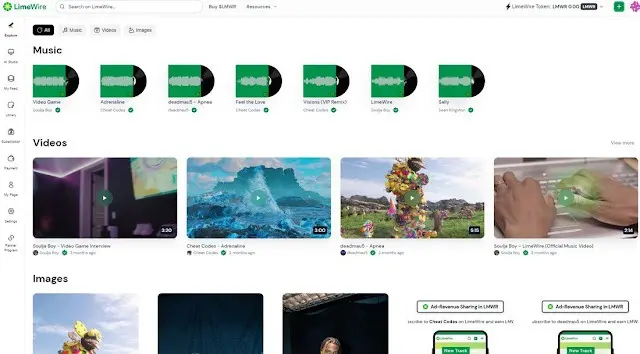
Unlike traditional closed-garden AI tools that merely output static files, LimeWire integrates automated blockchain minting, native cryptocurrency rewards through its proprietary LMWR token, and flexible content-sharing models. From high-profile celebrity adopters like Deadmau5 and Soulja Boy to everyday digital creators, the platform represents a bold experiment in how generative AI, content ownership, and creator economies can intersect in the Web3 era.
Detailed Chronology: The Journey from P2P Infamy to AI Innovation
Understanding LimeWire’s current positioning requires examining the timeline of its remarkable transformation:
- The 2000s Era (The Napster Successor): Founded in 2000 by Mark Gorton, LimeWire operated as an open-source, Java-based file-sharing client. At its peak, it was installed on tens of millions of computers globally, becoming the definitive cultural touchstone for digital media acquisition before shutting down in 2010 following a landmark copyright infringement lawsuit.
- The 2022 Rebrand (The Web3 Pivot): A decade after its demise, digital entrepreneurs Julian and Paul Zehetmayr acquired the LimeWire brand. They envisioned a radically different purpose: transforming the notorious file-sharing domain into a legitimate, creator-centric digital marketplace focused initially on digital collectibles and music NFTs.
- The Integration of Generative AI (2023–Present): Recognizing the explosive growth of artificial intelligence, LimeWire pivoted its infrastructure toward generative AI tooling. By merging its digital marketplace and community hub with state-of-the-art text-to-image models (such as Stable Diffusion and DALL-E), LimeWire Studio was born, allowing users to create, mint, and monetize AI-generated content under one unified roof.
Supporting Context & Metrics: Inside the LimeWire AI Studio
At its core, LimeWire Studio operates as a comprehensive ecosystem designed to streamline the journey from imagination to commercialization. The platform’s architecture rests on three primary pillars: advanced AI generation tools, automated Web3 distribution, and decentralized monetization models.
1. Advanced AI Image Generation Capabilities
LimeWire does not rely on a single, proprietary neural network. Instead, it aggregates industry-leading models—including Stable Diffusion 2.1, Stable Diffusion XL, and OpenAI’s DALL-E 2—to provide creators with a versatile suite of tools.
- Prompt Flexibility: Users can input simple descriptive phrases or highly complex instructions to tailor outputs to their exact artistic visions.
- Stylistic Diversity: Creators can effortlessly toggle between distinct artistic aesthetics, including cinematic renders, digital paintings, pixel art, anime, and analog film simulations.
- Granular Control: Advanced parameters, such as samplers and prompt guidance scales, allow both novice users and seasoned digital artists to fine-tune clarity, detail, and composition.
2. Automated NFT Minting via Polygon and Algorand
Once an image or piece of digital media is generated and published, LimeWire automates the process of transforming that creation into a Non-Fungible Token (NFT). Leveraging scalable and energy-efficient blockchains like Polygon and Algorand, every piece of content receives a unique cryptographic signature.
This infrastructure ensures immutable proof of authenticity and ownership. Creators retain total control over how their assets are distributed:
- Public Releases: Content is discoverable by the broader community, allowing enthusiasts to trade digital collectibles on secondary markets.
- Subscriber-Only Exclusives: Creators can lock specialized content behind paywalls, fostering intimate, direct-to-fan monetization models. Furthermore, whenever a creator’s NFT is traded on the secondary market, they receive an automatic 2.5% royalty fee.
3. Revenue Sharing and the LMWR Token Economy
LimeWire breaks away from traditional ad-revenue models by passing a substantial share of platform earnings directly back to its user base.
- Ad Revenue Share: Depending on the user’s tier, creators earn between 50% and 70% of all ad revenue generated when other users view their published images, music, and videos on the platform.
- The LMWR Cryptocurrency: All earnings are distributed monthly in LMWR tokens, LimeWire’s native utility token. These tokens can be traded on major centralized and decentralized exchanges—including Kraken, ByBit, and Uniswap—or re-invested directly into the platform to purchase additional prompt credits.
4. Subscription Tiers and Cost Structures
LimeWire operates on a freemium model designed to accommodate casual hobbyists and professional digital agencies alike:
- Free Plan:
- Cost: $0 / month
- Credits: 10 free credits (permitting up to 20 image generations per day)
- Ad Revenue Share: 50%
- Standard Tier:
- Cost: $9.99 / month
- Credits: 1,000 credits per month (up to 2,000 image generations)
- Ad Revenue Share: 50%
- Perks: Early access to new AI models, Pro profile badge, full creation history, faster processing, and an ad-free experience.
- Creator Tier:
- Cost: $29 / month
- Credits: 3,750 credits per month (up to 7,500 image generations)
- Ad Revenue Share: 60%
- Perks: Pro profile badge, full creation history, priority queue rendering, ad-free environment, and early AI model access.
- Advanced Tier:
- Cost: $49 / month
- Credits: 5,000 credits per month (up to 10,000 image generations)
- Ad Revenue Share: 70%
- Perks: Maximum revenue share percentage, priority compute access, and full creator suite capabilities.
- Pro Enterprise Tier:
- Cost: $99 / month
- Credits: 11,250 credits per month (up to 22,500 image generations)
- Ad Revenue Share: 70%
- Perks: Ultimate credit allocation for high-volume studios and professional digital creators.
Official Statements and Industry Reception
The strategic pivot of LimeWire has drawn significant attention from both the tech and entertainment sectors. Industry commentators have noted that repurposing a legacy brand with such polarizing historical baggage is a high-risk, high-reward maneuver.
Early digital marketing campaigns and artist adoption have signaled a warm reception from Web3-native creators. High-profile figures such as electronic musician Deadmau5, hip-hop artist Soulja Boy, and reggae-pop star Sean Kingston have utilized LimeWire’s ecosystem to release digital collectibles, music tracks, and multimedia art directly to their fanbases.
In corporate communications, platform leadership has consistently emphasized that LimeWire’s primary mission is democratization. By removing the technical hurdles traditionally associated with smart contract deployment, cryptographic wallets, and complex image generation suites, LimeWire aims to serve as an all-in-one launchpad where artistic expression translates seamlessly into digital commerce.
Future Outlook: Beyond Image Generation
As generative artificial intelligence continues to mature at an exponential rate, LimeWire’s roadmap points toward aggressive expansion. While the platform’s current generative capabilities are anchored primarily in text-to-image workflows, executive leadership has confirmed robust development pipelines aimed at introducing AI music and video generation tools.
This upcoming expansion is poised to redefine the platform’s value proposition. By integrating cross-modal AI generation—allowing users to produce cohesive audio-visual packages from a single unified prompt interface—LimeWire aims to capture a larger share of the creator economy.
Furthermore, the company’s ongoing research into proprietary, in-house AI models signals a transition from an aggregator of third-party open-source models to an independent innovator in generative architecture. For independent creators, musicians, and digital designers, LimeWire stands as a compelling case study in digital reinvention—proving that even the ghosts of the early internet can find new life on the cutting edge of artificial intelligence and decentralized finance.



