Executive Overview
Few brand names carry the distinct cultural resonance of LimeWire. In the early 2000s, the platform sat at the absolute epicenter of the digital peer-to-peer (P2P) file-sharing revolution, functioning as both a household utility and a legal battleground. Today, more than two decades after its initial notoriety, the brand has undergone one of the most radical corporate and technological reinventions in digital history.
Reborn as an advanced, AI-powered content publishing and generative studio platform, modern LimeWire has pivoted away from illicit mp3 distribution to embrace the cutting-edge frontiers of generative artificial intelligence, decentralized web technologies, and creator monetization.
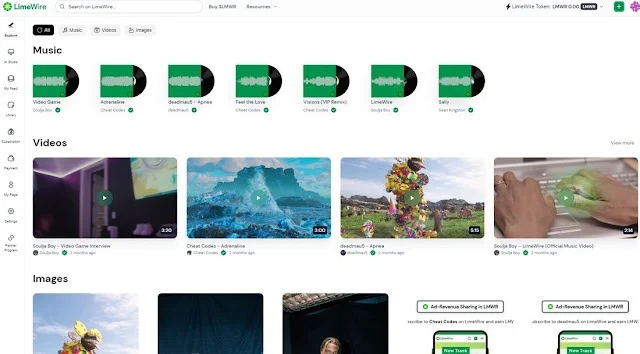
By merging top-tier AI image-generation models—such as Stable Diffusion and DALL-E—with automated blockchain minting and a native cryptocurrency rewards program, LimeWire has carved out a unique niche in the creator economy. Major music industry heavyweights and digital artists, including Deadmau5, Soulja Boy, and Sean Kingston, have utilized the ecosystem to publish tokenized media, proving that the platform is aiming far higher than mere nostalgic novelty.
This deep-dive investigation explores LimeWire’s technological architecture, its innovative approach to automated Non-Fungible Token (NFT) minting, its proprietary economic models powered by LMWR tokens, and the strategic roadmap positioning it as a competitive force in the generative AI landscape.
Detailed Chronology: The Phoenix Rise of a Digital Icon
To understand LimeWire’s current incarnation, one must trace its trajectory from a controversial P2P utility to a decentralized AI powerhouse.
Era 1: The P2P Genesis (2000–2010)
Founded in 2000 by Mark Gorton, LimeWire was built on the Java platform, allowing users to share files directly across the Gnutella network. At its peak, it was the most popular file-sharing client in the world. However, the platform became embroiled in catastrophic copyright infringement litigation orchestrated by the Recording Industry Association of America (RIAA). In October 2010, a federal judge ordered a permanent injunction, forcing LimeWire to shut down its software and operations, resulting in a landmark $105 million settlement in 2011.
Era 2: The Blockchain and Web3 Pivot (2022)
More than a decade after its court-ordered demise, the LimeWire brand was acquired by Austrian entrepreneurs Julian and Paul Zehetmayr. Recognizing the lingering brand equity, the new leadership did not seek to resurrect the file-sharing client. Instead, they executed a complete strategic pivot toward the emerging Web3 landscape. In mid-2022, LimeWire relaunched as a digital collectibles marketplace specifically tailored for music and art, initially capitalizing on the NFT boom.
Era 3: The Generative AI Integration (2023–Present)
As the generative AI wave swept across the technology sector throughout 2023, LimeWire adapted once again. The platform transitioned from a static marketplace into an active creation studio. By integrating advanced text-to-image architectures—including Stable Diffusion XL and DALL-E 2—LimeWire transformed into an end-to-end ecosystem where users can generate, publish, monetize, and trade AI-generated art, music, and video content within a single unified dashboard.
Supporting Context & Metrics: Inside the LimeWire Studio Architecture
Modern LimeWire’s primary engine is the LimeWire AI Studio, an accessible yet sophisticated creation hub designed to cater to both novice hobbyists and professional digital artists.
1. Advanced Image Generation Toolset
Unlike standalone image generators that require complex command-line setups or specialized software suites, LimeWire abstracts technical hurdles behind a clean, web-based user interface. The platform supports multiple state-of-the-art models:
- Stable Diffusion 2.1 & XL: Providing granular control over composition, texture, and photorealism.
- DALL-E 2: Renowned for its conceptual intelligence and adherence to complex prompt structures.
Users can initiate creations using simple natural-language prompts or deeply layered instructions. Furthermore, the studio allows seamless switching between diverse aesthetic styles:
- Cinematic & Photorealistic
- Digital & Pixel Art
- Anime & Manga
- Analog Film & Vintage Textures
Advanced parameters, including custom samplers, prompt guidance scales, and negative prompts, ensure that experienced creators retain fine-grained control over their final outputs. Crucially, LimeWire is actively developing its own proprietary AI model, signaling a transition from third-party reliance to bespoke algorithmic independence.
2. Automated Blockchain Minting (NFT Integration)
One of LimeWire’s most differentiating features is its frictionless approach to blockchain technology. Once a user finalizes a creation within the studio, the platform offers an optional, automated publishing step.
Upon publication, the digital asset is automatically minted as an NFT on either the Polygon or Algorand blockchain. This process embeds a permanent, verifiable digital signature onto the ledger, guaranteeing authenticity and establishing immutable proof of ownership.
Creators retain complete autonomy over how their minted assets are distributed:
- Public Releases: Content is indexed globally, allowing any platform user to discover, view, and trade the digital collectables. Creators earn a guaranteed 2.5% royalty every time their asset changes hands on the secondary market.
- Subscriber-Only Exclusives: Creators can lock specific assets behind paywalls or tier-based subscriptions, offering high-value content exclusively to dedicated fan communities.
3. Revenue Sharing and the LMWR Token Economy
LimeWire addresses one of the most persistent criticisms of the traditional creator economy—the lack of direct financial compensation for platform engagement—through an aggressive ad-revenue-sharing model and its native cryptocurrency, LMWR.
- Ad Revenue Share: When creators publish images, music, or video content that generates user views, LimeWire distributes up to 70% of the associated advertising revenue back to the creator.
- LMWR Token Utility: All earnings are disbursed monthly in LMWR tokens. These utility tokens can be liquidated on major international cryptocurrency exchanges—including Kraken, ByBit, and Uniswap—or reinvested directly back into the platform to purchase additional credits and prompt allocations for the AI tools.
Official Statements and Strategic Vision
Leadership behind LimeWire’s resurrection has consistently emphasized that the platform is designed to democratize content creation by removing technical and financial barriers.
In corporate briefs accompanying the platform’s multi-phased rollout, executives noted:
"LimeWire’s ultimate objective is to bridge the gap between complex artificial intelligence tools and the everyday digital creator. By combining frictionless generative tools with automated Web3 monetization, we are empowering artists, musicians, and designers to not only express themselves creatively but to build sustainable digital businesses with just a few clicks."
The inclusion of mainstream recording artists such as Soulja Boy, Deadmau5, and Sean Kingston early in the Web3 transition validated this mission statement, demonstrating that established creators saw genuine utility in tokenizing their digital footprints within the LimeWire ecosystem.
Pricing Tiers and Value Proportions
LimeWire operates on a freemium SaaS (Software-as-a-Service) model, ensuring that casual users can experiment with generative AI without upfront financial commitments, while heavy users and professionals can scale their operations.
| Tier Name | Monthly Subscription | Monthly Credits | Approximate Image Generations | Ad Revenue Share | Perks & Add-ons |
|---|---|---|---|---|---|
| Free Plan | $0 | 10 Credits | Up to 20 Images | 50% | Basic tools, community access. |
| Basic Plan | $9.99 | 1,000 Credits | Up to 2,000 Images | 50% | Early access to new models, basic profile. |
| Plus Plan | $29.00 | 3,750 Credits | Up to 7,500 Images | 60% | Pro badge, full creation history, faster rendering. |
| Pro Plan | $49.00 | 5,000 Credits | Up to 10,000 Images | 70% | Priority generation queues, ad-free experience. |
| Ultimate Plan | $99.00 | 11,250 Credits | Up to 22,500 Images | 70% | Maximum credit allocation, VIP support, Pro badge. |
All paid subscription tiers eliminate third-party advertisements, accelerate render speeds, provide complete audit logs of creation history, and award the user a verified Pro creator profile badge.
Future Outlook: Beyond Images into Music and Video
As the generative AI race intensifies, LimeWire is positioning itself for aggressive expansion. While the current platform utility centers heavily on text-to-image art generation, the engineering roadmap points toward a multi-modal future.
Upcoming AI Music and Video Tools
LimeWire has announced plans to roll out dedicated AI music and video generation tools in the near future. Given the platform’s historical ties to the digital music industry—and its early experiments with NFT music publishing—the introduction of generative audio models could prove transformative.
If executed successfully, independent musicians will be able to compose, produce, publish, and monetize AI-assisted tracks entirely within the LimeWire ecosystem. Similarly, short-form video generation tools will enable multimedia artists to construct cinematic narratives without expensive production overhead.
Market Implications
The convergence of generative AI, blockchain provenance, and direct-to-consumer monetization represents one of the most compelling trends in modern digital media. While regulatory scrutiny around both AI-generated intellectual property and cryptocurrency tokens remains high, LimeWire’s hybrid model provides a blueprint for how legacy technology brands can successfully reinvent themselves for the decentralized era.
For digital creators looking for an all-in-one ecosystem to experiment with generative art, protect ownership via blockchain infrastructure, and monetize their outputs directly through ad revenue and tokenized economies, LimeWire stands out as a uniquely comprehensive platform in an increasingly crowded market.