Executive Overview
The modern endurance sports landscape is undergoing a significant cultural shift. Gone are the days when marathon training was exclusively associated with ascetic, rigid routines, predawn suffering, and elite, razor-thin athletes pushing their bodies to the absolute brink of burnout. Today, a new generation of runners is proving that high-performance athleticism and holistic self-care can coexist harmoniously.
At the forefront of this movement is Hong, a Berlin-based graphic designer, international flight attendant, and seasoned endurance athlete currently preparing for her seventh marathon. Hong’s journey challenges the traditional archetype of the "natural runner." Self-admittedly prone to abusing the snooze button, reliant on her morning coffee to function, and deeply committed to comfort, Hong represents an increasingly influential demographic: the everyday multitasker who balances a demanding, jet-setting career with an ambitious athletic regimen.
This comprehensive feature explores Hong’s meticulously balanced weekly training architecture, examining how she integrates high-intensity track workouts, yoga, strength conditioning, and a vibrant social life without sacrificing her love for gemütlichkeit (comfort and coziness). Through her partnership with running communities like the Joy Run Collective, her strategic use of supportive gear such as the Nike Invincible 3, and her emphasis on mental well-being, Hong offers a masterclass in sustainable athleticism. Her philosophy is simple yet revolutionary: consistency and comfort do not have to be mutually exclusive.
Detailed Chronology: A Week in the Life of a Marathon-Training Multitasker
To understand how Hong maintains her high level of fitness while juggling two distinct, demanding professions, one must examine the granular details of her weekly schedule. Far from a monotonous loop of pavement-pounding, Hong’s week is a carefully curated blend of movement, recovery, community engagement, and cultural enrichment.
Monday: The Rhythm of the Run and the Power of the Playlist
The architectural foundation of Hong’s training week begins on Monday, a day that typically tests her mental resilience. Working dual roles as a visual designer and a commercial flight attendant means her schedule is volatile and prone to sudden disruptions.
"I am a designer and a flight attendant. Together with my training volume, my weeks are pretty packed. I cannot lose the joy of running, or I won’t stay consistent. What I absolutely need for this is my running playlist," Hong explains.
While she does not rely on music for every single outing, her curated playlist—featuring an eclectic mix of disco, house, and techno—serves as a psychological lifeline on days when motivation flags. Furthermore, Hong utilizes clever self-regulation techniques to manage her physical exertion. When fatigue threatens to derail her pace, she adopts an unconventional strategy: she starts singing.
"If I run out of breath, I shift down a gear and start singing," she notes with a smile. "It forces me to slow down and get my breathing back under control. The run becomes so much more fun, and I notice people smiling as I run past them singing."
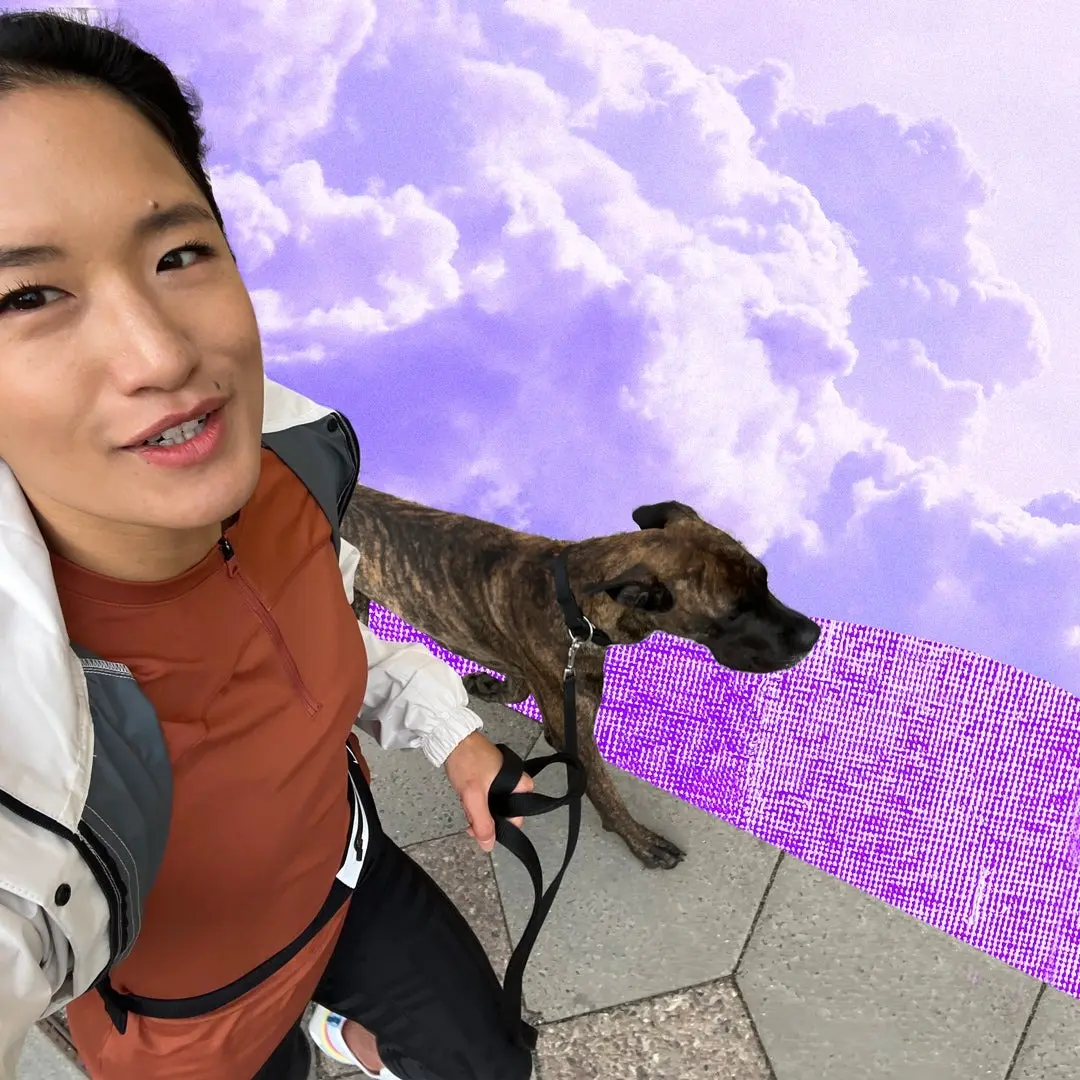
To keep her Monday runs engaging, Hong frequently incorporates external variables. On this particular Monday, she borrowed a friend’s dog, Mia. Brimming with boundless energy, Mia acts as both a pacing partner and a psychological distraction. "At the beginning, she pulls me; at the end, I pull her. I may not be as fast as her, but when it comes to endurance, I win."
Tuesday: Cross-Training, Yoga, and Injury Prevention
Recognizing that running is an inherently high-impact sport, Hong dedicates her Tuesdays entirely away from the pavement. Her philosophy dictates that building a bulletproof running body requires comprehensive cross-training.
Tuesday’s agenda features a dedicated yoga session coupled with targeted strength training designed to fortify injury-prone areas such as the hamstrings, core, and ankles. This is supplemented by scheduled physiotherapy appointments. This multidisciplinary approach ensures that when Hong eventually pushes her limits during high-intensity runs, she does so from a foundation of structural integrity.
Crucially, Hong views rest not as an interruption to her training, but as an active component of it. By preparing her musculoskeletal system to absorb high loads, she avoids the debilitating post-workout exhaustion that plagues many novice endurance athletes.
Wednesday: Professional Realities and Cultural Integration
Mid-week for Hong often means navigating the realities of her career in aviation. Jet-setting across time zones requires immense adaptability. When she is back on solid ground in Berlin, her social capital becomes just as important as her physical capital.
Rather than squeezing in a junk-mile run out of sheer guilt, Hong prioritizes her social network. Wednesday serves as a designated recovery and connection window. She intentionally steps away from her running shoes to visit local art exhibitions, meeting up with friends scattered across Berlin’s vibrant neighborhoods. This deliberate mental disengagement prevents the psychological burnout that often accompanies rigid, single-minded training blocks.
Thursday: Pushing Limits at the Track
If Monday is about finding flow and Monday’s dog-jog is about play, Thursday is where the crucible of marathon preparation takes place: the track workout.
Dispelling the myth that elite runners leap out of bed at 5:00 AM craving grueling intervals, Hong admits that she, too, requires a psychological push. "Some people think marathon runners tumble out of bed at 5 AM and effortlessly run 20 kilometers. In reality, I sometimes need an extra dose of comfort and motivation."
To bridge the gap between psychological resistance and physical output, Hong relies on gear optimization. For her high-speed track sessions, she laces up the Nike Invincible 3. The shoe’s highly responsive, "bouncy" foam midsole and stable platform provide the psychological and physical security she needs to test her anaerobic thresholds.
During Thursday’s session, Hong focuses on velocity and sustained pacing. She attacks the track with competitive fervor, treating the stopwatch not as an instrument of torture, but as a canvas to measure her growing capacities.
Friday: Active Recovery and Berlin’s Cultural Pulse
The physiological toll of Thursday’s high-intensity track session demands profound respect. Friday is thus dedicated to active recovery. Aside from a restorative, gentle yoga flow, Hong keeps her physical exertion to a minimum.
True to her identity as a deeply social Berliner, she spends her Friday afternoon exploring more of the city’s cultural offerings with friends. Because her job as a flight attendant pulls her away from home for days at a time, anchoring herself in Berlin’s local creative scene is vital for her emotional equilibrium.
Saturday: The Landwehrkanal Long Run and Culinary Rewards
Saturday morning belongs to one of Berlin’s most iconic running arteries: the Landwehrkanal. Hong’s standard route offers a shifting tapestry of surfaces—smooth asphalt, damp grass, and occasionally slick mud—which naturally challenges her stabilizer muscles.
As she moves along the water, Hong cycles through her mental landscape. Sometimes she loses herself in an immersive, long-form podcast; other times, she turns off her headphones entirely to absorb the ambient acoustic ecology of the city, watching fellow Berliners navigate their weekends.
The non-negotiable anchor of Saturday’s run is the post-workout ritual. Upon completing her mileage, Hong treats herself to a specialty coffee and a artisanal snack from a local market stall in Kreuzberg. It is a tangible, gustatory reward that transforms training from a chore into a celebratory ritual.
Sunday: Community Mileage and the Joy Run Collective
While solo runs offer mental solitude, Sunday is reserved for collective effervescence. As an active member of the Joy Run Collective, Hong tackles her long weekend run—often winding through the historic expanses of the Tiergarten—surrounded by peers.
Given the extended duration and Berlin’s often brisk climate, Sunday requires tactical preparation. Layering appropriately, Hong leans on the shared collective energy to push through the physical fatigue of the later miles.
The crowning glory of Sunday’s long run is the post-run gathering, where the community breaks bread together. "This time, the host made dumplings," Hong beams. "I’ve been looking forward to those dumplings all week."
Supporting Context & Metrics: The Evolution of Modern Running Culture
Hong’s trajectory mirrors broader demographic transformations within global running culture. Over the past decade, endurance sports have experienced a massive democratization. According to sports industry analytics, participation in urban running communities has surged by over 40% globally since 2018, driven heavily by millennial and Gen Z athletes who reject traditional, hyper-competitive coaching paradigms in favor of inclusive, lifestyle-oriented running crews.
The Physiology of Comfort-First Training
Sports scientists increasingly validate Hong’s intuitive approach to combining high-intensity output with psychological comfort. Dr. Marcus Lindner, a sports physiologist based in Munich, notes that psychological safety and low cortisol levels directly influence running economy.
"When an athlete associates running exclusively with punishment or extreme discomfort, the sympathetic nervous system remains chronically elevated," explains Dr. Lindner. "By integrating elements of play—such as Hong’s technique of singing when out of breath—athletes lower their perceived exertion levels. This prevents premature central nervous system fatigue and allows for greater overall training consistency over a multi-month marathon block."
The Gear Ecosystem: Engineering for Protection
Hong’s preference for maximum-cushion footwear like the Nike Invincible 3 highlights a major shift in running biomechanics. Modern footwear engineering has pivoted away from minimalist, austere designs toward high-stack, highly resilient foams designed to maximize energy return while mitigating impact shock on urban concrete. For runners balancing 50-plus kilometers a week with professions that require long hours on their feet—such as flight attendants—these technological advancements are vital in preventing overuse injuries like shin splints and plantar fasciitis.
Official Statements and Personal Philosophy
Reflecting on her four-year evolution from a self-proclaimed non-runner to a seasoned marathoner chasing her seventh medal, Hong offers profound perspective on what the sport has unlocked within her.
"I started running four years ago. At 30, I am healthier and fitter than I ever was in my twenties," Hong reflects. "But running is so much more than physical training. As a runner, I have gained a tremendous amount of self-confidence because I now know how hard I can push myself, even when I feel a bit low."
Her journey serves as a powerful antidote to the toxic hustle culture that frequently plagues endurance sports. By proving that one can pursue elite-level milestones—such as completing seven marathons—without sacrificing comfort, mental health, or a vibrant social and professional life, Hong redefines what it means to be an athlete in the 21st century.
"I have learned one fundamental truth: consistency and comfort do not have to exclude each other," she concludes. "I can set new boundaries for myself and feel completely at ease while doing it. Next stop: my 7th marathon."
Future Outlook: The Next Horizon for Everyday Athletes
As Hong looks ahead to her upcoming marathon start line, the implications of her philosophy extend far beyond her personal athletic resume. The "comfort-first" endurance movement is poised to reshape how running brands design products, how training camps structure their programming, and how communities welcome newcomers.
The traditional barrier to entry—the intimidation factor of the starting line—is being dismantled by urban collectives that prioritize community over pace charts, and post-run dumplings over restrictive dietary dogma. For everyday multitaskers, professionals, and creatives navigating the hyper-accelerated pace of modern urban life, Hong’s blueprint offers a sustainable path forward.
By refusing to choose between ambition and well-being, Hong and her contemporaries are proving that the ultimate victory in endurance sports isn’t just crossing the finish line—it’s enjoying every single step of the journey it takes to get there.
Hong’s 3 Essential Tips for Maximizing Enjoyment on Every Run:
- Invest in Supportive, Comfortable Footwear: Prioritize gear that protects your joints and gives you confidence on varied urban terrain, from wet asphalt to loose park gravel.
- Curate a Dynamic Audio Landscape: Maintain an eclectic playlist (incorporating high-energy genres like disco, house, and techno) to rescue your motivation when fatigue sets in.
- Plan the Full Experience: Pair scenic, engaging routes with a tangible post-run reward—whether it is specialty coffee, a local market snack, or sharing homemade dumplings with your running community.