Executive Overview
In the modern digital ecosystem, the sheer volume of information we encounter daily is staggering. Whether it is an insightful long-form essay shared on social media, a recipe discovered on a food blog, a technical documentation page for a coding project, or an intriguing product page, our typical coping mechanism is chaotic. We leave dozens of browser tabs open, take erratic screenshots destined to be buried in our camera rolls, or utilize a fragmented array of built-in bookmarking features scattered across disconnected applications. Over time, this digital hoarding leads to cognitive fatigue and the inevitable loss of valuable references.
Enter Laytr, a refreshing new entry into the iOS application landscape and the latest feature in our ongoing Indie App Spotlight series. Designed from the ground up to solve the universal pain point of digital fragmentation, Laytr positions itself as a sleek, all-in-one hub for saving, organizing, and resurfacing web content.
However, what truly sets Laytr apart in a crowded marketplace dominated by corporate read-later giants like Pocket or Instapaper is its uncompromising stance on user privacy. Eschewing cloud synchronization and user accounts entirely, Laytr adopts a radical local-first architecture. Your data remains strictly on your device, ensuring that your reading habits and saved references never touch a third-party server.
Available now for iOS users running iOS 17 and later, Laytr strikes a compelling balance between powerful organizational tools and ethical, minimalist software design. In this deep dive, we will explore the app’s core architecture, its unique workflow design, its privacy philosophy, and its monetization structure.
Detailed Chronology & Feature Architecture
To understand how Laytr transforms a chaotic web-browsing experience into an intentional reading habit, one must examine its mechanics from the moment a user discovers a piece of content to the moment they finally consume and archive it.
The Frictionless Capture Workflow
The lifecycle of a saved article or webpage in Laytr begins outside the application itself. Recognizing that productivity tools must integrate seamlessly into existing habits to survive, the developer integrated Laytr directly into the native iOS share sheet.
When a user encounters an article, PDF, or link they wish to reference later, they simply invoke the standard share menu within Safari, a social media client, or any other iOS app, and select Laytr. This action immediately triggers a lightweight, non-intrusive modal overlay. Within this prompt, the user can instantly assign the item to a specific custom category and, crucially, set a targeted reminder date. This shifts the paradigm from traditional bookmarking—where links go to die in endless, unorganized lists—to active, time-bound consumption.
The Tripartite UI: Now, Timeline, and Library
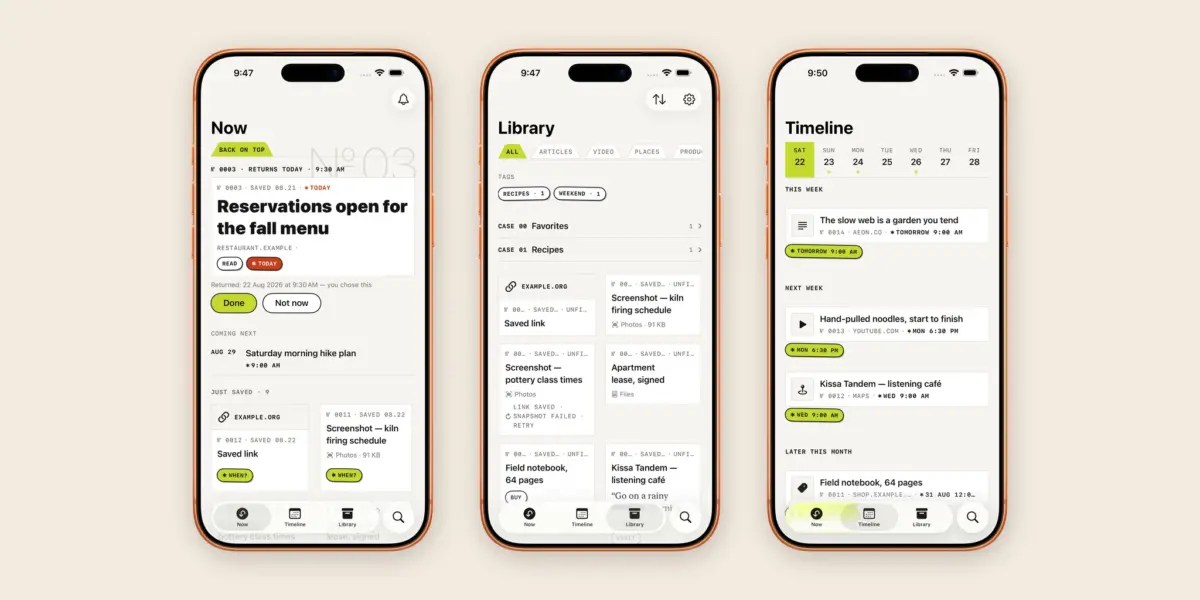
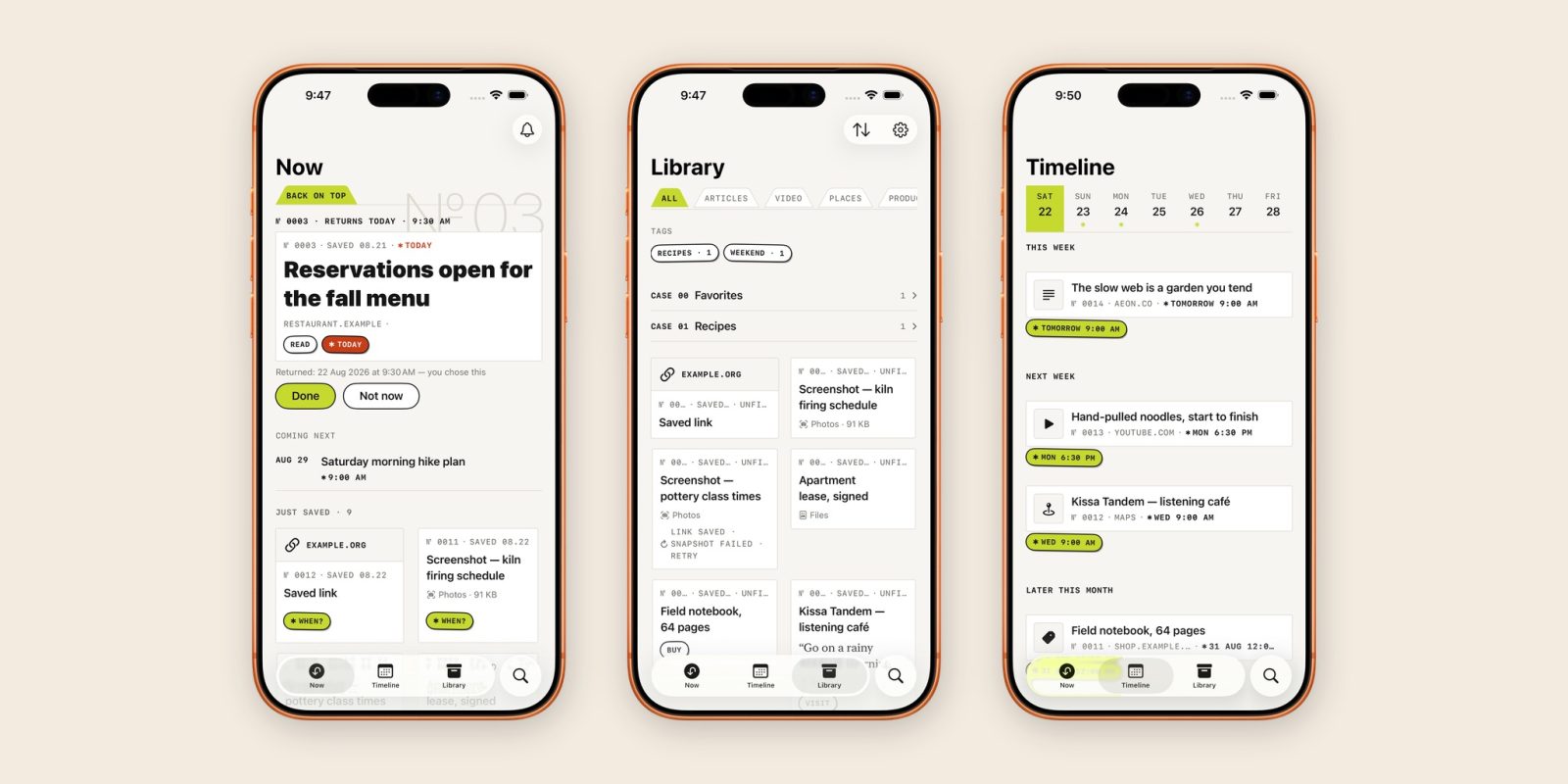
Once content is captured, Laytr presents it through a clean, distraction-free interface divided into three core navigation tabs, supplemented by a robust search engine:
- The "Now" Tab: Acting as the tactical dashboard of the application, the Now tab highlights items that require immediate attention or whose designated reminder windows have arrived. It filters out the noise of your entire archive, focusing solely on what matters to you today.
- The "Timeline" Tab: For users who prefer strategic forward-planning, the Timeline view offers a chronological window into the future. By scrolling ahead, users can preview upcoming readings based on the dates they assigned during capture, ensuring that heavy reading tasks can be distributed evenly across a busy week.
- The "Library" Tab: Serving as the ultimate repository, the Library houses every single item ever saved within Laytr. Users can toggle between browsing items cleanly grouped by their assigned categories or viewing a master chronological list.
- Global Search: Independent of the three main tabs, Laytr includes a fast, responsive search function that indexes titles, metadata, and categories instantly, ensuring that even if a specific reminder date passes, a piece of content is never truly lost.
Supporting Context & Metrics: The Privacy Imperative
In an era where software-as-a-service (SaaS) business models routinely demand user registration, cross-device cloud syncing, and continuous data harvesting for algorithmic profiling, Laytr’s architecture is a deliberate throwback to an earlier, more private era of personal computing.
The Local-First Revolution
The defining characteristic of Laytr is its complete absence of cloud synchronization and mandatory user accounts. There are no sign-up screens requiring an email address or password, no servers routing your reading history through corporate infrastructure, and no telemetry tracking your reading speed or categorization habits.
Every piece of data generated by Laytr lives exclusively inside a secure, sandboxed environment on the user’s physical iOS device. For privacy advocates, researchers, journalists, and security-conscious professionals, this local-first model offers absolute peace of mind. Your reading list is nobody’s business but your own.
Pricing, Accessibility, and the "Anti-Hostage" Paywall
Laytr operates on a freemium model that balances developer sustainability with user-friendly consumer protections. The application is entirely free to download and use on iPhone models running iOS 17 or later.

However, to unlock the application’s full suite of advanced organizational tools and unlimited capacity, users can choose from several subscription tiers:
- Monthly Subscription: $1.99 per month.
- Annual Subscription: $14.99 per year.
- Lifetime Access: Normally priced at $39.99, early adopters can secure lifetime access for a discounted one-time fee of $24.99.
What makes Laytr’s monetization model particularly commendable is its ethical implementation. Critical functionalities—specifically searching and data exporting—are permanently free and will never be locked behind a paywall. This ensures that if a user decides to discontinue their subscription or stop using the app, they are never held "hostage" by their own data. They can easily export their archive at any time, embodying the true spirit of indie software craftsmanship.
Official Statements & Developer Philosophy
While indie app development is often a solitary endeavor driven by personal frustrations and a desire to build better tools, the ethos behind projects like Laytr reflects a broader consumer movement away from bloated corporate applications.
Independent developers working within the Apple ecosystem frequently cite the constraints and capabilities of native frameworks—such as SwiftUI, Combine, and the iOS share sheet architecture—as the key enablers for building high-performance, privacy-compliant software. By leveraging native components rather than building cross-platform web wrappers, indie developers can deliver buttery-smooth animations, low battery consumption, and instantaneous response times.
Laytr’s creation stems from a simple, relatable frustration: the digital clutter caused by fragmented saving habits. By rejecting the prevailing venture-capital-backed software dogma that all data must live in the cloud to be useful, the developer behind Laytr has made a powerful statement. Utility does not require surveillance. Convenience does not require sacrificing privacy.
Future Outlook: The Road Ahead for Indie Read-Later Tools
As Laytr gains traction within the indie app community and continues to be featured across prominent tech publications like 9to5Mac, the application faces both exciting opportunities and unique challenges.

Potential Feature Expansion
Looking forward, users and early adopters are already speculating on potential roadmap items that could enhance Laytr’s local-first philosophy. While cloud sync via traditional servers is intentionally off the table, integration with private, user-controlled syncing mechanisms—such as encrypted local backups or optional, user-managed iCloud containers (where the developer has zero access to the data)—could represent a compelling middle ground for multi-device power users who rely on both an iPad and an iPhone.
Furthermore, integrating advanced readability views (similar to Safari’s Reader mode) directly within Laytr could transform the app from a simple bookmark manager into a comprehensive, distraction-free consumption environment.
The Sustained Rise of Indie Software
Laytr’s early success highlights a broader trend in consumer technology: a growing fatigue with subscription bloat, data tracking, and feature creep in mainstream applications. Users are increasingly willing to support independent creators who build focused, single-purpose tools that respect their privacy and their wallets.
For anyone drowning in open browser tabs, lost screenshots, and forgotten bookmarks, Laytr offers an immediate, elegant, and secure antidote. It proves that with thoughtful design, native integration, and a respect for user autonomy, the humble indie app can still outperform the tech giants at their own game.
To download Laytr and reclaim control over your digital reading list, visit the iOS App Store. If you are an independent developer with a new iOS application looking to showcase your work, consider reaching out to the Indie App Spotlight series to share your creation with a global audience.