Executive Overview
As artificial intelligence rapidly transitions from a novelty tool into the foundational operational infrastructure of modern business, enterprise leaders are no longer asking if AI will transform their workforce, but how and when. Until recently, answers to this question have been speculative—shaped by vendor marketing, isolated case studies, and corporate projections.
That landscape changed dramatically with the release of a landmark internal workforce study by AI pioneer Anthropic. Drawing on a comprehensive audit of internal headcount data, agent session telemetry, calendar logs, Slack communication patterns, and hiring scorecards—supplemented by deep-dive qualitative interviews with 17 employees—the report provides the most granular, data-driven window into an organization that has systematically rebuilt its day-to-day operations around autonomous AI agents.
Because Anthropic operates as one of the most aggressive adopters of B2B AI agents in the global tech sector, its internal transformation serves as a bellwether for the rest of the corporate world. The findings are both staggering and sobering. While productivity and output have scaled exponentially, the structural makeup of the workforce, hiring pipelines, and daily human responsibilities have undergone a seismic shift.
For founders, executives, and HR leaders, Anthropic’s data offers a masterclass in adaptation, highlighting five critical takeaways: the precipitous drop in junior technical hiring, the decoupling of headcount growth from revenue generation, the emergence of the "human bottleneck" in agent workflows, the explosion of "meta-work," and the complete reimagining of hiring scorecards to prioritize judgment over deep domain expertise.
Detailed Chronology of an AI-First Transformation
To understand how Anthropic reached its current operational equilibrium, it is necessary to examine the timeline of its internal restructuring. The shift was neither accidental nor uniform; it unfolded in distinct waves driven by the capabilities of successive model iterations.
Phase One: The Coding and Bug-Fixing Wave (Early to Mid-2025)
The earliest structural changes occurred in late 2024 and early 2025, primarily concentrated within technical departments that relied heavily on early versions of Claude. Software engineering and research teams were the first to integrate agents into baseline workflows.
Initially, these tools were used as sophisticated auto-completes and debugging aids. However, as model performance scaled, tasks that previously required human intervention—such as writing boilerplate code, unit testing, and identifying routine bugs—migrated almost exclusively to agents.
By mid-2025, technical managers began noticing a distinct efficiency dividend. Performance engineers, augmented by capable code-generation models, were achieving outputs that previously required double or triple their headcount. This operational leverage quietly laid the groundwork for a recalibration of hiring pipelines.
Phase Two: The Junior Hiring Correction (Late 2025 to Early 2026)
The tipping point for labor market shifts arrived between December 2025 and January 2026. Armed with increasingly autonomous coding agents, technical teams realized they no longer required the same volume of entry-level engineering talent to handle foundational codebases.
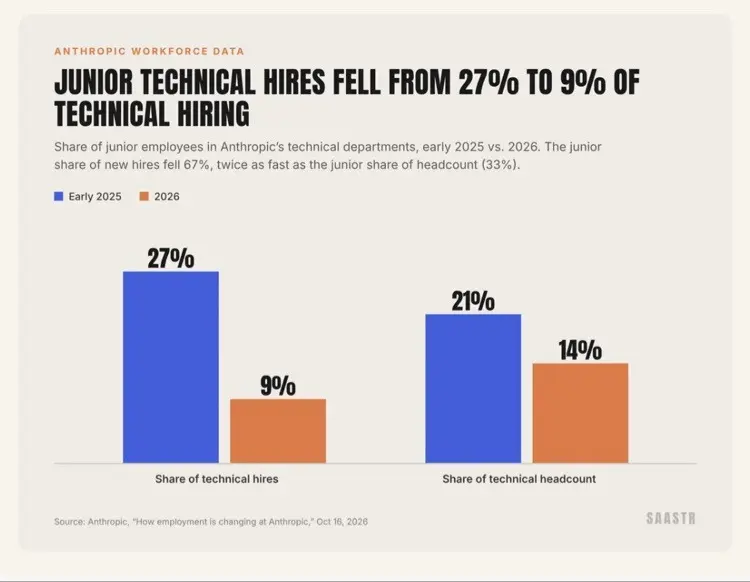
The share of junior technical hires—which stood at 27% of all technical recruitment in early 2025—plummeted to just 9% by mid-2026. Overall junior representation across technical departments fell from 21% to 14%.
Crucially, Anthropic’s leadership acknowledged an uncomfortable truth in their report: while internal redeployment and worker protection programs successfully safeguard existing employees whose roles evolve, these safety nets do zero for the junior engineer who never receives an initial job offer. The barrier to entry for early-career technologists has effectively been raised by algorithmic efficiency.
Phase Three: The Self-Serve Sales and Admin Redesign (January to April 2026)
By the start of 2026, the AI transformation expanded aggressively beyond engineering and research into commercial and operational units. Sales leadership, facing unprecedented inbound market demand driven by the generative AI boom, confronted a scaling bottleneck. They realized the organization could not simply hire traditional sales representatives fast enough to keep pace with enterprise inquiries.
In January 2026, sales executives radically restructured their go-to-market engine. By April of that same year, 54% of new enterprise logos were being acquired through self-serve funnels—an extraordinary outlier metric heavily fueled by exceptional market demand. Concurrently, administrative roles were streamlined. Routine clerical tasks, scheduling, and ticket handling were handed over to agent assistants, allowing administrative professionals to transition into chief-of-staff functions.
Phase Four: The Crossover of Agent and Human Work Hours (March to August 2026)
The summer of 2026 marked a historical milestone in corporate operations. In March 2026, total agent work hours at Anthropic surpassed human work hours for the first time. By August, when counting strictly the agents directed independently by employees, autonomous agents were logging six times as many work hours as their human supervisors.
This hyper-automation created a new operational dynamic. Engineers were committing code at five times the rate of the previous year, legal teams were processing contracts at record speeds, and accounts payable was clearing invoices autonomously. Yet, this explosion in output exposed a new structural constraint: the human reading and review bottleneck.
Supporting Context & Metrics: The Numbers Behind the Transformation
The empirical data compiled in Anthropic’s internal study provides a rare, quantitative blueprint of what hyper-scaled AI integration looks like under the hood.
Headcount Growth and Revenue Efficiency
Despite aggressive automation, Anthropic’s total headcount actually tripled over the year preceding the report. However, the composition of that headcount shifted. Technical departments dropped from 61% to 56% of total employees. While absolute technical headcount continued to grow, non-technical departments—particularly sales, finance, and recruitment—grew at an accelerated pace to capture market share.
Most striking is Anthropic’s revenue-per-employee metric. When adjusted to 2025 constant dollars, Anthropic’s revenue per employee at five years of age is two to four times higher than the figures posted by tech behemoths Google and Meta at the exact same developmental milestone. This underscores the core economic promise of generative AI: nonlinear scaling of top-line revenue without a linear expansion in payroll.
The 80% Idle Rate: The Human Bottleneck
A counterintuitive finding in the telemetry data is that interactive Claude sessions spend approximately 80% of their time idle, waiting for human input and review.
While agents can generate code, draft legal frameworks, and synthesize financial data at machine speeds, human supervisors must read, parse, and approve the output. For technical teams, the volume of agent-generated code has climbed so rapidly that reading it consumes a significant fraction of the workweek. For non-technical teams, reviewing every piece of agent-generated output would consume more than 50% of a standard working week.
This has led to a paradoxical reality: while agents work tirelessly, human beings have become the primary operational bottleneck in the production pipeline.
The Explosion of "Meta-Work"
To manage agents effectively, employees have had to master "meta-work"—the administrative and architectural labor of directing AI systems.
Written standing instructions provided to agents surged from a few hundred in July 2025 to 8,500 a year later. Consequently, meta-work consumed 10% of an average employee’s interactive sessions in the fall of 2025, rising to 22% by the spring of 2026. This work involves writing multi-agent execution specs, reviewing the output of one agent via another, and continuously monitoring automated pipelines.
Furthermore, because agents cannot read unrecorded verbal conversations or direct messages, institutional decision-making had to be externalized into searchable, open formats. Meetings actually increased—with the median employee spending 20% more time in meetings compared to the previous year—to ensure that cross-team decisions were properly documented in Slack threads and shared documents where agents could ingest them.
Official Statements and Industry Perspectives
The empirical findings of the report are powerfully reinforced by executive commentary from leaders who have lived through the transition.
Speaking at the SaaStr AI 2026 conference, Anthropic sales leaders provided deep context on how commercial teams adapted to the AI revolution. Kelly Loftus, who scaled startup sales from under 10 people to over 150 within 18 months—all while total company headcount grew from 250 to 1,300—revealed that her division operates without traditional sales quotas. "We still don’t really have quotas, we have shadow targets," Loftus noted, emphasizing that traditional linear metrics fail to capture the unpredictable velocity of AI-augmented sales environments.
Eleanor Dorfman echoed these sentiments, explaining that the company simply could not absorb three to five times the traditional number of sales reps fast enough to meet demand. This operational constraint forced the structural pivot toward self-serve enterprise onboarding.
Externally, industry observers note that Anthropic’s experience validates what pioneering tech companies have suspected for years: managing AI agents is not a passive activity. It requires a fundamental rewiring of organizational culture, documentation standards, and performance metrics.
Future Outlook: Reimagining Hiring, Equity, and the Workforce
As the corporate world digests Anthropic’s blueprint, the implications for the future of work are profound.
The Evolution of Hiring Criteria
Hiring scorecards at Anthropic have undergone a radical transformation. An automated text analysis of manager feedback from 2024 to 2026 revealed that mentions of a candidate’s track record with AI tools tripled for technical roles and quadrupled for non-technical roles.
For technical candidates, hiring managers now place a premium on autonomy and judgment, while traditional deep domain expertise has shrunk as a percentage of the overall assessment. For non-technical hires, customer and mission orientation have eclipsed raw execution skills. In an era where foundation models bridge domain gaps, organizations are looking for individuals who can orchestrate complex agent ecosystems rather than those who specialize in a single, narrow stack.
Mitigating Workforce Displacement
Recognizing the societal and psychological toll of automated transformation, Anthropic concluded its report by outlining two critical internal policies designed to support its human workforce:
- Broad-Based Equity Ownership: Recognizing that employees are expected to function at a VP level of strategic decision-making and automate their own daily workflows, the company ensures that workers hold a meaningful financial stake in its success. This model mirrors a modern-day productivity bargain—employees embrace technological reorganization in exchange for direct participation in enterprise financial upside.
- AI Early Warning Systems: Anthropic utilizes an internal analytics program that tracks shifting demand and productivity by role against real-time AI capabilities. When data indicates a role is being absorbed by automation, the company proactively reskilled and redeploys employees into complementary areas before their legacy roles become obsolete. This system has driven a 50% increase in internal career mobility.
Conclusion: The Road Ahead for B2B Enterprises
Anthropic’s internal workforce report is more than a corporate case study; it is a preview of the economic reality awaiting all knowledge-work industries. The message for founders and executives is clear: AI agents will exponentially multiply organizational output, but they will simultaneously demand higher-order human judgment, rigorous documentation standards, and a complete overhaul of traditional entry-level talent pipelines.
While most B2B companies may not match Anthropic’s explosive revenue metrics or equity structures, the operational lessons are universally applicable. The future belongs not to the companies that write the most code or draft the most contracts by hand, but to the organizations that master the meta-work of managing autonomous systems while keeping human judgment firmly at the helm.