Executive Overview
It is difficult to imagine a more daunting trajectory in modern space exploration than one directed at an alien moon named after the Greek god of fear—especially when every previous human attempt to reach it has ended in failure. Yet, as the Japan Aerospace Exploration Agency (JAXA) and its global coalition of space-faring partners gear up for launch, the prevailing mood is not trepidation, but profound anticipation.
"All the members are filled with a quiet sense of excitement," says Kiyoshi Kuramoto, who leads the mission’s extensive roster of international scientists.
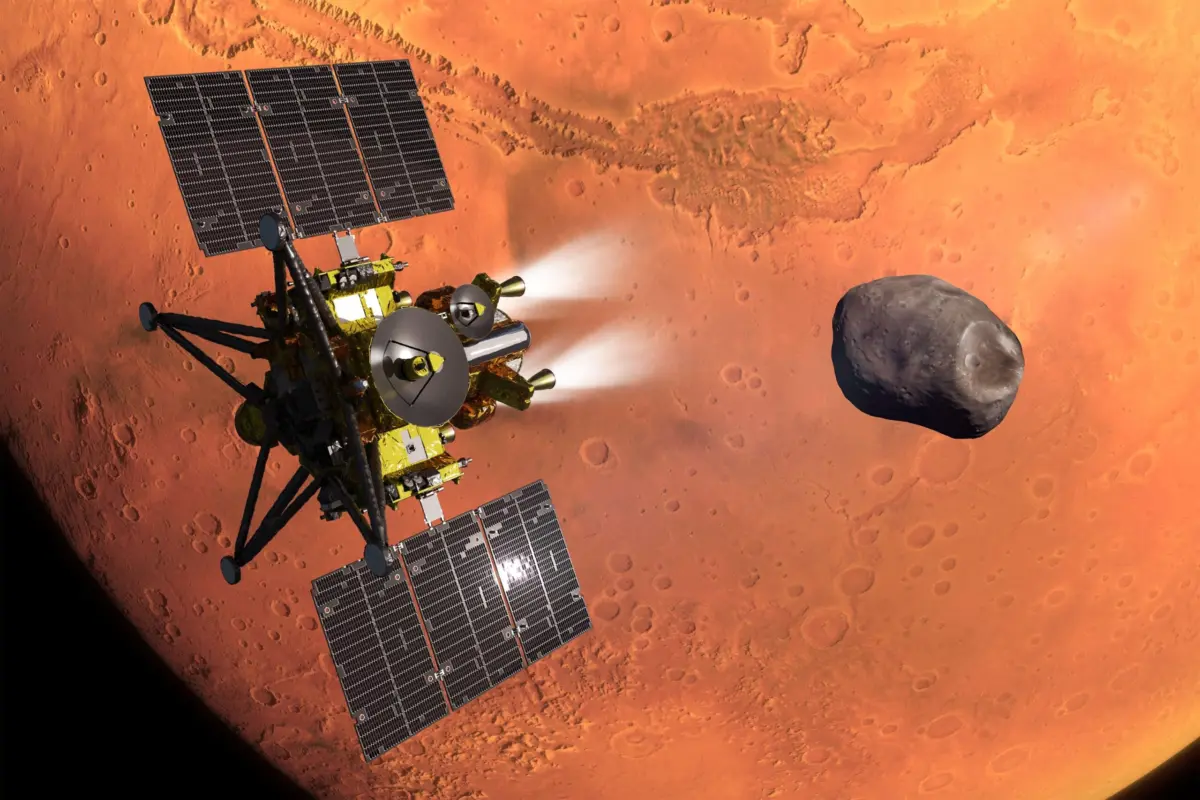
This historic endeavor, known as the Martian Moons eXploration (MMX) mission, is poised to blast off from the Tanegashima Space Center in southern Japan. Following a grueling, nearly year-long interplanetary cruise, the MMX spacecraft will insert itself into orbit around the Red Planet and its two enigmatic satellites: Phobos (meaning "fear") and Deimos (meaning "dread"). Once on station, MMX will survey the pair from afar before executing a high-stakes descent to the surface of Phobos. Its primary objective? To collect pristine geological samples and ferry them back to Earth by 2031.
If successful, MMX will achieve a monumental world-first: returning the first-ever physical samples from a moon other than Earth’s. More than a technical tour de force, the mission aims to resolve a decades-old scientific debate regarding how these Martian moons formed, while simultaneously offering a window into the broader evolutionary history of our solar system and capturing scattered geological whispers of ancient Mars.
Detailed Chronology: From Soviet Setbacks to JAXA’s Breakthrough
The journey to Phobos is littered with the mechanical ghosts of past attempts. Since the 1980s, the Soviet Union and its successor state, the Russian Federation, have launched three dedicated probes targeting the Martian moon: Phobos 1 and Phobos 2 in 1988, and the ill-fated Phobos-Grunt in 2011. Each mission succumbed to critical system failures before they could successfully study the moon up close or return material to Earth.
These persistent failures underscore why MMX is widely regarded within the aerospace community as a "mission impossible." Yet, the scientific imperative to understand Phobos and Deimos has only grown stronger over the decades.
The timeline of the MMX mission represents years of meticulous international planning, engineering trials, and planetary alignment windows:
- The Conceptual Phase (2010s): Building on the momentum of early asteroid rendezvous concepts, JAXA engineers began conceptualizing a dedicated Martian moon probe that could leverage lessons learned from the agency’s pioneering Hayabusa asteroid-sample missions.
- International Partnerships Form (Late 2010s–Early 2020s): Recognizing the immense complexity of the endeavor, JAXA formalized partnerships with NASA, the European Space Agency (ESA), the French space agency CNES, and the German aerospace center DLR, integrating cutting-edge foreign scientific payloads into the spacecraft architecture.
- Launch Operations (Present): The MMX spacecraft lifts off from the Tanegashima Space Center, beginning a roughly 11-month transit across the void of deep space toward the Martian system.
- Mars Arrival and Orbital Insertion (Late 2025 – Early 2026): MMX will arrive at Mars, firing its main engines to brake into a stable orbit around the planet, where it will begin transitioning into specialized orbits tailored for studying both Phobos and Deimos.
- Remote Sensing and Rover Deployment (2026–2028): The probe will spend years mapping the surface topography, thermal properties, and mineralogical composition of the moons. A specialized surface rover—developed jointly by CNES and DLR—will be deployed ahead of the main spacecraft to investigate local regolith and terrain conditions up close.
- The Sample-Collection Phase (2028–2029): Utilizing a dual-method sampling architecture, MMX will touch down on Phobos to scoop and extract at least 10 grams of regolith and subsurface material.
- Return Journey and Earth Landing (2031): The spacecraft will depart Mars orbit, swinging back toward Earth to drop off its precious sample capsule via a high-velocity atmospheric reentry over the Australian outback.
Supporting Context & Metrics: Solving the Martian Moon Paradox
To understand why thousands of hours and billions of dollars are being poured into a chunk of space rock only 27 kilometers across, one must understand the central mystery of Phobos and Deimos: Where did they come from?
For generations, planetary scientists have debated two primary hypotheses regarding the origin of Mars’ binary companions:
- The Captured-Asteroid Hypothesis: This theory suggests that Phobos and Deimos originated in the outer asteroid belt. Due to gravitational perturbations, they wandered inward and were eventually captured by Mars’ gravity well. Their dark, carbonaceous-chondrite-like surfaces lend physical weight to this argument.
- The Giant-Impact Hypothesis: Alternatively, the moons may be "born of Mars." This model posits that early in the planet’s history, a massive protoplanet or gigantic asteroid slammed into the nascent Mars, blasting an enormous volume of debris into orbit. Over time, this ring of debris coalesced into the two moons. Their near-circular orbits, perfectly aligned with the Martian equator, strongly support this formation pathway.
Unlocking the Clues via MEGANE and Volatiles
The MMX mission is specifically designed to settle this debate once and for all through a comprehensive suite of remote-sensing and in-situ instruments.
Among the most critical payloads is MEGANE (Mars-moon Exploration with GAmma rays and NEutrons), an instrument led by the Johns Hopkins University Applied Physics Laboratory. MEGANE will measure the elemental composition of Phobos by detecting the passive emission of gamma rays and neutrons generated when galactic cosmic rays slam into the moon’s surface.
"We know nothing about Phobos’ elemental composition," notes David Lawrence, who leads the MEGANE team. "For me, that’s what’s exciting—making a measurement nobody’s done before."
The presence or absence of volatile elements will serve as the ultimate cosmic fingerprint:
- High Volatiles (Hydrogen, Potassium, Carbon): If MEGANE detects significant concentrations of volatile elements, it points strongly toward the captured-asteroid hypothesis, as these elements are easily baked away in high-energy planetary impacts.
- Low Volatiles: A relative scarcity of volatiles will bolster the giant-impact theory, suggesting the material was subjected to the extreme thermal energies of a planetary-scale collision.
Furthermore, scientists suspect that Phobos’ surface regolith has spent eons acting as a cosmic dustbin, accumulating microscopic ejecta blasted off the surface of Mars by ancient meteorite impacts. By analyzing this embedded Martian dust, researchers can effectively study ancient samples of Mars without ever having to land a heavy sample-return vehicle directly on the hostile, deep-gravity surface of the Red Planet itself.
Official Statements and Expert Perspectives
The complexity of the MMX mission demands unprecedented cooperation across international borders. Space agencies that have traditionally operated as rivals or independent actors have pooled their resources, instruments, and intellectual capital to maximize the probability of success.
Tom Statler, MMX program executive at NASA, emphasized the broader implications of the mission during a recent press briefing:
"Laboratory analysis of the samples will help determine the origin of leftover material from the early solar system and how it was transported. This research will give us deep insight into our solar system at large."
Abigail Fraeman, an MMX team member at NASA’s Jet Propulsion Laboratory, highlights the complementary nature of the spacecraft’s scientific payload:
"Remote observations are going to give us a hint at some of the answers to the really big questions we have about Phobos. But really, the return samples are going to nail those questions down permanently."
Addressing the operational challenges of landing on a low-gravity body where scientists know very little about the local surface micro-topography, Kiyoshi Kuramoto points out the necessity of redundancy:
"Because scientists currently know little of Phobos’ surface, we can’t pick a landing spot until taking up-close observations of the moon. That is why the mission uses two different sampling methods as a safeguard in case one fails. Returning samples from a Martian moon is a world-first challenge that is not easy."
Elliot Sefton-Nash, MMX project scientist at the European Space Agency, underscores the value of the coalition:
"That kind of compounded set of expertise and contributions really helps make the mission objectives very achievable. We are bringing the best minds from multiple space agencies to tackle a problem that has defeated past generations."
Future Outlook: A New Paradigm for Deep-Space Exploration
JAXA enters this mission with a formidable reputation in the specialized field of extraterrestrial sample return. Despite facing severe technical setbacks during its development, JAXA’s pioneering Hayabusa mission achieved a historic milestone in 2010 by successfully returning microscopic surface grains from the near-Earth asteroid Itokawa to Earth.
A decade later, its highly optimized successor, Hayabusa2, executed an even more flawless campaign, delivering pristine subsurface samples from the primitive, carbon-rich asteroid Ryugu in December 2020. Many of the veteran engineers and scientists who designed Hayabusa2 have lent their expertise to architecting the MMX mission.
However, mission architects are quick to emphasize that Phobos is a fundamentally different beast than Ryugu.
"JAXA’s learned and achieved so much with their sample-return missions that they are really well positioned to be able to do this," says Abigail Fraeman. Yet, as Kuramoto cautions, the orbital dynamics, gravitational complexities, and tidal forces experienced within the Martian system present an entirely distinct set of engineering hurdles.
As MMX clears the launch tower at Tanegashima and sets its sights on the crimson horizon of Mars, it carries the hopes of the global scientific community. If the spacecraft successfully navigates the hazards of deep space, maps the rugged terrain of fear and dread, scoops up its target 10 grams of ancient regolith, and plunges safely back into Earth’s atmosphere in 2031, it will do much more than solve an astronomical mystery.
It will inaugurate a bold new era of interplanetary archaeology—proving that humanity’s reach can finally extend past our own celestial doorstep to touch the moons of other worlds.