Executive Overview
Federal investigators in the United States have widened their net in a high-stakes crackdown on the notorious ShinyHunters cybercrime syndicate. Following a brazen breach of the FBI’s recruitment portal, investigators have identified executives at two distinct ransomware negotiation and cybersecurity firms who maintained suspiciously intimate ties with the extortion collective. Sources close to the investigation reveal that at least one U.S.-based executive actively assisted ShinyHunters in operating a public pressure website designed to coerce corporate victims into paying multimillion-dollar ransoms.
The widening probe highlights a dark and often-obscured intersection within the cyber-incident response industry: the blurred lines between remediation professionals and the threat actors they are hired to counter. With the FBI moving with uncommon urgency following the compromise of its own personnel files, the arrests of key digital extortion figures—including Canadian cybersecurity executive Edward Dubrovsky and Dutch hacker Pepijn van der Stap—have exposed deep-seated conflicts of interest, alleged murder-for-hire plots, and systemic corruption within the multi-billion-dollar ransomware negotiation ecosystem.
Detailed Chronology: From the Netherlands to Amman and Beyond
The modern iteration of ShinyHunters represents a decentralized, highly aggressive evolution of a threat group that first emerged in 2019. While the organization’s original French operatives were steadily picked off and jailed by law enforcement, leadership of the brand eventually coalesced around "Rey," identified as a teenage hacker residing in Amman, Jordan. According to federal estimates, ShinyHunters has extorted upward of $70 million from corporate and governmental victims this year alone.
The FBI Portal Breach and Immediate Retaliation
The group’s trajectory shifted from opportunistic corporate theft to direct provocation in late September, when hackers aligned with ShinyHunters compromised the FBI recruitment portal, fbijobs.gov. The attackers taunted federal authorities by threatening to release highly sensitive personnel records, including home addresses, Social Security numbers, psychological evaluations, and internal unit specializations.
The compromise of federal infrastructure triggered an immediate, aggressive response from U.S. law enforcement. Reuters reported that Rey was detained by Jordanian authorities in early October and is currently cooperating with the FBI.

The Arrest of Pepijn van der Stap
Rey’s ability to seize control of the group followed closely on the heels of a major international law enforcement win. On the evening of September 15, 2026, Dutch police executed a high-intensity tactical raid—utilizing flash-bang grenades to stun and apprehend convicted hacker and ShinyHunters suspect Pepijn van der Stap while he was actively logged into his accounts.
According to investigative sources, law enforcement seized control of Van der Stap’s active Signal instant messaging session. This gave investigators instantaneous access to his communication logs with frequent contacts, including ransomware negotiators based in the United States and Canada.
These message logs reportedly uncovered explosive evidence:
- The Extortion Network: Direct communications with high-profile ransomware negotiators who possessed advance knowledge of breaches—often before the victims themselves were aware.
- The FBI Breach: Proof that figures like Edward Dubrovsky knew ShinyHunters had exfiltrated sensitive data from FBI servers long before the group publicly threatened to publish the personnel records, without alerting the bureau.
- A Murder-for-Hire Plot: Dutch news outlet RTL reported that Van der Stap’s chats revealed discussions ordering two overseas murders (though there is no indication these plots were successfully carried out).
The Arrest of Edward Dubrovsky
On October 9, federal authorities arrested 54-year-old Canadian cybersecurity executive Edward Dubrovsky. Dubrovsky, who had recently published a book on navigating cyber extortion that advocated for constant engagement with threat actors, was charged with threatening to disclose hacked data and interfering with interstate commerce through extortion. Federal prosecutors have requested that Dubrovsky remain in custody pending trial, with related court dockets kept under seal.
Supporting Context & Metrics: Infrastructure, Affiliates, and Inside Dynamics
Shinywire: The Corporate Shaming Engine
Federal investigators believe that at least one executive at a prominent U.S.-based consulting firm played a direct operational role in running shinywire[.]com, a now-defunct extortion portal utilized by ShinyHunters.

Active from May 3 to October 16, the Shinywire platform indexed nearly 100 victim organizations. Each entry displayed samples of stolen corporate data and imposed a strict seven-day deadline for victims to negotiate ransom payments before the complete data archive was published on the group’s Tor-based leak site. Among the targeted entities was Intuitive Surgical, an American medical technology firm breached via a targeted employee phishing campaign in March 2026.
The Corporate Feud and the "Ghostbyte" Legacy
Court records from Ontario reveal that Dubrovsky’s legal troubles coincided with a bitter corporate feud. Earlier this year, Dubrovsky filed a lawsuit against Daniel Tobok, the former CEO of Cypfer, alleging that Tobok had systematically pushed him out of business decisions following a falling out between the long-time partners. Tobok denied the allegations, filing a counterclaim accusing Dubrovsky of competing unfairly through a separate entity, CyberSteward Inc.
The historical ties within this network run even deeper. Interviews with former colleagues indicate that years prior, Tobok was known within ransomware circles by the handle Ghostbyte. In 2018, when a Canadian company fell victim to the Russian-language Dharma ransomware affiliate program, the threat actors explicitly directed the victim to contact an IT professional via the email address [email protected] to secure guarantees of data deletion.
While Tobok has not responded to requests for comment regarding the Ghostbyte moniker, threat-intelligence firm Constella Intelligence linked an email address frequently used by Tobok ([email protected]) to online accounts bearing the "ghostbyte" username. Furthermore, the Dharma representative’s crypto-wallet linked in the 2018 extortion scheme has processed dozens of Bitcoin transactions valued in the millions.
Conflicting Interests in the Ransomware Economy
The investigation throws a harsh spotlight on the financial incentives driving the cyber-incident response industry. While paying ransoms to non-sanctioned groups like ShinyHunters is not strictly illegal in the United States, the business models of many negotiation firms create perverse incentives.

Many negotiation and remediation companies charge a percentage-based fee tied directly to the total ransom paid out. Mark Camillo, CEO of CyberAcuView, noted that this dynamic introduces a clear conflict of interest:
"It has come to the industry’s attention that many of the ransomware payers charge a percentage of the final payment… This makes no sense if they are also the negotiator. There needs to be more transparency in the process as no one in the ecosystem should be profiting purely on the size of the ransomware transaction."
This conflict is compounded by the fact that threat actors frequently retain stolen data regardless of whether a ransom is paid. For instance, educational technology giant PowerSchool reportedly paid a $2.85 million ransom facilitated by CyberSteward after a 2024 breach compromised data on 62 million students and 9.5 million teachers. Despite the payment, individual school districts subsequently received separate extortion demands using the exact same stolen files.
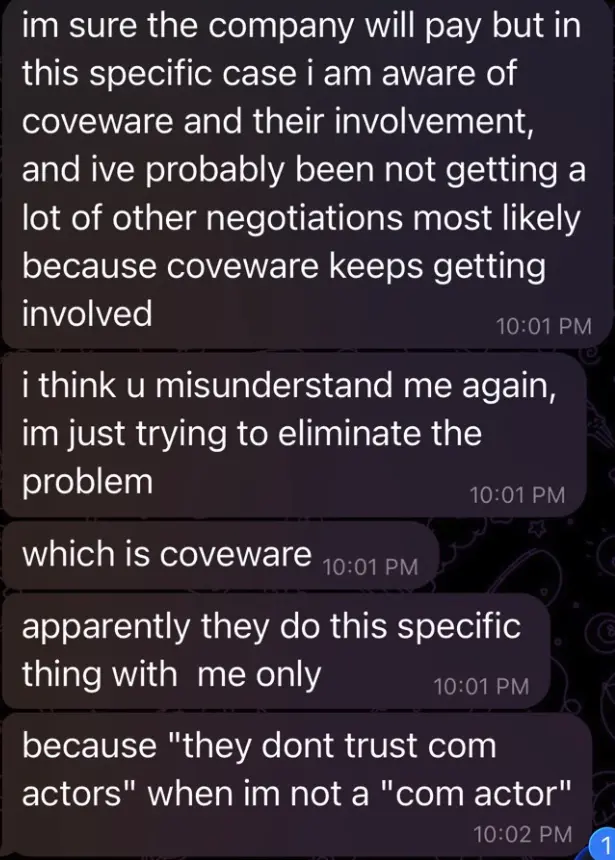
Prominent incident response firms like Coveware and Unit 221B have consistently warned victims against paying ShinyHunters, pointing out that threat actors routinely re-extort victims or monetize exfiltrated data elsewhere. These warnings made Coveware a prime target for ShinyHunters leadership; private Telegram chats recovered by investigators show group administrators complaining bitterly about Coveware’s anti-payment advisories, explicitly plotting to "eliminate the problem."
Official Statements & Legal Actions
The Department of Justice has increasingly turned its focus toward corrupt remediation professionals who double as double agents for cybercrime syndicates. Recent federal actions underscore a broader regulatory sweep:

- Zohar Pinhasi: On October 7, the DOJ charged MonsterCloud CEO Zohar Pinhasi with wire fraud and conspiracy for allegedly billing clients $19 million for remediation while secretly paying ransomware groups only $8 million behind their clients’ backs.
- Angelo Martino: In July, Florida-based ransomware negotiator Angelo Martino was sentenced to 70 months in prison for conspiring with the BlackCat/ALPHV syndicate to leak confidential client negotiating strategies to hackers to maximize payouts.
Meanwhile, institutional players are scrambling to distance themselves from the fallout. Representatives for Cypfer issued a formal statement maintaining that the firm has no prior knowledge of Dubrovsky’s actions, has not been contacted by law enforcement, and does not facilitate ransom payments. Cypfer was recently acquired by the Apros Group, a holding company led by former FBI special agent Jason Hogg.
Future Outlook
The unfolding federal case against the ShinyHunters network and its alleged enablers marks a watershed moment in cybersecurity enforcement. For years, the cyber-extortion ecosystem operated in a legal gray area, sustained by corporate confidentiality, insurance payouts, and the quiet complicity of specialized intermediaries.
By targeting the facilitators—the negotiators who bridge the gap between corporate boardrooms and digital cartels—law enforcement is striking at the circulatory system of modern ransomware. As prosecutors examine encrypted chats, international money flows, and operational footprints like the Shinywire portal, the industry faces an inevitable reckoning. True cyber resilience will now require unprecedented transparency, strict regulatory oversight of incident response pricing models, and a zero-tolerance approach to insider collusion within the cybersecurity community.