Executive Overview
As artificial intelligence rapidly transitions from experimental proof-of-concept prototypes to mission-critical production environments, the engineering challenges surrounding infrastructure scalability have grown exponentially. Enterprise developers moving beyond simple conversational chat interfaces quickly discover that sophisticated AI agents require robust, stateful foundations. These systems must preserve complex operational states across multi-step workflows that can span hours, days, or even weeks. Furthermore, they demand the ability to seamlessly coordinate with auxiliary agents, share contextual memory, and, in many specialized workloads, tap into hardware acceleration like graphics processing units (GPUs) to execute demanding compute tasks.
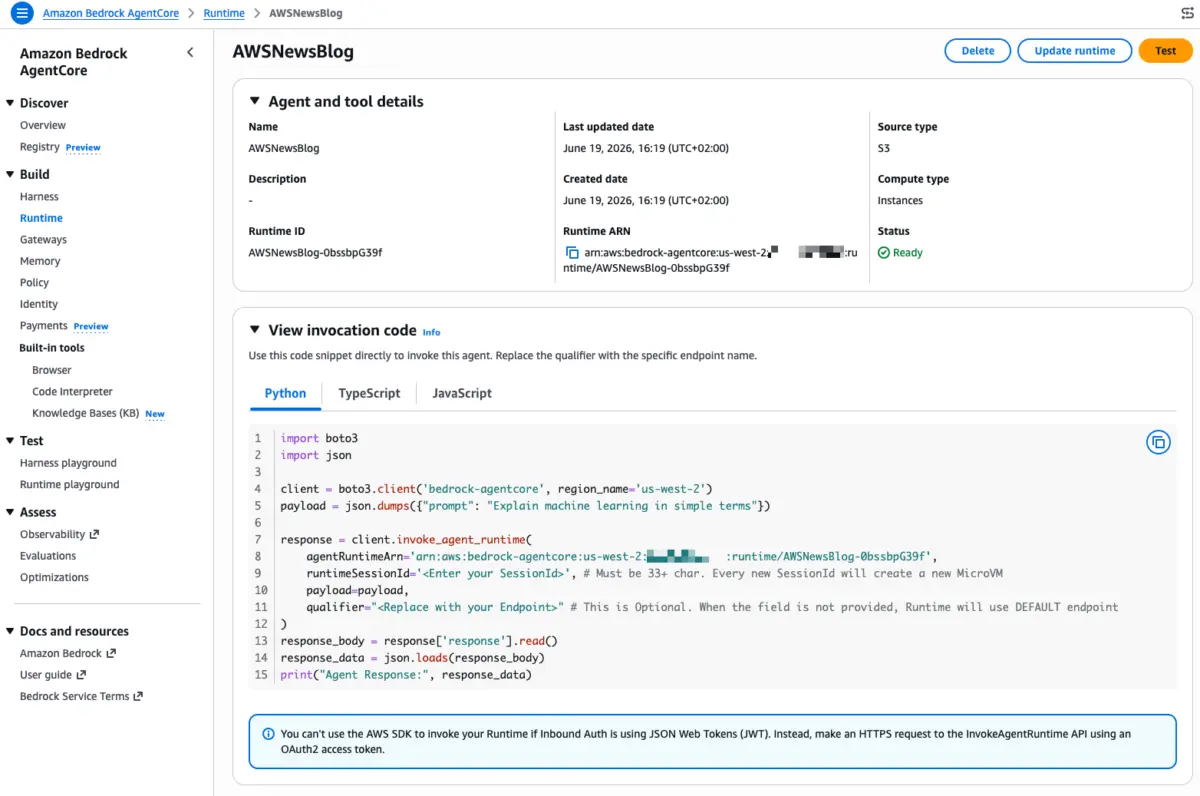
To address these architectural bottlenecks, Amazon Web Services (AWS) has announced a powerful new compute option within the Amazon Bedrock AgentCore Runtime: runtime instances. Building upon the existing capabilities of AgentCore Runtime microVMs—which provide fully managed environments for invocations lasting up to eight hours with managed session storage—runtime instances introduce a dedicated, larger-capacity EC2-backed infrastructure. This new offering is purpose-built to handle complex, long-running, and resource-intensive multi-agent workloads.
With runtime instances, developers can now deploy multiple cooperating agents onto a single managed host, granting them shared, persistent environments that endure for up to 14 days. By eliminating the heavy lifting of manual infrastructure provisioning, networking configuration, and state synchronization, AWS is streamlining how organizations deploy collaborative agent fleets in production.
Detailed Chronology: From MicroVMs to Dedicated Instances
To understand the significance of runtime instances, it is helpful to examine the evolutionary path of agentic infrastructure on AWS.

Initially, moving AI agents from development environments to production meant tackling a fragmented landscape of virtual machines, container orchestrators, and custom networking scripts. Developers frequently found themselves provisioning Amazon Elastic Compute Cloud (EC2) instances manually, configuring virtual private clouds (VPCs), setting up complex session management databases, handling horizontal scaling policies, and stitching together disparate observability platforms.
The introduction of Amazon Bedrock AgentCore Runtime microVMs represented a major leap forward, offering managed environments for short-to-medium-term invocations with built-in session storage. However, certain advanced enterprise workloads demanded more than what a standard microVM could offer. Workflows requiring continuous operation across multiple days, deep operating system access, GPU acceleration for heavy model fine-tuning or code compilation, and dense multi-agent collaboration on a single host forced developers back into the realm of custom infrastructure management.
Recognizing this friction, AWS engineered runtime instances to complement—not replace—the existing microVM architecture. Released as a natively integrated feature of the AgentCore ecosystem, runtime instances bridge the gap between ephemeral serverless execution and heavy, self-managed server clusters. Today, developers can leverage a unified API surface to orchestrate both lightweight microVMs and robust runtime instances, matching the precise compute profile to the specific requirements of each task in an agentic pipeline.
Architectural Deep Dive: How Runtime Instances Work
The core innovation of runtime instances lies in their ability to provide AWS-managed EC2 infrastructure tailored specifically for multi-agent ecosystems. Rather than isolating individual agents in fragmented silos, runtime instances allow developers to deploy multiple distinct agents onto a single managed host.
Key Capabilities and Specifications
- Extended Session Persistence: While microVMs cater to workflows lasting up to 8 hours, runtime instances support shared sessions that persist for up to 14 days. Workflows can be safely hibernated and resumed without losing contextual state.
- GPU Acceleration: Compute-intensive tasks—such as local code compilation, automated security vulnerability scanning, graphical user interface (GUI) automation, and heavy data parsing—can tap directly into hardware-accelerated instances.
- Cost Optimization via Stop/Restart: Organizations can pause and restart active sessions during idle periods, significantly reducing compute overhead during non-operational hours.
- Flexible Containerization & Packaging: Development teams can ship independently using minimal packaging—often just an
@app.entrypointdecorator paired with a zip file or a custom container image—while retaining freedom of choice across AI frameworks (such as CrewAI, LangGraph, LlamaIndex, and Strands) and underlying foundational models. - Long-Term Memory and Storage: Runtime instances pair naturally with Amazon Elastic Block Store (Amazon EBS) and AgentCore Memory, enabling agents to maintain long-term recall across sessions and environments.
Hybrid Orchestration: MicroVMs and Instances Working in Harmony
One of the most powerful architectural patterns enabled by this release is the hybrid deployment model. Developers are no longer forced to choose between serverless flexibility and dedicated horsepower; they can use both concurrently through unified AgentCore runtime APIs.
For example, a lightweight orchestrator agent running on a rapid-scaling runtime microVM can act as the front-end dispatcher. It handles incoming API calls, manages task routing, and aggregates final results. When heavy lifting is required, this orchestrator dispatches tasks to specialized worker agents running on dedicated runtime instances. While the microVM ensures low-latency user interaction and fast scaling, the instances handle intensive, state-dependent processing with direct operating system access.
Hands-On Implementation: Building a Multi-Agent Collaborative Pipeline
To demonstrate the practical application of runtime instances, consider a common software engineering workflow: a collaborative system featuring a code writer agent and a code reviewer agent.
The Scenario
In this architecture, two distinct agents share the same underlying file system on a managed EC2 host:
- The Code Writer Agent: Translates natural language descriptions into clean, functional Python code.
- The Code Reviewer Agent: Analyzes the generated code for bugs, architectural style issues, and performance optimizations.
Crucially, because both agents reside on the same runtime instance within a shared session, they do not need to exchange complex payloads over network APIs or transfer files via external storage buckets. They simply read and write to a shared local directory tied to their session identifier.
Step 1: Creating a Capacity Provider
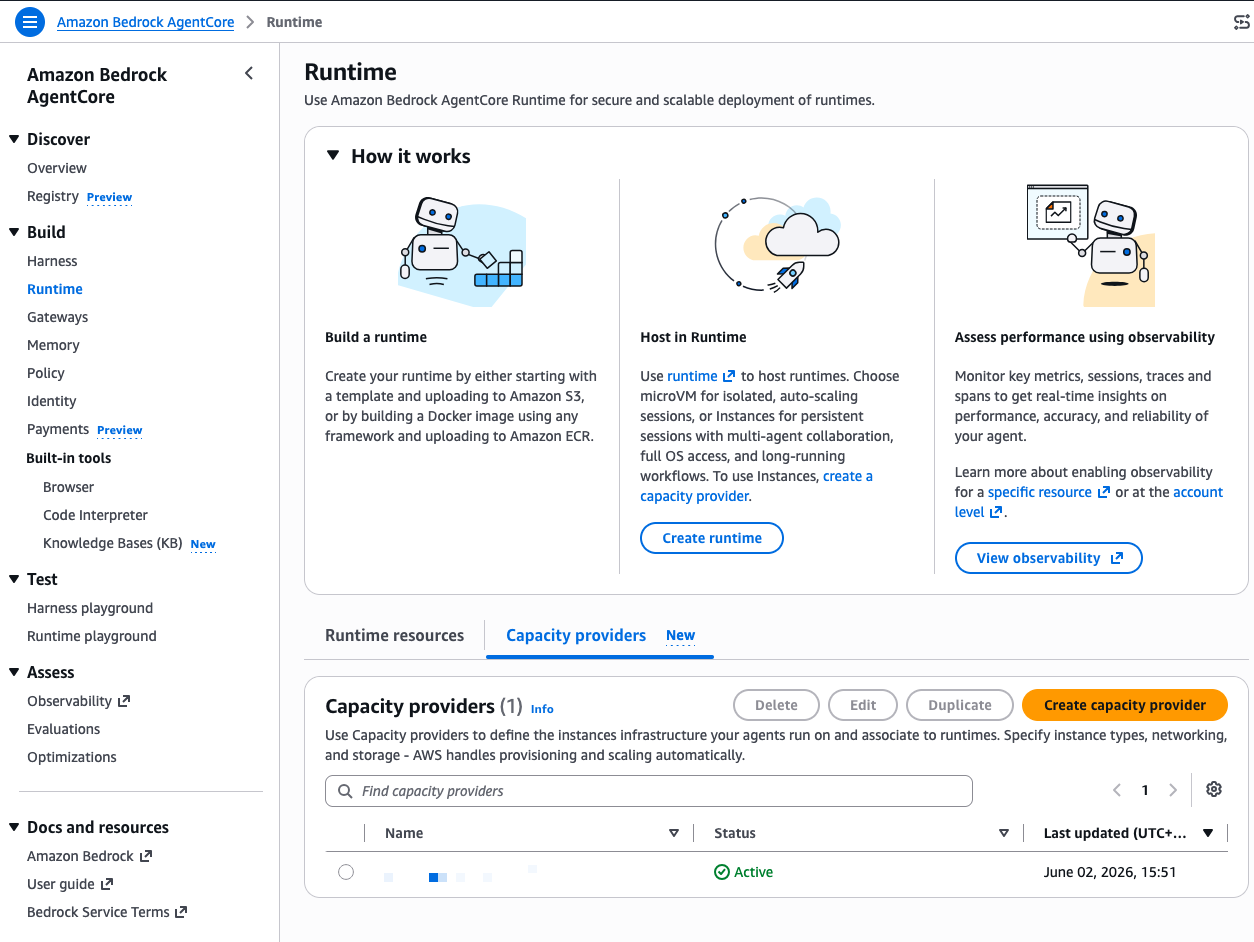
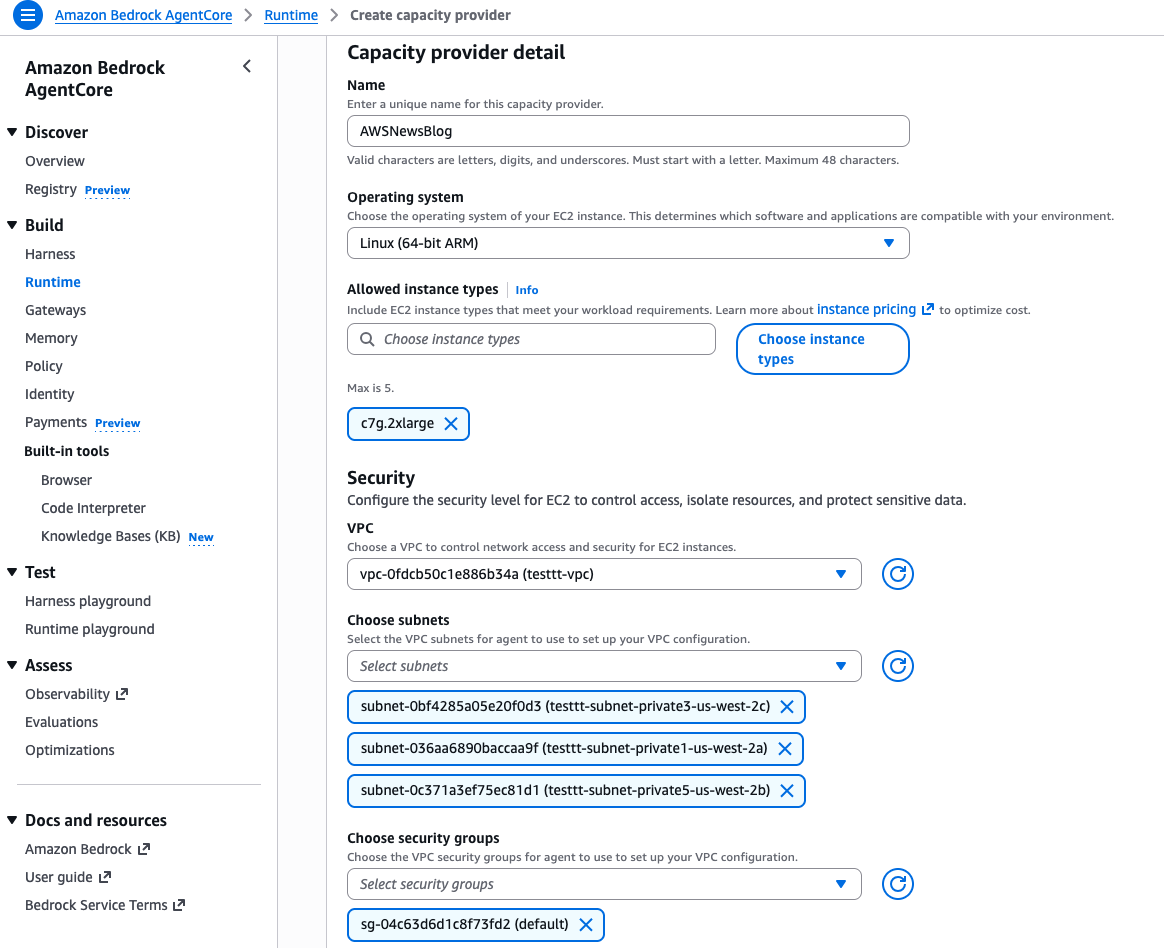
The first step in the AWS Management Console is defining the underlying compute infrastructure via a Capacity Provider.
- Operating System: Linux (64-bit ARM)
- Instance Type:
c7g.2xlarge(providing 8 vCPUs and 16 GiB of memory, ensuring ample headroom for both agents to operate side-by-side) - Networking: Configured within a secure VPC, specifying subnets and security groups.
- Storage: Standard
gp3Amazon EBS volume. - IAM Roles: Automatically provisioned service and instance roles to manage EC2 resources securely.
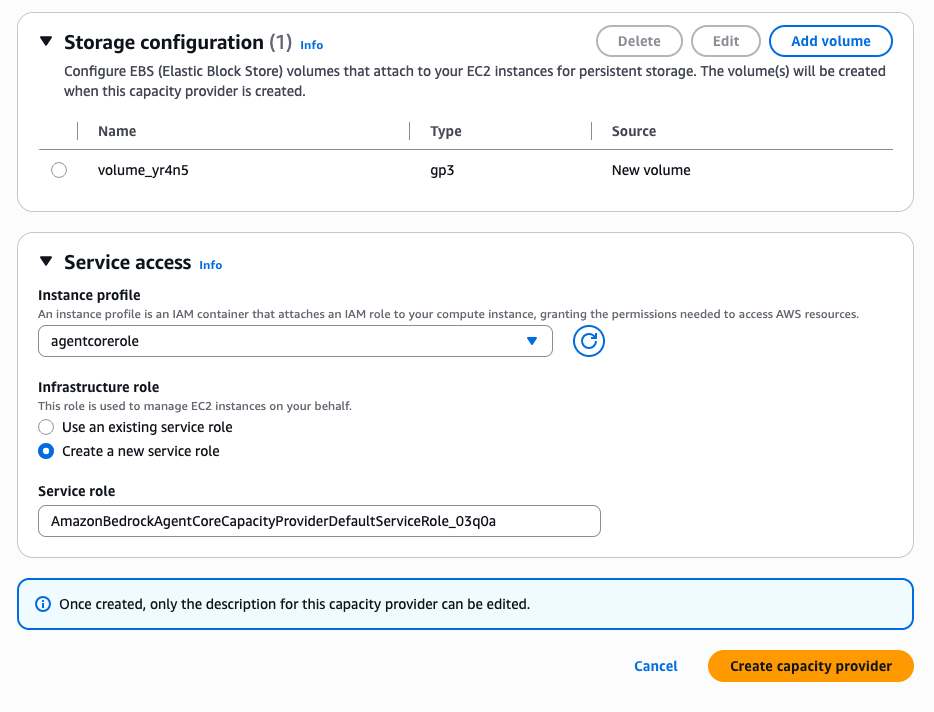
Once initialized, the capacity provider transitions to an active state, ready to host deployed agent runtimes.
Step 2: Deploying the Agents
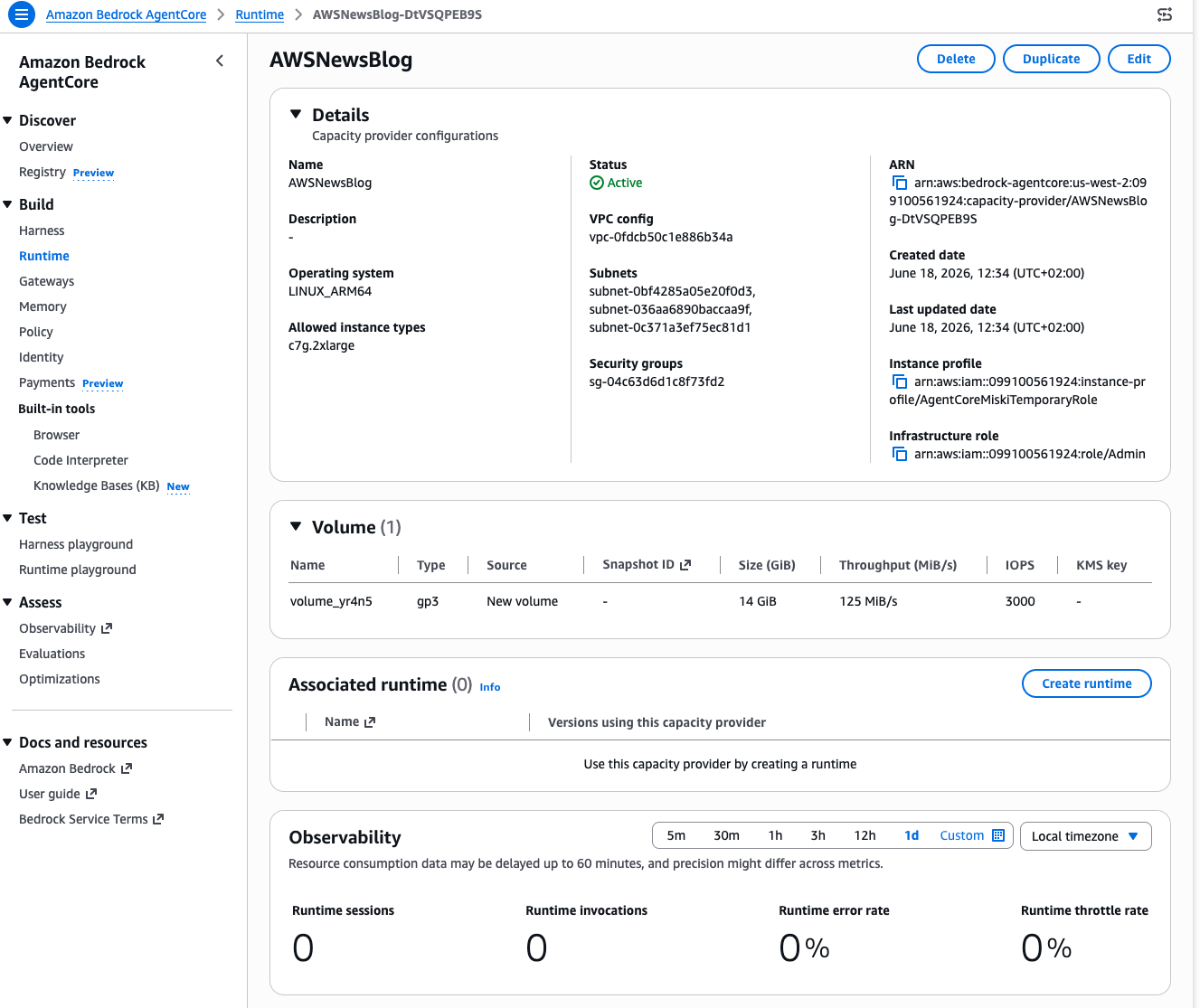
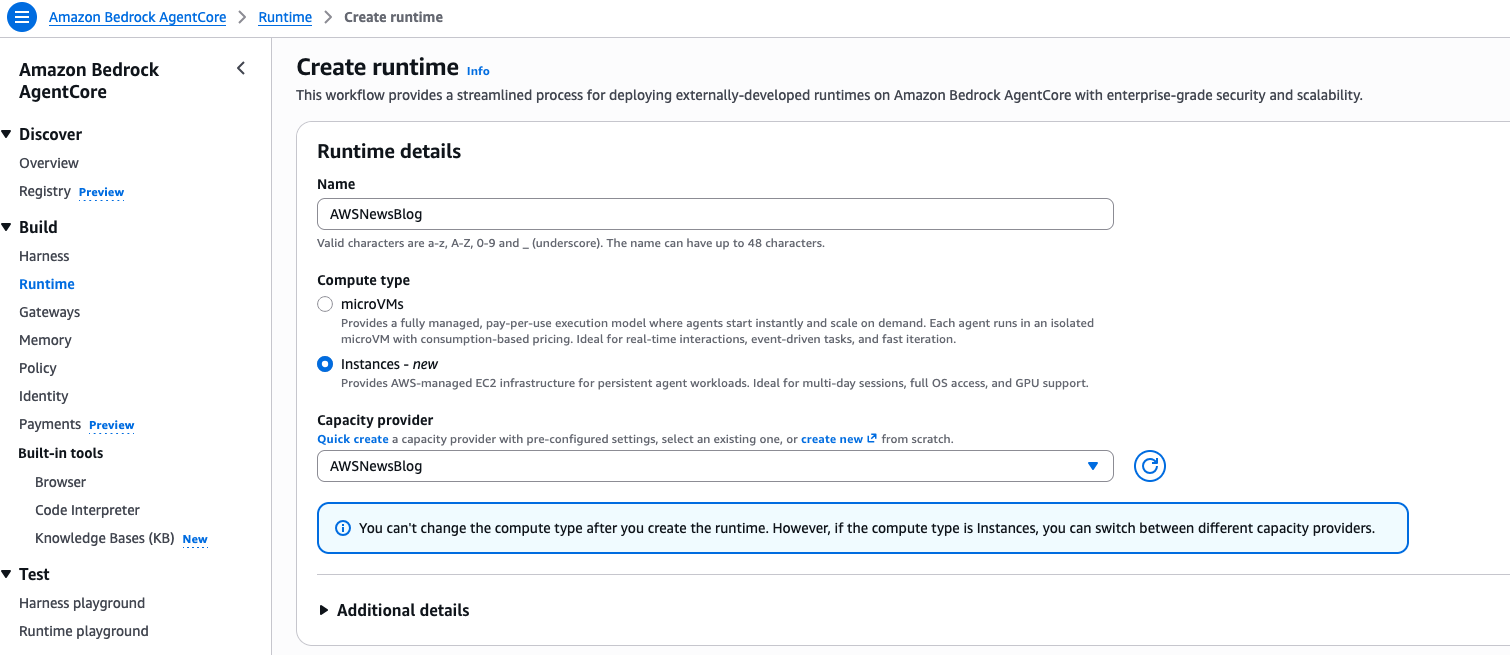
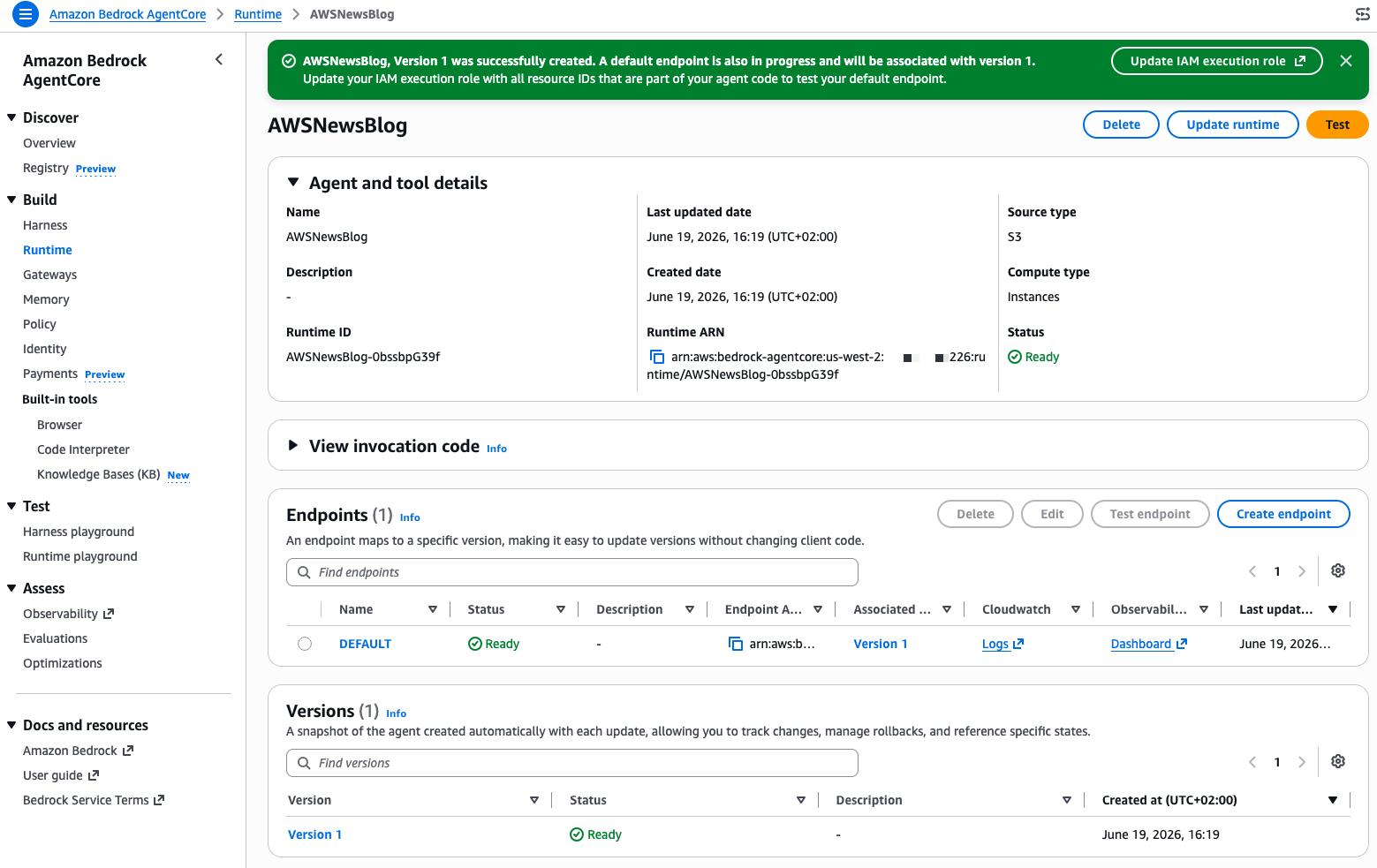
Next, the developer creates two distinct runtimes using the newly minted capacity provider as the compute backend:
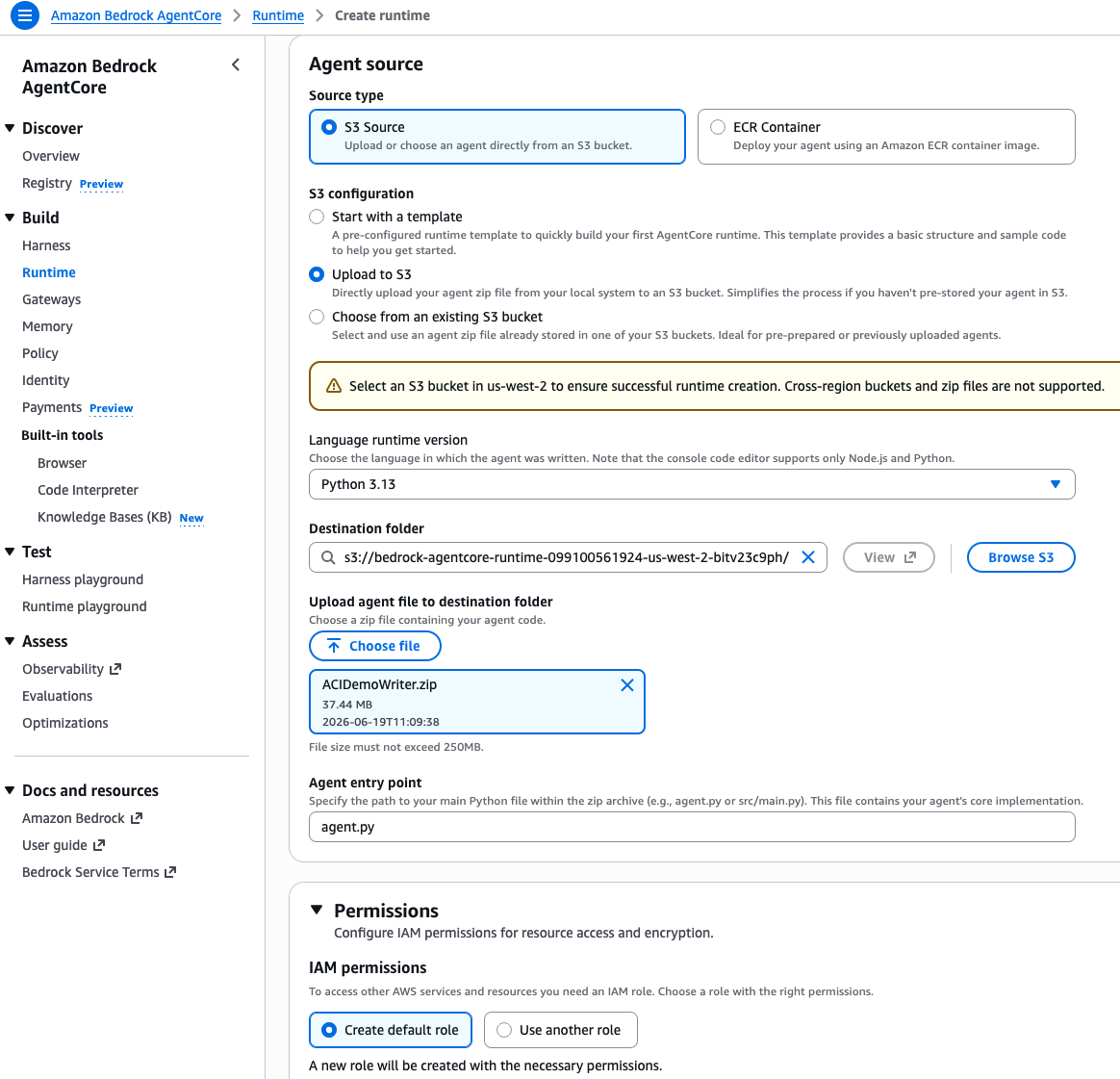
- Writer Deployment: An S3-hosted zip package (
ACIDemoWriter.zip) running Python 3.13, utilizing the@app.entrypointdecorator to expose the handler function. - Reviewer Deployment: A separate S3-hosted package (
ACIDemoReviewer.zip) configured similarly, pointing to the same underlying capacity provider.
Step 3: Execution and Collaboration in the Playground
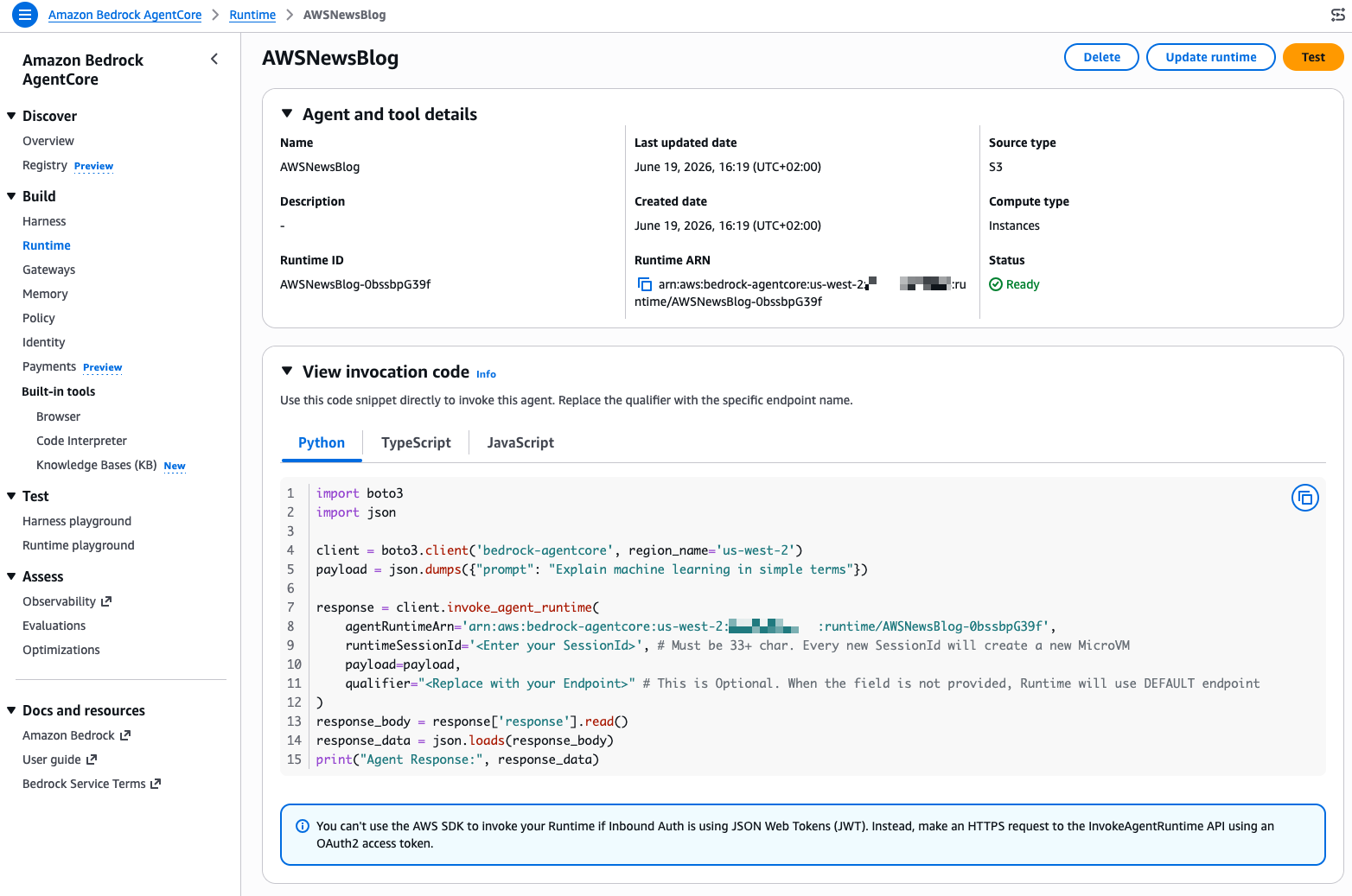
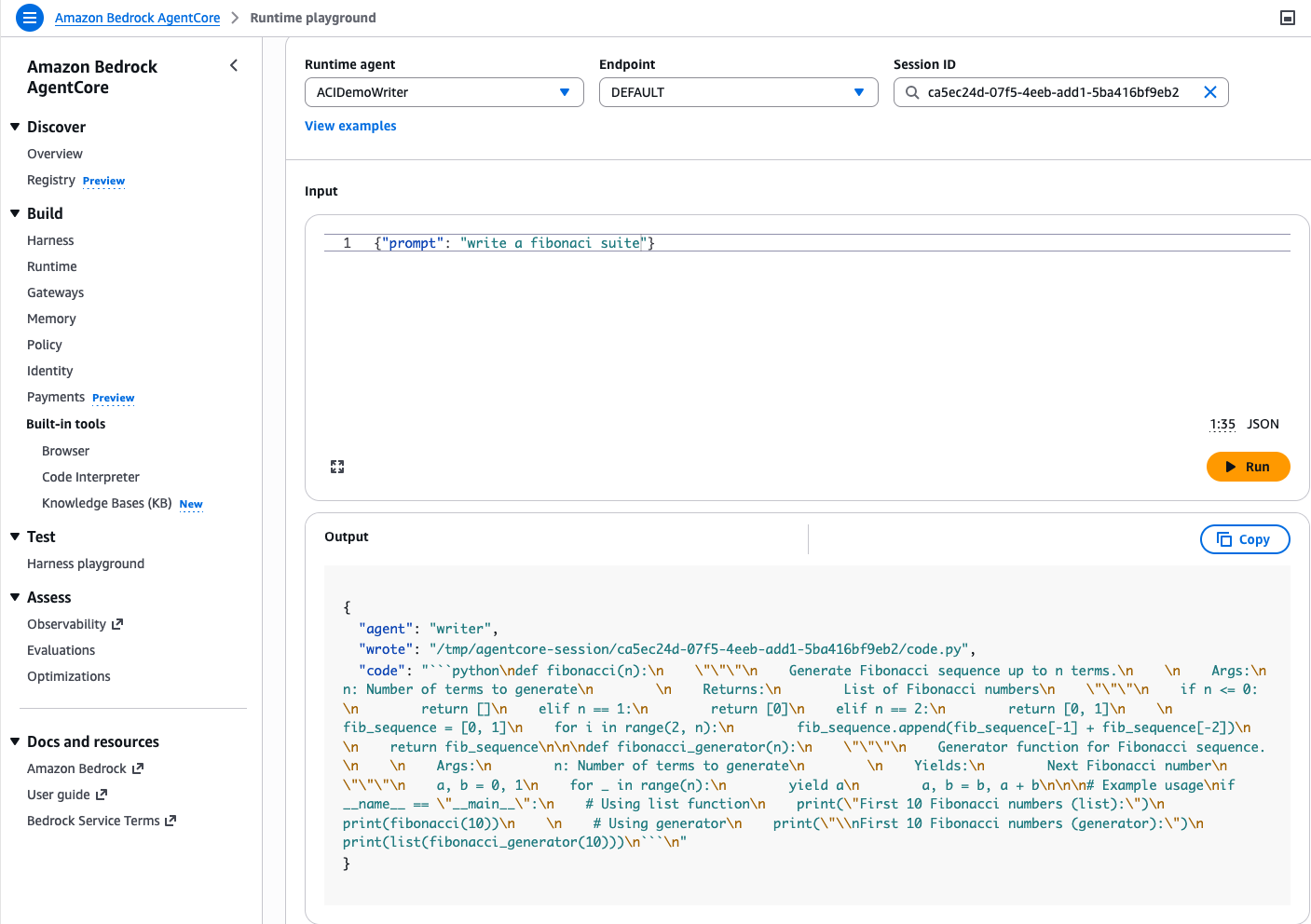
Using the AWS AgentCore Runtime playground, the workflow is initiated via a JSON payload:
"prompt": "write a fibonacci suite"The writer agent generates a Python module containing two implementations of the Fibonacci sequence and writes it directly to the shared session directory:
/tmp/agentcore-session/<session-id>/code.py
Next, by switching the active runtime agent in the console dropdown to the reviewer agent—while retaining the exact same Session ID—the reviewer immediately accesses the file produced by the writer:
"prompt": "review the code"The reviewer reads the file from the shared local file system, evaluates its syntax and structure, and outputs actionable suggestions regarding type hints and input validation—all without making a single inter-agent API call. This pattern can be effortlessly scaled to include testing agents, documentation generators, and automated security scanners.
Supporting Context & Metrics
The introduction of runtime instances arrives at a critical juncture in enterprise AI adoption. According to recent industry surveys, while over 75% of large enterprises have experimented with generative AI prototypes, fewer than 25% have successfully scaled multi-agent workflows into production environments. The primary inhibitors cited by engineering leaders are infrastructure complexity, state management overhead, and unpredictable latency during multi-step reasoning tasks.
By providing AWS-managed EC2 infrastructure that abstracts away the undifferentiated heavy lifting of cluster management, Amazon Bedrock AgentCore addresses these friction points directly:
- Reduction in Operational Overhead: Teams save an estimated 40–60 hours per month previously spent configuring custom EC2 autoscaling groups, session synchronization scripts, and networking policies.
- Extended Workflow Horizons: Moving from 8-hour microVM limits to 14-day persistent runtime sessions unlocks complex asynchronous tasks, such as automated codebase refactoring, multi-day data analysis pipelines, and continuous compliance auditing.
- Hardware Flexibility: Support for ARM-based Graviton processors (
c7ginstances) alongside GPU acceleration ensures that organizations can optimize price-to-performance ratios based on the exact computational density required by their models.
Future Outlook
As autonomous AI agents evolve from reactive query-responders into proactive, long-running digital workers, the infrastructure supporting them must mature in lockstep. The launch of runtime instances for Amazon Bedrock AgentCore signals a shift toward enterprise-grade agent orchestration—where cloud providers absorb the complexities of state persistence, inter-agent collaboration, and hardware acceleration.
Looking ahead, we can expect AWS to expand the AgentCore ecosystem further, introducing tighter integrations with enterprise identity providers, advanced automated checkpointing for multi-week workflows, and deeper observability metrics tailored specifically to agentic reasoning loops. For software architects and AI developers, these advancements clear the path for a new generation of resilient, autonomous applications capable of operating reliably at enterprise scale.