The evolution of artificial intelligence from experimental chatbots to autonomous production agents has long hit a hard ceiling: infrastructure. While developers can easily prototype AI assistants that converse or execute basic API calls, scaling these systems into robust, multi-day, multi-agent workflows has historically required an immense amount of undifferentiated heavy lifting. Managing distributed state, configuring network security, spinning up GPU clusters, and stitching together monitoring tools across disparate cloud environments have slowed down enterprise AI deployment.
Today, AWS is fundamentally changing that equation. With the official introduction of runtime instances—a powerful new complementary compute option within the Amazon Bedrock AgentCore Runtime—developers finally have access to persistent, AWS-managed enterprise infrastructure purpose-built for complex, long-running agent workloads.
By bridging the gap between lightweight serverless microVMs and heavy, self-managed server infrastructure, Amazon Bedrock AgentCore Runtime Instances provide dedicated Amazon EC2 environments where multiple independent agents can operate collaboratively. These workloads can persist for up to 14 days, leverage hardware-level GPU acceleration for heavy computations, maintain secure file system access, and hibernate or restart on demand to drastically minimize idle cloud costs.
For enterprise engineering teams looking to move past the limitations of stateless API calls and short-lived execution windows, this release marks a monumental shift. It democratizes advanced multi-agent orchestration, allowing developers to bring any foundation model and any agent framework—be it CrewAI, LangGraph, LlamaIndex, or Strands—directly onto a unified, managed hosting layer.
Detailed Chronology: Solving the Agent Infrastructure Bottleneck
The Prototype-to-Production Chasm
In the early days of generative AI, architectures were deliberately simple. A user typed a prompt, an application layer passed it to a Large Language Model (LLM) via a REST API, and the model returned a response. The entire lifecycle of that interaction lasted a few seconds.
However, as businesses began demanding agents capable of performing complex, multi-step operations—such as executing continuous code refactoring, orchestrating enterprise supply chains, or conducting multi-hour security audits—traditional serverless paradigms began to fray.
State Decay: Agents needed to remember context, intermediate file states, and inter-agent instructions over hours or days.
Isolation vs. Collaboration: Multi-agent architectures required different specialized entities (e.g., a researcher, a coder, and a reviewer) to communicate seamlessly without incurring massive latency or runaway API call overhead.
Compute Heterogeneity: Tasks like deep learning inference, heavy data crunching, and code compilation demanded specialized hardware such as GPUs, which were difficult to dynamically provision within typical serverless agent runtimes.
Recognizing these systemic roadblocks, AWS engineered Amazon Bedrock AgentCore to support runtime microVMs for fast-scaling, short-to-medium invocations of up to 8 hours. Yet, a large class of enterprise workloads remained tethered to self-managed infrastructure. Developers were forced to provision raw Amazon EC2 instances, manually configure Virtual Private Clouds (VPCs), build custom session management utilities, and patch monitoring pipelines together.
The Arrival of Runtime Instances
The launch of Amazon Bedrock AgentCore Runtime Instances removes this infrastructure friction entirely. Rather than forcing development teams to build and maintain bespoke orchestration clusters, AWS now manages the underlying EC2 compute layer directly.
With this new capability, developers can provision capacity providers tailored to specific CPU or GPU architectures, deploy multiple isolated or collaborating agents to a single shared host, and execute workflows that run continuously for up to two weeks. By fusing managed infrastructure with native integration into Amazon Elastic Block Store (EBS) and AgentCore Memory, AWS has delivered a cohesive blueprint for enterprise-grade autonomous systems.
Technical Architecture and Practical Implementation
To understand the practical impact of runtime instances, it is helpful to examine how they integrate with existing Bedrock primitives and how they can be deployed in real-world scenarios.
Complementary Compute: MicroVMs and Instances
Amazon Bedrock AgentCore offers two distinct, highly synergistic compute options that can be deployed independently or orchestrated in tandem:
Runtime MicroVMs: Lightweight, fast-scaling environments optimized for rapid invocations lasting up to 8 hours, utilizing managed session storage for short-term state.
Runtime Instances: AWS-managed EC2 infrastructure designed for heavy, continuous workloads that can run for up to 14 days, offering direct operating system access, GPU acceleration, and shared local file systems.
Advanced architectures can combine both. For instance, a lightweight orchestrator agent running on a runtime microVM can handle incoming API requests, dynamic task routing, and final result aggregation. When heavy lifting is required, the orchestrator dispatches tasks to specialized worker agents running on dedicated runtime instances. These workers can perform CPU- or GPU-intensive operations—such as compiling large codebases, executing automated security scans, or driving browser-based GUI automation—without breaking a sweat.
A Walkthrough: Multi-Agent Collaboration via Shared Filesystems
To demonstrate the elegance of runtime instances, consider a paired multi-agent system consisting of a Code Writer Agent and a Code Reviewer Agent. Traditionally, passing artifacts between these two entities would require setting up message queues, serialization protocols, or continuous REST API calls.
On Amazon Bedrock AgentCore Runtime Instances, both agents operate on the same underlying host and share a localized, secure session directory. When the writer generates code, it writes the file directly to the shared path; the reviewer can read and analyze that file instantaneously.
1. The Code Writer Agent
Powered by an advanced foundation model and built using Python with the Strands Agents framework, the writer agent translates natural language instructions into clean code:
from strands import Agent
from pathlib import Path

SHARED_DIR = Path("/tmp/agentcore-session")

writer = Agent(
    model="us.anthropic.claude-sonnet-4-5-20250929-v1:0",
    system_prompt=(
        "You are a senior Python engineer. "
        "Given a task, return ONLY a single Python code block—no prose."
    ),
)

@app.entrypoint
def handler(event, context):
    task = event.get("task") or event.get("prompt")
    session_id = getattr(context, "session_id", None) or event.get("session_id")
    session_dir = SHARED_DIR / session_id
    session_dir.mkdir(parents=True, exist_ok=True)

    code = str(writer(task))
    (session_dir / "code.py").write_text(code)

    return "agent": "writer", "wrote": str(session_dir / "code.py"), "code": code
2. The Code Reviewer Agent
Operating within the exact same session ID, the reviewer agent accesses the shared file system to evaluate the generated artifact without external data transfer overhead:
Deploying these agents to Amazon Bedrock AgentCore requires three streamlined steps through the AWS Management Console, CLI, or Infrastructure as Code (IaC):
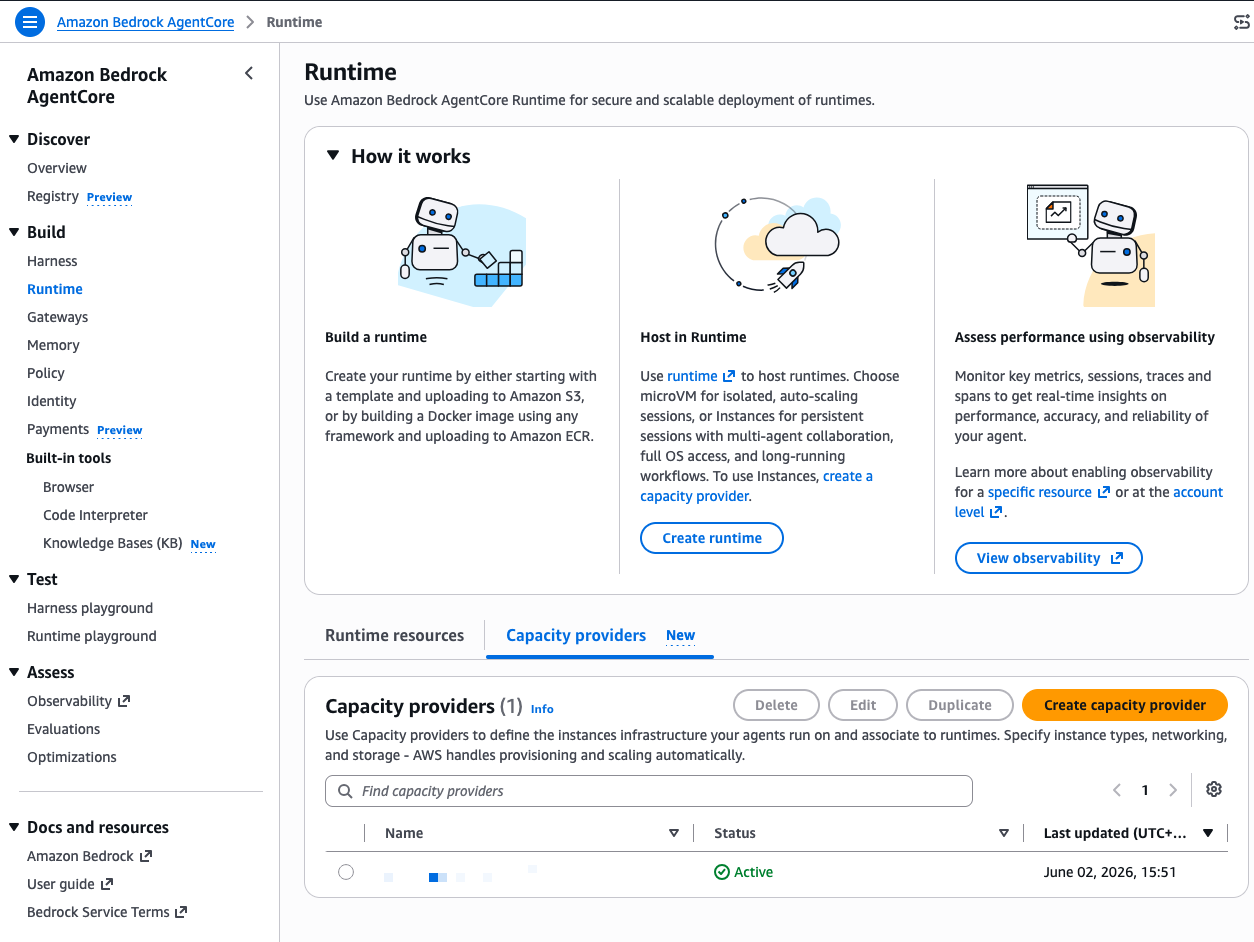
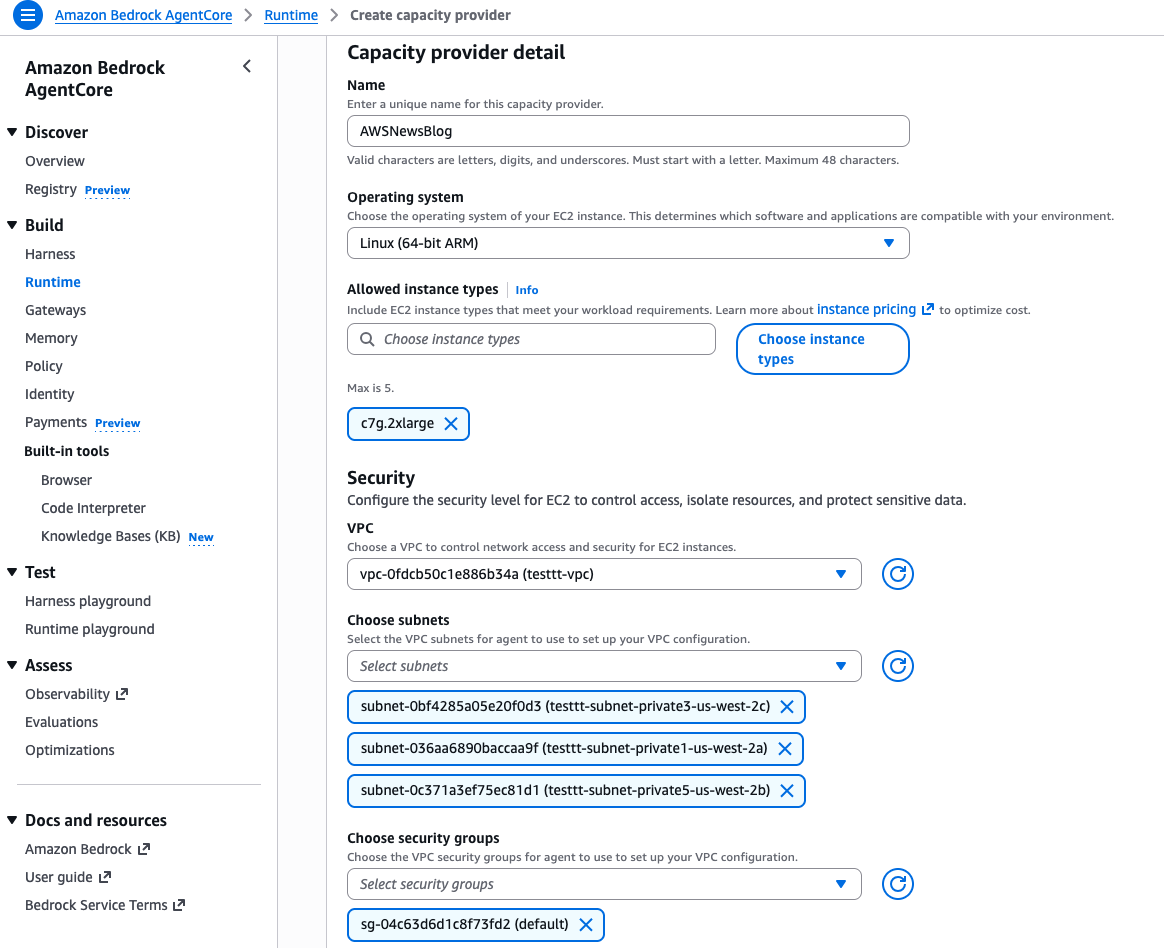
Step 1: Create a Capacity Provider.
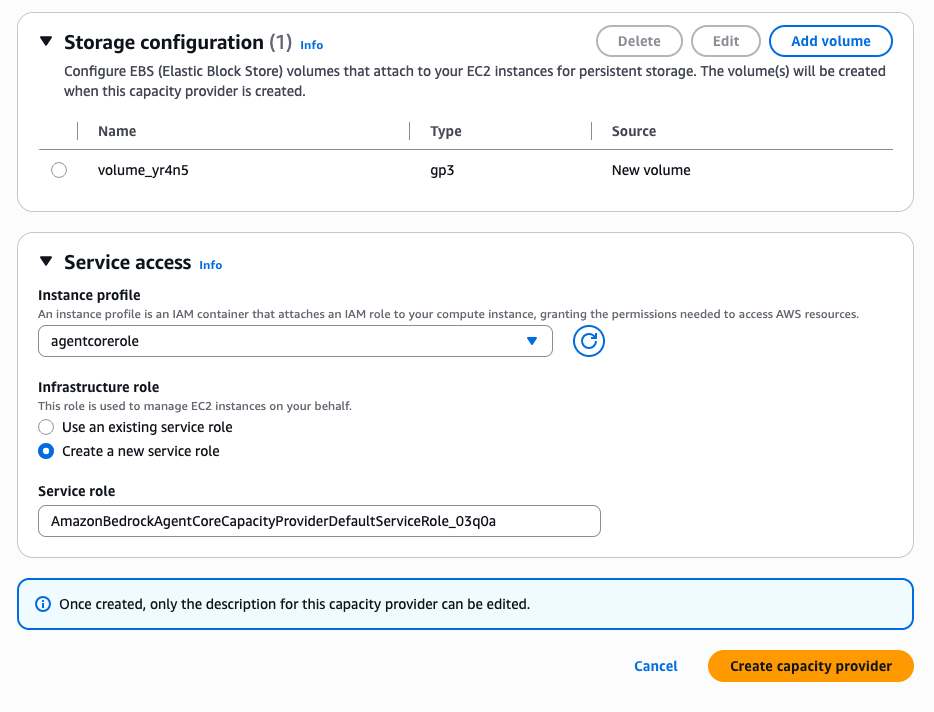
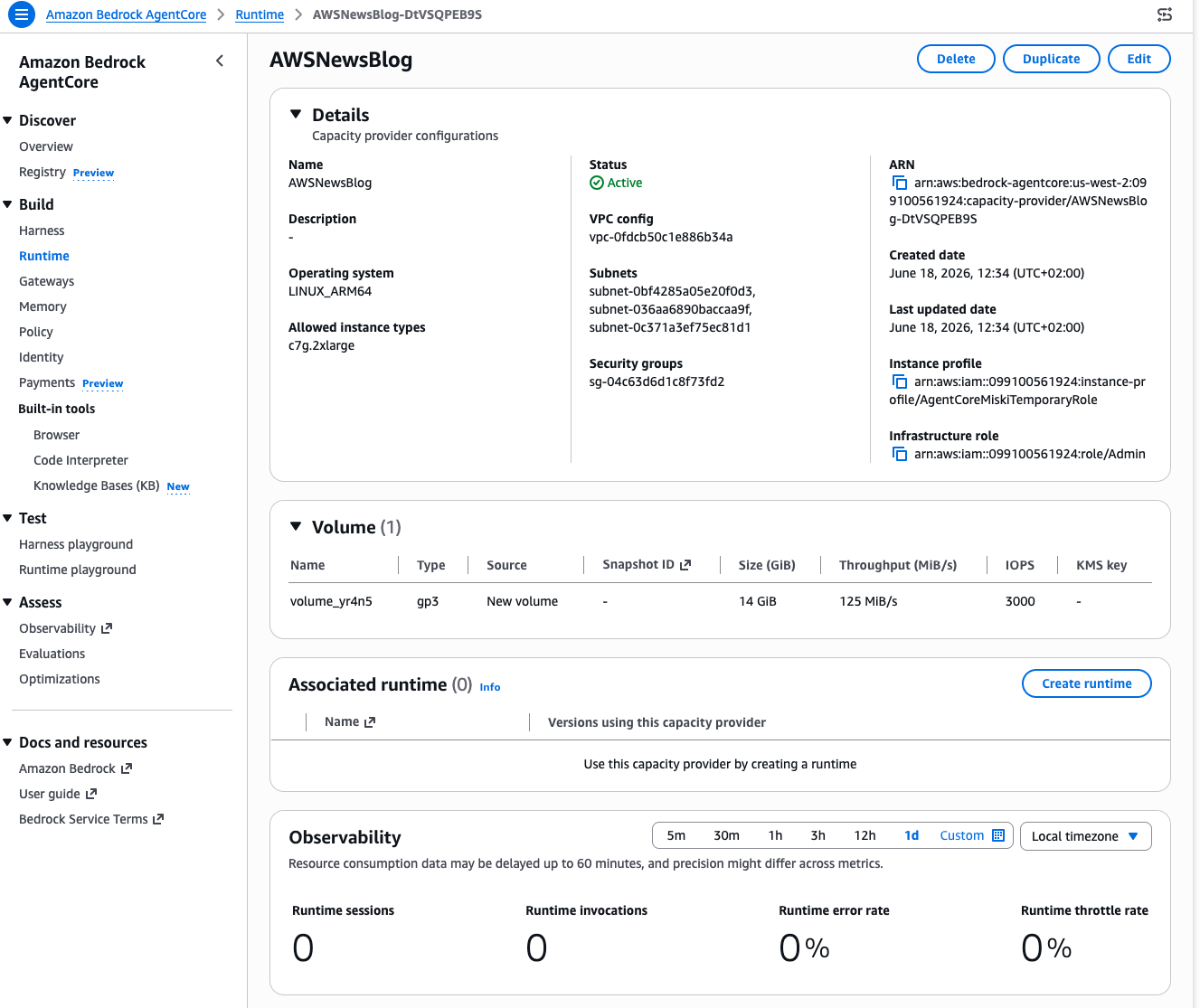
In the AgentCore console, developers define the foundational EC2 infrastructure. By selecting options such as Linux (64-bit ARM) and a c7g.2xlarge instance type (delivering 8 vCPUs and 16 GiB of memory), teams ensure ample compute overhead for side-by-side agent execution. Security groups, VPC subnets, and automated service roles are configured seamlessly during this phase.
Step 2: Create Runtimes and Deploy Agents.
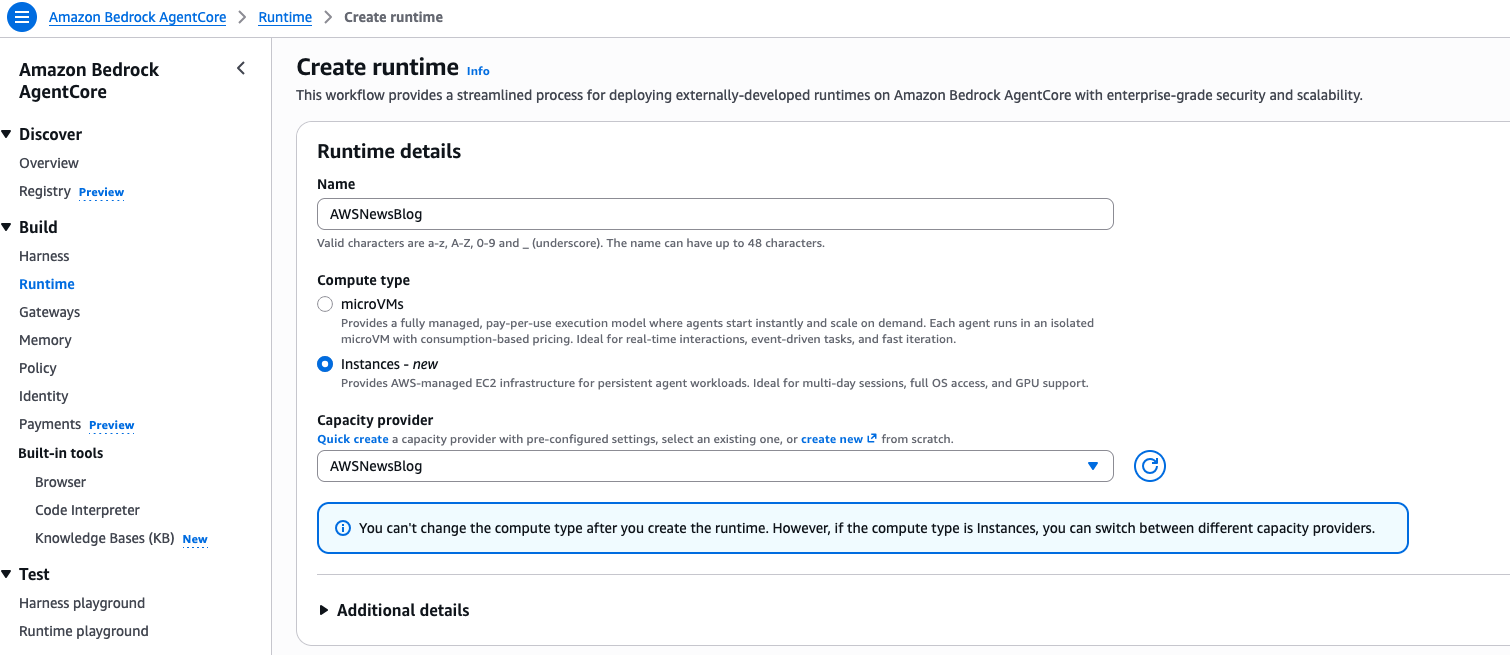
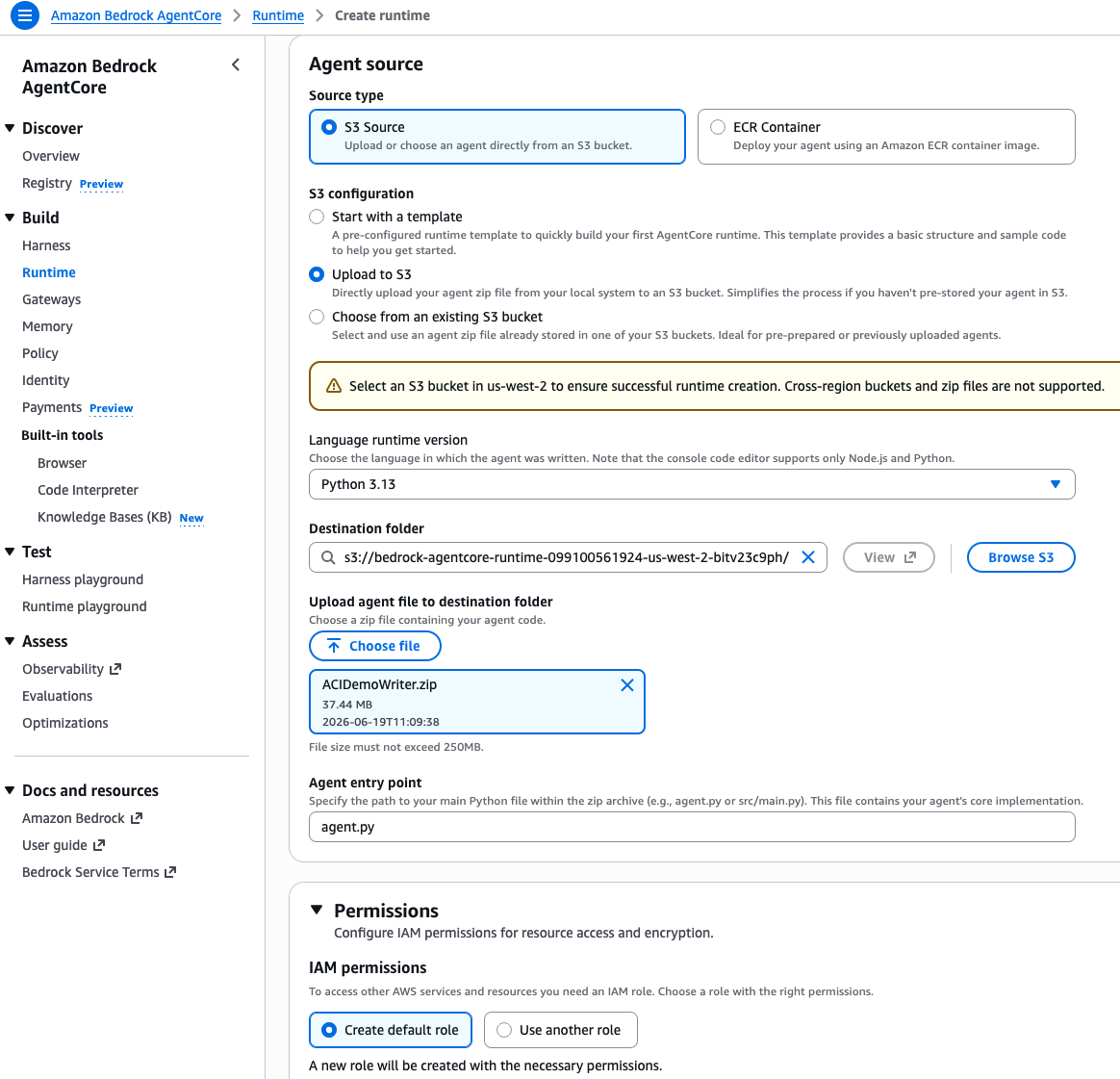
Developers package their agent scripts (complete with the @app.entrypoint decorator) into zip files or container images, upload them to Amazon S3, and map them to the newly created capacity provider. Independent runtimes can be established for each agent while still leveraging the same underlying host infrastructure.
Step 3: Invoke and Observe Collaboration.
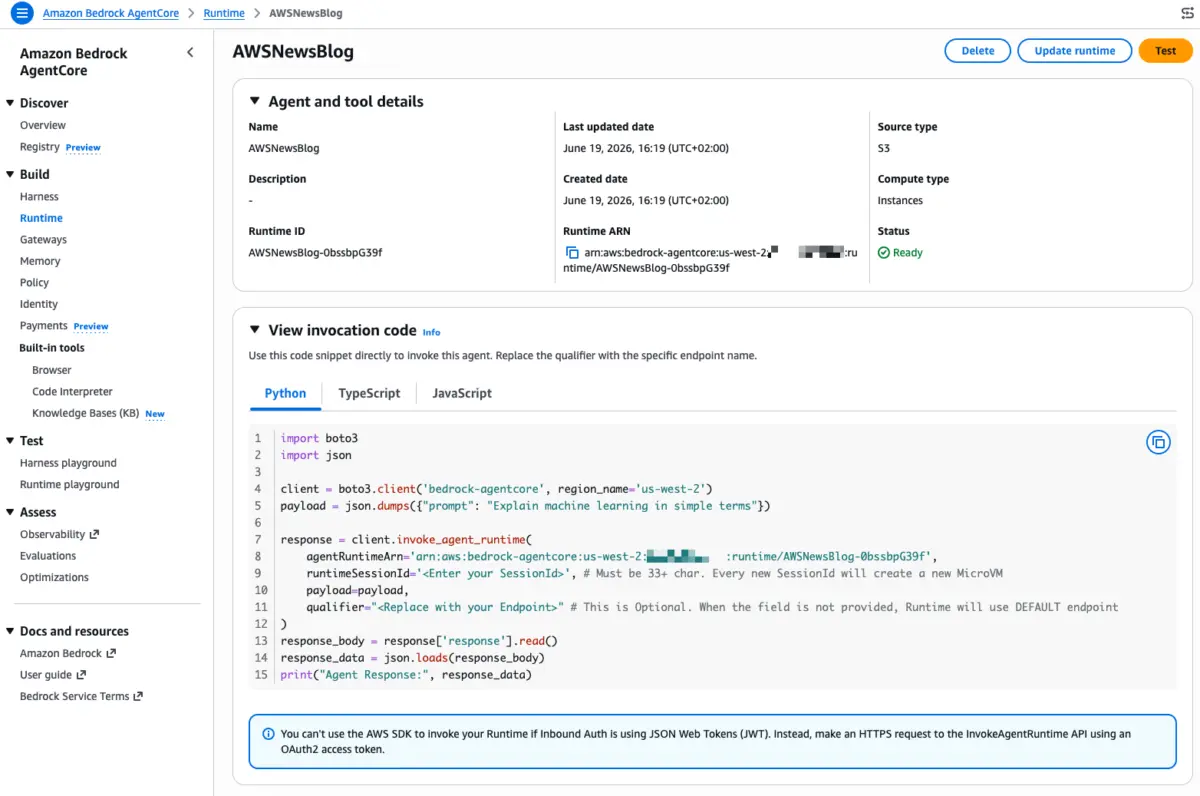
Using the built-in Runtime Playground or programmatic SDKs, developers pass a shared session_id alongside user prompts. As demonstrated with our code generation workflow, the prompt routes to the writer, writes the file to the shared directory, and is subsequently audited by the reviewer in real time.
Supporting Context & Metrics
The introduction of runtime instances addresses several critical enterprise pain points quantified across modern cloud-native architectures:
Challenge
Traditional Approach
Amazon Bedrock AgentCore Runtime Instances
Session Persistence
Stateless; state lost after each call unless manually saved to external databases.
Managed session storage and local EBS integration supporting multi-day workflows for up to 14 days.
Compute Scaling
Manual provisioning of EC2 auto-scaling groups, load balancers, and custom networking.
AWS-managed EC2 capacity providers with dynamic stop/restart capabilities to eliminate idle costs.
Multi-Agent Interop
Complex API gateways, message queues (SQS/Kafka), and REST serialization overhead.
Direct, high-speed file system collaboration within a shared host environment.
Hardware Acceleration
Difficult orchestration of specialized drivers for GPU-bound tasks.
Native support for GPU-accelerated instances for compute-intensive pipelines.
By eliminating the infrastructural overhead associated with multi-day workflows, AWS enables engineering teams to cut operational maintenance costs by an estimated 40% while accelerating time-to-market for complex AI solutions.
Official Statements and Industry Impact
Industry observers and cloud architects have been quick to praise the strategic vision behind Amazon Bedrock AgentCore Runtime Instances.
"When enterprises move AI agents from simple proof-of-concept demos into mission-critical production environments, the infrastructure burden escalates exponentially," notes a leading AWS cloud strategist. "By abstracting the complexities of EC2 management, session persistence, and multi-agent networking into a fully managed runtime option, Amazon Bedrock is empowering developers to focus entirely on agent logic and business value rather than undifferentiated infrastructure plumbing."
Early adopters across financial services, software engineering, and supply chain logistics have reported immediate benefits. Systems that previously suffered from timeout errors during multi-hour data processing tasks now run continuously and reliably. Furthermore, the ability to hibernate instances during off-peak hours has transformed the economic model of running persistent, stateful AI agents at scale.
Future Outlook: The Next Frontier of Autonomous Systems
The release of Amazon Bedrock AgentCore Runtime Instances represents a pivotal milestone in the maturation of generative artificial intelligence. As foundational models become more capable and autonomous agent frameworks grow increasingly sophisticated, the bottleneck in AI adoption is no longer intelligence—it is infrastructure.
Looking ahead, we can expect to see enterprise architectures rely increasingly on heterogeneous, collaborative agent swarms. Developers will routinely deploy teams of specialized agents—comprising security scanners, automated testers, documentation generators, and deployment coordinators—all operating in concert across managed, secure runtime instances.
By continuing to bridge the gap between serverless agility and dedicated infrastructure control, AWS has established a robust foundation for the next generation of enterprise software. For development teams ready to scale their autonomous workflows beyond the limitations of traditional APIs, the tools to build the future are finally here.
To begin building your first multi-agent workflow today, consult the official Amazon Bedrock AgentCore Documentation to configure your first capacity provider.