Executive Overview
In a significant development for cloud-native web and artificial intelligence engineering, developers building applications on Vercel can now provision and manage Amazon Simple Storage Service (Amazon S3) resources directly from the Vercel Marketplace and v0. This native integration effectively bridges the gap between Vercel’s high-velocity frontend provisioning workflow and the robust durability, scalability, and performance of AWS infrastructure.
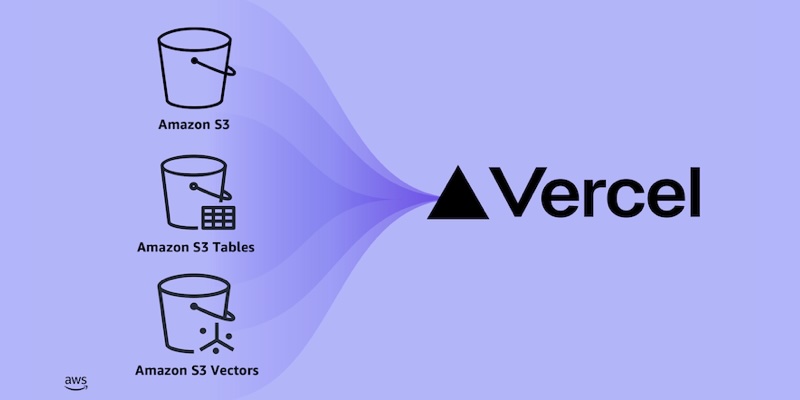
Announced natively today, the integration encompasses the entirety of the Amazon S3 ecosystem—including standard general-purpose buckets, Amazon S3 Tables, and Amazon S3 Vectors. By collapsing what was once a multi-step administrative hurdle into a few clicks or a natural language prompt in v0, this release targets three distinct modern workloads: everyday file storage, high-throughput analytics, and AI-driven semantic search.
Crucially, the architecture eliminates the friction of manual credential management. By utilizing Vercel Functions and OpenID Connect (OIDC) via the AWS Security Token Service (AWS STS), applications securely exchange short-lived tokens at runtime, bypassing the security risks associated with static, long-lived access keys. Combined with existing integrations for Amazon Aurora, Amazon DynamoDB, and Amazon OpenSearch Serverless, developers can now deploy a complete, production-grade application stack entirely through Vercel while billing directly to their designated AWS accounts.
Detailed Chronology & Technical Implementation
1. Provisioning and Authentication Mechanics
Historically, integrating AWS object storage into a Vercel-hosted Next.js application required developers to manually navigate the AWS Management Console. Teams had to provision an S3 bucket, configure Identity and Access Management (IAM) policies, generate programmatic access keys, and manually copy sensitive credentials into Vercel’s environment variables manager.
The new Vercel-AWS marketplace integration radically streamlines this operational pipeline:
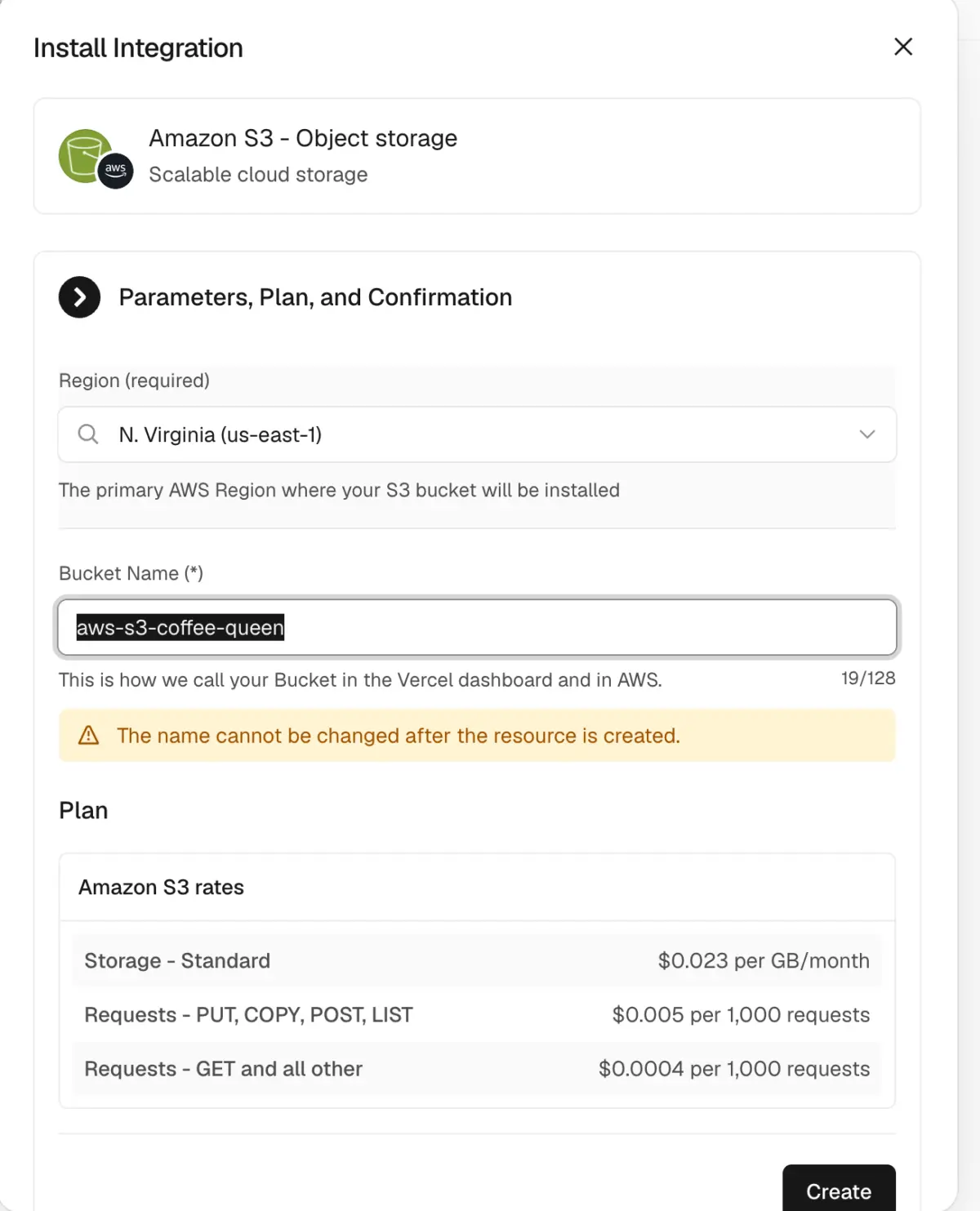
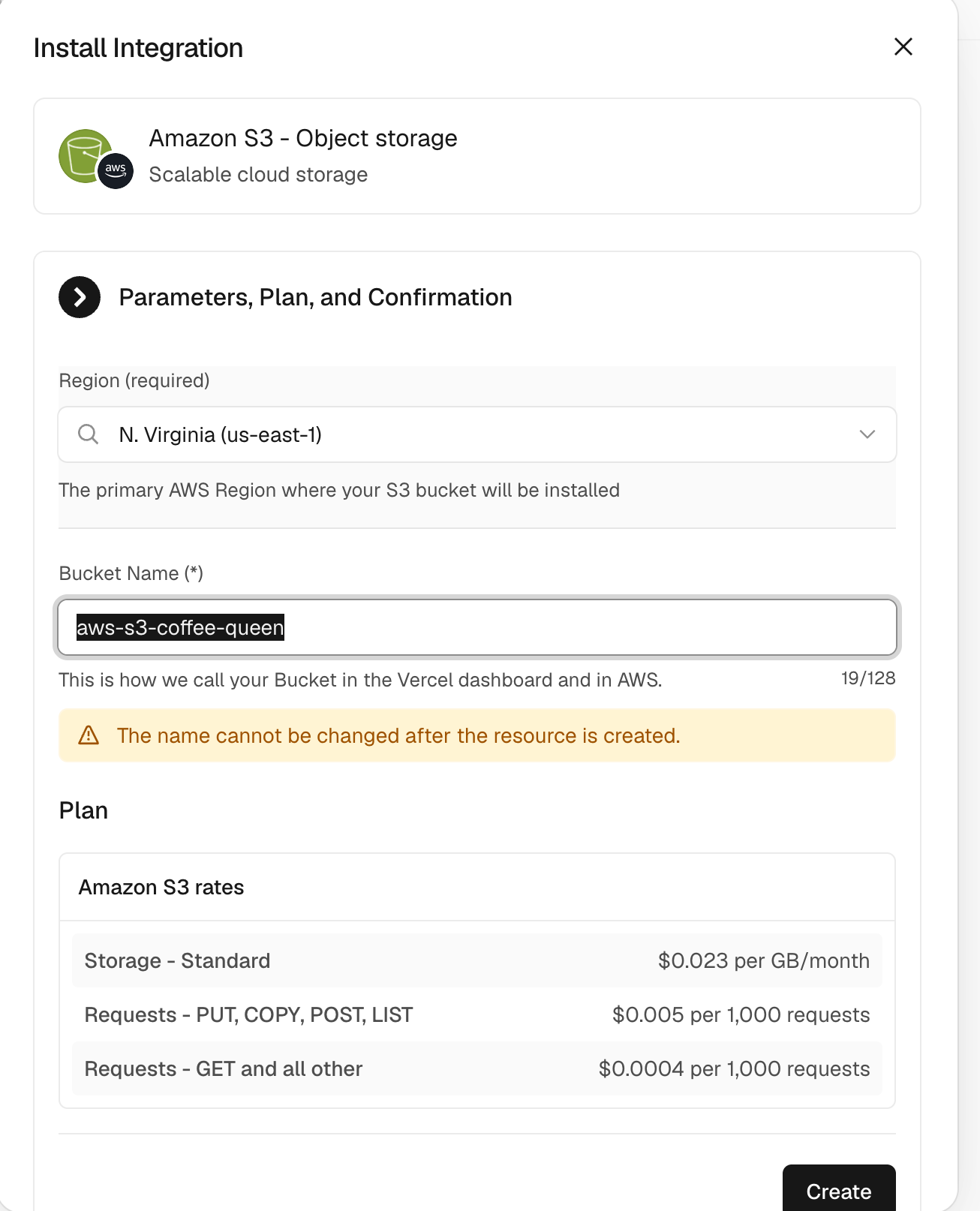
- Resource Creation: Within the Vercel dashboard, engineers navigate to the Storage tab, select Create, choose AWS, specify the desired S3 bucket type and AWS Region, and execute the creation. The provisioning sequence completes in seconds.
- Project Linking: Developers link the newly created resource to their Vercel project and pull local environment variables using the Vercel Command Line Interface (CLI):
vercel link vercel env pull .env.local - Runtime Security via OIDC: The integration automatically injects configuration variables such as
AWS_REGION,AWS_ROLE_ARN,AWS_RESOURCE_ARN, and bucket-specific identifiers into the environment. At runtime, theawsCredentialsProviderfunction from@vercel/functions/oidcsecurely exchanges a short-lived OIDC token with AWS STS. This generates scoped, temporary credentials on the fly, ensuring zero static keys reside in the codebase or environment files.
2. General-Purpose Object Storage in Practice
For standard web workflows—such as media uploads, document management, and asset delivery—developers can instantly interact with general-purpose S3 buckets using the official AWS SDK for JavaScript (@aws-sdk/client-s3).
Consider a production-ready Next.js API route handling secure file uploads:
import  S3Client, PutObjectCommand  from "@aws-sdk/client-s3";
import  awsCredentialsProvider  from "@vercel/functions/oidc";

const s3 = new S3Client(
  region: process.env.AWS_REGION,
  credentials: awsCredentialsProvider(
    roleArn: process.env.AWS_ROLE_ARN,
  ),
);

export async function POST(request)
  try
    const formData = await request.formData();
    const file = formData.get("file");

    if (!file)
      return Response.json( error: "No file provided" ,  status: 400 );


    await s3.send(new PutObjectCommand(
      Bucket: process.env.S3_BUCKET_NAME,
      Key: file.name,
      Body: Buffer.from(await file.arrayBuffer()),
      ContentType: file.type,
    ));

    return Response.json( success: true, fileName: file.name );
   catch (error)
    console.error("S3 Upload Error:", error);
    return Response.json( error: "Internal Server Error" ,  status: 500 );
By leveraging the same initialized client with GetObjectCommand and ListObjectsV2Command, development teams can implement comprehensive file management systems with minimal boilerplate.
3. High-Performance Analytics with Amazon S3 Tables
As applications scale, extracting analytical insights from raw data lakes often requires complex ETL (Extract, Transform, Load) pipelines. Amazon S3 Tables solve this by offering object storage purpose-built for analytics, featuring fully managed Apache Iceberg tables with automated table maintenance, compaction, and optimization as data volumes grow.
Because S3 Tables are compatible with any Apache Iceberg REST Catalog-compliant engine, developers can execute high-speed analytical queries directly inside a serverless Vercel Function using DuckDB.

The following implementation connects an S3 Table bucket by its ARN and performs an aggregated SQL query over Iceberg-formatted data:
import  DuckDBInstance  from "@duckdb/node-api";
import  awsCredentialsProvider  from "@vercel/functions/oidc";

export async function GET()
  const creds = await awsCredentialsProvider(
    roleArn: process.env.AWS_ROLE_ARN,
  )();

  const db = await DuckDBInstance.create();
  const conn = await db.connect();

  await conn.run("INSTALL aws; LOAD aws; INSTALL httpfs; LOAD httpfs; INSTALL iceberg; LOAD iceberg;");

  await conn.run(`
    CREATE SECRET s3cred (
      TYPE s3,
      KEY_ID '$creds.accessKeyId',
      SECRET '$creds.secretAccessKey',
      SESSION_TOKEN '$creds.sessionToken',
      REGION '$process.env.AWS_REGION'
    );
  `);

  await conn.run(`
    ATTACH '$process.env.AWS_RESOURCE_ARN' AS s3tables (
      TYPE iceberg,
      ENDPOINT_TYPE s3_tables
    );
  `);

  const result = await conn.run(`
    SELECT town_city, AVG(median_price) AS avg_price
    FROM s3tables."$process.env.S3_TABLES_NAMESPACE".town_monthly
    GROUP BY town_city
    ORDER BY avg_price DESC
    LIMIT 10
  `);

  const rows = await result.getRowObjects();

  return Response.json( data: rows );
Developer Note: When bundling serverless functions in Next.js that utilize native bindings like @duckdb/node-api, engineers must ensure the package is registered under serverExternalPackages inside next.config.mjs to prevent bundling errors.
4. Semantic Search and AI Workflows with Amazon S3 Vectors
Modern artificial intelligence applications—particularly Retrieval-Augmented Generation (RAG) architectures and semantic search engines—rely heavily on vector embeddings. Amazon S3 Vectors provides a purpose-built, cost-optimized vector storage layer integrated directly into S3, eliminating the operational overhead of maintaining a separate, dedicated vector database infrastructure.
While S3 Vectors stores and queries vector embeddings natively, it does not generate them. Developers generate embeddings via their preferred AI models and query the index for high-dimensional proximity matches:
import  S3VectorsClient, QueryVectorsCommand  from "@aws-sdk/client-s3vectors";
import  awsCredentialsProvider  from "@vercel/functions/oidc";

const vectors = new S3VectorsClient(
  region: process.env.AWS_REGION,
  credentials: awsCredentialsProvider(
    roleArn: process.env.AWS_ROLE_ARN,
  ),
);

export async function POST(request)
  try
    const  embedding  = await request.json();

    const result = await vectors.send(new QueryVectorsCommand(
      vectorBucketName: process.env.S3_VECTOR_BUCKET_NAME,
      indexName: "documents",
      queryVector:  float32: embedding ,
      topK: 5,
      returnMetadata: true,
    ));

    return Response.json( matches: result.vectors );
   catch (error)
    console.error("Vector Search Error:", error);
    return Response.json( error: "Vector query failed" ,  status: 500 );
Supporting Context & Architectural Metrics
The Evolution of Frontend-to-Cloud Workflows
Historically, frontend and full-stack development platforms operated in silos separate from deep cloud-infrastructure providers. Developers faced a fragmentation problem: writing code in a framework like Next.js on Vercel while managing backend databases, caching layers, and object storage across disparate cloud provider consoles.
This new integration reflects a broader industry shift toward Unified Application Stacks. By pairing Vercel with AWS storage and database primitives, engineering teams achieve:
- Consolidated Billing: All object storage, table analytics, vector databases, and compute logs aggregate neatly onto a single AWS account and invoice.
- Unified Governance: Because S3 resources reside natively within the developer’s own AWS account, corporate compliance, encryption keys (AWS KMS), and bucket policies remain fully governed by internal security teams.
- Reduced Time-to-Market: Tasks that previously required weeks of infrastructure scripting and IAM policy tuning can now be instantiated instantaneously.
Natural Language Provisioning via v0
Beyond traditional dashboard clicks and CLI commands, Vercel’s generative UI tool, v0, now natively understands and interacts with AWS S3 resources.
By typing intuitive natural language prompts into the v0 interface, developers can command the system to generate fully functional applications complete with provisioned cloud infrastructure:
- "Build a photo gallery where users can securely upload high-resolution images using AWS S3." (v0 automatically provisions a general-purpose S3 bucket).
- "Create an intelligent customer support chatbot that answers queries by searching through my uploaded PDF manuals." (v0 provisions Amazon S3 Vectors and wires up the retrieval logic).
- "Construct an executive analytics dashboard for real-time clickstream data." (v0 provisions Amazon S3 Tables and establishes the Apache Iceberg query bridge).
v0 not only writes the frontend and backend application code but also configures the underlying environment connections automatically, displaying a live preview instantly.
Official Statements and Industry Perspectives
The convergence of Vercel’s developer-first deployment platform with Amazon S3’s enterprise-grade storage scale marks a milestone in cloud systems architecture.
Industry analysts point out that developer experience (DevEx) has become the primary bottleneck for engineering velocity. By removing infrastructural friction points—such as manual IAM provisioning, static credential rotation, and multi-console context switching—platforms like Vercel and AWS are setting a new benchmark for how modern software is conceived, built, and scaled.
Furthermore, the seamless interoperability between S3 storage nodes and existing AWS data layers on Vercel—such as pairing file metadata stored in Amazon Aurora or document chunks stored in Amazon DynamoDB with vector embeddings in S3 Vectors—creates an optimized environment for enterprise RAG deployments.
Future Outlook
As enterprise applications increasingly lean on multimodal AI models, real-time analytics, and globally distributed serverless architectures, the demand for unified, low-friction infrastructure will only intensify.
The introduction of native Amazon S3, S3 Tables, and S3 Vectors to the Vercel Marketplace and v0 signals the future of cloud engineering: infrastructure abstracted into intent. Developers no longer need to spend days stitching together disparate cloud services; instead, they can declare what they want to build, and the underlying platform orchestrates the storage, security, and compute layers automatically.
Pricing, Availability, and Getting Started
- Integration Cost: The Vercel-AWS S3 integration carries no additional platform fee. Developers pay standard, metered Amazon S3 pricing for the storage, tables, and vectors they consume.
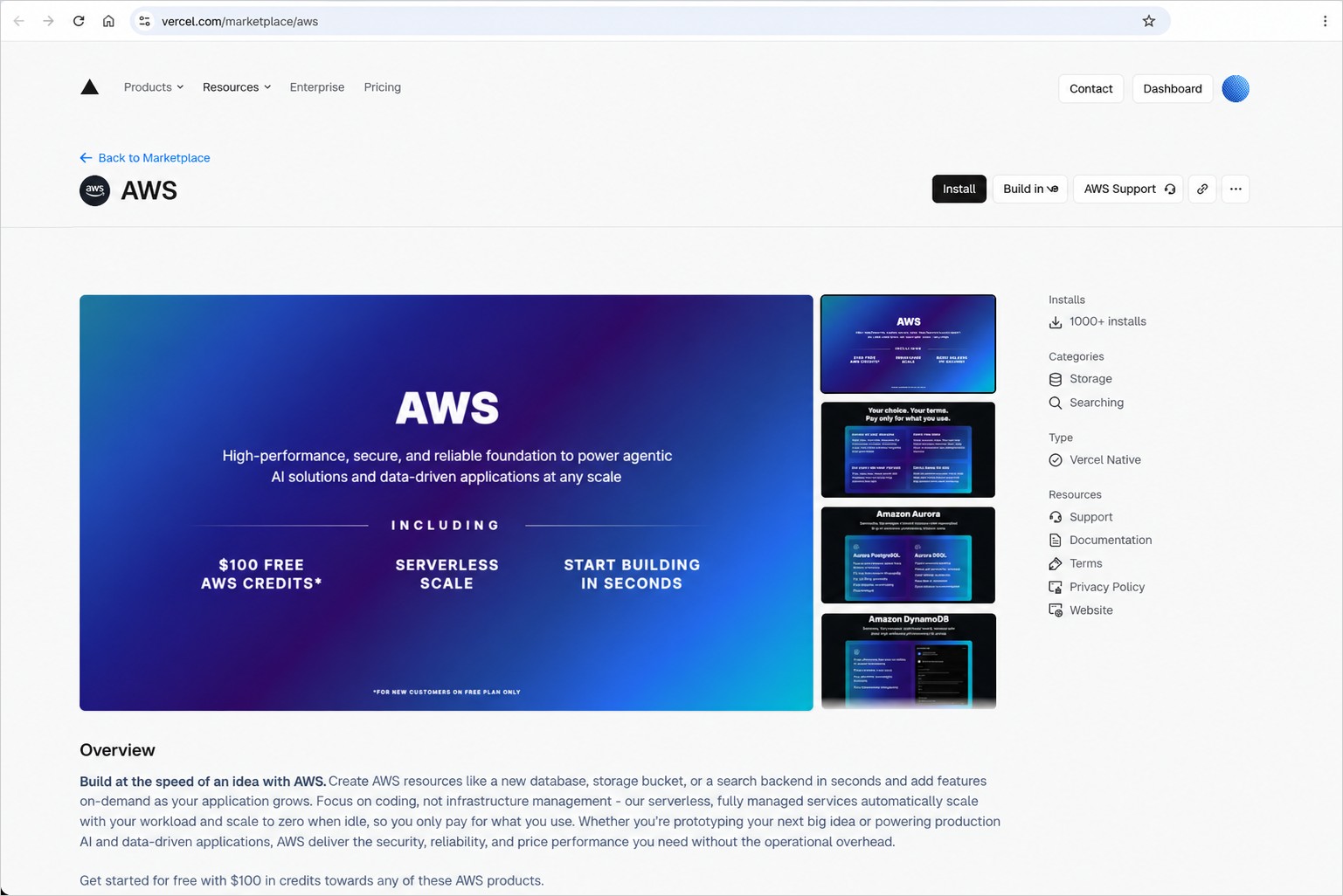
- Promotional Credits: New AWS accounts created directly through the Vercel integration are eligible for $100 in AWS credits, valid for six months.
- Global Availability: Amazon S3, S3 Tables, and S3 Vectors are available immediately via v0 and the Vercel Marketplace across all commercial AWS Regions supported by Vercel.
- Existing Accounts: Engineering teams with pre-existing AWS infrastructure can seamlessly link their accounts to utilize their existing billing structures while provisioning new S3 resources through Vercel.
To begin building today, developers can visit v0.app or navigate to the AWS section on the Vercel Marketplace. For technical troubleshooting, API exploration, and regional availability checks, developers are encouraged to utilize the AWS MCP Server and official plugins, and share feedback via the AWS re:Post for Amazon S3 community forums.