Executive Overview
The landscape of tactical first-person shooters has long been dominated by high-octane franchises prioritizing fast-paced, individualized action over historical fidelity. Yet, nestled within this crowded ecosystem, developer BlackMill Games has quietly carved out a distinct and respected niche. With the release of Gallipoli—the fourth and most ambitious installment in their celebrated World War I series—the studio has delivered its finest project to date. Stepping away from the over-examined mud and barbed wire of the Western Front, Gallipoli thrusts players into the brutal, sun-baked crucibles of the Middle Eastern theater, capturing both the harrowing historical tragedy of the 1915 campaign and a masterclass in cooperative squad-based gameplay.
Merging meticulous historical authenticity with visceral, modern gameplay mechanics, Gallipoli establishes a new high-water mark for the franchise. It avoids the arcade-like tropes of titles such as Call of Duty or Battlefield, choosing instead to honor the horrifying reality of an era where military technology catastrophically outpaced tactical doctrine. Featuring breathtaking environments, innovative new class systems, and a remarkably dedicated community, Gallipoli proves that historical realism and deeply engaging multiplayer design are not mutually exclusive.
Detailed Chronology & Campaign Context
To fully appreciate Gallipoli, one must examine the geographic and historical blind spots it seeks to illuminate. Set entirely within the Middle Eastern theater of World War I, the game focuses on the historic clash between the ailing Ottoman Empire and the sprawling might of the British Empire. For many Western players, particularly those educated in the United States, the Middle Eastern front remains a footnote—if mentioned at all—overshadowed by the mechanized slaughter of the Somme or Verdun.
Conversely, for nations like Australia and New Zealand, the Gallipoli campaign holds a profound, foundational place in national consciousness, its anniversary often superseding traditional remembrance days in cultural significance. BlackMill Games has capitalized on this underexposed historical window, designing maps like the iconic Anzac Cove and V Beach not just as battlegrounds, but as interactive historical monuments.
The Assault on Anzac Cove
The match experience on maps like Anzac Cove immediately establishes the tone. Eschewing the diesel-powered, ramp-dropping landing craft popularized by World War II media, attacking British Empire forces are crammed into painfully slow, exposed double-ender rowboats. Players are forced to scramble out of fragile wooden hulls under a relentless torrent of enemy machine-gun fire.
This archaic method of amphibious assault underscores one of the game’s core thematic triumphs: the terrifying schism between early-20th-century technology and the primitive strategies used to deploy it. At the outbreak of the war, military uniforms were still tailored more for parade grounds than modern combat, and armies were forced to figure out how to survive mechanized slaughter in real time. The prevailing answer to devastating casualties was straightforward, callous, and grim: throw more men into the meat grinder. Gallipoli captures this tragic dynamic with unblinking clarity.
Supporting Context, Mechanics, & Gameplay Metrics
While historical context provides the soul of Gallipoli, its mechanical depth delivers the adrenaline. BlackMill Games has introduced several groundbreaking systems that fundamentally alter how players approach team-based shooters, most notably the implementation of a comprehensive suppression and panic mechanism.
The Fog of War: Suppression and Panic
The machine gun represents a pivotal technological shift in World War I, yet armies initially lacked a doctrinal framework for its battlefield scale. Gallipoli replicates this psychological and tactical terror brilliantly. The game features two distinct machine gunner classes: the light machine gunner and the newly introduced heavy machine gunner.
When pinned down by sustained enemy fire—whether from a heavy emplacement or a standard-issue rifle—players do not merely take damage; their characters experience authentic panic. Vision blurs, and maintaining a steady aim down the sights becomes virtually impossible. This mechanic transforms missed shots into valuable tactical assets. Suppressive fire actively breaks enemy lines by degrading the psychological fortitude of opposing players, forcing them to scramble for cover or lose their faculties entirely.
Furthermore, environmental elements like dust clouds kicked up by artillery barrages or mortar strikes drastically alter the fog of war. These cinematic plumes obscure objectives and targets alike, creating genuine friction in team communication. Teammates can easily mistake one another for enemies in the blinding haze, and the inclusion of unavoidable friendly fire—ranging from errant bayonet thrusts in tight trenches to catastrophic miscalculated officer artillery strikes—ensures that every action carries genuine weight.
Class Roles and Realism
Class composition in Gallipoli is tightly restricted to enforce tactical discipline. Aside from basic Rifleman and Engineer roles, all specialized classes feature strict caps per team, preventing the lobby-wide sniper spam common in arcade shooters.
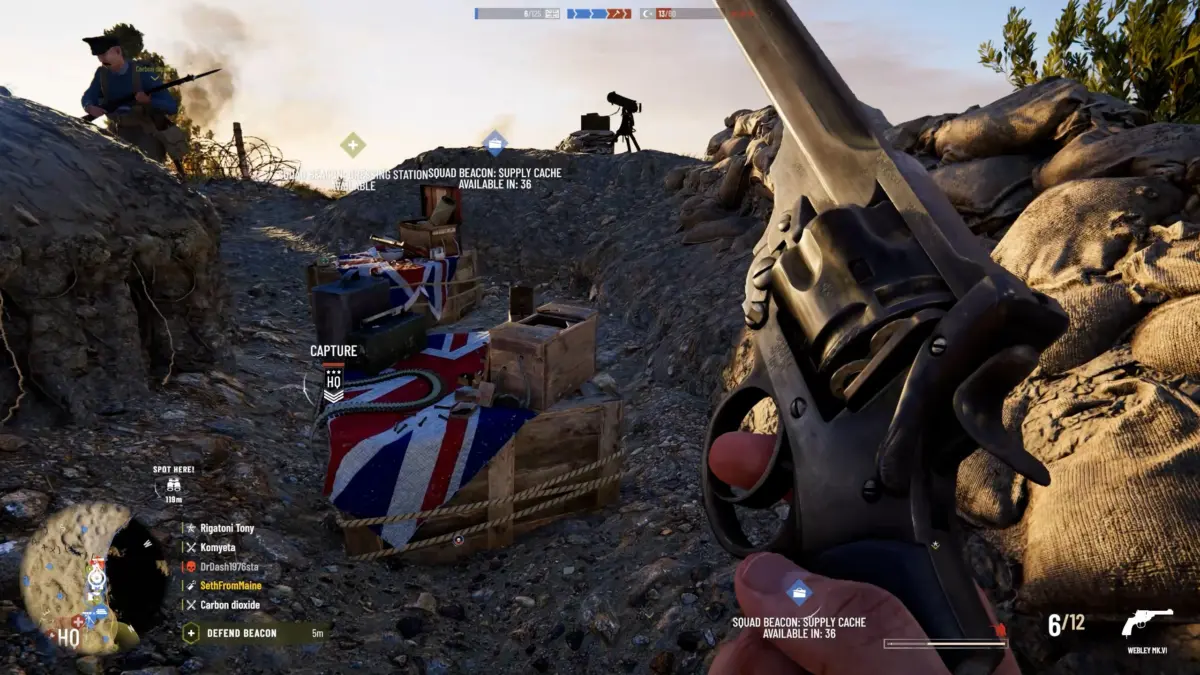
- Stretcher Bearer: Serving as the battlefield medic, this class is vital for sustained pushes. Players can construct forward medical stations and risk their lives to heal and revive fallen squadmates within the claustrophobic confines of trench networks.
- Heavy & Light Machine Gunners: Heavy gunners establish stationary embankments to lock down choke points and secure advances. Light machine gunners carry their weapons into the fray, though attempting to "run and gun" or hip-fire results in wild, inaccurate recoil that exposes the shooter as an easy target. Success requires going prone and providing steady covering fire.
- Ammo Bearer: A crucial support role focused on keeping squads supplied, either by dropping crates or directly handing fresh magazines to desperate teammates under fire.
- The Bomber: Armed with grenades and improvised explosive devices fashioned from metal food tins (featuring fictional brands uniquely crafted by BlackMill Games), the bomber excels during aggressive offensives, though landing effective throws requires precise coordination and line-of-sight awareness.
- The Sniper: Limited strictly to one per team, the sniper rewards patience, positioning, and precise engagement over fast-paced, quick-scoping maneuvers.
Weapon lethality is similarly grounded in reality. Rifles and pistols lose effectiveness over distance, and short-barreled officer pistols kick wildly, making long-range engagements nearly impossible.
Official Statements & Community Sentiment
Perhaps the most remarkable element of Gallipoli’s success is its player base. Multiplayer shooters often struggle with toxic communities or lobbies dominated by individuals chasing personal Kill/Death ratios at the expense of team objectives. However, Gallipoli has naturally cultivated a mature, cooperative player ecosystem.
Industry observers and early players have praised the title’s welcoming yet serious atmosphere. Unlike fiercely competitive titles where uncoordinated players are ruthlessly berated and driven away, Gallipoli strikes a delicate balance. The community overwhelmingly understands that victory requires adherence to squad roles, communication, and mutual support.
"When everyone locks in, listens to one another, sticks to their role, and makes smart decisions, Gallipoli is a sublime experience," early reviews note. The absence of intimidating, toxic gatekeeping allows newcomers to seamlessly integrate into squads, follow objective markers, and participate meaningfully without fearing immediate ostracization from veteran players.
Future Outlook
As Gallipoli establishes its footing in the competitive multiplayer space, its long-term viability looks remarkably secure. By successfully expanding the franchise beyond the Western Front, BlackMill Games has proven that historical tactical shooters have an enthusiastic, underserved audience hungry for depth, authenticity, and mature gameplay design.
The game’s reliance on environmental storytelling—from loading screen historical snippets that inspire players to research the actual Gallipoli campaign to the visceral, chaotic realism of trench warfare—signals a promising blueprint for future historical front expansions. If BlackMill Games maintains its commitment to historical accuracy, rigorous team mechanics, and community cultivation, Gallipoli will not only remain the crown jewel of their WW1 series but will also serve as a benchmark for how tactical shooters should handle lesser-known historical narratives for years to come.