Executive Overview
In the modern landscape of cloud-native application development, enterprise platform teams are under continuous pressure to balance velocity with security and governance. Managing containerized applications at scale on Amazon Elastic Container Service (Amazon ECS) has historically unlocked unprecedented flexibility, but it has also introduced a persistent operational friction point: ingress networking configuration. For every new microservice or containerized workload deployed into a production environment, engineering teams have traditionally been forced to manually provision, wire, and maintain a complex web of supporting infrastructure.
This boilerplate setup typically encompasses Application Load Balancers (ALBs), AWS Certificate Manager (ACM) SSL/TLS certificates, AWS WAF web access control lists (ACLs), and intricate security group rule sets. Furthermore, as services scale, undergo rolling updates, or sunset altogether, keeping these disparate networking resources synchronized presents a monumental administrative burden. This per-service overhead not only throttles deployment velocity—often turning what should be a minutes-long CI/CD pipeline into a multi-day review process—but also dramatically elevates the systemic risk of configuration drift, orphaned resources, and critical security gaps across the organization.
To fundamentally resolve this architectural bottleneck, Amazon Web Services (AWS) has announced the official launch of Amazon ECS Gateway, a powerful new account-level resource designed to completely revolutionize how organizations handle ingress networking for containerized workloads. By shifting the paradigm from per-service manual provisioning to automated, dynamic lifecycle management, ECS Gateway enables platform teams to establish centralized networking guardrails while empowering application developers to spin up production-ready endpoints instantly.
Operating directly within the customer’s AWS account, the new service introduces a clean separation of responsibilities, supports up to 25 services per ALB for optimized cost efficiency, and orchestrates everything from DNS name generation to TLS certification behind the scenes. Available today across all commercial AWS Regions where ECS operates at no additional software charge, ECS Gateway represents a watershed moment for enterprise container orchestration.
Detailed Chronology: The Evolution of ECS Ingress and the Birth of ECS Gateway
The Historical Burden of Container Ingress
To understand the profound impact of Amazon ECS Gateway, one must examine how container networking has evolved over the past decade. When AWS first introduced Amazon ECS, it provided a robust, highly scalable scheduler for Docker containers. However, connecting those containers to the outside world required architects to map task ports directly to host ports or couple services tightly with traditional Elastic Load Balancing (ELB) constructs.

As microservices architectures grew from a handful of monolithic components to hundreds or thousands of distributed services, the networking overhead scaled exponentially. Platform engineers found themselves trapped in a repetitive, error-prone cycle:
- Provisioning Load Balancers: Creating a dedicated ALB for every service quickly became economically unviable and management-heavy, while forcing multiple services onto a shared ALB required intricate target group routing, path-based matching, and manual listener rule updates.
- Managing Certificates & Security: Securing incoming traffic meant generating and validating ACM certificates for every unique domain or subdomain, binding them to ALB listeners, and crafting tight security groups to ensure that backend tasks only accepted traffic originating from trusted load balancer interfaces.
- Tracking Configuration Drift: As services scaled horizontally, deployment targets shifted, and teams altered routing policies, documentation frequently fell out of sync with reality, leading to security vulnerabilities and difficult-to-diagnose networking failures.
The Engineering Breakthrough
Recognizing that these operational overheads were dampening the agility that containers were meant to provide, AWS engineering teams set out to rethink ingress from the ground up. The goal was to abstract the mechanical toil of networking configuration without sacrificing the deep security, compliance, and customizability that enterprise customers demand.
The result of this initiative is Amazon ECS Gateway. Rather than treating ingress as an afterthought bolted onto individual service definitions, ECS Gateway treats ingress as an intelligent, managed fabric spanning clusters and accounts. By introducing a new abstraction layer—the Gateway resource—AWS has automated the complex choreography required to bring a containerized service from code commit to public or internal accessibility.
[ Application Service ]
         │ (Gateway Connector)
         ▼
[ Amazon ECS Cluster ]
         │ (Many-to-Many Association)
         ▼
[ Amazon ECS Gateway ] ──> Dynamic Provisioning ──> [ ALBs, ACM Certificates, DNS, WAF ]
From Architecture to API: Setting Up the Gateway
The modern implementation of ECS Gateway is designed for seamless integration into existing Infrastructure-as-Code (IaC) workflows, AWS CLI automation, and the AWS Management Console.
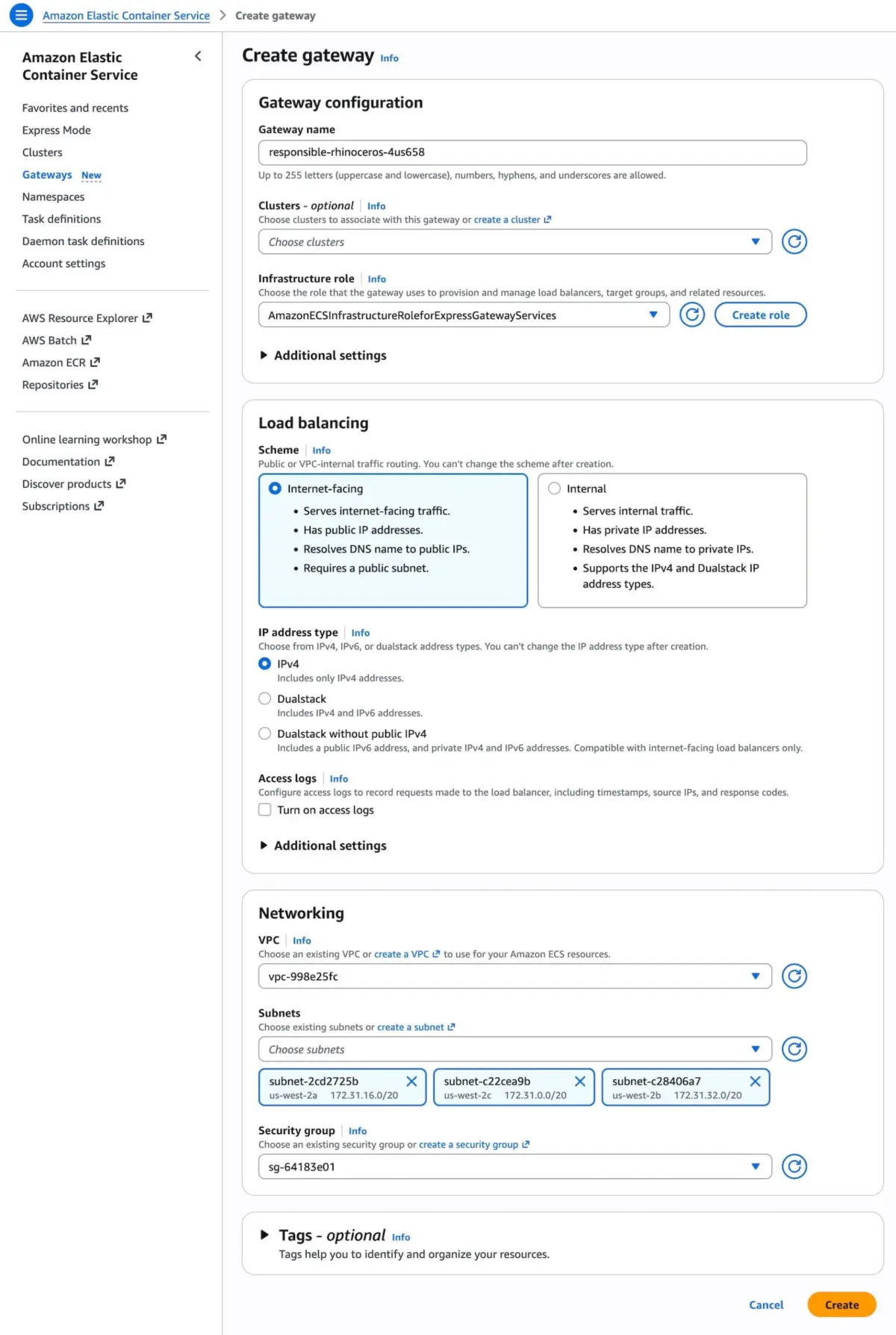
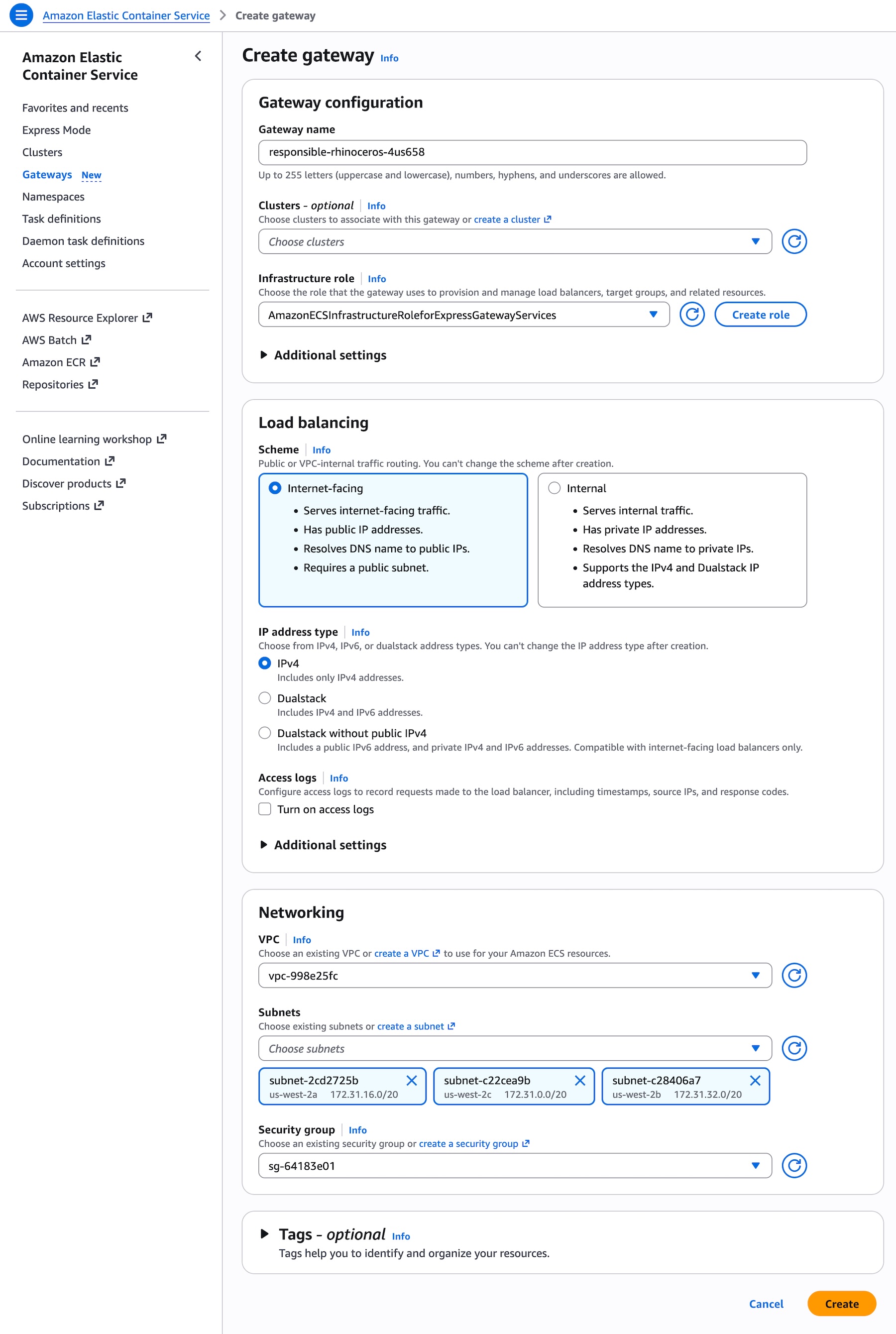
Platform teams begin by defining a gateway at the account level. Using the AWS Command Line Interface (CLI), an administrator invokes the CreateGateway API, passing a unique name, an IAM infrastructure role, and a comprehensive configuration object specifying network parameters such as VPC subnets and traffic schemes (internet-facing or internal VPC routing):

aws ecs create-gateway
  --name my-team-gateway
  --infrastructure-role-arn arn:aws:iam::123456789012:role/ECSGatewayRole
  --configuration '
    "HostSharedAlb":
      "networkConfiguration":
        "subnets": [
          "subnet-080779f9bd887757a",
          "subnet-03d5b2fead6bc6258",
          "subnet-0861210a397d31252",
          "subnet-06539e194023cb77a"
        ],
        "ipAddressType": "ipv4"
      ,
      "scheme": "internet-facing"

  '
Crucially, no underlying infrastructure is provisioned at the moment the gateway is created. This lazy-allocation architecture ensures that resource consumption remains zero until an actual application service connects via a gateway connector.
Once the gateway is active, platform teams establish a many-to-many relationship by associating the gateway with one or more ECS clusters using the AssociateGatewayWithCluster command:
aws ecs associate-gateway-with-cluster
  --gateway my-team-gateway
  --cluster arn:aws:ecs:us-east-1:123456789012:cluster/my-cluster
A single gateway can be associated with up to 10,000 distinct clusters, while an individual cluster can support up to five distinct gateway associations. This flexibility allows organizations to enforce multi-tenancy, partition environments (e.g., separating public-facing internet traffic from internal service-mesh traffic), and maintain strict organizational boundaries.
Supporting Context & Metrics: Cost Optimization and Operational Efficiency
Density and Cost Optimization through Host-Based Routing
One of the most compelling economic benefits of Amazon ECS Gateway is its intelligent handling of Application Load Balancer capacity. Historically, platform teams faced a difficult compromise: provision a dedicated ALB per service (resulting in prohibitively high fixed infrastructure costs, especially for smaller or low-traffic microservices) or manually share an ALB using complex path- or host-header routing rules that required constant maintenance.
ECS Gateway solves this dilemma natively through host-based routing. The service allows up to 25 distinct microservices to share a single Application Load Balancer. Amazon ECS automatically manages the full lifecycle of the underlying infrastructure:
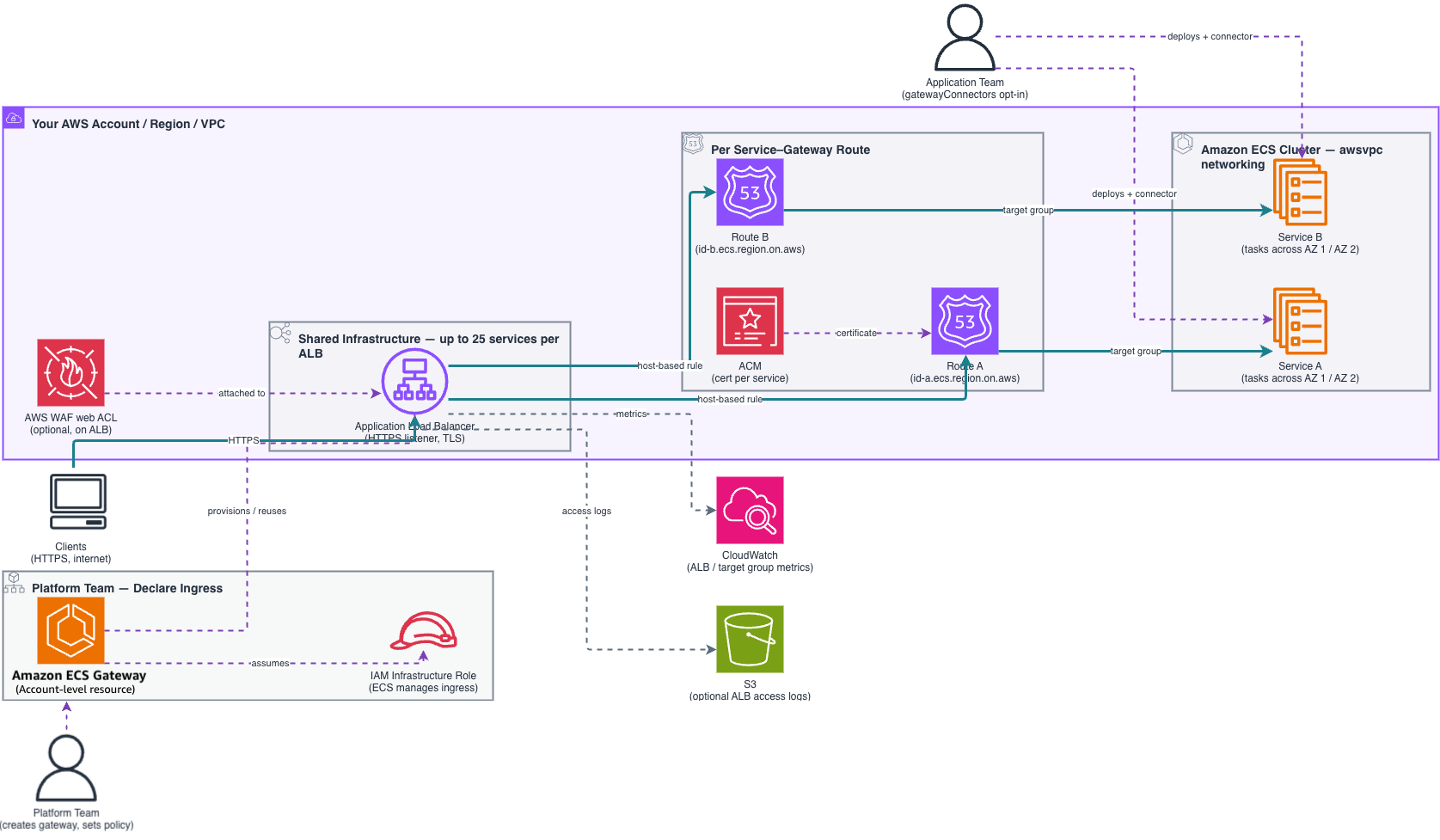
- When the first service connects to a gateway, ECS provisions the initial ALB.
- As additional services attach and approach the density limits of that load balancer, ECS automatically provisions subsequent ALBs to absorb the capacity.
- When services are decommissioned and load decreases, ECS safely scales down and removes idle ALBs, ensuring that organizations never pay for unutilized infrastructure.
Incremental Adoption and Backward Compatibility
Enterprise migrations are notoriously complex, and "rip-and-replace" strategies often introduce unacceptable business risk. Recognizing this operational reality, AWS designed ECS Gateway to support incremental adoption.
If an organization already operates existing ECS services equipped with their own manually configured load balancers, engineers do not need to execute a risky, all-at-once cutover. Instead, teams can call the UpdateService API to append a gateway connector to an existing service definition:
aws ecs create-service
  --cluster my-cluster
  --service my-api-service
  --task-definition my-api-service:1
  --gateway-connectors '[ "portName": "api", "filters": "accessTypes": ["PUBLIC"], "healthCheck": ... ]'
By maintaining both ingress paths simultaneously, development teams can rigorously validate the new ECS Gateway connection, verify DNS resolution, test TLS handshakes, and confirm security posture before deprecating and removing the legacy load balancer configuration.
Behind the Scenes: Automated Orchestration
When an application team deploys a service with a gateway connector, Amazon ECS executes a sophisticated orchestration sequence:
- Compatibility Evaluation: ECS evaluates all gateways associated with the cluster, matching the service’s connector filters against gateway access types, verifying VPC alignment, and confirming that the gateway covers all Availability Zones specified in the service’s subnets.
- Resource Provisioning: For each valid connection, ECS automatically provisions the necessary per-service artifacts: an ACM certificate for secure transport, a unique DNS hostname providing an instant production-ready endpoint, a listener rule that precisely directs traffic for that hostname to the correct service target group, and a dedicated security group allowing ingress exclusively from the ALB.
- Status Transition: Once all underlying components reach a healthy state, the gateway route transitions to an
ACTIVEstatus, and the service URL immediately begins routing production traffic.
Official Statements and Industry Perspective
The release of Amazon ECS Gateway addresses long-standing pain points articulated by cloud architects and DevOps leaders across the global AWS community.
"For years, our platform engineering teams spent an inordinate amount of time writing and maintaining automation scripts just to wire up basic load balancing and certificate management for new ECS services," noted a leading cloud infrastructure architect at a major enterprise fintech firm. "Amazon ECS Gateway fundamentally changes the equation. By abstracting the boilerplate networking infrastructure into a managed, account-level resource, it bridges the gap between developer velocity and platform governance, allowing us to enforce security standards without acting as a bottleneck to software delivery."
AWS product leadership emphasizes that ECS Gateway is part of a broader corporate commitment to reducing undifferentiated heavy lifting in containerized environments. By integrating native support for advanced tools—including the ability to manage gateways programmatically via the AWS MCP Server and associated plugins within modern AI coding assistants—AWS is positioning ECS Gateway as a foundational pillar for next-generation, AI-augmented cloud operations.
Security and compliance officers have also welcomed the granular controls enabled by the service. By pairing ECS Gateway’s infrastructure roles with rigorous IAM policies and AWS WAF web ACL integration, organizations can guarantee that every microservice deployed across up to 10,000 clusters adheres to corporate perimeter defense standards from the exact second of its creation.
Future Outlook: The Next Era of Container Networking
As container architectures continue to grow in scale and complexity, the boundary between application code and underlying infrastructure will continue to blur. The introduction of Amazon ECS Gateway signals a decisive shift toward intent-based cloud networking, where developers declare what traffic needs to be routed and secured, and intelligent control planes handle how those resources are provisioned, scaled, and maintained.
Looking ahead, industry analysts predict that features pioneered by ECS Gateway—such as dynamic multi-tenant load balancer sharing, automated certificate lifecycle management, and frictionless incremental adoption paths—will become baseline expectations for enterprise container orchestration platforms. For organizations standardizing on Amazon ECS, this release eliminates one of the most persistent hurdles in distributed systems management, freeing engineering talent to focus on writing business logic rather than debugging networking plumbing.
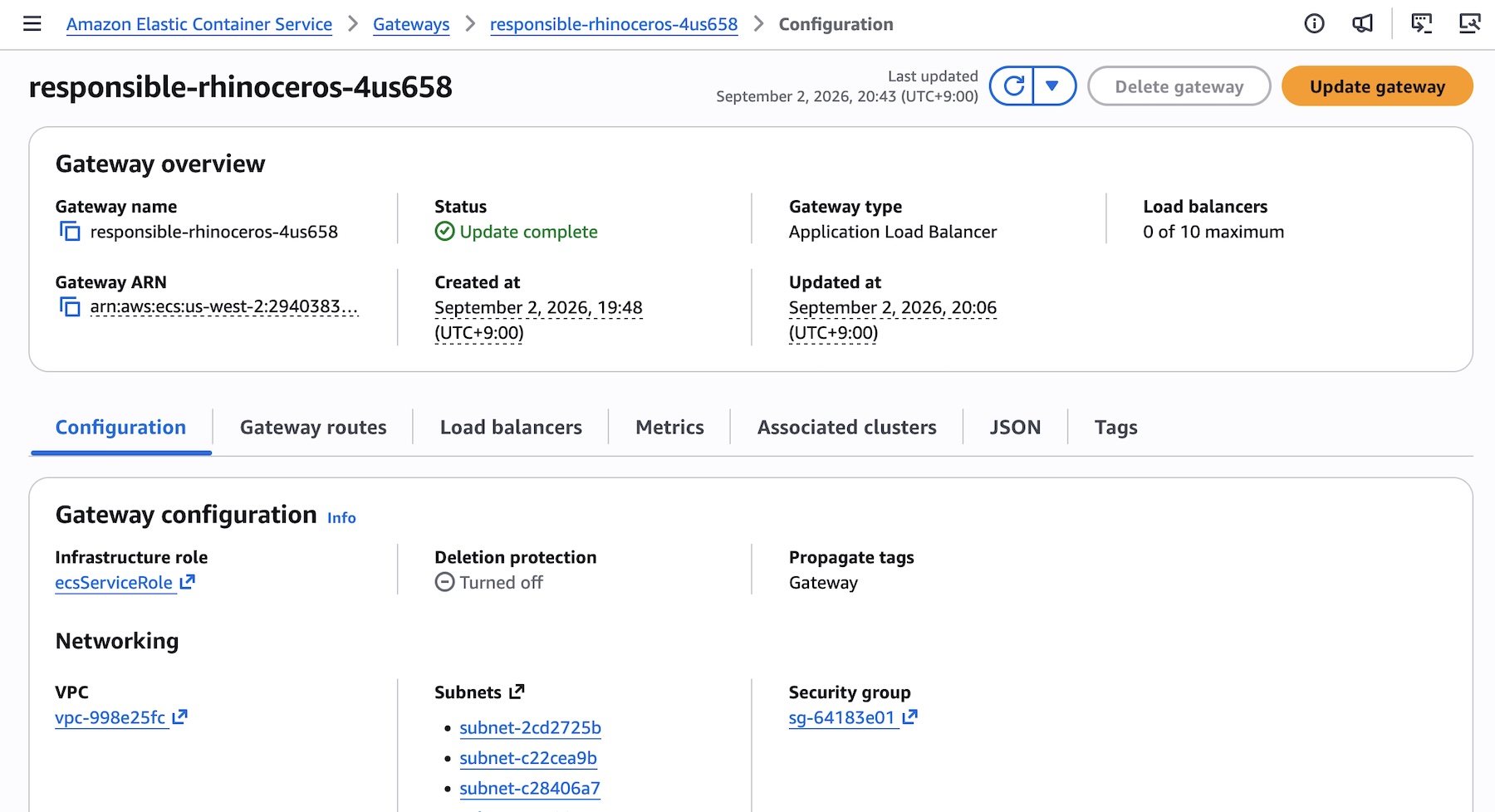
Amazon ECS Gateway is available today across all commercial AWS Regions at no additional software charge. Enterprises can begin modernizing their container ingress strategies immediately by navigating to the ECS console or utilizing the AWS CLI to provision their first account-level gateways.