Executive Overview
In a major leap forward for cloud-native software development, Vercel and Amazon Web Services (AWS) have announced a strategic integration that brings Amazon Simple Storage Service (Amazon S3)—including advanced variants like S3 Tables and S3 Vectors—directly into the Vercel Marketplace and v0 by Vercel. This development bridges the gap between frontend-focused deployment pipelines and enterprise-grade backend infrastructure. Developers can now provision, configure, and manage scalable object storage, data lakes, and vector embeddings without ever leaving the Vercel ecosystem or manually navigating the AWS Management Console.
This deep integration aligns with the explosive growth of modern web architectures, where applications demand seamless coordination between fast static assets, high-performance analytical queries, and complex artificial intelligence workloads. By merging Vercel’s frictionless provisioning workflows with the unparalleled durability and security of AWS, teams can now deploy complete, production-ready application stacks—encompassing everything from serverless database layers to vector and tabular storage—under a unified architecture and billing framework.
Detailed Chronology: How the Integration Came to Life
The path to native Amazon S3 integration on Vercel is the result of a multi-year evolution in serverless computing, developer experience (DX), and the rising dominance of AI-driven applications.
The Pre-Integration Era: Fragmented Workflows
Historically, developers building full-stack applications on Vercel enjoyed rapid deployment cycles for frontend frameworks like Next.js, alongside serverless functions. However, introducing robust backend data and storage layers often introduced friction. To hook up an S3 bucket, a developer had to:
- Log into the AWS Management Console.
- Manually configure Identity and Access Management (IAM) policies, roles, and security credentials.
- Generate static access keys and manually copy-paste them into Vercel’s environment variable dashboard.
- Continuously manage credential rotation and security overhead to prevent data leaks.
While Vercel previously introduced native integrations for databases like Amazon Aurora, Amazon DynamoDB, and Amazon OpenSearch Serverless, a foundational piece of the puzzle—object storage—still required out-of-band management.
The Foundation: Expanding AWS Services on Vercel
Over the past year, Vercel and AWS steadily laid the groundwork for deeper infrastructural alignment. The introduction of serverless databases on the Vercel Marketplace proved that developers wanted a unified billing and account model. They wanted the ability to leverage their existing AWS investments while benefiting from Vercel’s lightning-fast edge network and deployment automation.
The Milestone Launch: S3, Tables, and Vectors on Vercel
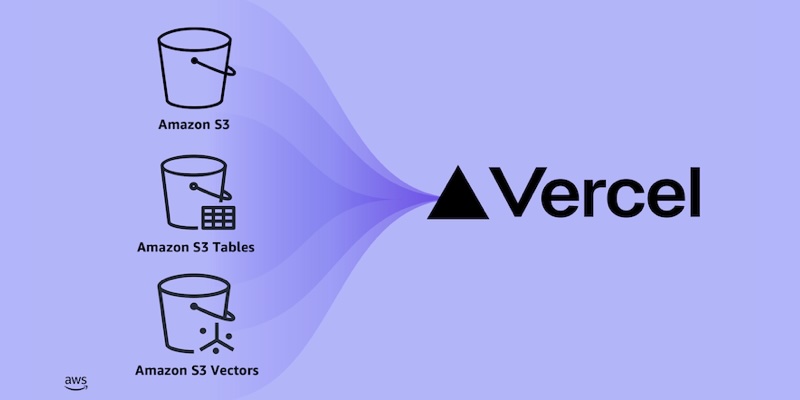
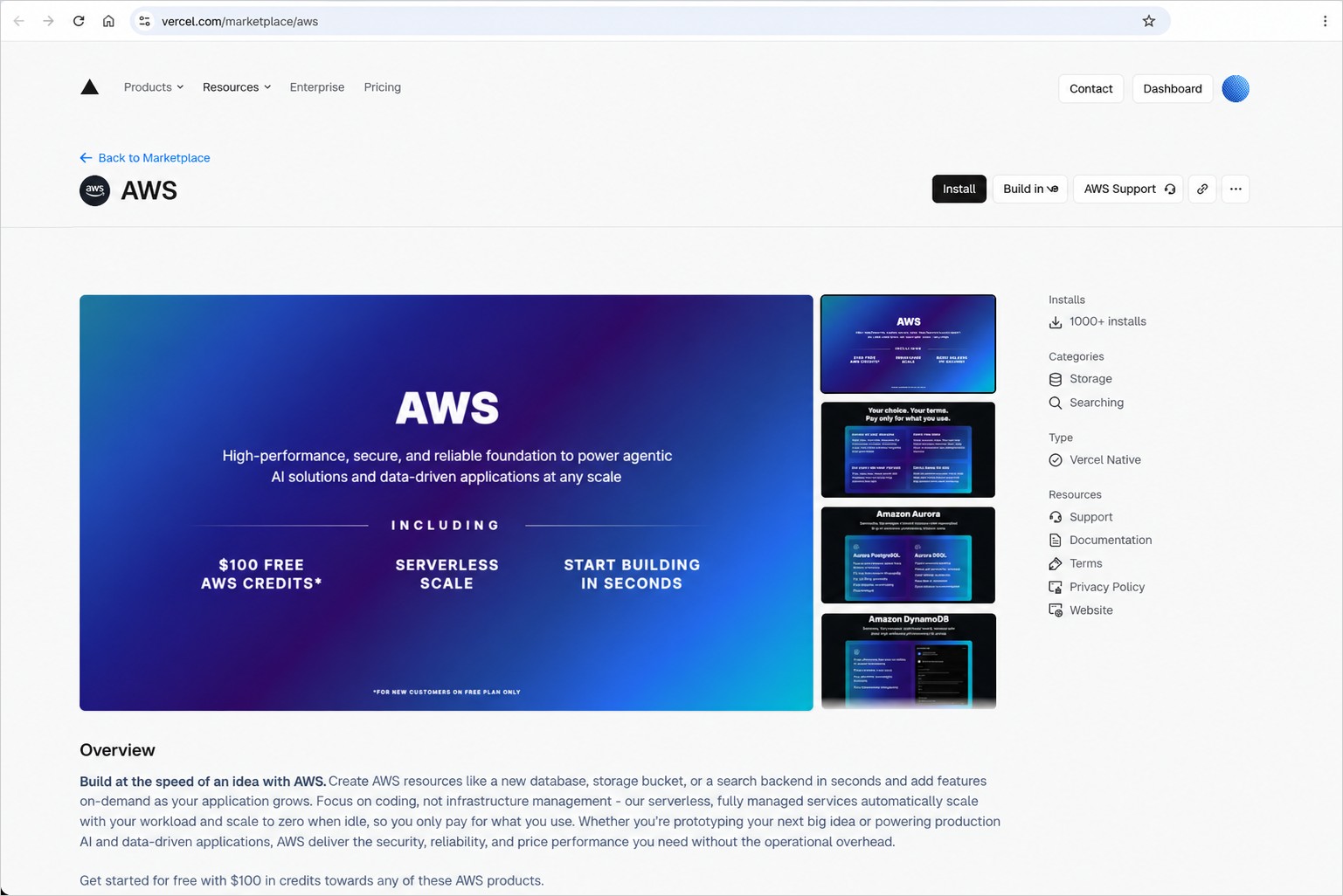
The current rollout changes the paradigm entirely. Amazon S3 is now natively available on both the Vercel Marketplace and v0, categorized into three distinct operational workloads:
- Everyday Object Storage: Traditional S3 buckets for file uploads, media hosting, and general assets.
- Analytics Workloads: Amazon S3 Tables, purpose-built for data lakes and optimized query performance.
- AI Workloads: Amazon S3 Vectors, designed for semantic search, retrieval-augmented generation (RAG), and AI agent memory.
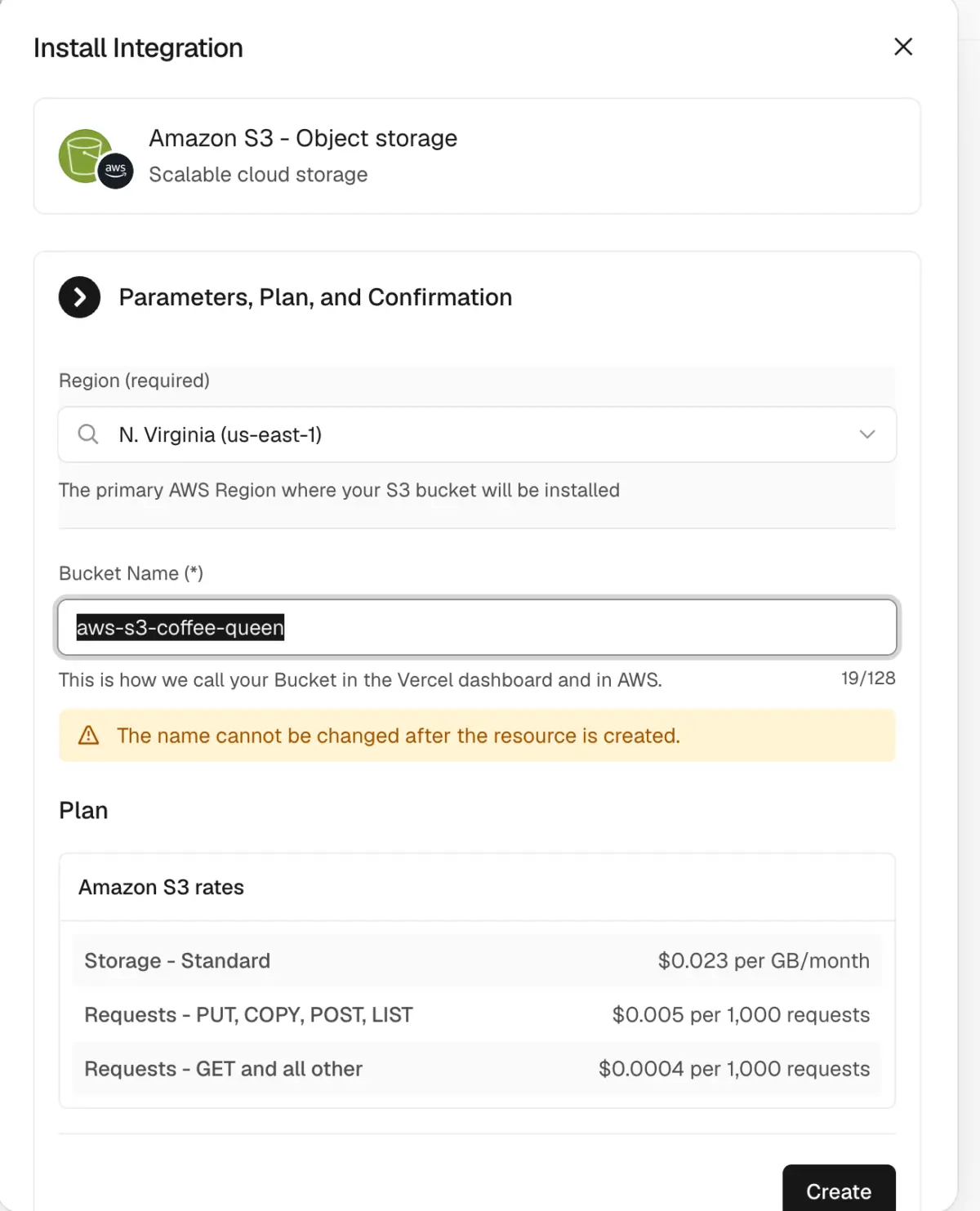
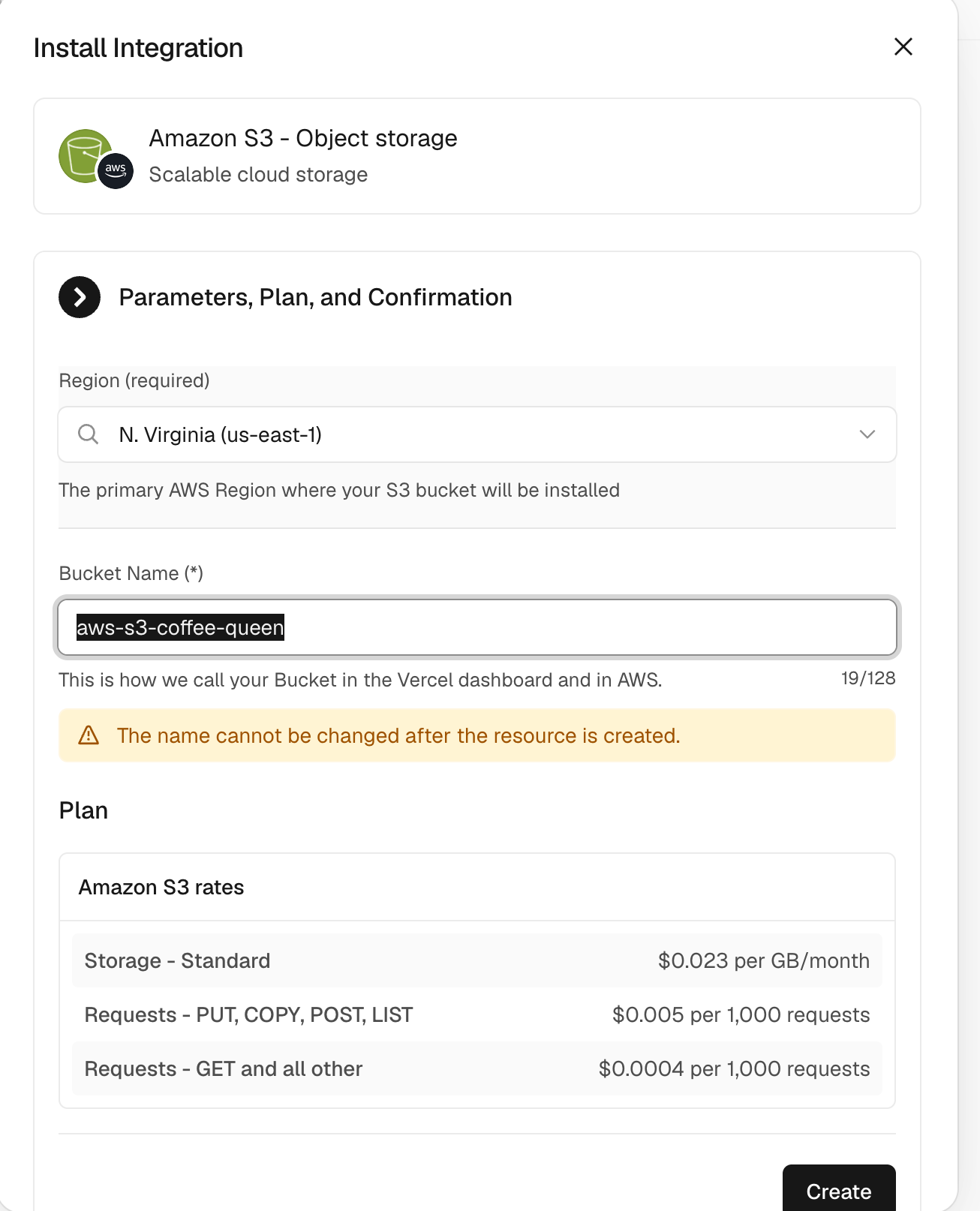
Provisioning has been reduced to a matter of seconds. Developers can navigate to the Storage tab in the Vercel dashboard, click Create, select AWS, define their bucket type and region, and instantly link the resource to their projects.
Supporting Context & Metrics: Security, Architecture, and Code Integration
Beyond sheer convenience, the technical underpinnings of this integration prioritize enterprise-grade security and modern runtime performance.

Secure-by-Design Authentication via OIDC
A standout architectural feature of the Vercel-AWS S3 integration is the complete elimination of static access keys. When a developer links an S3 bucket to a Vercel project, the integration injects crucial environment variables—such as AWS_REGION, AWS_ROLE_ARN, AWS_RESOURCE_ARN, and bucket identifiers—into the application.
At runtime, the awsCredentialsProvider utility from @vercel/functions/oidc dynamically exchanges a short-lived OpenID Connect (OIDC) token with the AWS Security Token Service (AWS STS). This generates temporary, highly scoped credentials on the fly. Because no long-lived static keys are stored in environment variables, the attack surface for credential theft is radically minimized.
Practical Implementations Across Workloads
1. Object Storage in Next.js
Handling file uploads no longer requires complex intermediary microservices. Using the standard AWS SDK alongside Vercel’s OIDC provider, developers can securely process files directly within serverless Next.js API routes:
import  S3Client, PutObjectCommand  from "@aws-sdk/client-s3";
import  awsCredentialsProvider  from "@vercel/functions/oidc";

const s3 = new S3Client(
  region: process.env.AWS_REGION,
  credentials: awsCredentialsProvider(
    roleArn: process.env.AWS_ROLE_ARN,
  ),
);

export async function POST(request)
  const formData = await request.formData();
  const file = formData.get("file");

  await s3.send(new PutObjectCommand(
    Bucket: process.env.S3_BUCKET_NAME,
    Key: file.name,
    Body: Buffer.from(await file.arrayBuffer()),
    ContentType: file.type,
  ));

  return Response.json( success: true );
2. Analytics with S3 Tables and DuckDB
Amazon S3 Tables provide fully managed Apache Iceberg tables featuring automated maintenance and compaction. Developers can harness lightweight engines like DuckDB directly inside a Vercel Function to run complex analytical queries over massive data lakes without spinning up dedicated data warehouses:
import  DuckDBInstance  from "@duckdb/node-api";
import  awsCredentialsProvider  from "@vercel/functions/oidc";

const creds = await awsCredentialsProvider(
  roleArn: process.env.AWS_ROLE_ARN,
)();

const db = await DuckDBInstance.create();
const conn = await db.connect();

await conn.run("INSTALL aws; LOAD aws; INSTALL httpfs; LOAD httpfs; INSTALL iceberg; LOAD iceberg;");

await conn.run(`
  CREATE SECRET s3cred (
    TYPE s3,
    KEY_ID '$creds.accessKeyId',
    SECRET '$creds.secretAccessKey',
    SESSION_TOKEN '$creds.sessionToken',
    REGION '$process.env.AWS_REGION'
  );
`);

await conn.run(`
  ATTACH '$process.env.AWS_RESOURCE_ARN' AS s3tables (
    TYPE iceberg,
    ENDPOINT_TYPE s3_tables
  );
`);

const rows = await (await conn.run(`
  SELECT town_city, AVG(median_price) AS avg_price
  FROM s3tables."$process.env.S3_TABLES_NAMESPACE".town_monthly
  GROUP BY town_city
  ORDER BY avg_price DESC
  LIMIT 10
`)).getRowObjects();
3. Vector Search for AI Applications
With the rise of generative AI, managing embeddings has become a primary engineering bottleneck. S3 Vectors provides cost-optimized, native vector storage directly within S3, allowing developers to perform semantic searches without maintaining a separate standalone vector database:
import  S3VectorsClient, QueryVectorsCommand  from "@aws-sdk/client-s3vectors";
import  awsCredentialsProvider  from "@vercel/functions/oidc";

const vectors = new S3VectorsClient(
  region: process.env.AWS_REGION,
  credentials: awsCredentialsProvider(
    roleArn: process.env.AWS_ROLE_ARN,
  ),
);

export async function POST(request)
  const  embedding  = await request.json();

  const result = await vectors.send(new QueryVectorsCommand(
    vectorBucketName: process.env.S3_VECTOR_BUCKET_NAME,
    indexName: "documents",
    queryVector:  float32: embedding ,
    topK: 5,
    returnMetadata: true,
  ));

  return Response.json( matches: result.vectors );
Generative UI Prototyping with v0
Perhaps the most futuristic aspect of this release is its integration with v0 by Vercel, the company’s generative UI tool. Developers can now use natural language prompts to dictate application architecture. Asking v0 to build "a photo gallery where users upload images using AWS" automatically provisions a general-purpose S3 bucket. Requesting "a support bot that answers questions from my PDFs" spins up S3 Vectors, while "an analytics dashboard for my clickstream data" triggers the provisioning of S3 Tables—complete with fully generated, functional frontend and backend code.
Official Statements and Industry Impact
Industry observers have noted that this collaboration represents a maturation in how cloud providers view developer experience. Rather than forcing developers into monolithic, vendor-locked consoles, infrastructure giants are increasingly meeting developers where they write code—in platforms optimized for rapid iteration like Vercel.
By allowing engineering teams to either spin up brand-new AWS accounts (complete with promotional incentives such as $100 in AWS credits valid for six months) or link existing enterprise AWS accounts, Vercel has removed administrative hurdles. Organizations retain complete ownership of their data infrastructure, preserving native AWS tooling, compliance standards, and unified enterprise billing, while supercharging their product velocity.
Furthermore, the introduction of the AWS Model Context Protocol (MCP) Server and associated plugins allows developers to query APIs, search documentation, and troubleshoot regional availability directly inside AI-assisted coding environments. This creates a closed-loop ecosystem where artificial intelligence tools assist in both writing the application code and interacting with the underlying cloud documentation.
Future Outlook: The Next Generation of Cloud-Native Architecture
The convergence of Vercel’s frontend orchestration with Amazon S3’s robust storage, analytics, and vector capabilities signals a definitive shift in software engineering paradigms.
As AI agents, multimodal web applications, and real-time data analytics become baseline requirements for modern software, the barriers between application logic and infrastructure management must continue to fall. The ability to orchestrate multi-layered stacks—storing relational metadata in Amazon Aurora, unstructured assets in standard S3 buckets, analytical datasets in S3 Tables, and high-dimensional embeddings in S3 Vectors—all governed by short-lived OIDC tokens and managed via natural language prompts in v0, paints a clear picture of the future.
In this upcoming era, infrastructure will no longer be an upfront engineering hurdle to be painstakingly configured and maintained. Instead, it will be an on-demand, fluid utility summoned instantly at the point of creation, empowering developers to focus exclusively on delivering exceptional user experiences.