Executive Overview
The global technology and venture capital markets are experiencing a period of historic paradox. On one hand, generative artificial intelligence continues to shatter traditional economic velocity metrics. Startups are scaling from concept to multi-billion-dollar valuations in weeks, global decacorns are minting at a record-breaking pace, and foundational model providers are aggressively deflating inference costs. On the other hand, a quiet structural Darwinism is sweeping through the legacy software and mid-market B2B ecosystems.
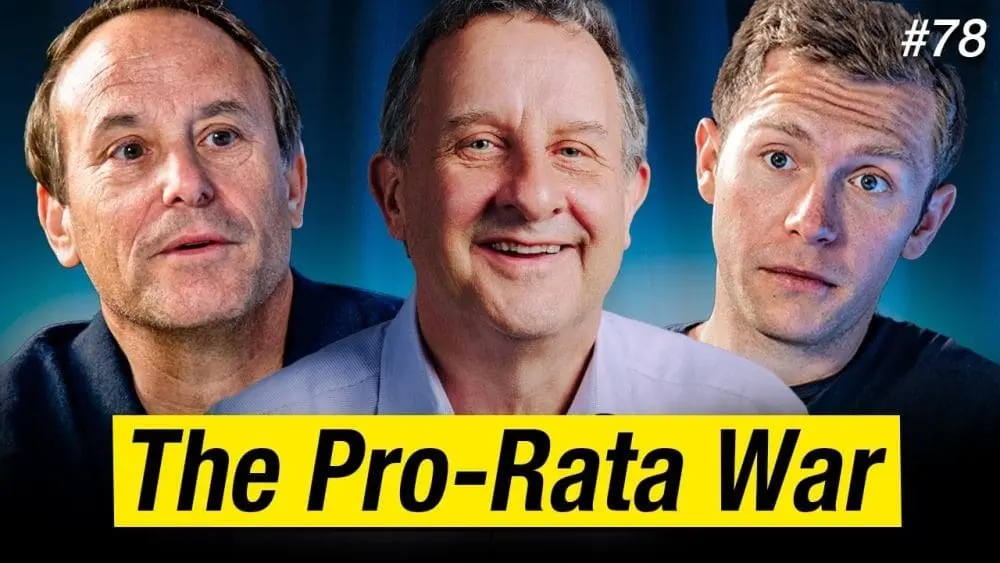
Recently, tech luminaries Harry Stebbings, Rory O’Driscoll, and Jason Lemkin convened to dissect the tectonic shifts shaking the venture and enterprise landscapes. From Valar Atomics’ high-stakes legal showdown in Delaware over pro rata rights to Meta’s re-entry into the frontier model race, NVIDIA’s strategic consolidations, and the ongoing contraction of sub-$1B enterprise software, the market is defined by a singular reality: scale is the only safe harbor. This report provides an exhaustive, investigative look into the forces rewriting the rules of modern capitalism.
Detailed Chronology of Key Market Events
1. The Valar Atomics Pro Rata Showdown in Delaware
The intersection of massive capital raises and institutional governance reached a boiling point when nuclear energy startup Valar Atomics filed for a declaratory judgment in Delaware against its earliest institutional backer, Day One Ventures.
Valar is currently closing a monumental $1 billion Series B round at an approximate $6 billion pre-money valuation, spearheaded by Sequoia Capital. According to Valar CEO Isaiah Taylor, the company requested that major legacy investors waive their allocations to bypass a complex spring-back pro rata clause. While the broader investor syndicate agreed, Day One Ventures—which contributed $1M to the seed round and $15M to the Series A, retaining a sub-5% stake—became embroiled in a structural deadlock.
Day One General Partner Masha Bucher asserted that the firm offered to forfeit the vast majority of its allocation, but claims Valar demanded a total surrender of pro rata rights across all future rounds. Rather than launching a counter-lawsuit (contrary to widespread rumors on social media platform X), Day One found itself dragged into a declaratory judgment action initiated by the startup.
- Jason Lemkin’s Analysis: "Everyone’s a little wrong. The big funds put ‘everyone waives’ in every term sheet, and letting one existing investor in as a ‘strategic’ was going to annoy Day One. But once the founder decides, you raise it once and let it go. It’s not your company and it’s not your cap table." Lemkin shared a personal anecdote of being cut down to zero in a legacy portfolio company, noting that fighting the founder permanently fractures vital relationships.
- Rory O’Driscoll’s Perspective: "Ask what you’d actually win. Day One’s 5% is already worth around $300M. They’re fighting to put maybe $10M to $15M more in at $6B. Both people can be intellectually wrong but pragmatically right."
- Harry Stebbings’ Take: The paradigm around pro rata is shifting industry-wide. Emerging venture firm Neo reportedly abandoned taking pro rata rights entirely this year, explicitly citing the Valar dispute as a cautionary tale. However, critics note that while lean micro-VCs can afford to skip follow-ons, mega-funds routinely demand seed waivers while fiercely protecting their own.
2. Meta Ships Muse Wonder: The Return to the Frontier
Meta’s Superintelligence Lab officially unveiled its long-awaited frontier closed models, Muse Wonder and Muse Wonder Full. On internal benchmarks, the models score competitively alongside Fable 5.1 and GPT-6 Astra. While the standard Muse Wonder is commercially available via API at $4 per million input tokens and $20 per million output tokens, the higher-performing "Muse Wonder Full" tier remains walled off inside the proprietary Muse Code environment.
- Industry Implications: Industry observers note that restricting the headline-tier model to internal applications turns the API offering into a performative evaluation exercise rather than an accessible builder tool. Nevertheless, the underlying Meta consumer AI application ecosystem is rapidly maturing, positioning Mark Zuckerberg’s enterprise to potentially capture massive consumer mindshare. Rory O’Driscoll summarized the financial imperative: "If we’re going to spend $100 billion, we’d better at least be able to charge for the damn thing."
3. NVIDIA Circles Reflection AI and Consolidates Infrastructure
Reports surfaced that hardware titan NVIDIA is engaged in early-stage acquisition talks—or discussions to significantly deepen its equity stake—in Reflection AI. Having already deployed $800 million into the ecosystem, NVIDIA’s maneuvers are viewed by market analysts as a potential strategic acqui-hire designed to circumvent intense global regulatory scrutiny. Reflection last raised capital at a staggering $25 billion pre-money valuation, with market chatter putting a prospective buyout figure near $30 billion.
- Strategic Dynamics: NVIDIA’s aggressive consolidation strategy—highlighted by its $12.9 billion agreement to acquire Hugging Face earlier in the autumn—signals a calculated effort to ensure that the economic gravity of the AI stack remains tied to silicon rather than proprietary software layer rent-seekers. By fostering open models, NVIDIA systematically weakens software moats that threaten its hardware dominance.
4. TypeSafe’s Meteoric $870M Series A
In what may be the fastest institutional capitalization cycle in tech history, decision-intelligence startup TypeSafe (founded by Jev Maker) closed an $870 million Series A round at a $7.5 billion valuation just 24 days after its public launch. Led by Andreessen Horowitz (a16z) alongside Sequoia Capital and DCVC, the 20-person enterprise claims that a third of the Fortune 500 utilizes its platform, which returns structured, calibrated probabilistic decisions rather than raw generative text.
- Market Skepticism vs. Utility: While critics mock the reflexive "buy every share, block the pro rata, and mark it to $15B" playbook of modern mega-funds, actual enterprise adopters report high operational utility. With frontier inference markets expanding rapidly, the bet is that automated decision-making engines will capture high-margin software workflows previously dominated by manual analysis or legacy enterprise resource planning (ERP) extensions.
Supporting Context & Metrics
The broader macro-environment is currently dictated by extreme bifurcations in liquidity, valuation paradigms, and enterprise spending habits:
- The Decacorn Surge: PitchBook data confirms a historic anomaly: 42 new decacorns have been minted globally through the first three quarters of 2026. This shatters the previous all-time record of 34 set during the liquidity delirium of 2021.
- The Isomorphic Labs Valuation Leap: DeepMind drug-discovery spinout Isomorphic Labs is reportedly commanding early acquisition or funding discussions at valuations ranging between $40 billion and $50 billion, arriving just five months after a $2.1 billion Series B led by Thrive Capital.
- Mecka’s Robotics Data Play: Capturing the downstream explosion of humanoid robotics, Mecka secured a $60M Series B from Sequoia. Operating on high-margin human telemetry data collection, the firm projected run-rate revenues exceeding $300M by year-end with a lean workforce of 40 to 60 employees.
- Anthropic’s Deflationary Pricing: Anthropic introduced Haiku 5.5, slashing input/output pricing by 90% ($0.10/$0.50 per million tokens for prompts under 100K). This introduces genuine enterprise deflationary pressure, allowing engineering teams to run continuous inference across every database row rather than relying on historical sample approximations.
- Bending Spoons’ Airtable Restructuring: Following its $1.285 billion enterprise acquisition of Airtable in August, serial acquirer Bending Spoons initiated sweeping structural layoffs. This mirrors historical playbooks applied to Evernote and Vimeo, prompting intense debates over fiduciary duties to shareholders versus employee preservation.
- Bumble Goes Private: Ithaca Holdings finalized a private buyout of dating platform Bumble for $1.3 billion ($6.05 per share), representing a 138% premium over its trading lows but standing in stark contrast to its $14 billion 2021 IPO valuation.
Official Statements & Industry Quotable Moments
The tension between hyper-growth optimism and structural realism was captured by the panel’s sharp commentary:
"You just got to get in line and move on. It’s not your company. It is not your cap table."
— Jason Lemkin, Founder of SaaStr, on navigating venture investor allocations."Either this is the most economically transformative event since the Industrial Revolution, or we’re getting a wee bit ahead of ourselves."
— Rory O’Driscoll, Partner at Scale Venture Partners, evaluating the 42 new decacorns minted in 2026."Everyone without massive scale is living a worse apocalypse than in March or April, because no one wants to buy software. Everyone’s breathing a sigh of relief. I don’t think we should be."
— Jason Lemkin, on the bifurcated recovery of the B2B software ecosystem."What worries me in every justification for a lot of these prices is, ‘the downside protection is that it’ll just get bought by a great acquirer.’ I just hear this every single time."
— Harry Stebbings, 20VC, highlighting the systemic reliance on mega-cap tech buyouts.
Future Outlook: The Bifurcated Software Economy
As the technology sector navigates the final stretch of 2026, the structural fault lines are clear. The narrative that "the B2B software apocalypse is over" is a statistical illusion engineered by the massive capitalization and public market dominance of firms boasting over $1 billion in Annual Recurring Revenue (ARR). For the rest of the ecosystem—mid-sized SaaS operators, sub-$500M ARR startups, and legacy applications failing to implement aggressive AI-first reconstructions—the operating environment remains deeply hostile.
Key Predictions for the Next 12 Months:
- Accelerated Consolidation: Mid-tier software firms will increasingly seek life-boat acquisitions by private equity roll-up vehicles (such as Bending Spoons) or cash-heavy enterprise giants as organic customer acquisition costs continue to rise.
- Pro Rata Legal Precedents: The Valar Atomics v. Day One Ventures litigation in Delaware will set a critical legal precedent governing founder autonomy versus legacy investor rights, likely forcing a rewrite of standard venture capital term sheets.
- The Margin Compression of Inference: As foundational model providers engage in destructive price wars (exemplified by Anthropic’s 90% Haiku cuts), application-layer software margins will expand, shifting value capture decisively toward verticalized workflow owners and proprietary data monopolies like Mecka and Isomorphic Labs.