Executive Overview
The B2B software landscape is undergoing a structural paradigm shift, moving rapidly away from the predictable, seat-based subscriptions that have anchored the software-as-a-service (SaaS) industry for the last two decades. According to comprehensive new data from G2’s 2026 AI Agents Insight Report—which surveyed 1,019 B2B decision-makers in July 2026—adoption rates for autonomous artificial intelligence systems have skyrocketed. Fully 86% of B2B software buyers report that their organizations purchased AI agent software or services within the past year, marking a sharp ascent from 69% in 2025. Furthermore, 66% of these buyers state that their agents are currently operating in limited or fully scaled production environments.
Yet, beneath this explosive growth lies a volatile commercial reality for software founders and executive leadership teams: the traditional rules of SaaS monetization are breaking down. As enterprises channel substantial capital into autonomous agents—with roughly half of companies across major industries now dedicating annual budgets exceeding $1 million specifically to AI agents—buyer expectations around pricing, value, and vendor stickiness have completely transformed.
Most critically, the report reveals that nearly every single AI agent purchase is "up for grabs" when renewal time arrives. Buyers are no longer locked into historical platform inertia. Armed with new expectations around value-based pricing, robust API ecosystems, and transparent operational costs, three out of four enterprise buyers are entirely open to evaluating competitors and launching rigorous pilot programs during contract renewals. For software companies, surviving the 2027 renewal cycle will require an urgent pivot away from legacy per-seat pricing models toward highly governed, metered, and outcome-oriented frameworks.
Detailed Chronology: The Evolution of Enterprise AI Adoption (2025–2027)
To understand the immense pressure facing B2B software vendors heading into 2027, it is necessary to trace how enterprise adoption and buyer sentiment have evolved over a remarkably compressed timeline.
2025: The Experimental Phase and the Per-Seat Fallback
When generative AI first broke into mainstream enterprise software architectures throughout 2024 and early 2025, the initial wave of adoption was characterized by experimentation and risk mitigation. Software buyers rushed to test the waters, resulting in a baseline adoption rate of 69% for AI-related tools.
During this initial phase, many B2B software vendors rushed to market by retrofitting existing products. They either bundled nascent AI capabilities directly into legacy per-seat pricing tiers or introduced superficial "per-seat AI SKUs." At the time, this was viewed as a pragmatic, low-friction go-to-market strategy. It allowed procurement departments to approve software purchases through familiar administrative pathways without requiring complex new budgetary approvals. However, as the G2 data illustrates, this convenience was merely a temporary band-aid on a fundamentally broken economic model.
Early 2026: Scaling Production and Budget Expansion
By the first half of 2026, enterprise engagement with AI shifted decisively from proof-of-concept sandboxes to operational reality. Adoption surged to 86%, and crucially, 66% of organizations moved beyond testing to run AI agents in active, limited, or fully scaled production workflows.
This operational integration triggered a massive influx of capital. Across five of the six major industries surveyed by G2, approximately 50% of companies reported that their dedicated annual budgets for AI agents had surpassed the milestone threshold of $1 million. Enterprises were no longer viewing AI as an experimental line item; it had transformed into a core operational expenditure. Yet, as spending scaled, cracks began to emerge in the underlying vendor relationships. Enterprises quickly realized that continuous, autonomous software agents do not map neatly onto human-centric administrative billing models.
Mid-2026 to 2027: The Renewal Confrontation
As the market approaches the 2027 contract renewal cycles, enterprise buyers are taking stock of their return on investment. The honeymoon phase of AI adoption has officially concluded. Armed with operational metrics, performance data, and a growing frustration with runaway token consumption and heavy supervisory overhead, buyers are adopting a highly aggressive posture. With 74% of organizations openly willing to replace their current agent vendors at renewal, the upcoming contract cycle represents the most turbulent competitive window the B2B software industry has faced in decades.
Supporting Context & Metrics: Dissecting the G2 2026 AI Agents Insight Report
A deep dive into the metrics compiled in G2’s landmark report reveals four fundamental pillars defining the modern enterprise buyer’s mindset regarding AI agents.
1. The Death of Per-Seat Pricing
The most striking rebuke of legacy SaaS conventions centers on monetization preferences. When asked to identify the fairest method for pricing agentic services, only 9% of B2B buyers selected per-user or per-seat pricing. Every alternative pricing model surveyed ranked higher.
This disconnect is rooted in simple operational logic: a human seat represents an individual who logs into a system periodically throughout the workday. In contrast, an AI agent runs continuously in the background, executing complex, multi-step workflows without ever logging into a traditional dashboard. Tying the cost of a tireless autonomous worker to human headcount metrics fundamentally misaligns financial value with computational output. Vendors clinging to per-seat models are officially offering the pricing structure that enterprise buyers rank dead last.
2. The Rise of Platform Builders vs. Purpose-Built Agents
Enterprise preferences regarding where and how they build and deploy agents have also undergone a dramatic shift. G2’s data highlights a widening chasm between standalone, ready-made agents and extensible platform builders:
- Agent-builder platform adoption (leveraging systems from enterprise giants like Salesforce, ServiceNow, UiPath, and Microsoft) grew from 38% to 42%.
- Ready-made, purpose-built standalone agents saw a decline in preference, dropping from 30% to 27%.
The gap between platform ecosystems and standalone applications nearly doubled year-over-year, widening from 8 points to 15 points. Enterprises increasingly favor centralized platforms where custom agents can be orchestrated to interact across diverse enterprise tools.
Consequently, API depth, robust action libraries, and Model Context Protocol (MCP) coverage have become existential requirements for application vendors. Fully 72% of buyers state that a strong prebuilt ecosystem of connectors, actions, and skills is a must-have when selecting agent software. If a software vendor’s APIs are restricted or poorly documented, platform-orchestrated agents simply cannot access or execute workflows within the application, rendering the software obsolete in modern enterprise stacks.
3. The Shock of Variable Operating Costs and Supervisory Drag
While enterprises are eager to embrace metered and consumption-based pricing models, reality has introduced friction. 46% of agent buyers report that operating costs have significantly exceeded their initial expectations. Because agents autonomously consume tokens, execute model calls, issue backend API requests, and pull continuous data streams, corporate finance departments are frequently surprised by the unpredictability of trailing usage bills.
To embrace variable spend safely, enterprise buyers have demanded strict institutional guardrails. When ranked by priority, buyers insist on the following controls before accepting consumption-based models:
- Hard, customizable spending caps and budget limits.
- Real-time usage monitoring dashboards with predictive cost analytics.
- Automated alerting systems triggered by unusual activity spikes or infinite execution loops.
- Granular role-based access controls to restrict autonomous actions.
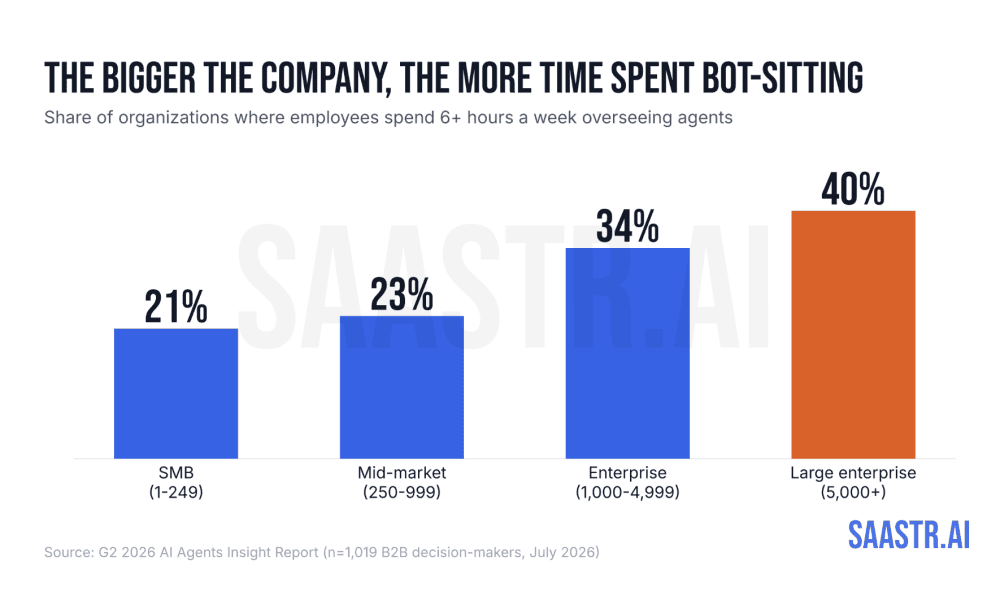
Compounding these financial surprises is the hidden cost of human supervision. 31% of organizations report that employees spend six or more hours every single week supervising and auditing AI agents—a figure that spikes to 40% within large enterprise environments. Furthermore, 45% of buyers admit that supervisory oversight and subsequent rework consume more than a quarter of the total productivity gains they originally anticipated. When an enterprise is paying per outcome while simultaneously dedicating the equivalent of a part-time human employee to monitor those outcomes, pricing negotiations at renewal become remarkably contentious.
4. Enterprise Budget Realities and Headcount Impacts
The migration toward seven-figure agent investments is reshaping corporate financial allocations. The share of companies committing over $1 million annually to AI agents has surged across nearly every major vertical:
- Financial Services: Rapidly scaling past 50% adoption of seven-figure budgets.
- Healthcare & Life Sciences: Seeing accelerated deployment due to administrative automation needs.
- Technology & SaaS: Leading the charge in total capital commitment.
- Manufacturing & Logistics: Integrating agents deeply into supply chain orchestration.
Crucially, however, this capital is not coming from automated headcount reductions. Only 14% of companies report a net reduction in headcount as a direct result of deploying AI agents. Instead, 35% note that they have redeployed existing staff to higher-value strategic initiatives, while the remainder fund agents as a brand-new operational line item layered on top of traditional software and labor costs.
As corporate CFOs inevitably begin demanding concrete net savings and efficiency metrics, software vendors armed with hard cost-per-outcome data will thrive, while legacy vendors relying on vanity usage metrics will face severe budget contractions.
Official Statements & Industry Perspective
Industry leaders and market analysts monitoring the transition emphasize that software companies must fundamentally alter their go-to-market strategies to survive the current climate. Market observers note a clear divergence in investor sentiment regarding B2B software valuations:
"I won’t invest in an agentic B2B company right now unless it unlocks budget entirely beyond the traditional software budget, and I want to see that reflected in deal sizes at least two times what pre-AI competitors command," venture capital analysts note. "A company merely taking a slice of the exact same software line item at the same price point is directly competing with legacy incumbents who are now successfully shipping their own native agents."
This perspective underscores a vital strategic truth: competing on feature parity within an existing software category is a losing battle. To command premium enterprise pricing and defend against the 74% churn risk at renewal, software vendors must position their AI capabilities as revenue-generating or cost-displacing economic engines that tap directly into executive-level capital reserves.
Future Outlook: What Software Founders Must Change Before the 2027 Renewal Cycle
As the B2B software ecosystem barrels toward the 2027 contract renewal cycle, executive leadership teams and product founders must take immediate, decisive action across four key operational pillars:
1. Abandon Per-Seat Pricing for Autonomous Offerings
Vendors must transition away from human-centric user licensing for autonomous features. Adopting consumption-based, value-oriented, or outcome-based pricing models aligns commercial terms directly with the actual computational work performed by the agent. Crucially, any metered model must be paired with transparent usage dashboards and hard budget caps to satisfy corporate procurement requirements.
2. Treat Every Renewal Like a Competitive New Logo Acquisition
With 74% of enterprise buyers willing to entertain rival pitches and pilot programs during contract renewals, account management teams can no longer treat renewals as administrative rubber stamps. Major enterprise accounts must be staffed and resourced with the same strategic intensity, executive sponsorship, and technical firepower dedicated to brand-new competitive sales cycles.
3. Open and Harden API Ecosystems for Platform Orchestration
As enterprise adoption shifts decisively toward centralized agent-builder platforms (such as those provided by Microsoft, Salesforce, and ServiceNow), software applications must be architected for interoperability. Vendors must prioritize robust API coverage, comprehensive action libraries, and Model Context Protocol (MCP) compatibility. If an application cannot be seamlessly commanded by an external enterprise orchestration layer, it risks being bypassed entirely.
4. Provide Undeniable ROI and Productivity Metrics
To protect profit margins against intense downward pressure from procurement departments—especially given that supervisory overhead consumes significant employee bandwidth—vendors must bake data-driven accountability directly into their product offerings. Software companies that can transparently demonstrate verified cost-per-outcome metrics and net productivity gains will successfully insulate themselves from churn, securing their place in enterprise budgets for years to come.