Executive Overview
The global software industry is undergoing its most profound structural transformation since the transition from on-premise infrastructure to cloud computing. At the nexus of this shift is artificial intelligence, which has lowered the barrier to entry for software creation to a point where the distinction between "coder" and "non-technical innovator" is rapidly dissolving. Generative AI models and agentic coding tools have made it possible for an unprecedented demographic—ranging from enterprise product managers to non-technical entrepreneurs—to write code, construct databases, and deploy production-grade software applications in hours rather than months.
This democratizing wave has simultaneously created immense market opportunities and intense friction. While non-technical creators leverage AI to build functional software out of raw ideas, seasoned software engineers face escalating corporate pressure to adopt AI-assisted workflows to boost output velocity. The resulting tension highlights a central debate in modern tech: Does rapid, AI-driven software assembly compromise long-term code quality, security, and maintainability, or does it represent the inevitable evolution of abstract computer science?
Sitting at the center of this movement is Replit, the online software development platform led by CEO and co-founder Amjad Masad. Once viewed primarily as a browser-based integrated development environment (IDE) for education and rapid prototyping, Replit has evolved into an AI-native development ecosystem. The company’s trajectory highlights the sheer speed of the AI software boom. Having reported a modest $2.8 million in revenue in 2024, Replit’s annual run-rate is now rapidly approaching $1 billion in 2026. This exponential growth was matched by venture capital markets when investors elevated Replit’s valuation to $9 billion—a threefold increase from its $3 billion valuation just six months prior.
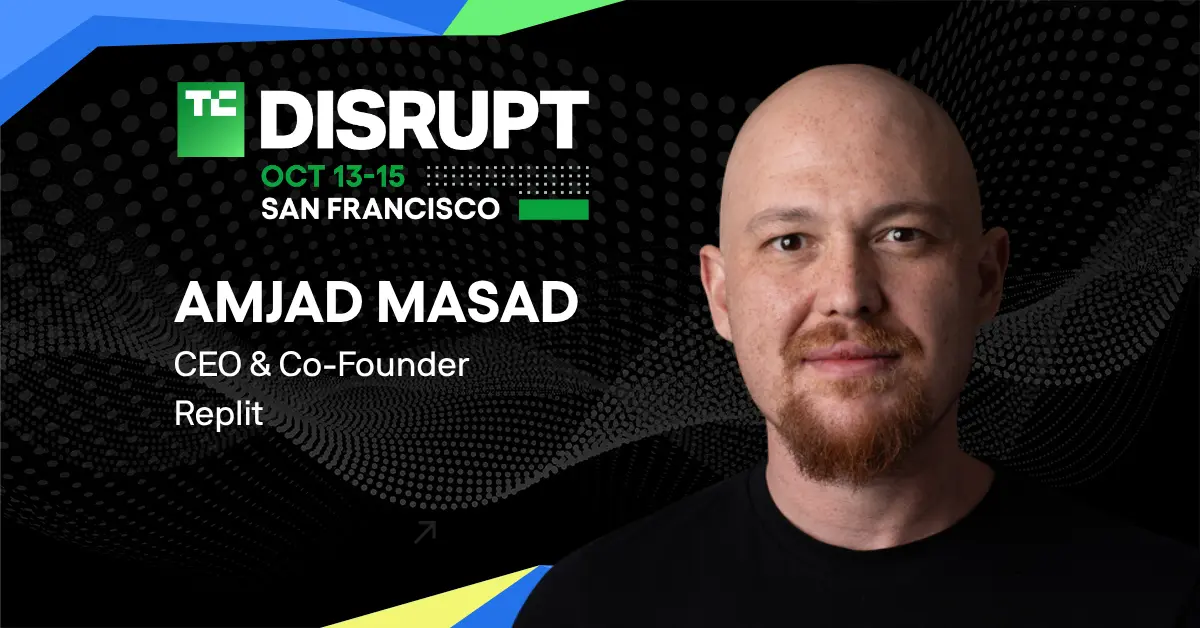
As Masad prepares to deliver a keynote address at TechCrunch Disrupt 2026 at San Francisco’s Moscone West (October 13–15), the industry is closely examining how Replit intends to navigate its next phase of growth. The central question for Replit—and the broader software ecosystem—is whether these hyper-growth trajectories can be sustained, and how the nature of technology entrepreneurship changes when software creation becomes accessible to anyone with an internet connection and a prompt.
Detailed Chronology: The Ascent of Replit and the AI Coding Ecosystem
To understand the broader implications of the current AI development landscape, it is necessary to examine the timeline of events that catapulted browser-based coding tools into billion-dollar infrastructure platforms.
+-----------------------------------------------------------------------------------+
| CHRONOLOGY OF REPLIT'S METEORIC RISE                                              |
+-----------------------------------------------------------------------------------+
| 2016            - Founded by Amjad Masad, Faris Masad, and Haya Odeh as a       |
|                   cloud-native browser IDE designed for frictionless setup.   |
|                                                                                   |
| 2016 - 2023     - Expands primarily across educational institutions and developer |
|                   sandboxes; builds a collaborative online community.             |
|                                                                                   |
| 2024            - Reports $2.8M in annual revenue; pivots heavily toward LLM    |
|                   integration and native AI code completion infrastructure.       |
|                                                                                   |
| Late 2025       - Replit achieves a $3 billion valuation on the back of early      |
|                   agentic workspace tools and expanding subscription tiers.       |
|                                                                                   |
| Early 2026      - Valuation surges to $9 billion in a private funding round,    |
|                   reflecting explosive adoption among non-technical builders.     |
|                                                                                   |
| Mid-2026        - Annual revenue run-rate approaches $1 billion; enterprise     |
|                   tier expansion begins competing with legacy local IDEs.         |
|                                                                                   |
| October 2026    - Keynote address at TechCrunch Disrupt (Moscone West, SF).       |
+-----------------------------------------------------------------------------------+
The Foundations (2016–2023)
Founded a decade ago by Amjad Masad, Faris Masad, and Haya Odeh, Replit was built on a simple premise: eliminate the tedious setup time required to configure local development environments. By shifting the entire compiler, runtime, and editor workflow into the web browser, Replit quickly became a favored tool for computer science educators, students, and hackathon participants. For nearly seven years, the platform focused on refining its cloud infrastructure, supporting dozens of programming languages natively, and fostering a collaborative developer community.
The AI Inflection Point (2024)
While Replit possessed millions of active users by 2024, its financial footprint remained modest, generating a reported $2.8 million in annual revenue. The tipping point occurred with the commercial viability of Large Language Models (LLMs) tuned specifically for code generation and repository-wide context reasoning. Recognizing that a cloud-native IDE was uniquely positioned to integrate real-time AI context without local hardware limitations, Replit pivoted its product architecture toward AI-first software synthesis.
The Valuation Surge (Late 2025 – Early 2026)
As AI coding assistants matured into fully autonomous software agents capable of reading documentation, writing tests, and fixing bugs, Replit saw user engagement and paid subscriptions explode. In late 2025, venture capital investors valued the company at $3 billion.
By early 2026, that figure had multiplied. Driven by unprecedented growth in both consumer subscriptions and early enterprise pilot programs, Replit secured fresh capital at a $9 billion valuation. The 200% jump in six months reflected a market-wide realization: AI coding tools were no longer mere autocomplete utilities; they were evolving into primary platforms for software creation.
Present Trajectory (Mid-to-Late 2026)
In 2026, Replit’s annual revenue run-rate moved toward $1 billion. This financial surge reflects broader changes in developer habits, where legacy, locally hosted IDEs face stiff competition from cloud systems built natively around agentic AI capabilities.
Supporting Context & Financial Metrics: Dissecting the Hypergrowth
The financial and operational metrics surrounding Replit illustrate the speed with which generative AI platforms are monetizing compared to historical SaaS benchmarks.
+----------------------------------------------------------------------------------+
| REPLIT FINANCIAL TRAJECTORY (2024 vs. 2026)                                      |
+----------------------------------------------------------------------------------+
| Metric                      | 2024                 | 2026 (Run-Rate / Current)   |
+-----------------------------+----------------------+-----------------------------+
| Annual Revenue / Run-Rate   | $2.8 Million         | ~$1.0 Billion               |
| Enterprise & Consumer Base  | Primarily Hobbyist   | Citizen + Enterprise Coders |
| Private Valuation           | ~$800 Million        | $9.0 Billion                |
| Primary Value Proposition   | Cloud Browser IDE    | Agentic AI Software Studio  |
+----------------------------------------------------------------------------------+
Key Factors Behind the Metric Expansion
- Monetization of Non-Technical Builders: Historically, software engineering tools were sold to a small base of trained software engineers. By enabling non-technical users ("citizen developers") to build and launch production software using natural language, Replit unlocked a much larger market.
- Cloud Infrastructure Monetization: Unlike desktop-based AI plugins that rely on third-party API keys, Replit charges for compute, deployment, hosting, and AI execution within a unified environment. This creates a multi-layered revenue stream combining SaaS subscriptions with utility-based compute usage.
- Shift in the Enterprise Developer Stack: Engineering organizations are increasingly paying premium rates for developer platforms that provide measurable developer efficiency gains. As companies push senior developers to deliver features faster, enterprise licenses for automated workflows have surged.
Industry Dynamics: Productivity vs. Technical Debt
While the growth metrics are clear, the widespread adoption of AI coding tools has triggered sharp debates within engineering circles:
- The Velocity Gain: Startups and enterprise teams report accelerated prototyping phases. Software features that previously required dedicated sprint cycles can now be stubbed out and iterated on in hours.
- The Refusal to Work Without AI: A growing segment of professional developers now actively declines roles at organizations that mandate manual coding without AI tooling. This reliance has forced corporate IT departments to reevaluate security policies and tool procurement.
- The Codebase Inflation Problem: Software architects warn that hyper-fast code generation can lead to severe code quality issues. Unchecked AI generation risks introducing security vulnerabilities, duplicate modules, and maintainability issues that require human oversight to resolve.
Official Statements & Industry Perspectives
As Replit prepares for its featured showcase at TechCrunch Disrupt 2026, executive leadership and industry analysts have framed the platform’s vision around democratizing creation while addressing the software engineering talent gap.
The Vision: Moving from Ideas to Products
Addressing the future of software creation, Replit CEO Amjad Masad has repeatedly emphasized that the ultimate goal of AI-native environments is not merely auto-completing syntax, but drastically shortening the distance between human imagination and deployment.
"The goal has always been to lower the barrier to software creation. What we are seeing now is a fundamental collapse in the friction required to build software. It’s no longer just about giving someone an environment where they can type Python or JavaScript without local configuration. It’s about creating a space where an idea can be described, prototyped, tested, hosted, and scaled seamlessly—without the creator needing a four-year computer science degree to get off the ground."
— Amjad Masad, CEO and Co-founder, Replit
Masad has also addressed investor speculation regarding the sustainability of the company’s growth, signaling that Replit remains focused on expanding its underlying capabilities rather than pursuing an immediate exit or public listing.
"When you look at our valuation moving from $3 billion to $9 billion in half a year, it reflects a structural shift in how software is made. But our focus isn’t on short-term valuation bumps. The challenge for 2026 and beyond is building infrastructure that doesn’t just help someone build a lightweight prototype, but helps them manage, scale, and maintain a serious, fully fleshed-out product over years."
The Venture and Founder Perspective
Venture capital investors back this thesis, arguing that the market value of software platforms is shifting from tools that assist coders to platforms that perform end-to-end development work.
"The legacy software tools market was sized based on the number of professional developers worldwide—roughly 25 to 30 million people. AI-native development ecosystems redefine that addressable market. If anyone who can articulate a business logic workflow can become a software creator, the addressable user base expands by an order of magnitude. Replit’s financial metrics reflect that platform transition."
— Venture Market Analysis, 2026 AI Infrastructure Report
However, senior software engineers offer a more cautious perspective, noting that software engineering involves far more than generating syntax.
"AI tools excel at generating boilerplate code, setting up standard frameworks, and solving localized logic problems. But enterprise engineering is fundamentally about system design, data integrity, edge-case mitigation, and long-term security maintenance. If developers become reliant on AI without understanding the underlying code, the industry will spend the next decade paying off massive technical debt."
— Principal Systems Architect, Enterprise SaaS Platform
Future Outlook: Software Production in the Post-Code Era
As the industry looks toward the upcoming keynotes and panels at TechCrunch Disrupt 2026, several strategic questions will define the next operational phase for Replit and its competitors in the AI development space.
+-----------------------------------------------------------------------------------+
| EMERGING STRATEGIC CHALLENGES FOR AI-NATIVE CODING PLATFORMS                      |
+-----------------------------------------------------------------------------------+
| 1. LONG-TERM CODEBASE MAINTAINABILITY                                             |
|    - How platforms handle large-scale refactoring and legacy technical debt.      |
|                                                                                   |
| 2. INFRASTRUCTURE & COMPUTE COSTS                                                 |
|    - Managing model inference unit economics as user usage scales dramatically.  |
|                                                                                   |
| 3. ENTERPRISE SECURITY & COMPLIANCE                                               |
|    - Preventing IP leakage, auditing code, and ensuring zero vulnerability.  |
|                                                                                   |
| 4. THE EVOLUTION OF THE DEVELOPER ROLE                                            |
|    - Shifting software engineering from manual coding to architecture design.     |
+-----------------------------------------------------------------------------------+
1. The Transition from Prototype to Enterprise Architecture
Replit’s primary focus moving into late 2026 and 2027 is proving that software generated on its platform can scale into enterprise environments. While non-technical creators have embraced the platform to build simple tools, internal dashboards, and lightweight consumer apps, convincing large enterprise engineering teams to migrate core business logic into cloud-native AI environments remains a hurdle. Success will depend on Replit’s ability to offer enterprise-grade security compliance, robust version control, and advanced automated testing.
2. Compute Cost Economics and Inference Efficiency
Running autonomous agents that constantly write, test, execute, and debug code requires significant GPU compute capacity. As Replit approaches a $1 billion revenue run-rate, managing its unit economics and model inference costs will be crucial for long-term margins. The company’s profitability depends heavily on whether it can optimize its proprietary agentic orchestration layers while reducing reliance on third-party model providers.
3. Redefining the Engineering Career Path
The rapid democratization of software creation is reshaping computer science education and corporate hiring. As routine coding tasks are increasingly handled by AI, entry-level engineering roles are shifting toward system architecture, security auditing, and AI prompt orchestration. TechCrunch Disrupt 2026 will serve as an essential forum for founders, venture capitalists, and technical executives to debate how engineering teams should adapt to a world where software creation is no longer constrained by human typing speed, but by the clarity of human logic.
Conclusion
Replit’s evolution from a browser-based educational sandbox into a $9 billion AI development engine highlights a fundamental shift in the technology industry. As Amjad Masad takes the stage in San Francisco, the focus will extend beyond Replit’s remarkable financial metrics to a broader industry transformation: software is evolving from a craft practiced by a specialized few into an accessible utility available to anyone with an idea.