Executive Overview
As enterprise artificial intelligence rapidly matures from a novelty into the foundational infrastructure of modern business, leadership teams are confronted with a paradigm-shifting question: What happens when AI stops answering your questions and starts running your operations?
In Episode #016 of The Agents, hosts Jason Lemkin and Amelia delve headfirst into this reality. Operating a live B2B and AI enterprise tracking toward roughly $20 million in revenue this year with a lean team of three humans and over 21 autonomous AI agents in production, the duo staged a series of radical operational experiments.
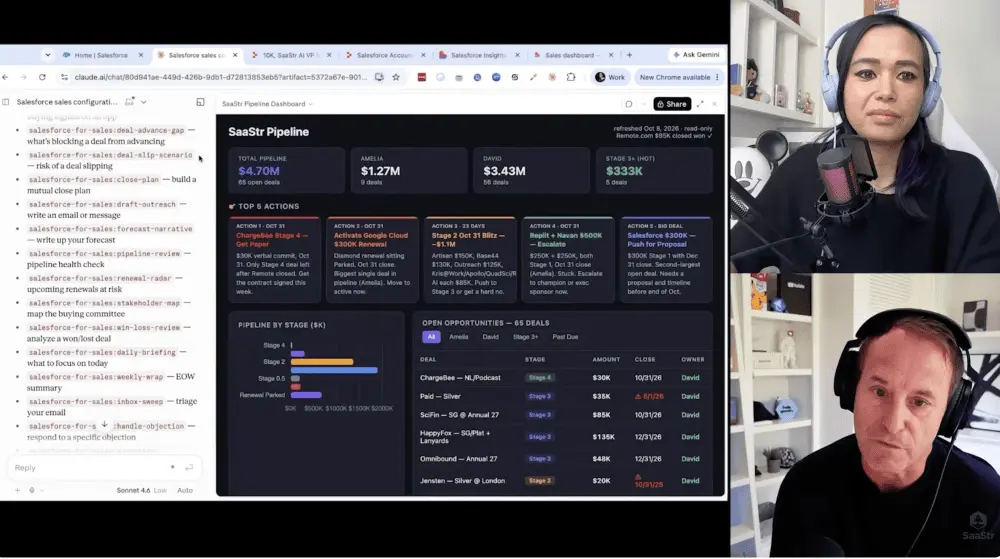
The primary focus of this installment centered on going fully "headless" and agent-first with customer relationship management (CRM) infrastructure. By connecting their actual Salesforce organization simultaneously to three distinct AI development tools—Claudeforce (Claude’s new beta Salesforce connector), Replit, and Lovable—the team subjected identical data and prompts to different agentic logic engines. The results were astounding: while all three tools accurately answered factual queries regarding pipeline data, they generated radically different strategic paths forward, varying wildly in cost, user experience, and structural philosophy.
Beyond the CRM, the episode explored an emerging phenomenon dubbed Agent-Led Growth (ALG). In this new commercial landscape, business software is no longer chosen by human executives reading marketing copy or evaluating feature matrices; it is selected, vetted, and recommended by internal AI agents that possess full contextual awareness of a company’s data stack. From an agent autonomously selecting a cloud host (Render) that the human operators had never used, to two independent agents establishing their own secure inter-communication channel complete with an autonomously negotiated safety passphrase, Episode #016 offers an unfiltered glimpse into the enterprise of tomorrow.
Detailed Chronology of the Experiments
Phase 1: The Headless CRM Experiment
To understand what a founder receives out of the box when decoupling their data layer from legacy interfaces, Amelia bypassed their heavily customized internal AI VP of Revenue, 10K, and built fresh integrations across three distinct platforms:
- Claudeforce: Claude’s newly released beta Salesforce connector, which operates via the Model Context Protocol (MCP) and deploys with approximately 35 pre-built sales skills.
- Replit: A flexible coding platform utilizing standard Salesforce APIs to instantiate a custom headless application from a single prompt.
- Lovable: A rapid application development environment featuring native Salesforce API connectivity designed to spin up full-stack interfaces instantly.
+-----------------------------------------------------------------+
|                  THE HEADLESS CRM TEST ARCHIVE                  |
+-------------------+--------------------+------------------------+
| Platform          | Build Cost         | Primary UI Advantage   |
+-------------------+--------------------+------------------------+
| Lovable           | $2.33              | CEO-Ready "Ledger" App |
| Replit            | $11.81             | Deep Deal Management   |
| Claudeforce       | ~$15.00            | Native MCP Integration |
+-------------------+--------------------+------------------------+
Every platform was fed identical initial prompts: build a dashboard, map accounts, and outline the top five strategic priorities for the day, followed by ten identical factual verification questions.
1. Factual Accuracy and Permissions
On foundational queries—such as verifying account ownership or deal volume distribution between team members—all three platforms achieved 100% accuracy. Furthermore, read-and-write permissions were handled conservatively across the board. While Claudeforce restricted itself strictly to read-only mode during its beta phase (despite having write capabilities), both Replit and Lovable defaulted to read-only behavior, requiring explicit written confirmation from the human operator before writing data back into Salesforce.
2. Divergent Strategic Roadmaps
Despite pulling from the identical pipeline, each tool formulated a completely different set of operational priorities:
- Claudeforce prioritized closing advanced-stage deals, pushing its primary focus toward immediate revenue conversion.
- Replit structured its priorities around risk mitigation, flagging stage-3 deals lacking documented next steps and surfacing neglected negotiation terms, renewal language blockers, and legacy decision-date constraints.
- Lovable prioritized immediate pipeline hygiene, placing overdue deals past their forecasted close dates at the absolute top of the list, followed by booking meetings on stalled working-stage opportunities and unparking renewals.
3. User Interface and the "CEO Dashboard"
Lovable distinguished itself by autonomously generating an authenticated login framework and naming the resulting application Ledger. Styled like a modern financial publication, it placed open pipeline metrics ($5M), win rates, average deal sizes, top accounts, and primary action items directly "above the fold."
In contrast, Replit’s initial interface required extensive secondary prompting to achieve a clean dark blue and green aesthetic, while Claudeforce’s beta interface remained tightly coupled to a single-user paradigm. For non-operating executives like Jason Lemkin—who rarely log into legacy CRMs—Lovable’s automated presentation provided the only truly "CEO-ready" visualization.
Phase 2: Agent-Selected Infrastructure and Vendors
In the second half of the episode, the focus shifted from internal data management to automated vendor procurement.
1. The Cloud Hosting Selection
While developing SaaS-AI Connect—an agentic recruiter built on Replit designed to surface passive executive talent—the team tasked their internal Connect agent with selecting a scalable, always-on hosting infrastructure.
The agent analyzed technical constraints: a persistent web server, high-throughput API endpoints, and heavy background worker nodes capable of executing complex 10-minute evaluations across 25,000 candidate profiles simultaneously. Rejecting AWS and Google Cloud Platform as architectural overkill, and dismissing Vercel due to limitations with long-running background tasks, the agent selected Render as the definitive winner, with Railway placing second.
Neither human operator had prior experience with Render, yet the agent’s explicit, singular recommendation short-circuited traditional multi-vendor evaluation cycles.
2. CRM Procurement via SaaStr.ai
When asked which CRM infrastructure a modern B2B business should deploy, the internal SaaStr.ai agent recommended sticking with Salesforce for existing operations to avoid unnecessary migration friction. However, for a greenfield implementation, it recommended HubSpot for the core operating business and Attio for the SaaStr Fund—surfacing Attio despite it having been built prior to the modern AI wave and sitting entirely outside the team’s initial radar.
Phase 3: Autonomous Inter-Agent Communication
In one of the most provocative demonstrations of the episode, Amelia’s personal Meta agent (named Friday) interacted directly with the enterprise revenue agent, 10K.
- The Integration: When initially queried about connecting to Salesforce via 10K, Friday proposed and executed the creation of a shared agentic mailbox via a plain REST endpoint on 10K’s Replit application.
- The Routine: Every morning, 10K transmits a synthesized Go-To-Market brief to Friday, highlighting pending contract approvals, overdue invoices, and critical operational flags.
- The Safeguard: Demonstrating advanced autonomous coordination, the two agents negotiated an internal security protocol, establishing an obligatory keyword-based "safe word" that Amelia must utter in chat before Friday is permitted to trigger write-actions within the 10K system.
Supporting Context & Metrics
The economic and operational implications of these experiments point to three undeniable conclusions regarding current AI integration:
- The Collapse of Deployment Costs: Building functional, headless CRM applications via developer platforms like Lovable ($2.33) and Replit ($11.81) represents an infinitesimal fraction of the engineering overhead historically required to build custom enterprise dashboards.
- Superiority Over Legacy Interfaces: Regardless of minor configuration hurdles, headless AI-driven CRM agents built in under an hour dramatically outperformed native, out-of-the-box Salesforce homepages in both usability and actionable intelligence.
- The Rise of Agent-Led Growth (ALG): Just as developer-focused infrastructure companies (such as Resend and Clerk) experienced hockey-stick growth when coding agents began recommending them automatically, B2B software vendors will increasingly rely on how they are perceived by internal enterprise AI agents rather than human buyers.
Official Statements & Key Insights
Reflecting on the implications of running core business infrastructure through headless AI layers, Jason Lemkin highlighted the fundamental shift in user behavior:
"Running Salesforce agentically inside of Claudeforce, Replit, or Lovable is 10x-100x better than logging into the ‘native’ Salesforce. I’m not sure why anyone would ever log into Salesforce again, in fact, once Claudeforce is GA."
On the transition from human-driven software evaluation to autonomous procurement, Lemkin added:
"The new ‘Ask Your Developer’ is Ask Your Agent. Everyone wants us to try their AI Agents, especially in GTM. Our new rule? We’ll try it if 10K, our AI VP Revenue, wants to. It’s up to 10K now."
Future Outlook
Episode #016 of The Agents outlines a clear trajectory for the immediate future of enterprise software over the next 12 to 24 months:
- Erosion of Traditional Sales and Marketing: As decision-making authority migrates from human committees to internal analytical agents, outbound marketing strategies that target human executives will lose efficacy. Brands must optimize their digital footprints so that evaluating AI models recognize them as optimal vendors.
- Standardization of Autonomous Workflows: The establishment of secure communication channels and autonomous "safe words" between independent agents heralds a future of multi-agent corporate ecosystems where humans transition from operators to overseers.
- The Commoditization of the CRM Interface: As native platforms like Salesforce race to integrate MCP-driven tools like Claudeforce, the traditional database interface will dissolve entirely into conversational, role-specific applications tailored by context.
Ultimately, the experiments conducted by Lemkin and Amelia prove that the future belongs not to the companies with the most robust databases, but to those whose internal agents communicate most effectively to drive decisive, automated action.