SAN FRANCISCO — Silicon Valley has weathered its share of transformative economic waves over the last three decades. Veterans of the tech sector have cut their teeth on the hyper-exuberance of the dot-com boom and its subsequent, sobering bust; they engineered the migration to software-as-a-service (SaaS) and lived through the explosive, consumer-driven hyper-growth of social media networks. They watched early-stage startups evolve into unicorns, then decacorns, and finally into multi-trillion-dollar juggernauts.
Yet, as the bell rings at the Nasdaq tomorrow morning for Anthropic’s historic initial public offering, industry observers are witnessing a growth story unlike anything that has come before it.
The San Francisco-based artificial intelligence powerhouse is slated to begin public trading with a valuation hovering near $1.4 trillion, aiming to raise a staggering $88.5 billion through its IPO and a concurrent private placement. Less than six years old, Anthropic is bucking the modern venture capital trend of staying private longer to mature. More remarkably, the company reported an astonishing $17 billion in revenue for the third quarter alone—a financial milestone achieved less than four years after its flagship AI model, Claude, launched from a baseline of absolute zero.
This breathtaking ascent signals the definitive arrival of a brand-new technological era. It is an epoch defined by unimaginable wealth creation, blinding speeds of enterprise adoption, and societal shifts that stretch the imagination. But it is equally characterized by astronomical capital expenditure, profound geopolitical risks, and unprecedented technical unknowns. As Anthropic makes its leap onto the public stage, it carries the weight of an entire industry’s high-stakes gamble on the future of artificial intelligence.
Executive Overview: The Numbers That Define a New Era
To comprehend the sheer magnitude of Anthropic’s public market debut, one must look past the headline-grabbing valuation and examine the granular metrics tucked away within the company’s S-1 filing.
The most jarring figure—and the one dominating boardroom discussions across Wall Street and Sand Hill Road—is the nearly $900 billion in compute purchase and lease commitments the company has amassed. Building, training, and maintaining frontier artificial intelligence models requires an industrial infrastructure of unimaginable scale, and Anthropic’s balance sheet reflects the heavy toll of keeping pace in the generative AI arms race.
Yet, the demand driving these capital requirements is equally historic. While OpenAI captured the public consciousness in late 2022 with the viral consumer release of ChatGPT—reaching 100 million users in two months and scaling to a billion monthly active users in under four years—Anthropic’s hyper-growth has been forged in the crucible of enterprise software.
The catalyst for this institutional dominance was the launch of Claude Code just last year. According to the company’s S-1 filing, Claude Code has secured the fastest enterprise adoption rate of any product on record. Already, 11,900 enterprise customers are paying $100,000 or more on a trailing twelve-month basis—representing a staggering 12-fold increase from a year prior.
Anthropic is no longer merely an academic research lab or an experimental chat interface; it has rapidly matured into an indispensable corporate utility, deeply embedded in the software development pipelines and operational workflows of thousands of global enterprises.
Detailed Chronology: From Series A to the Threshold of Wall Street
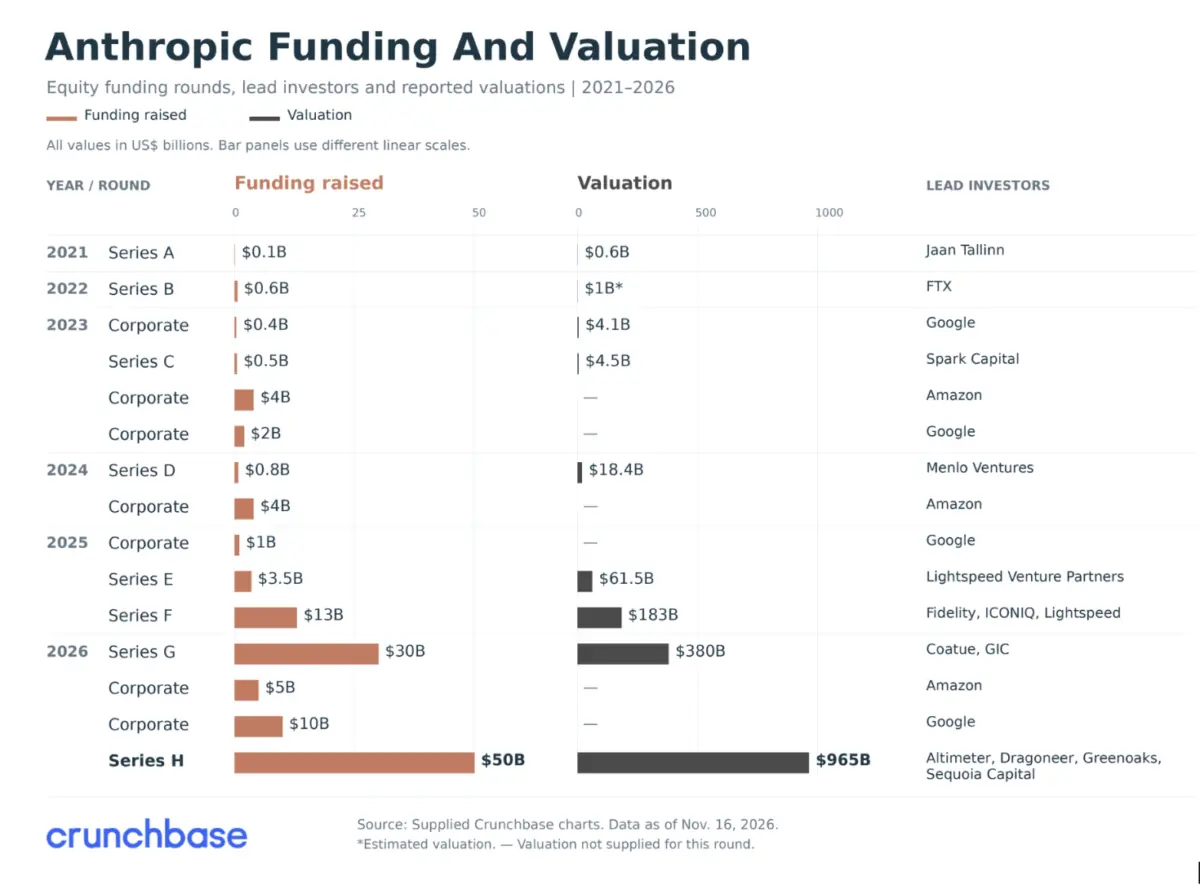
Anthropic’s path to the public markets reads less like a traditional startup journey and more like a high-speed orbital insertion. Founded by a cadre of former AI safety and research leaders, the company rapidly moved through successive rounds of funding, establishing deep strategic partnerships that insulated it with immense capital and compute resources.
- 2021 (The Genesis): The company’s trajectory began with a Series A funding round led by Jaan Tallinn, laying the foundational research and safety architecture that would distinguish Anthropic from its peers.
- 2022–2023 (The Era of Alignment): As generative AI began to capture global attention, Anthropic secured early institutional backing, emphasizing its commitment to constitutional AI and safety-first model development.
- 2024–2025 (Strategic Consolidation): The company orchestrated massive capital infusions, forming unprecedented strategic alliances with tech giants Google and Amazon. These partnerships provided not only billions in cash injections but also guaranteed access to custom silicon and cloud infrastructure essential for scaling frontier models.
- May 2026 (The Series H Milestone): In a final private funding sprint earlier this year, Anthropic closed its Series H round, cementing a staggering valuation of $965 billion.
- Tomorrow (The Public Debut): Moving from private venture backing to a public market behemoth, Anthropic stands alongside an elite group of financial winners—including Spark Capital, Menlo Ventures, Lightspeed Venture Partners, Coatue, and Sequoia Capital—who validated the company’s vision years before it became a household name.
Supporting Context & Metrics: The Backers and the Buildout
The velocity of Anthropic’s capitalization is unprecedented. In less than six years, the company transitioned from a whiteboard concept to a corporate titan commanding a seven-figure enterprise valuation. This acceleration was made possible by a syndicate of venture capital heavyweights and strategic corporate partners who recognized early on that the race for artificial general intelligence (AGI) would be won by those with access to infinite capital.
Google and Amazon, in particular, acted as critical structural pillars. By intertwining their cloud ecosystems with Anthropic’s research goals, they secured a front-row seat to the commercialization of generative AI. Meanwhile, traditional venture powerhouses like Sequoia Capital, Lightspeed, and Menlo Ventures deployed capital at scales previously reserved for late-stage public equity.

However, this financial backing tells only half the story. The operational reality of running a frontier AI lab requires immense physical infrastructure. The $900 billion in compute commitments outlined in the S-1 filing underscores a brutal economic truth: the cost of staying at the cutting edge of intelligence is astronomical. Powering data centers, acquiring next-generation AI accelerators, and securing reliable, clean energy sources to run massive training clusters demand capital outlays that dwarf historical infrastructure projects like telecommunications networks or freight rail systems.
For public market investors buying into tomorrow’s IPO, the central question will not be whether the demand for Claude exists—the $17 billion Q3 revenue run-rate answers that emphatically—but whether top-line growth can sustainably outpace the relentless burn of capital expenditure.
Official Statements and Corporate Structure: Balancing Profit and Purpose
As a Public Benefit Corporation (PBC), Anthropic occupies a unique structural position in corporate America. The company’s governance model is explicitly designed to balance commercial profitability against the broader public good—a tension that is vividly laid out in the risk factor disclosures of its S-1 filing.
The company’s corporate framework incorporates the Long-Term Benefit Trust, a body consisting of founders, employees, and independent stewards with no financial stake in the company. This trust holds governance power specifically tailored to weigh the broader societal impacts of Anthropic’s technology, including national security, economic disruption, and global health implications.
In its S-1 filing, Anthropic highlights its deliberate rollout of advanced models—such as the Mythos project—as a case study in balancing rapid commercial deployment with rigorous safety evaluations.
Company leadership acknowledges that the technological revolution they are spearheading cuts both ways. Beyond software development and coding assistants, Anthropic’s strategic roadmap for 2027 targets autonomous AI agents designed for complex knowledge work and scientific discovery. The S-1 points to potentially monumental breakthroughs in biology, rare-disease research, and the democratization of healthcare—citing World Health Organization estimates that 4.6 billion people currently lack access to basic health services.
At the same time, the filing pulls no punches regarding the perils of the technology it builds. Anthropic explicitly flags risks ranging from sophisticated cyber and biological attacks to unpredictable model behavior, authoritarian state surveillance, and widespread economic displacement. Furthermore, the company notes potential friction with its enterprise customers: businesses often harbor legitimate anxieties that proprietary data shared with AI providers could inadvertently train models that eventually compete with their own core products.
Future Outlook: Navigating the Unknowns of the AI Frontier
As Anthropic begins trading on the Nasdaq tomorrow, Wall Street will be watching a stress test of historic proportions.
The IPO will establish a definitive public benchmark for what a pure-play artificial intelligence enterprise is worth in the modern economy. More importantly, it will test whether the public markets possess the appetite—and the patience—to fund the multi-billion-dollar infrastructure buildout required to sustain the AI revolution over the next decade.
Can Anthropic successfully convert surging enterprise demand for Claude and Claude Code into a durable, margin-expanding business? Can it navigate the complex minefield of regulatory scrutiny, competitive pressures, and model safety risks? And can its unique Public Benefit Corporation structure genuinely withstand the relentless quarterly pressures of Wall Street analysts?
Silicon Valley has seen bubbles inflate and pop, industries transform overnight, and technological paradigms shift from science fiction to everyday utility. But as Anthropic opens its first day on the public markets, it does so at the absolute apex of the technological frontier. The rewards on the other side of this transition are nearly boundless—and the risks are equally profound. Tomorrow morning, the entire financial world logs on to watch the future begin trading.