Executive Overview
In the sprawling, hyper-accelerated ecosystem of contemporary digital culture, viral phenomena often emerge from unexpected, absurdist corners of the internet. Yet, few creations have managed to capture the public imagination—and provoke such profound psychological dissonance—quite like the "Abuse Goblin."
Created by the pseudonymous webcomic artist Vost (known online as @Foolibuster), the series revolves around a deeply unsettling premise: a nondescript man in a green shirt and cargo shorts who keeps a literal goblin chained in his home purely as a punching bag and emotional outlet for his daily frustrations.
Since its debut on X (formerly Twitter) on January 23, 2026, the series has transcended its niche webcomic origins to become a sprawling cross-platform phenomenon. Spanning multiple installments, the comics routinely rack up tens of thousands of likes and millions of impressions, bleeding over into Reddit, TikTok, and specialized fan art communities.
However, the cultural footprint of the Abuse Goblin extends far beyond standard viral amusement. The character has sparked fierce online debates concerning morality, dark humor, parasocial empathy, and the boundaries of fiction. While some users treat the strips as pitch-black satire on modern alienation and emotional misdirection, a vocal segment of the internet has responded with an overwhelming wave of protective fan art, demanding justice, rehabilitation, and care for the abused creature.
This report provides an exhaustive investigation into the origin, chronological evolution, cultural spread, and psychological implications of the Abuse Goblin phenomenon, mapping its trajectory from a single provocative sketch to a defining internet meme of 2026.
Detailed Chronology: The Evolution of the "Abuse Goblin" Series
The narrative architecture of the Abuse Goblin series relies on a rigid, recurring formula that subverts standard comic pacing. Each installment pairs mundane therapeutic environments with domestic surrealism, escalating the absurdity of the abuse while highlighting the abuser’s utter emotional detachment.
Genesis: The First Comic (January 23, 2026)
The phenomenon officially commenced on January 23, 2026, when Vost published the inaugural Abuse Goblin strip on X. The panel opens in a therapist’s office, where the protagonist—a blank-faced man wearing a green shirt and cargo shorts—casually informs his mental health professional that he utilizes an "abuse goblin" as a coping mechanism for his negative emotions. The therapist, displaying total professional apathy, offers a superficial brush-off.
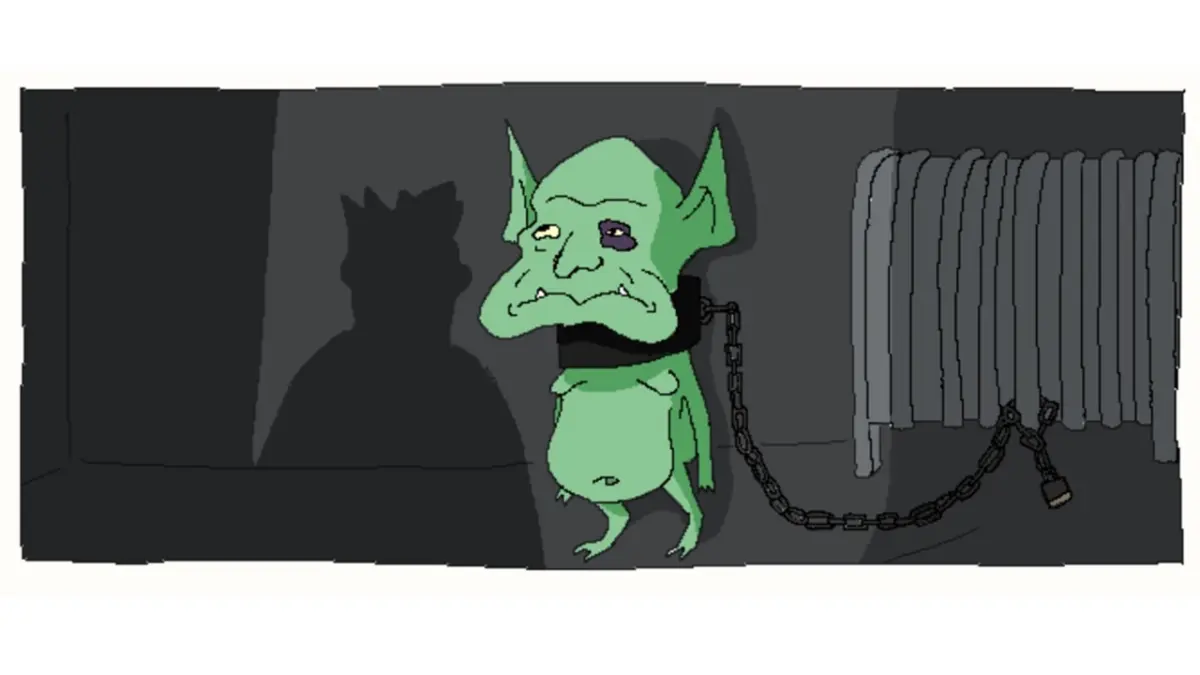
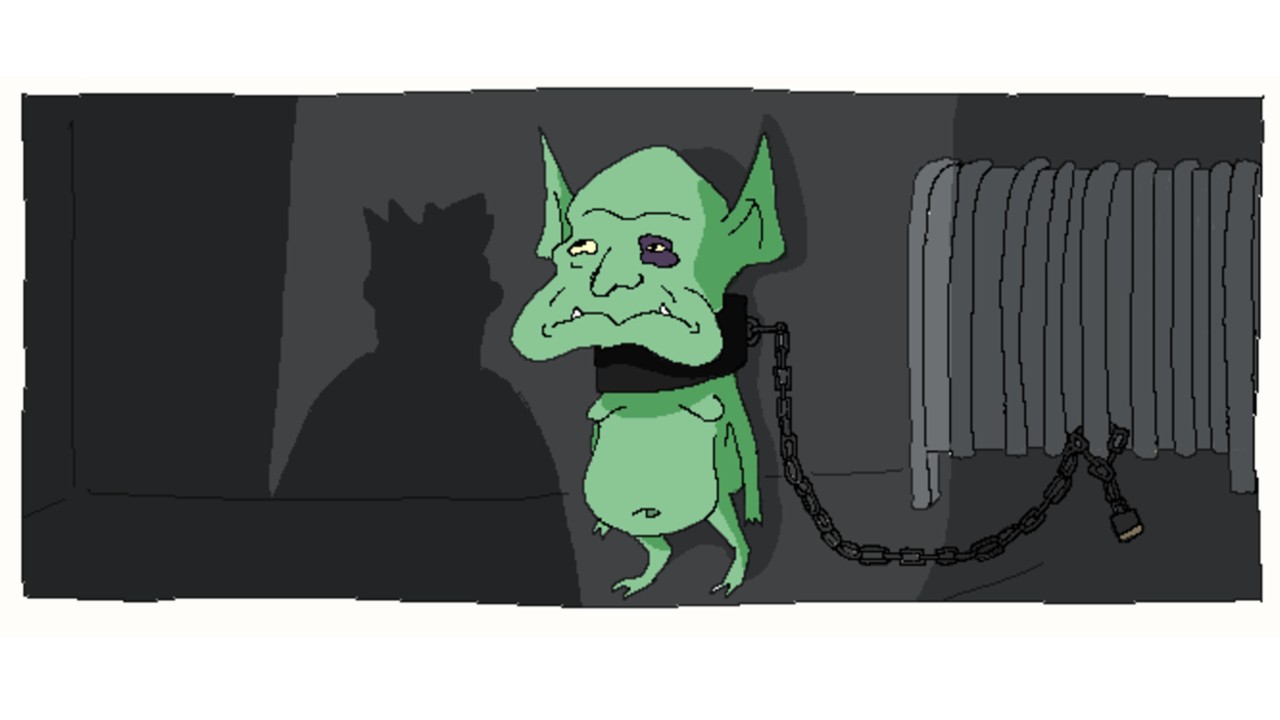
The scene cuts to the man’s home, where the Abuse Goblin is revealed: a pathetic, bruised creature chained to a radiator with a black eye. The abuser gleefully taunts his captive with the now-infamous line: "Guess who embarrassed me at therapy todaaaaay?"
The post struck an immediate nerve, rapidly accelerating across social media algorithms to amass over 112,000 likes and an estimated 4.3 million views within eight months. It established the bleak tonal baseline that would define the entire intellectual property.
Escalation and Expansion (February – May 2026)
Capitalizing on the immediate virality of the debut, Vost delivered subsequent installments that pushed the dark comedic premise into increasingly surreal and visceral territories.
- The Microwave Incident (February 2, 2026): Vost posted the second official strip, detailing the abuser casually recounting to his therapist an episode where he placed the Abuse Goblin inside a household microwave. Despite the escalation in cruelty, the post pulled in over 54,000 likes, proving that the audience’s appetite for the bleakly absurd was far from satiated.
- The Spring Installments (March 24, April 4, and May 5, 2026): As Vost released the third, fourth, and fifth comics, the engagement metrics scaled exponentially. The March 24th strip secured over 32,000 likes; the April 4th installment cleared 100,000 likes; and the May 5th entry crossed the 114,000-like threshold by September 2026. Each new chapter deepened the lore of the anonymous suburban tormentor and his captive, cementing the series as a tentpole of Vost’s artistic portfolio.
The Cockroach Arc and Fan Intervention (August 2026)
By late summer, the narrative expanded to include micro-elements of the goblin’s desolate domestic life. On August 24, 2026, Vost published a strip wherein the abuser maliciously kills the Abuse Goblin’s only companion: a pet cockroach.
This particular act of cruelty served as a narrative tipping point for the fandom. Within 24 hours, counter-narratives and protective fan art flooded social media timelines. Notably, X user @Blkkites posted a corrective piece of fan art depicting a compassionate woman rescuing both the goblin and its pet insect, accompanied by the defiant declaration: "That is not true. His pet is alive and well. So is the goblin. Everyone is okay." The post garnered nearly 4,000 likes, signaling a collective fan rebellion against the bleak canon established by Vost.
Supporting Context & Metrics: Cultural Spread and Community Reaction
The virality of the Abuse Goblin is not confined to the original posts by Vost; rather, its true cultural footprint is found in the decentralized remix culture it catalyzed across Reddit, TikTok, and art-sharing forums.
Social Media Amplification and Psychological Fascination
On May 5, 2026, X user @BlutBaer captured the internet’s bewildered fascination with a quote-tweet that resonated deeply with the digital populace: "honest to GOD i dont think ive ever felt the way i do when i look at the abuse goblin comics." The post accumulated over 52,000 likes in four months, articulating a widespread sentiment that Vost’s creation elicited an entirely novel, albeit deeply uncomfortable, emotional response from viewers.
Simultaneously, the content migrated to Reddit, where it was dissected through various analytical and satirical lenses.
- Moral Philosophy: On May 5, 2026, Redditor Weeblord42069help shared a comic to the
/r/MoralityScalingsubreddit—a digital town square dedicated to debating the psychological and ethical standing of fictional characters. The post pulled over 13,000 upvotes, as users earnestly debated the absolute moral depravity of the green-shirted man compared to standard fictional villains. - Meta-Satire: On June 6, 2026, the community engaged in classic meme deconstruction when Redditor No_Equipment_4841 posted a "Coaxed Into a Snafu" parody version to
/r/coaxedintoasnafu, reducing the comic to its bare structural tropes and earning over 2,000 upvotes. - Subversive Fan Fiction: On August 14, 2026, Redditor Astrid_Regndottir published an independent comic on
/r/comicsfeaturing an old witch stepping in to care for and rehabilitate the Abuse Goblin. The wholesome subversion struck a massive chord, amassing over 34,000 upvotes in under a week.
Cross-Over Parodies and Artistic Redraws
The distinctive character designs and recognizable dialogue structure quickly transformed the Abuse Goblin into an exploitable meme template.
- On August 17, 2026, X user @Gin_San31 published a viral redraw incorporating characters from the critically acclaimed anime and manga series Frieren: Beyond Journey’s End, fusing high fantasy melancholia with the drab suburban cruelty of Vost’s creation and securing over 16,000 likes.
- Global creative adaptations followed suit, including parodies featuring Minecraft villagers ("Abuse Villager" by @DIOsaurio93) and animated TikTok breakdowns by creators such as
@clowntherapyand@byeorionbye, the latter of whom posted an emotional plea to adopt the fictional creature, writing: "give him to me let me hold him sweet baby boy."
Official Statements & Creator Perspective
Throughout the meteoric rise of the Abuse Goblin, artist Vost has largely maintained the role of an observational chronicler, allowing the chaotic discourse surrounding the comics to unfold organically without heavy-handed authorial intervention.
In various social media interactions, Vost has acknowledged the jarring emotional whiplash the comics produce, noting that the juxtaposition of mundane psychological therapy with unabashed, cartoonish sadism serves as an intentional critique of how modern individuals externalize internal emotional decay. Rather than positioning the abuser as a grand supervillain, Vost’s work frames him as an utterly mundane, apathetic consumer of convenience and comfort who offloads his psychological burdens onto a defenseless proxy.
While Vost has not offered a formal manifesto regarding the series, the minimalist storytelling relies on the audience’s capacity to fill in the moral blanks. The creator’s ongoing willingness to lean into darker narrative beats—such as the targeted elimination of the goblin’s pet cockroach—demonstrates a deliberate commitment to refusing sanitized, palatable resolutions, thereby forcing the audience to grapple with their own desires for poetic justice versus bleak realism.
Future Outlook: The Legacy of the Abuse Goblin in Digital Media
As the digital landscape moves deeper into the latter half of 2026, the Abuse Goblin stands as a fascinating case study in modern internet folklore. It highlights how contemporary audiences interact with transgressive art: swinging wildly between ironic detachment, deep psychological projection, and aggressive protective empathy (often manifested through fan redemption arcs).
Looking ahead, several trajectories remain open for the phenomenon:
- Institutionalization within Webcomic Canon: Vost’s ongoing contributions indicate that the Abuse Goblin universe will likely continue to expand, potentially introducing new supporting characters, therapists, or external interventions that threaten the abuser’s domestic status quo.
- The Rise of Alternative Universes (AUs): Given the prolific output of fan artists and Reddit creators determined to give the goblin a safe haven, a distinct sub-genre of "Wholesome Abuse Goblin" fan fiction has established permanent roots. This duality—between Vost’s bleak canon and the internet’s therapeutic fanon—ensures the character’s longevity well beyond standard meme life cycles.
- Broader Cultural Analysis: Media theorists and cultural critics are increasingly pointing to the Abuse Goblin as an accidental mirror for late-stage digital alienation. By externalizing the ugly, unvarnished impulses of modern frustration into a literal fantasy creature, Vost has inadvertently tapped into a collective subconscious vein, ensuring the character will be studied as a defining artifact of 2026 internet dark humor.
Ultimately, whether viewed as a pitch-black satire on modern mental health culture, an exercise in artistic provocation, or a vehicle for collective online empathy, the Abuse Goblin has secured its permanent, strange place in the annals of internet history.