Executive Overview
In the fast-paced, multi-billion-dollar universe of interactive entertainment, the intersection of corporate sponsorship and critical journalism has long been a contentious boundary. Few moments in modern gaming history crystallized this tension quite as vividly as an innocuous online interview conducted in October 2012. Featuring prominent Canadian video game journalist Geoff Keighley seated in front of an overwhelming, unblinking wall of junk food marketing, the broadcast ignited a digital firestorm.
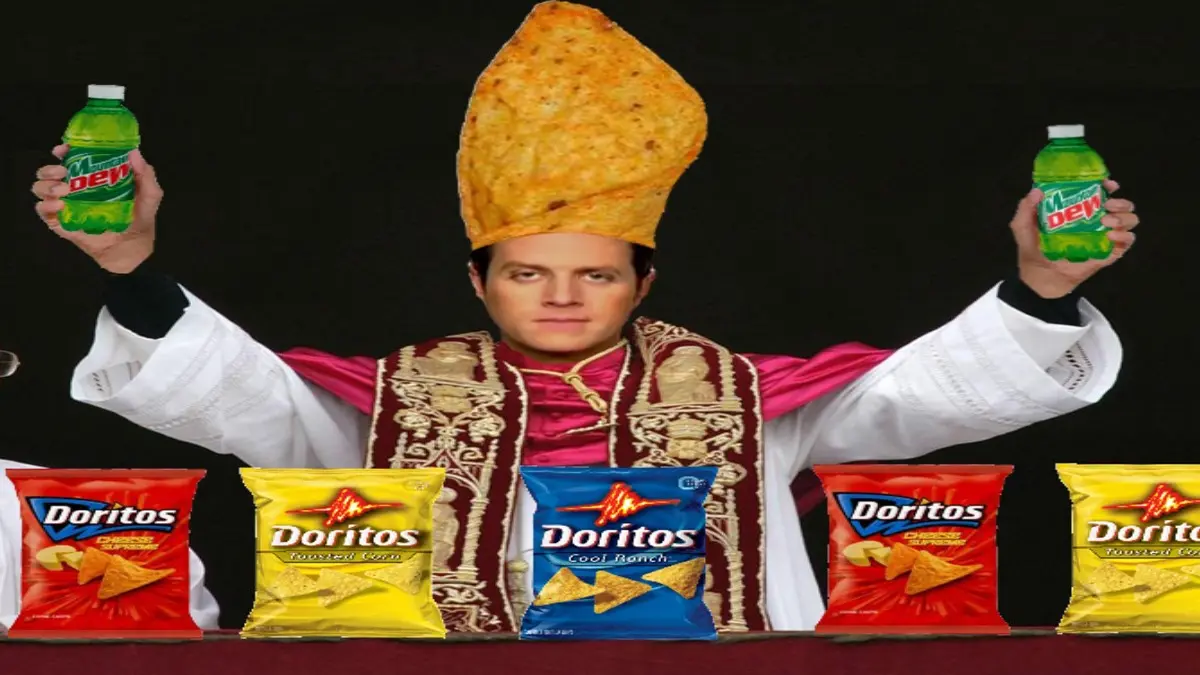
Out of this corporate-heavy tableau emerged one of internet culture’s most enduring and satirical monikers: the "Dorito Pope."
What began as an awkward promotional alignment quickly metastasized into a watershed cultural moment known colloquially as "Doritosgate." The incident laid bare the precarious financial dependencies of digital games media, sparking intense industry-wide introspection regarding ethics, conflicts of interest, and the cozy relationships between major publishers, snack food giants, and the journalists tasked with covering them. This comprehensive retrospective examines the origins of the moniker, the sequence of events that amplified it, the structural media criticisms it unmasked, and its lasting legacy on the digital landscape.
Detailed Chronology
October 18, 2012: The Catalyst Interview
The saga commenced on October 18, 2012, when LevelSave.com, a prominent video game culture and review website, published an interview featuring Geoff Keighley, then a towering figure in games journalism and television hosting. The interview was ostensibly designed to explore Keighley’s experiences at San Diego Comic-Con, his early hands-on impressions of Microsoft’s highly anticipated Halo 4, and his broader perspectives on the industry.
However, viewers tuning into the video were immediately struck by the bizarre and claustrophobic staging. Keighley was positioned directly in front of an aggressive commercial installation: an arrangement of Mountain Dew bottles and bags of Doritos explicitly branding the "Mtn Dew and Doritos XP" promotion. This joint marketing venture between PepsiCo and Microsoft offered gamers in-game XP bonuses for Halo 4 by redeeming unique alphanumeric codes printed under the caps of sodas and inside snack bags.
Rather than conducting a traditional interview within a neutral journalistic space, the visual architecture of the broadcast turned Keighley into a human billboard. The stark incongruity between serious critical discourse about video games and the unabashed peddling of high-sodium, high-sugar snack foods was not lost on the community. Within days, the video began accumulating a tidal wave of negative sentiment, eventually amassing a staggering disparity of views, downvotes, and critical commentary.
October 24, 2012: Eurogamer and the Birth of "Doritosgate"
The online mockery might have remained a localized internet joke had it not been for a piercing critical intervention by Eurogamer writer Rab Florence. On October 24, 2012, Florence published a searing column titled "Lost Humanity 18: A Table of Doritos."
Florence seized upon the Keighley interview as a symptom of a much deeper, systemic rot within games journalism. He argued that the medium had become overly compromised by corporate access, where journalists traded critical independence for exclusive previews, swag, and proximity to power. Florence’s column did not merely critique the staging of the interview; it drew a straight line between the junk-food-laden backdrop and a broader culture of promotional subservience that plagued mainstream gaming outlets.
The article struck a massive chord, instantly polarizing the industry and igniting the "Doritosgate" controversy. It prompted immediate defensive posturing from various corners of the media, swift editorial retractions or edits from publications feeling the heat, and an unprecedented wave of community scrutiny regarding how journalists maintain their ethics while relying on publisher-funded travel and early access.
Late October to January 2013: Parody, Satire, and the Proliferation of the "Dorito Pope"
As the discourse spilled across Reddit, NeoGAF, YouTube, and independent blogs, the internet did what it does best: it weaponized satire.
On October 26, 2012, just two days after Florence’s column went live, YouTuber PewpewVIDEOGAMES uploaded a satirical supercut titled "Double your Gaming Journalism with Geoff Keighley™." The video expertly spliced the most egregiously promotional segments of Keighley’s Halo 4 discussion with footage of Halo 3 multiplayer matches featuring the quintessential online act of disrespect: a player "teabagging" a fallen opponent. The juxtaposition visually encapsulated the community’s view of how corporate partnerships were metaphorically debasing the craft of games writing.
Concurrently, the nickname "Dorito Pope" crystallized across image boards and social media. The title elevated Keighley to a satirical ecclesiastical status, implying that he was the high priest of a church dedicated not to artistic critique, but to the hollow consumption of corporate synergy. Memes flooded the web, superimposing Keighley’s face onto religious iconography, replacing game discs with bags of chips, and mocking press release jargon disguised as objective journalism.
The controversy refused to die down quietly. By January 1, 2013, high-profile content creator AngryJoeShow cemented the event in internet lore by ranking the Keighley interview and Doritosgate among the top 10 gaming controversies of 2012. In Joe’s retrospective, the incident ranked just behind the fierce community backlash over Mass Effect 3’s controversial endings and the bizarre international espionage arrests surrounding Bohemia Interactive’s Arma 3 developers in Greece.

Supporting Context & Metrics
To fully understand why a single interview generated such an explosive societal reaction, one must examine the socio-technical and economic landscape of games media in 2012.
The Financial Pressures of Early Digital Media
In 2012, traditional print magazines were rapidly dying or already dead, and digital outlets were caught in a brutal race for traffic driven by programmatic ad networks and click-through metrics. To survive, digital outlets relied heavily on "exclusive" scoops, review event invites, and early review code—all of which were tightly controlled by multi-billion-dollar publishers like Microsoft, Electronic Arts, and Activision.
When a journalist appeared to actively shill for cross-promotional snack products during an interview, it served as a stark visual reminder of the economic compromise underpinning the entire beat. The audience realized—often with cynical amusement—that the barrier separating editorial critique from corporate advertising had become paper-thin.
Engagement Metrics and Digital Footprint
While the original LevelSave.com interview was eventually scrubbed or buried by its creators, historical metrics paint a clear picture of the community’s immediate hostility. By mid-2014, archival metrics for the video demonstrated a severe community backlash:
- Total Views: Nearly 50,000 views (a notable number for a niche website interview at the time).
- Audience Sentiment: Over 1,200 downvotes compared to a meager 125 upvotes, yielding an overwhelmingly negative engagement ratio that signaled profound consumer dissatisfaction.
+-------------------------------------------------------------+
|               LevelSave Interview Metrics (2014)            |
+-------------------------------------------------------------+
| Total Views:      ~50,000                                   |
| Upvotes:          125       (███░░░░░░░░░░░░░░░░░)          |
| Downvotes:        1,200     (████████████████████)          |
+-------------------------------------------------------------+
Furthermore, the search interest surrounding terms like "Dorito Pope," "Doritosgate," and "Rab Florence Eurogamer" spiked dramatically in late October 2012, sustaining a long-tail presence in internet lexicon for over a decade. The phrase transitioned from a targeted jab at an individual into a generalized shorthand for institutional corruption and sell-out behavior within entertainment journalism.
Official Statements & Industry Reaction
The fallout from Doritosgate forced editors, publishers, and journalists to publicly defend or recalibrate their operational standards.
Geoff Keighley himself found navigating the fallout uniquely challenging. As a pioneer of bridging traditional television production values with interactive entertainment—having worked extensively on Spike TV’s Video Game Awards (VGAs)—Keighley was deeply enmeshed in the corporate machinery required to fund high-end broadcasting. While Keighley largely weathered the storm by pivoting away from traditional editorial writing toward independent production (ultimately founding The Game Awards in 2014), the "Dorito Pope" moniker dogged his public persona for years.
In subsequent years, industry figures acknowledged that the incident marked a turning point in how press events were staged. Publishers grew acutely aware that modern audiences possessed zero tolerance for blatant, unvarnished corporate synergy masquerading as organic journalism.
Editors-in-chief across major gaming publications utilized the Rab Florence column and the ensuing debate to institute stricter internal guidelines regarding sponsored content, disclosure policies, and acceptance of promotional swag. The conversation inadvertently laid the groundwork for modern disclosure standards, where digital creators and journalists are now legally and ethically required to explicitly state when content is sponsored, partnered, or financially supported by corporate entities.
Future Outlook: The Legacy of "Dorito Pope" in the Era of Influencer Marketing
More than a decade after Geoff Keighley sat before that fateful wall of Mountain Dew and Doritos, the landscape of gaming promotion has undergone a seismic evolution—yet the core anxieties highlighted by Doritosgate remain entirely relevant.
Today, the traditional "games journalist" has largely been supplanted or augmented by independent content creators, Twitch streamers, and YouTube influencers. Ironically, the hyper-transparent corporate shilling that scandalized the community in 2012 has now been democratized and commercialized on an unprecedented scale. Modern streamers routinely display energy drink sponsorships, hardware partnerships, and sponsored game segments directly on their personal channels, often with far fewer traditional editorial safeguards than institutional media outlets maintained.
However, the consumer vigilance forged during Doritosgate has not vanished. Audiences are sharper, more cynical, and quicker to call out perceived authenticity gaps among digital creators. The term "Dorito Pope" endures not merely as a relic of 2012 meme culture, but as a permanent warning sign in the digital age: a reminder of what happens when the boundary separating independent critical analysis from corporate advertising completely dissolves.
As the entertainment industry continues to grapple with new frontiers—such as metaverse integrations, AI-generated marketing, and virtual brand sponsorships—the ghost of the Dorito Pope serves as a cautionary totem. It challenges both creators and consumers to demand greater transparency, integrity, and self-awareness in an ecosystem where corporate dollars and creative passion perpetually collide.