Executive Overview
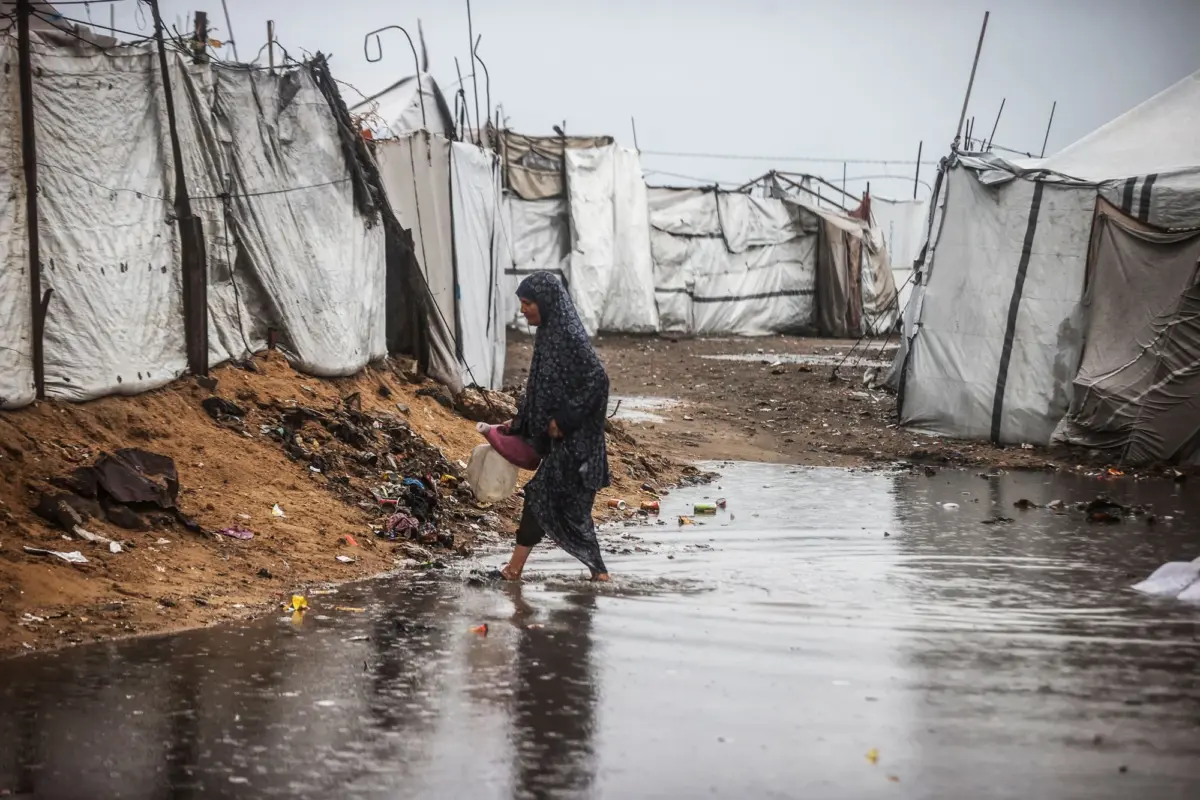
As torrential November rainstorms swept across the Gaza Strip, overwhelming vulnerable displacement sites and makeshift camps, municipal authorities in the Al Maghazi refugee camp were thrust into an agonizing dilemma. Besieged by a severe lack of fuel, critical infrastructure degradation, and strict import blockades, local engineers faced a grim zero-sum choice: divert scarce diesel supplies to pump toxic floodwaters away from collapsing shelters, or conserve the fuel to run wells providing bare-minimum quantities of drinkable water to the displaced population.
The weekend storms of November 7 and 8 exposed the catastrophic fragility of Gaza’s post-conflict landscape. With housing stock devastated by months of sustained bombardment—destroying or damaging over 371,000 housing units according to joint UN, EU, and World Bank estimates—approximately 1.4 million people, or 65 percent of Gaza’s population, are now relegated to fragile tents and makeshift shelters. When the autumn rains arrived, they did not just bring water; they brought widespread environmental contamination, structural collapse, and a surging health crisis.
This investigative report examines the cascading humanitarian and infrastructural failures unfolding across Gaza. By looking closely at the ground realities in Al Maghazi, the systemic supply restrictions documented by the United Nations, and the severe medical emergencies reported by frontline health workers, this piece details how a combination of seasonal weather and severe material shortages has pushed an already fractured region to the absolute brink of humanitarian catastrophe.
Detailed Chronology of the Crisis
The Weekend Deluge: November 7–8
The crisis escalated rapidly over the weekend of November 7 and 8, when severe rainstorms battered the Gaza Strip. The sudden influx of water overwhelmed compromised and unmaintained drainage systems, sending torrential runoff directly into overcrowded displacement sites.
In the Al Maghazi refugee camp, situated in the central Gaza Strip, municipal engineer Imad Abdel Jawad and his team watched helplessly as water levels inside residential tents surged past a foot deep. The camp’s western and northern sectors, sitting primarily on low-lying ground, rapidly transformed into stagnant lakes of mixed rainwater and overflow.
For families like that of 46-year-old Hanan Saied, the storm struck with terrifying velocity. Living in a compromised shelter constructed of mud walls, structural cracks, and precarious plastic sheeting overhead, Saied and her seven children found themselves entirely defenseless against the elements.
"The house flooded, and stones and mud fell on us," Saied recounted. "The bedding was soaked, and the children’s clothes were soaked."
As mud and debris collapsed around them, Saied’s children desperately bailed water out of their living space with small buckets while her eldest son scrambled to reinforce the failing shelter walls. Throughout the night, Saied held her young daughter, Sara—who suffers from severe asthma—desperately attempting to shield her from the damp cold without blankets or heating supplies.
Immediate Municipal Response and the Fuel Trade-Off
Faced with widespread inundation, municipal engineering teams in Al Maghazi deployed pumps to extract water from the most heavily affected encampments. However, this immediate relief came at a devastating cost to the broader community’s basic survival needs.
Imad Abdel Jawad explained the structural mechanics of their impossible choice:
"The diesel we use for these pumps comes from the allocation for the wells that are supposed to pump water."
Because fuel allocations are strictly rationed and desperately scarce, every hour spent running pumps to clear floodwaters directly deprives local water wells of the power they need to supply drinkable water.

Furthermore, the underground infrastructure has been critically compromised. Municipal sewage manhole covers across Al Maghazi have either been destroyed by Israeli bombardment, deteriorated due to age, or stolen amid the chaos. These open manholes act as conduits, allowing millions of gallons of rainwater to flood directly into sewage systems utterly incapable of handling the combined volume. The result is widespread wastewater overflow, turning streets into toxic rivers of raw sewage.
Replacement manhole covers are virtually nonexistent in the local market, and the raw materials required to manufacture alternatives are heavily restricted from entering the territory. Faced with a choice between fixing drainage covers and keeping water wells functioning, Jawad noted that the municipality has had to triage its limited resources entirely toward water production.
Supporting Context & Metrics: The Scale of the Catastrophe
Displacement and Housing Collapse
The devastating impact of the November storms cannot be separated from the unprecedented scale of destruction that preceded them. A joint rapid damage and needs assessment released in April by the European Union, the United Nations, and the World Bank estimated that the conflict has left more than 371,888 housing units damaged or destroyed. This systemic obliteration of civilian infrastructure has internally displaced approximately 1.9 million people—many of whom have been forced to move multiple times.
By November 8, the United Nations Office for the Coordination of Humanitarian Affairs (OCHA) estimated that 1.4 million Palestinians—representing roughly 65 percent of Gaza’s entire population—were living in temporary tents, makeshift structures, or damaged public buildings. Humanitarian partners on the ground reported receiving urgent appeals from more than 26,000 households whose shelters, bedding, and personal belongings had been completely ruined by the initial rains.
The Government Media Office in Gaza reported that at least 70,000 tents sheltering displaced families were flooded within a mere 12-hour window during the height of the storm.
Infrastructural Stagnation and Import Restrictions
The inability to repair, reinforce, or expand Gaza’s drainage and sanitation infrastructure is heavily linked to severe restrictions on the import of vital equipment and materials. In a series of situation reports, including its November 5 update, OCHA detailed how Israeli authorities continue to enforce stringent limitations on the entry of engine oil, lubricants, essential spare parts, and new electrical generators.
Without access to heavy earth-moving machinery, trucks, and gravel, municipal teams are unable to regrade muddy terrain or build defensive berms around displacement sites prone to pooling. According to humanitarian agencies, restoring a sustainable baseline of power and sanitation operations is entirely dependent on securing formal permission to import industrial solar panels, reconnect fractured electrical grids, and restart Gaza’s primary power plant.
Official Statements and International Response
The crisis has elicited starkly contrasting narratives from local humanitarian actors, international observers, and geopolitical authorities.
Local Municipalities and UN Agencies
Frontline municipal engineers and international aid workers have repeatedly emphasized that the crisis is man-made, driven by the systematic dismantling of civil infrastructure and the enforcement of tight blockades on recovery materials.
Dr. Asma Saleh, a general practitioner at the Al Maghazi clinic run by the United Nations Relief and Works Agency for Palestine Refugees (UNRWA), highlighted the direct correlation between infrastructural collapse and public health deterioration:
"The inhumane living conditions, collapse of infrastructure, the flowing streets contaminated with sewage, and the shortage of medical supplies are all factors that profoundly impact the health care system in Gaza."
International Bodies
United Nations agencies have issued urgent appeals for unrestricted humanitarian access, warning that winter conditions will prove lethal if heavy machinery, fuel, and shelter reinforcement materials are not permitted to enter the enclave immediately. OCHA has stressed that existing contingency stocks are wholly inadequate to meet the scale of needs across the 1.4 million-strong tent population.

Government and State Responses
Amid the escalating humanitarian outcry, official communications from external state actors have drawn sharp international focus. On November 8, the official account on X (formerly Twitter), operated by Israel’s Ministry of Foreign Affairs, posted a statement reading:
"Contrary to popular belief, Israel does not control the weather."
While the post did not explicitly mention the catastrophic flooding in Gaza, it drew widespread criticism from humanitarian advocates who pointed out that while foreign actors may not control meteorological patterns, policies governing the import of fuel, spare parts, heavy machinery, and construction materials directly dictate whether civilian populations can survive seasonal weather events.
When WIRED Middle East and other investigative outlets formally requested comment from the Israel Defense Forces regarding restrictions on flood-prevention equipment and infrastructure repair supplies, no response was provided.
The Human Toll: Healthcare and Daily Survival
Beyond the structural and logistical nightmares faced by municipal engineers, the human cost of the flooding is acutely visible in Gaza’s overwhelmed medical facilities.
At the Al Maghazi UNRWA clinic, Dr. Asma Saleh reports treating an alarming surge of pediatric patients suffering from acute respiratory infections and gastrointestinal diseases. The clinic routinely processes approximately 120 children daily. Among these young patients, Dr. Saleh notes that roughly 22 present with severe influenza-like illnesses directly attributable to cold, damp living conditions, while another 13 arrive daily suffering from acute gastroenteritis caused by contaminated water and overflowing sewage in the streets.
For families like Hanan Saied’s, medical vulnerabilities are compounded by a complete lack of basic utilities. Her young daughter, Sara, suffers from chronic asthma that flares dangerously during the winter months. Yet, the family possesses neither a nebulizer nor the electricity required to operate one.
"My older son spent hours repairing our worn shelter using simple tools," Saied says, her voice heavy with exhaustion as she looks toward the horizon. "But I don’t know what to do during upcoming storms."
Future Outlook: A Race Against Winter
As the rainy season deepens, the outlook for the Gaza Strip remains perilous. Meteorological forecasts predict further storms in the coming weeks, threatening to transform temporary displacement sites into permanent health and environmental hazards.
Without an immediate, large-scale intervention involving the unfettered influx of fuel, heavy earth-moving equipment, solar power units, and construction materials for drainage and sewage repair, local municipalities will remain trapped in an impossible cycle. Engineers like Imad Abdel Jawad will continue to face the cruel choice between keeping water taps running and keeping floodwaters at bay, while millions of displaced civilians are left exposed to the elements, waterborne disease, and structural collapse.
The convergence of blocked humanitarian aid, destroyed housing stock, and failing sanitation networks means that for Gaza’s displaced millions, every rainfall is no longer merely a weather event—it is a critical test of endurance against the collapse of civil society itself.