The intersection of popular culture and geopolitical activism reached a dramatic boiling point in September 2026, culminating in the high-profile removal of rapper Macklemore from Ed Sheeran’s international stadium tour. What began as an on-stage political statement at MetLife Stadium quickly spiraled into a multi-layered industry crisis involving billionaire venue owners, prominent pop stars, cascading artist boycotts, and a tidal wave of viral internet discourse.
The controversy centers on free expression, corporate responsibility, and the boundaries of political discourse in mainstream entertainment spaces. As fans, artists, and promoters took sides, the fallout exposed deep ideological fault lines within the Western music industry regarding the ongoing Israel-Hamas conflict. This report provides an in-depth journalistic examination of the events, statements, and cultural ramifications surrounding the Ed Sheeran and Macklemore tour controversy.
Detailed Chronology of Events
September 4, 2026: The Catalytic Speech at MetLife Stadium
On September 4, 2026, rapper Macklemore—long known for his vocal political stances and his May 2024 pro-Palestine protest track "Hind’s Hall"—took the stage as a supporting act for Ed Sheeran’s concert at MetLife Stadium in East Rutherford, New Jersey. During his set, Macklemore delivered an impassioned speech advocating for the "Free Palestine" movement, addressing the devastating human toll of the ongoing Middle Eastern conflict. Immediately following the speech, he transitioned into performing "Hind’s Hall," cementing the moment as a direct political protest within a major commercial arena setting.
September 6–11, 2026: Escalating Tensions and Industry Backlash
The reverberations of the New Jersey performance were felt almost immediately. On September 6, the Israeli American Council (IAC) reportedly initiated a petition calling for Macklemore’s removal from the remaining tour dates, condemning his remarks as one-sided political propaganda. Macklemore doubled down on his position the following day, posting footage of the speech to Instagram with the caption: "Wanting all humans to be treated equal should never be controversial."
Tensions heightened on September 11 when pop star Pink weighed in via a widely shared Instagram statement. While expressing support for a free Palestine, Pink harshly criticized Macklemore’s delivery. She argued that utilizing a stadium full of families—complete with wartime imagery on stadium screens—and dedicating a song to a political movement while telling Jewish attendees "it wasn’t about them" crossed a line of presumptive authority. Pink’s statement also dredged up a controversial 2014 incident wherein Macklemore was accused of wearing a caricature-resembling costume, which the rapper had previously denied and apologized for.
September 14, 2026: Macklemore’s Ouster and Kraft’s Confirmation
On September 14, Macklemore announced via social media that he had been officially removed from Ed Sheeran’s tour. In his statement, he pointed directly to billionaire Robert Kraft—CEO of the Kraft Group and owner of Gillette Stadium—as a primary driver of the pressure exerted on Sheeran and tour promoters.
Kraft subsequently confirmed the decision, issuing a statement defending the venue’s stance:
"Based on Macklemore’s recent actions, material shared from the stage during Ed Sheeran’s shows in New Jersey, and a broader history of antisemitic rhetoric and imagery that we believe has been deeply offensive and hurtful to the Jewish community, we determined that his participation in the September 25th and 26th concerts at Gillette Stadium would cross that line."
September 15, 2026: Sheeran’s Defense and the Tour’s Collapse
Faced with mounting pressure from both sides of the political spectrum, Ed Sheeran released a comprehensive, long-form statement on September 15 via Instagram. Sheeran maintained that Macklemore’s removal was ultimately a promoter and venue decision, not his own, though he acknowledged his active participation in bridging talks.
Sheeran described the Israel-Palestine conflict as an absolute "human tragedy" while defending his choice to keep political discourse off his stages, emphasizing that his concerts are designed to be safe, inclusive sanctuaries for families and children of all backgrounds. He stated:
"I respect Macklemore’s strength of purpose to stand up and shout for what he believes. However, there is room for multiple approaches to the same end: peace. I choose to use my fame and platform to be a place of safety and sanctuary…"
Simultaneously, the fallout expanded rapidly across the tour’s infrastructure. Later that day, it was confirmed that all remaining supporting acts—including Aaron Rowe, Lukas Graham, Beoga, and Finneas—had voluntarily dropped out of the tour in solidarity or protest against the handling of the situation.
Supporting Context & Metrics
The controversy generated unprecedented digital engagement across multiple social media platforms, transforming a physical tour dispute into a massive online cultural phenomenon.
Social Media Metrics and Public Engagement
Pink’s Statement: Gained over 564,000 likes within five days of publication on Instagram, drawing sharp divisions among music fans regarding artist responsibility.
Ed Sheeran’s Statement: Accumulated more than 540,000 likes in its first 24 hours online, sparking intense debate in the comments section where critics accused the British singer-songwriter of complicity or cowardice.
Meme Culture & Viral Satire: On X (formerly Twitter) and Reddit, users weaponized satire to mock the absurd corporate-geopolitical collision. Streamer @ConnorEatsPants posted, "rough time to be a fan of both Ed Sheeran and Hamas," generating over 51,000 likes in a day. Another user, @superkeara, posted a play on Sheeran’s hit song: "Ed Sheeran be like I’m in love with the shape of Netanyahu," racking up 1.3 million views and 110,000 likes in 24 hours.
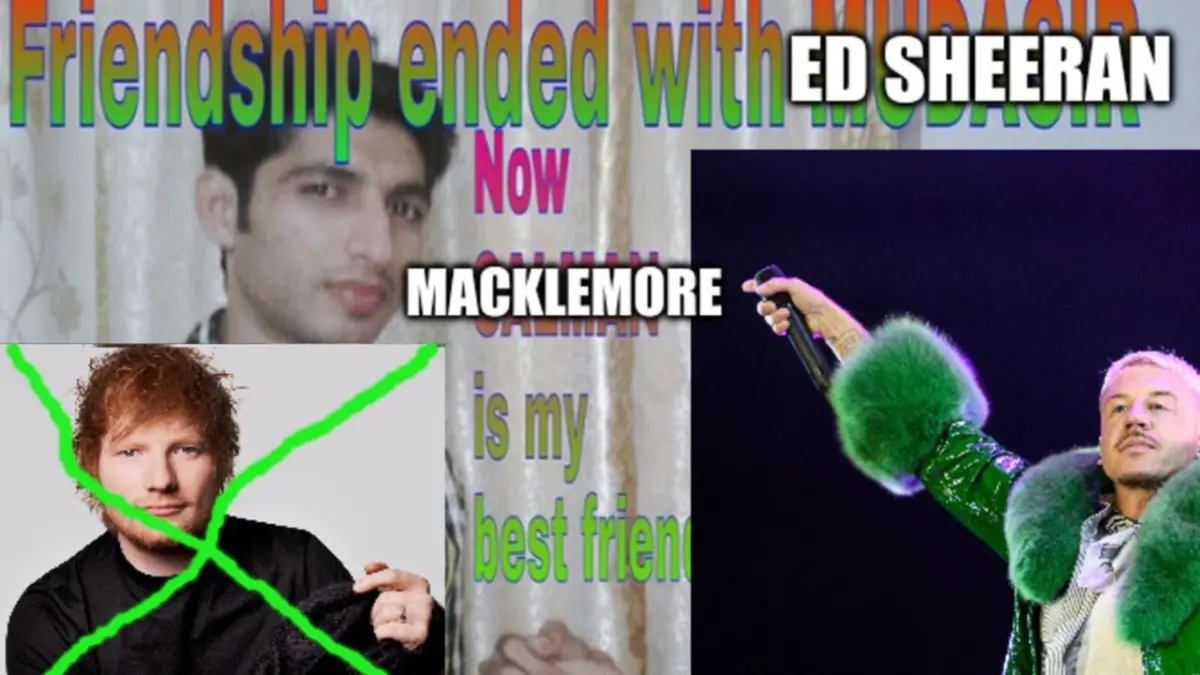
Redditor Contributions: Communities like r/memes and r/dankmemes quickly adopted classic formats—such as the "Friendship Ended" and "All My Homies" templates—to visualize the breaking ties between the artists, garnering thousands of upvotes rapidly.
Official Statements Breakdown
To fully understand the gravity of the controversy, the core arguments of the primary figures involved must be contextualized:
Macklemore: Frames his activism as a moral imperative for universal human rights. By releasing "Hind’s Hall" and speaking out on stage, he positions himself within a long tradition of protest art, arguing that censorship of pro-Palestinian speech suppresses calls for equality and basic humanitarian aid.
Robert Kraft & Venue Ownership: Argue that public stages rented for commercial entertainment must maintain community standards. They point to what they view as inflammatory staging, wartime imagery, and historical controversies as justifications for denying venue access to safeguard Jewish concertgoers from feeling targeted or unsafe.
Ed Sheeran: Advocates for a diplomacy-first, neutral approach in live entertainment. Sheeran insists that while he recognizes the profound devastation of the conflict, international pop tours involving young children and families are not appropriate forums for polarized political speeches. He maintains that his contracts tie his hands regarding promoter decisions, though his refusal to sever ties with the tour entirely led to the walkout of his remaining support acts.
Pink: Asserts a nuanced position—supporting Palestinian rights while aggressively condemning the manner of Macklemore’s execution. Pink criticized the intrusion of raw wartime trauma into family-oriented spaces and highlighted historical sensitivities regarding antisemitism within pop culture.
Future Outlook & Industry Implications
The Ed Sheeran and Macklemore controversy serves as a watershed moment for the live music and touring industry. Several long-term implications are already taking shape:
Stricter Venue Clauses and Rider Policies: Venue owners, stadium magnates, and promoters are expected to implement tighter contractual controls regarding on-stage political statements, potentially subjecting artist speeches to prior review or outlining strict penalties for unsanctioned political rhetoric.
The Polarization of Supporting Acts: The coordinated drop-out of supporting acts like Finneas and Lukas Graham demonstrates that artists are increasingly willing to sacrifice major career opportunities to align with ideological movements. This sets a precedent where future tours may struggle to assemble diverse line-ups if ideological friction arises.
The Erosion of Neutrality: Ed Sheeran’s experience proves that in the modern sociopolitical climate, attempting to remain neutral or appealing to universal "peace" no longer shields artists from intense public scrutiny. Both pro-Palestinian activists and pro-Israel organizations increasingly demand explicit alignment, leaving little room for middle-ground diplomacy in the eyes of the public.
As the dust settles on the 2026 tour collapse, the music industry is left grappling with a permanent shift: the stage is no longer just a place for escapism; it has become an inescapable battleground for global politics.