Executive Overview
The digital landscape of the 21st century is littered with the ghosts of disruptive software platforms that once defined internet culture. Among the most recognizable names from the peer-to-peer (P2P) revolution of the 2000s is LimeWire—a brand historically synonymous with the decentralized sharing of music files, legal battles, and the nostalgic hum of early broadband connections. Today, however, the LimeWire moniker has undergone one of the most radical corporate and technological transformations in internet history. Reborn as an advanced artificial intelligence (AI) content publishing platform and generative studio, LimeWire has positioned itself at the intersection of generative AI, Web3 tokenomics, and creator economy monetization.
In its modern iteration, LimeWire serves as a multi-faceted ecosystem where digital artists, musicians, and everyday users can leverage state-of-the-art AI models to generate, publish, trade, and monetize multimedia content. By blending accessible AI image-generation tools with automated blockchain minting—specifically utilizing the Polygon and Algorand networks—the platform transforms standard digital creations into verifiable, tradable Non-Fungible Tokens (NFTs). Furthermore, the integration of a proprietary utility token, the LMWR token, along with robust ad-revenue sharing models, offers a compelling financial incentive for content creators navigating the modern digital economy.
This comprehensive report explores the technological architecture, monetization frameworks, structural pricing tiers, and strategic trajectory of the revitalized LimeWire. Through an analysis of its generative AI capabilities, creator-fan subscription dynamics, and future roadmap, we examine how a legacy software brand has reinvented itself to meet the demands of the contemporary AI-driven creative landscape.
Detailed Chronology: The Journey from P2P Pioneer to Generative AI Studio
To understand the current positioning of LimeWire, one must contextualize its dramatic historical pivot. The platform’s timeline bridges two entirely distinct eras of internet technology:
- The Early 2000s (The P2P Era): Launched in 2000 as a Java-based peer-to-peer file-sharing client, LimeWire quickly became a ubiquitous cultural phenomenon. Alongside competitors like Napster and Kazaa, it democratized music distribution but simultaneously embroiled itself in severe copyright litigation.
- October 2010 (The Shutdown): Following a protracted legal battle brought by the Recording Industry Association of America (RIAA) in the case Arista Records LLC v. Lime Group LLC, a federal judge ordered LimeWire to halt its file-sharing operations, effectively killing the original application and leaving a permanent mark on digital copyright history.
- The Decadal Hiatus: For over a decade, the LimeWire brand remained dormant as a relic of early web history, remembered primarily for its prevalence of digital malware and music piracy culture.
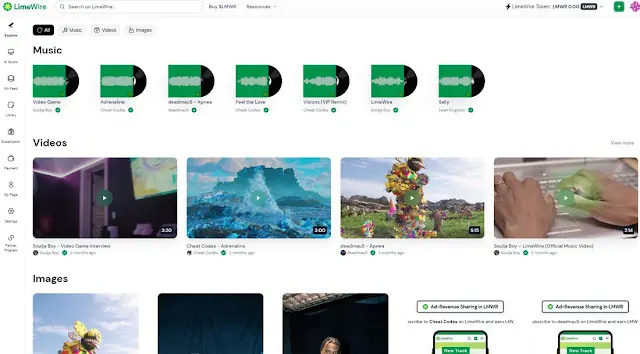
- 2022–2023 (The Web3 and AI Pivot): Acquiring the brand rights, new leadership spearheaded a strategic resurrection. Initially conceived as a digital collectibles marketplace for music and art—attracting high-profile endorsements from mainstream artists like Deadmau5, Soulja Boy, and Sean Kingston—the platform swiftly adapted to the generative AI boom.
- The Modern Era (LimeWire AI Studio): Today, LimeWire operates as an enterprise-grade AI content studio. It seamlessly integrates generative models such as Stable Diffusion and DALL-E into a publishing pipeline that automatically mints user-generated works onto scalable blockchains, democratizing both creation and monetization.
Supporting Context & Metrics: Inside the LimeWire AI Studio Architecture
At the heart of the modern platform is the LimeWire AI Studio, designed to lower the technical barriers traditionally associated with digital art creation and distribution. Rather than requiring advanced proficiency in software like Adobe Photoshop or complex coding frameworks for generative scripts, LimeWire offers an intuitive, prompt-driven user interface.
AI Image Generation and Multimodel Integration
The platform’s generative engine does not rely on a single, isolated algorithm. Instead, it supports an array of industry-leading generative architectures, giving users unprecedented creative flexibility:
- Stable Diffusion (Versions 2.1 and XL): Provides robust capabilities for photorealistic rendering, detailed text-to-image translations, and high-resolution output.
- DALL-E 2: Offers exceptional conceptual interpretation, allowing users to translate abstract prompts into vivid, highly creative visual assets.
Users can initiate the creative process with simple text prompts or dive into granular controls. The platform supports diverse artistic styles, ranging from cinematic and digital art to pixel art, anime, and analog film simulations. Furthermore, advanced features such as custom samplers, prompt guidance scales, and negative prompt fields allow creators to fine-tune their outputs. Notably, the platform’s developers are actively constructing a proprietary AI model, signaling a transition from third-party reliance to bespoke technological infrastructure.
Blockchain Integration and Automated NFT Minting
One of LimeWire’s most distinctive operational features is its automated approach to digital asset ownership. Once a user generates an image, video, or piece of music and elects to publish it, the platform initiates an automated smart contract sequence:
- Blockchain Infrastructure: Content is automatically minted as an NFT on either the Polygon or Algorand blockchains. This dual-chain approach ensures low transaction fees (gas fees) and high transaction throughput.
- Verifiable Provenance: Each asset receives a unique digital signature, cementing the creator’s ownership and establishing absolute authenticity within the decentralized ledger.
- Dual Publishing Modes: Creators retain absolute control over distribution. They can choose a public release, making the asset discoverable to the entire community for trading and interaction, or a subscriber-only release, fostering an exclusive, intimate tier for dedicated fans.
Official Statements and Economic Models: The LMWR Token and Revenue Sharing
LimeWire’s economic framework is designed to address one of the most persistent criticisms of the traditional creator economy: the systemic lack of fair compensation for digital artists and designers. By decentralizing revenue streams and introducing crypto-economic incentives, LimeWire attempts to align platform growth directly with creator success.
The 70% Ad-Revenue Share Model
Unlike conventional social media and content-sharing platforms that retain the vast majority of ad revenue generated by user views, LimeWire implements a transparent, creator-first distribution model:
- Creators receive up to 70% of all ad revenue generated when other users view their published images, music, and video assets on the platform.
- This model transforms casual hobbyists and professional designers alike into stakeholders, ensuring that engagement directly translates into a sustainable secondary income.
LMWR: The Platform Utility Token
The economic lifeblood of the modern LimeWire ecosystem is the LMWR token. Operating as an ERC-20 utility token, LMWR serves multiple vital functions within the platform:
- Monthly Payouts: All creator earnings—derived from ad revenue shares, secondary market royalties, and direct subscriptions—are distributed monthly in LMWR tokens.
- Liquidity and Exchange Accessibility: Creators are not locked into the platform’s ecosystem; LMWR tokens can be transferred and traded on major centralized and decentralized cryptocurrency exchanges, including Kraken, Bybit, and Uniswap.
- Platform Utility: Beyond cashing out, users can utilize LMWR tokens to purchase additional prompt credits, pay for premium generation features, and engage in ecosystem governance.
Secondary Market Royalties
When a creator’s minted NFT is traded among collectors within the LimeWire marketplace, the original creator is hardcoded to receive a 2.5% royalty fee on every subsequent transaction. This perpetual royalty mechanism ensures that successful artists continue to benefit as the secondary market value of their digital collectibles appreciates.
Subscription Tiers and Pricing Architecture
To accommodate everyone from casual experimenters to high-volume professional digital agencies, LimeWire utilizes a tiered subscription model. Each tier balances monthly credit allocations, generation limits, ad-revenue percentages, and platform perks.
| Subscription Tier | Monthly Price | Monthly Credits | Estimated Image Generations | Ad Revenue Share | Pro Perks & Features |
|---|---|---|---|---|---|
| Free Tier | $0 | 10 Credits | Up to 20 images/day | 50% | Basic tool access, standard generation speed. |
| Basic Tier | $9.99 | 1,000 Credits | Up to 2,000 images | 50% | Pro profile badge, creation history, ad-free experience. |
| Plus Tier | $29.00 | 3,750 Credits | Up to 7,500 images | 60% | Early access to new AI models, faster rendering speeds. |
| Pro Tier | $49.00 | 5,000 Credits | Up to 10,000 images | 70% | Priority queue generation, full commercial usage rights. |
| Advanced Tier | $99.00 | 11,250 Credits | Up to 22,500 images | 70% | Maximum allocation, VIP support, elite creator status. |
Across all paid tiers, users benefit from an ad-free creation environment, a verified Pro profile badge, complete access to their generation history, and accelerated processing queues that prioritize their rendering requests during peak network hours.
Future Outlook: Expanding Beyond Images into Audio and Video
As artificial intelligence continues to accelerate at an exponential rate, LimeWire’s strategic roadmap points toward a multi-modal future. While the platform’s current infrastructure is heavily optimized for AI image generation, executive leadership has confirmed aggressive expansion plans slated for the near term.
The Integration of AI Music and Video Generation
The next frontier for LimeWire Studio involves the deployment of advanced generative music and video creation tools. Given the platform’s historical roots in music distribution—and its early success in onboarding mainstream musical acts like Soulja Boy and Deadmau5 for NFT drops—the introduction of native AI audio generation represents a powerful homecoming.
- AI Music Studios: Creators will soon be able to generate custom instrumentals, vocal tracks, and complete soundscapes using simple text prompts, instantly minting these audio files as tradable assets.
- Synthetic Video Production: The upcoming video generation tools will enable users to produce short-form cinematic content, animations, and promotional videos directly within the LimeWire browser interface.
Democratizing Digital Art and the Road Ahead
By removing the technical hurdles of coding, advanced software mastery, and manual smart contract deployment, LimeWire is actively democratizing the generative art space. The platform bridges the gap between decentralized finance (DeFi), blockchain provenance, and accessible creative tools.
For digital artists, designers, and multimedia creators seeking an all-in-one ecosystem to build, showcase, and monetize their work, LimeWire represents a compelling paradigm shift. As the platform rolls out its proprietary AI models and expands into audio-visual synthesis, it solidifies its status not merely as a reimagined ghost of the past, but as a forward-looking titan of the modern AI creator economy.