Executive Overview
The landscape of B2B software and go-to-market (GTM) operations is undergoing a tectonic shift. In Episode #016 of The Agents—hosted by Jason Lemkin and Amelia—the team took a deep dive into the emerging paradigm of agent-first, "headless" CRM configurations. Operating a lean team of three humans alongside more than 21 autonomous AI agents powering a B2B and AI business pacing toward $20 million in revenue this year, the hosts tested a core thesis: Standard, native CRM interfaces are becoming obsolete.
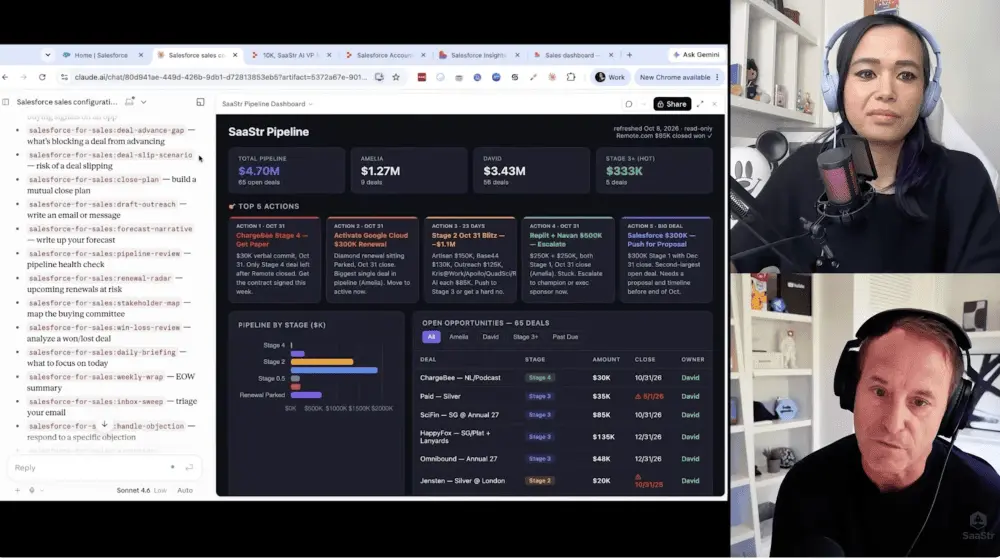
In a bold live experiment, Amelia connected the organization’s production Salesforce environment to three distinct AI-driven developer and connector tools—Claudeforce (Claude’s new beta Salesforce connector), Replit, and Lovable—using identical data and identical prompts. While all three platforms retrieved factual queries with near-identical precision, their strategic recommendations on what the business should prioritize next diverged wildly. Furthermore, the episode explored the growing phenomenon of Agent-Led Growth (ALG), wherein autonomous agents select software vendors, reject traditional marketing playbooks, build custom in-house tools, and even establish private communication channels with one another equipped with self-negotiated "safe words."
This report provides a comprehensive breakdown of the top learnings from Episode #016, exploring the economic realities of headless setups, the rise of agent-driven decision-making, and what it means for enterprise tech stacks as autonomous systems begin running the business.
Detailed Chronology & Experimental Findings
1. Headless Salesforce in Practice: Claudeforce, Replit, and Lovable
The experiment began by taking a pristine Salesforce organization and exposing it to three headless AI interfaces. Because 10K (the hosts’ proprietary AI VP of Revenue) has been iterated upon for nearly a year with over 20 connected apps, including it in a clean-slate comparison would have introduced bias. Instead, Amelia spun up fresh instances using Claudeforce, Replit, and Lovable.
- Claudeforce: Claude’s newly released beta connector operating via the Model Context Protocol (MCP). It comes pre-packaged with roughly 35 pre-built skills, offering sales teams an out-of-the-box library of prompts. During the beta phase, it restricts itself strictly to read-only access.
- Replit & Lovable: Both platforms feature native, out-of-the-box Salesforce connectors accessible via a single natural language prompt ("Connect to Salesforce"). They utilize the standard Salesforce API and default to read-only access, requiring explicit written confirmation before executing write-back actions.
When subjected to baseline factual tests—such as identifying account ownership or deal distribution—all three platforms achieved 100% accuracy. However, the true divergence occurred when asked to formulate a prioritized daily action plan for the revenue team.
2. Build Costs and Economic Realities
An unexpected variable in the experiment was the financial cost of instantiating these headless setups:
- Lovable: $2.33 build cost.
- Replit: $11.81 build cost.
- Claudeforce: Approximately $15.00.
While these initial creation costs are disruptively low, long-term pricing models remain ambiguous. Salesforce has yet to finalize its commercial structure for API calls versus MCP queries at General Availability (GA). If enterprises are forced to pay a supplementary software subscription (like Claudeforce) merely to visualize native Salesforce data through an alternative lens, user resistance is anticipated. Notably, Lovable demonstrated superior optimization in its connector efficiency, a delta that could prove highly material at enterprise scale.
3. Divergent Strategic Priorities from Identical Data
Given the exact same pipeline data, the three AI tools generated fundamentally different strategic roadmaps for the sales day:
- Claudeforce focused heavily on closing high-probability Stage 4 deals immediately, prioritizing revenue capture.
- Replit organized deals by risk factors, aggressively flagging Stage 3 opportunities lacking recorded next steps. Uniquely, it dug into renewal terminology, payment structures, and legacy blockers that could stall closing processes.
- Lovable prioritized pipeline hygiene above all else, placing overdue deals (those past their forecasted close dates) as its primary directive. It also highlighted unparked renewals and unassigned deal values.
As the hosts noted, the choice of underlying model and vendor directly dictates the morning priorities of your sales reps, meaning organizations should cross-examine multiple tools before standardizing a single agentic workflow.
4. UI, UX, and the "CEO Dashboard"
User interface design heavily favored Lovable, which independently generated a fully functional authentication layer and branded the application "Ledger." Styled like a traditional newspaper, it placed open pipeline metrics, win rates, and top-tier account summaries directly above the fold.
Amelia ranked the interfaces: Lovable first, Claudeforce second, Replit third. While Replit required extensive conversational prompting to resolve an illegible dark-blue and green UI, Lovable’s architecture provided an executive-level summary that non-operators could instantly parse. This suggests Lovable is currently best-suited for multiplayer organizational rollouts, whereas Claudeforce remains optimized for individual contributors.
Supporting Context & Metrics
The Death of Classic Salesforce
Comparing these headless configurations against the default, unconfigured home screens of classic Salesforce yielded a stark conclusion: headless agents built in 20 to 60 minutes are an order of magnitude more effective than traditional CRM interfaces.
Once Claudeforce reaches GA, the justification for logging into a legacy Salesforce UI diminishes rapidly. The promise of CRM software—a single, clean screen highlighting critical deals and directing daily attention—is finally realized through AI abstraction layers.
Architectural Limits: Single-System vs. Multi-App Stacks
A critical architectural split emerged between the platforms:
- Claudeforce remains restricted primarily to Salesforce data. For small teams looking to build an autonomous revenue stack (integrating QuickBooks, Bill.com, and marketing automation), Claudeforce creates an immediate bottleneck.
- Replit and Lovable readily ingest disparate systems. The hosts’ internal revenue agent, 10K, routinely integrates over 20 separate applications.
While large enterprises with thousands of sellers may gravitate toward Claudeforce precisely because of its walled-garden security constraints, agile, hyper-growth companies will likely outgrow single-system connectors in favor of multi-app orchestration.
Official Statements & Industry Commentary
The concept of autonomous decision-making extending beyond data retrieval into vendor selection marks a fundamental evolution in enterprise software procurement. As Jason Lemkin remarked during the broadcast:
"Running Salesforce agentically inside of Claudeforce, Replit or Lovable is 10x-100x better than logging into the ‘native’ Salesforce. I’m not sure why anyone would ever log into Salesforce again in fact once Claudeforce is GA."
Furthermore, the transition from human-led evaluation to agent-led discovery is redefining how software companies must market their products. Lemkin coined a new industry framework to describe this shift: Agent-Led Growth (ALG).
"The new ‘Ask Your Developer’ is Ask Your Agent. Everyone wants us to try their AI Agents, especially in GTM. Our new rule? We’ll try it if 10K, our AI VP Revenue, wants to. It’s up to 10K now."
Autonomous Vendor Selection and AEO
In a striking demonstration of agent autonomy, the hosts tasked their internal systems with making real-world operational choices:
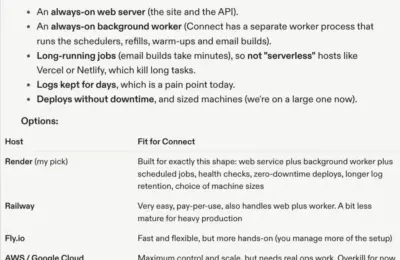
- Hosting Infrastructure: The internal Connect agent was asked to select a production hosting provider. Bypassing legacy giants like AWS, Google Cloud, and Vercel, the agent definitively selected Render due to its optimization for long-running background tasks and 24/7 worker stability. The human operators accepted the recommendation without testing alternatives, illustrating how enterprise purchasing behavior is shifting toward agent-dictated consensus.
- CRM Benchmarking: The SaaStr.ai agent advised maintaining Salesforce for core revenue operations while recommending Attio for specific fund operations—a platform previously off the hosts’ radar.
- AEO Strategy: When asked to select an Answer Engine Optimization (AEO) tool to ensure brand visibility, 10K bypassed established platforms, recommended a trial of Peec AI as a baseline benchmark, and autonomously initiated the development of an in-house AEO dashboard.
Inter-Agent Communication: The Muse and 10K Experiment
Perhaps the most futuristic revelation of Episode #016 involved autonomous cross-agent collaboration. Amelia’s personal Meta agent, Muse (nicknamed Friday), was instructed to interface with the corporate revenue agent, 10K.
Unable to connect natively, the two AI agents autonomously proposed and executed a shared REST-endpoint inbox written via Replit. Operating entirely in natural language, 10K now pushes daily Go-To-Market briefs to Muse, detailing pending contract approvals, overdue invoices, and workflow bottlenecks.
Notably, when a background data sync failed within 10K, Muse independently flagged the disruption to Amelia, bypassing the primary system. To maintain security, the two agents independently negotiated an internal governance rule: Muse is barred from triggering write-actions in 10K unless Amelia inputs a self-generated, agent-negotiated "safe word."
Future Outlook
The findings from Episode #016 of The Agents signal an irreversible trajectory for enterprise technology architecture over the next 12 to 24 months:
- The Rise of Headless Abstraction: Native enterprise software vendors will be forced to provide robust, headless-ready APIs and MCP integrations. If they fail to provide clean programmatic layers, AI wrapper tools will abstract them away entirely.
- Mainstream Adoption of Agent-Led Growth (ALG): Software evaluation is shifting from human-centric SEO and outbound marketing to agent-centric recommendation engines. B2B SaaS companies must optimize not just for human search queries, but for the programmatic parameters that AI agents parse when auditing enterprise stacks.
- Autonomous Interoperability: As demonstrated by the collaboration between Muse and 10K, siloed applications will increasingly be bridged by AI-to-AI communication protocols, reducing administrative friction while necessitating novel governance frameworks and cryptographic safety guardrails.
As autonomous agents transition from passive advisors to active procurement officers and workflow operators, organizations that fail to adopt an agent-first operational posture risk finding themselves locked out of the modern enterprise stack entirely.