Executive Overview
The global technology ecosystem is experiencing a period of intense, high-stakes structural transformation. Driven by relentless advancements in artificial intelligence, unprecedented mega-funding rounds, and aggressive corporate consolidation, the boundaries between traditional software, frontier research, and physical-world robotics are rapidly blurring.
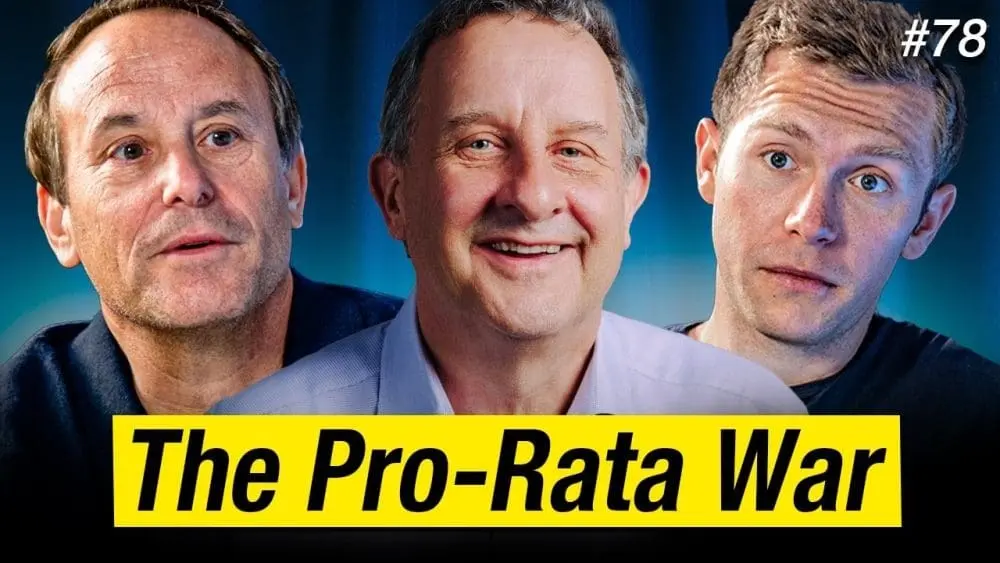
In this edition, industry veterans Jason Lemkin, Rory O’Driscoll, and Harry Stebbings dissect the defining trends of the week. From explosive legal disputes over cap table rights in Delaware to Meta’s re-entry into the frontier model race, and from Nvidia’s strategic maneuvers surrounding Reflection AI to a quiet B2B software apocalypse affecting every firm under $1 billion in Annual Recurring Revenue (ARR), the market is moving at a blistering pace.
While public markets and headline-grabbing decacorn valuations paint a picture of boundless optimism, a closer examination reveals profound systemic strains. Pro rata rights are facing unprecedented legal and contractual erosion; enterprise software buyers are exercising extreme caution unless dealing with multi-billion-dollar scale players; and workforce restructuring has become the default playbook for private equity buyers acquiring mature SaaS assets. This report delivers an exhaustive, authoritative breakdown of these paradigm shifts, offering deep insights into where venture capital, enterprise tech, and artificial intelligence are heading next.
Detailed Chronology & Sector Breakdown
1. The Valar Atomics Legal Battle: Pro Rata Rights on Trial in Delaware
Nuclear energy startup Valar Atomics found itself at the center of a major venture capital dispute, taking its earliest institutional backer, Day One Ventures, to court in Delaware for a declaratory judgment. Valar is currently raising approximately $1 billion at a staggering $6B valuation, led by Sequoia Capital.
According to Valar CEO Isaiah Taylor, the company asked its major investors to relinquish their pro rata allocations to bypass a complex spring-back pro rata clause. While all other early backers agreed, Day One Ventures—which invested $1 million in the seed round and $15M in the Series A, retaining a sub-5% stake—pushed back. Day One General Partner Masha Bucher stated that the firm offered to forfeit the vast majority of its allocation, but claims Valar demanded the total surrender of its rights across all future funding rounds. Valar subsequently filed for a declaratory judgment in Delaware, though viral rumors on social media platform X falsely claimed that Day One was suing its portfolio company.
- Jason Lemkin’s Analysis: Both sides carry some blame, but founders ultimately dictate cap table hygiene. Megafunds routinely inject "universal waiver" clauses into term sheets. Granting a single legacy investor "strategic" status inevitably alienates incoming heavyweights. However, once a founder makes a definitive call, investors must step back: “It’s not your company and it’s not your cap table.”
- Rory O’Driscoll’s Analysis: Investors must weigh the practical return of legal battles. Day One’s 5% stake is already valued at roughly $300 million; fighting to deploy an extra $10M to $15M at a $6B valuation carries diminishing risk-adjusted returns. “Both people can be intellectually wrong but pragmatically right.”
- Harry Stebbings’s Analysis: Market sentiment regarding pro rata rights is shifting rapidly. Seed-stage specialist Neo announced it has stopped taking pro rata rights entirely, pointing directly to friction points like the Valar dispute.
2. Meta Ships Muse Wonder: Re-Entering the Frontier Closed-Model Race
Meta’s Superintelligence Lab officially released Muse Wonder and Muse Wonder Full, achieving benchmark scores comparable to Fable 5.1 and GPT-6 Astra on internal evaluations. Muse Wonder is priced at $4 per million input tokens and $20 per million output tokens via API. However, the flagship Muse Wonder Full model—responsible for its frontier-tier performance—is restricted exclusively to Meta’s internal Muse Code environment.
- Industry Takeaways: While developers bemoan the inability to access the flagship model for external applications, the real strategic play is Meta’s consumer-facing Muse application. Observers note that Meta has engineered a powerful consumer AI product pipeline. Having spent heavily on infrastructure, leadership is pivoting aggressively toward monetization.
3. Nvidia Sets Sights on Reflection AI
Reports indicate that chip titan Nvidia is engaged in early-stage discussions to either acquire Reflection AI or significantly deepen its financial stake. Having already injected $800 million into the enterprise, and with Reflection’s previous pre-money valuation hovering near $25 billion, rumors place the target acquisition price around $30 billion. Industry watchers suggest an acqui-structure may be utilized to sidestep intensive regulatory antitrust scrutiny, mirroring Nvidia’s September acquisition of Hugging Face for $12.9 billion.
- Strategic Dynamics: Nvidia’s overarching thesis prioritizes hardware sales over software margin capture. By fostering open-source and widely accessible frontier models, Nvidia ensures sustained demand for its GPU architecture, effectively keeping independent model labs on notice.
4. Jev Maker TypeSafe Raises $870 Million Just 24 Days After Launch
In one of the most compressed fundraising cycles in venture capital history, TypeSafe—the creator of the decision-making AI engine Jev—closed an $870 million Series A round at a $7.5 billion valuation, led by Andreessen Horowitz (a16z), Sequoia, and DCVC. Launched publicly on September 15, TypeSafe boasts a lean 20-person team and claims that one-third of the Fortune 500 utilize its engine, which outputs calibrated binary or probabilistic business decisions rather than unstructured text.
- Market Skepticism vs. Production Utility: While critics mock the hyper-inflated valuations and compressed timelines of modern AI rounds, enterprise adopters praise Jev’s speed and operational efficiency. Analysts calculate that if Jev captures even a fraction of the multi-hundred-billion-dollar inference market for automated enterprise decisions, the math behind a multi-billion-dollar revenue stream becomes plausible.
5. A Record 42 Decacorns in 2026
According to PitchBook data, the global tech ecosystem has minted a record 42 new decacorns (companies valued at $10 billion or more) through the first ten months of 2026, surpassing the previous all-time high of 34 set during the peak market mania of 2021.
- Macroeconomic Implications: Over the prior five decades, public markets historically produced roughly 20 tech decacorns per decade. Minting 42 in under a year signals either an unprecedented industrial revolution driven by artificial intelligence or an unsustainable valuation bubble driven by hyper-abundant venture liquidity.
6. Isomorphic Labs Eyes $40B–$50B Valuation
DeepMind’s drug-discovery spinout, Isomorphic Labs, is reportedly in early discussions for a funding round valuing the enterprise between $40 billion and $50 billion. This milestone follows closely on the heels of a $2.1 billion Series B round led by Thrive Capital just five months prior.
- The Investment Thesis: Investors view computational biology and AI-driven drug discovery as a generational market opportunity. Compressing clinical target identification timelines by years dwarfs the economic scale of traditional software inference, promising massive royalty streams from successful pharmaceutical assets.
7. Mecka Secures $60M Series B from Sequoia for Robotics Training Data
Mecka, a specialized training data provider that pays human operators to wear sensor suits while executing physical tasks, closed a $60 million Series B round led by Sequoia Capital. The company reported annualized run-rate revenue exceeding $100 million in June, with expectations of reaching $300 million by year-end with a team of fewer than 60 employees.
- The Robotics Bottleneck: While the picks-and-shovels play of supplying data to humanoid robotics developers is exceptionally lucrative, market skeptics point out a critical deployment lag: logistics and manufacturing enterprises are running dozens of proof-of-concept (PoC) trials with humanoid hardware, but actual scaled commercial deployments remain sparse.
8. Anthropic Cuts Haiku Pricing by 90% With Haiku 5.5
Anthropic announced a dramatic 90% price reduction with the rollout of Haiku 5.5, slashing token costs to $0.10 per million input tokens and $0.50 per million output tokens for prompts under 100,000 tokens—a tier that accounts for roughly 90% of legacy Haiku enterprise traffic.
- Deflationary Realities: For enterprise developers, Haiku 5.5 delivers performance comparable to legacy Sonnet models at a tenth of the cost, introducing true deflationary utility to AI consumption. While per-unit token costs are plunging, aggregate enterprise usage volume is scaling exponentially to offset top-line revenue compression.
9. Bending Spoons Executing Deep Layoffs at Airtable
Private equity and serial tech acquirer Bending Spoons initiated a wave of sweeping layoffs across Airtable following its $1.285 billion enterprise acquisition in August. The playbook mirrors Bending Spoons’ historical acquisitions of Evernote and Vimeo, where aggressive operational restructuring and workforce reduction immediately followed the close of the transaction.
- Corporate Governance Realities: While emotionally distressing for incoming workforces, legal mandates require boards to optimize shareholder value. Industry experts advise founders of cash-flow-positive enterprises to carefully weigh the long-term human cost before entertaining buyout offers from roll-up serial acquirers.
10. Bumble Taken Private in a $1.3B Buyout
Dating platform Bumble accepted a buyout offer from Ithaca Holdings, led by Ravi Gupta and John Hegeman, at $6.05 per share—representing a 138% premium over its trading lows, though a stark decline from its $14 billion valuation at its 2021 initial public offering.
- Future Product Horizons: Industry participants note that while dating app user churn has historically plagued venture capitalists, the integration of generative AI matching agents and autonomous dating avatars could radically transform user engagement and monetization models.
Supporting Context & Metrics
The broader software market reflects a profound bifurcation. While major stock indexes like the Nasdaq are up roughly 22% year-to-date, and specialized SaaS AI indexes show gains of 25% to 28%, these aggregate numbers mask a painful underlying reality for mid-market operators.
- The B2B Revenue Cliff: The "B2B SaaS Apocalypse" has only truly ended for category-defining giants generating upwards of $1 billion in ARR. Software companies operating below this threshold face severe headwinds, as enterprise procurement departments restrict software spend.
- M&A Consolidation: Pre-AI legacy software companies are increasingly forced to reinvent themselves through AI-first architectural rebuilds or seek distressed exits to enterprise giants, as seen in recent historic cross-border software acquisitions.
Notable Quotable Moments
Jason Lemkin:
"You just got to get in line and move on. It’s not your company. It is not your cap table."Rory O’Driscoll:
"Either this is the most economically transformative event since the Industrial Revolution, or we’re getting a wee bit ahead of ourselves."Harry Stebbings:
"What worries me in every justification for a lot of these prices is, ‘the downside protection is that it’ll just get bought by a great acquirer.’ I just hear this every single time."
Future Outlook
As the market advances through the final stretch of 2026, several critical trajectories are emerging:
- Cap Table Friction Will Escalate: As mega-funds continue to demand pro rata waivers from early-stage institutional investors, legal battles akin to the Valar-Day One dispute will likely become more prevalent, forcing a systemic rewiring of early-stage venture agreements.
- Inference Price Wars Will Accelerate Adoption: With Anthropic, Meta, and OpenAI aggressively compressing inference costs, enterprise software applications will transition from human-in-the-loop sampling to exhaustive, automated database-wide processing.
- The Mid-Market Squeeze: Software firms under $1 billion in ARR that fail to deliver demonstrable, high-ROI AI capabilities will face an unforgiving M&A market characterized by aggressive restructuring, valuation markdowns, and consolidation by hyperscalers.