Executive Overview
Reportedly commanding the largest production budget in South Korean cinematic history, Hope (released internationally in late September) stands as an audacious monument to visionary filmmaking. Directed by genre architect Na Hong-jin—celebrated for his Cannes-acclaimed triumphs The Chaser, The Yellow Sea, and The Wailing—this nearly three-hour science-fiction blockbuster aggressively subverts traditional narrative structures. Doing away with prolonged expositions and heavy-handed backstory, Hope delivers an unremitting torrent of kinetic action set-pieces, dark comedic absurdity, and unsettling extraterrestrial encounters.
Brought to life through motion-capture performances by Hollywood heavyweights Michael Fassbender, Alicia Vikander, and Taylor Russell, the film’s lanky, blue-hued visitors are as anatomically striking as they are psychologically complex. Positioned somewhere between a spiky, primordial flora and a gym-honed Xenomorph, these beings defy standard cinematic tropes. They weep, they gasp with wide-open eyes evocative of silent-era cinema, and they evoke an eerie sense of mirrored reflection in the humans who hunt them.
Yet, Hope is far more than a high-concept creature feature. Set against the politically charged backdrop of the Korean Demilitarized Zone (DMZ), Na’s epic weaves a dense tapestry of socio-political subtext, theological inquiry, and subversive humor. Following its celebrated festival run—including a prestigious competition slot for the Palme d’Or—the film has been rigorously polished, notably upgrading its early visual effects to match its breathtaking practical stunts. As Hope carves its path through international box offices, it signals not only the arrival of a new gold standard for South Korean blockbusters, but also the first chapter of a deeply philosophical, multi-part cosmic tragedy.
Detailed Chronology: From Cannes Competition to Global Theatrical Release
The trajectory of Hope is a testament to meticulous long-form craftsmanship and iterative refinement. Director Na Hong-jin, a 52-year-old auteur renowned for his precise command of tension and genre mechanics, spent years developing the project. Unlike his previous nocturnal thrillers, which relied heavily on shadows and the disquieting gloom of midnight cat-and-mouse chases, Hope represents a radical departure in aesthetic philosophy.
The Festival Premiere and Visual Corrections
Months prior to its wide theatrical distribution, Hope made waves on the international festival circuit, securing a coveted spot in competition for the Palme d’Or at the Cannes Film Festival. While critics heralded the picture as an arthouse answer to Avatar—imbued with a distinctly chaotic, high-octane energy—early reactions were not entirely uniform. Reviewers from major trade publications, including Variety, lauded the project for featuring "some of the most breathtakingly elegant action moviemaking" ever captured on film, while simultaneously critiquing elements of its "janky VFX."
Rather than dismissing the feedback, Na and his post-production teams seized the opportunity to rejig and refine the computer-generated imagery. The resulting cut, optimized for viewing on the largest cinematic canvases imaginable, seamlessly bridges the gap between hyper-realistic practical environments and otherworldly creature design.
The Narrative Unfolding in Hope Harbour
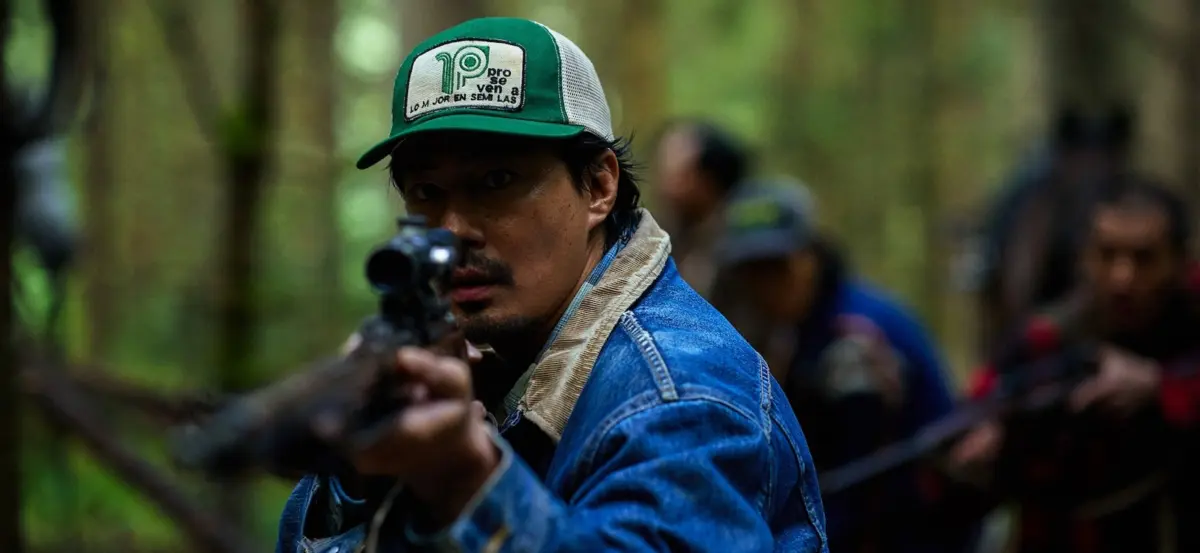
The film’s plot kicks into gear in Hope Harbour, an isolated, rural settlement nestled dangerously close to the heavily fortified Korean Demilitarized Zone. The local tranquility is shattered by a grim discovery: mutilated animal carcasses, shredded perimeter fences, and, most chillingly, a human arm dangling nonchalantly from a tree branch.
When the shapeshifting extraterrestrial entities finally leap into the narrative frame—using massive transport trucks as improvised flyswatters against terrified humans—the film unapologetically pivots into an ultra-violent, adrenaline-fueled shoot-’em-up. The ensuing spectacle features breakneck car chases, horse-riding resistance fighters, and a breathtaking climactic sequence staged on an entirely empty motorway that fuses vehicular fury with equestrian agility. Remarkably, the sheer visceral weight of these scenes is anchored by practical stunts; the camera choreography is so intimately visceral that viewers are left wondering how operators managed to dodge hurtling vehicles and splintering timber.
Supporting Context & Metrics: Production Scale, Cinematography, and Performances
Budgetary Scale and Production Metrics
While precise financial figures are frequently guarded within the competitive landscape of Asian cinema, industry analysts and trade reports consistently position Hope as the most expensive South Korean motion picture ever produced. This unprecedented financial backing allowed Na Hong-jin to assemble a dream team of international talent and technical virtuosity.
The film’s distinct visual grammar is largely credited to cinematographer Hong Kyung-pyo, whose previous masterclasses in framing include Bong Joon-ho’s Oscar-winning Parasite and Lee Chang-dong’s Burning. Eschewing the conventional cinematic shorthand for science fiction—dark, neon-drenched alleyways or sterile, metallic spaceship interiors—Hong lensed Hope entirely in broad daylight.
"It was easier not doing night-time scenes, because there’s no lighting needed, only the daylight," Na explains. "However, I used the forest to give the feel of night-time. The next half of the story will go into actual night-time."
By confining the human inhabitants to the sunlit village and the aliens to the dense, brooding canopies of the surrounding forest, Na establishes a rigid spatial dichotomy. When both species inevitably cross these geographical and existential boundaries, the resulting friction forms the kinetic heartbeat of the narrative.
Standout Performances and Comedic Sensibilities
Despite its heavy themes and visceral splatter-punk violence, Hope is laced with an irreverent, sharp-witted humor that constantly undercuts its own absurdity. The cast leans wholeheartedly into the madness, resulting in a series of unforgettable character dynamics.
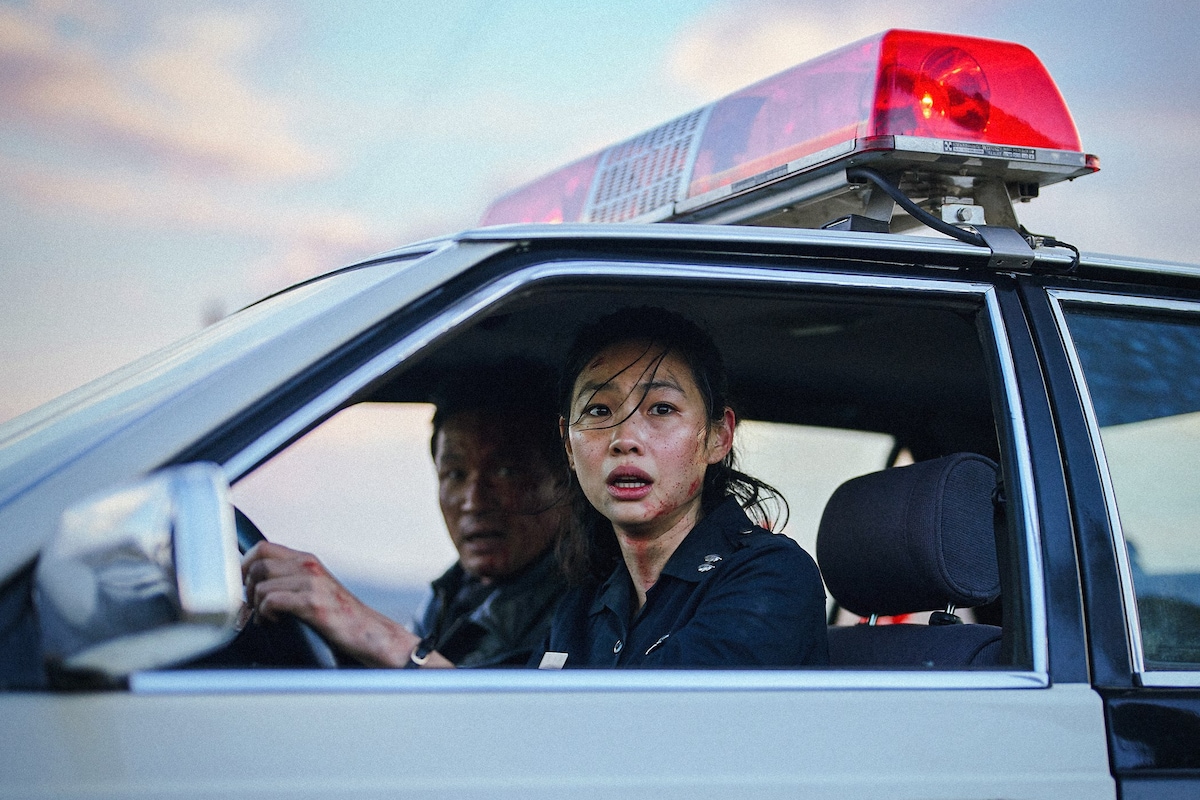
- Jung Ho-yeon (globally recognized for Squid Game) stars as Sung-ae, a hardened policewoman whose deadpan composure is tested when she witnesses an amateur gunman casually obliterating an otherworldly threat. Her awestruck, highly quotable reaction—"Are you a movie star? So damn hot!"—encapsulates the film’s self-aware tonal tightrope.
- Zo In-sung (Possible Love) delivers a charismatic turn as Sung-ki, the trigger-happy local hero executing gravity-defying maneuvers against the invaders.
- Im Hyun-sik, the legendary 80-year-old Korean actor, steals the film entirely. In a surreal, unforgettable monologue, his elderly character ruminates on spicy food, gastrointestinal distress, and the miraculous day a middle finger ultimately saved his life.
Official Statements & Director’s Vision
In late September, speaking through an interpreter, director Na Hong-jin opened up about the deep conceptual architecture underpinning Hope, shedding light on the psychology of his extraterrestrial antagonists and the theological undercurrents of the narrative.
The Alien Perspective and Communication Breakdown
Crucially, Na’s visiting entities are designed to evoke profound empathy and unsettling self-recognition in human viewers. Their faces feature hyper-identifiable human expressions—gasping jaws, furrowed brows, and wide, expressive eyes reminiscent of silent-film icons.
"There’s a backstory that’s not really in the film, because I’m saving it for a later stage," Na reveals. "These aliens — or otherworldly beings — have fear in meeting homo sapiens, and then also disappointment."
When asked whether the humans’ shock at seeing themselves in the aliens implies a reciprocal realization, Na confirms that this psychological mirroring is foundational to the script.
"That’s an underlying factor. They view things from a different position. The problem is that they have a different language and can’t communicate."
Prompted on his deliberate rejection of the term "aliens," Na clarifies a fundamental semantic shift: "To the visiting creatures, it’s the humans that are aliens, and therefore the word is irrelevant."
Theological Undertones: Faith in the Unseen
Beyond the kinetic carnage, Hope introduces a profound layer of religious philosophy. In the film’s closing moments, Alicia Vikander’s character, J’aur, delivers a striking monologue relaying a dream from her emperor: "Faith is evidence of what we do not see." The line is a direct quotation from the biblical Book of Hebrews.
Na, a practicing Christian who similarly laced his previous horror masterwork The Wailing with scriptural references from the Gospel of Luke, notes that these spiritual motifs are entirely deliberate.
"I wanted to subtly have this religious philosophy in Hope," Na explains. "I will talk about having faith in a god in the next chapter."
Expanding on the theological implications of shared scripture between divergent species, Na elaborates on the cosmic hierarchy hinted at in the film’s closing shots:
"At the end, you see a spaceship falling. If you look closely in the sequel, the design of the spaceship is very ancient. Within it, there is an emperor. From our human point of view, it could be a god that’s fallen in that spaceship. To the aliens, it might be their king, who they consider a god, whose duty is not continuing. I wanted to ask a question: when that disappears, how will the cosmic world go on?"
Future Outlook: The Tragedy of the Sequel
For audiences dazzled by the chaotic spectacle of Hope, it may come as a surprise that the current three-hour feature represents only the first half of the narrative Na Hong-jin originally conceived. The foundational draft for a follow-up feature already exists, and the director is actively writing and structuring its evolution.
While Hope leans heavily into kinetic action, brilliant comedic beats, and explosive blockbusting momentum, its successor promises a much darker, more introspective descent into cosmic despair.
"The sequel is a tragedy that goes into more theories, twists, and aggressions," Na states candidly. "I’m writing it at the moment, and trying to organise my thoughts. It might turn into something very different. I don’t find it fun to do the same thing again and again."
Drawing a parallel to his career trajectory—such as how his second feature, The Yellow Sea, intentionally reversed the dynamic between the protagonist and villain of his debut, The Chaser—Na’s planned sequel will pivot the narrative focus firmly toward the perspective of the extraterrestrial beings.
As Hope continues its global theatrical rollout (hitting UK cinemas on September 25), it establishes a new benchmark for international science fiction. By fusing gargantuan financial investment with idiosyncratic arthouse sensibilities, visceral practical stunts, and profound existential questions, Na Hong-jin has not merely delivered South Korea’s most expensive film—he has birthed a cinematic universe poised to redefine the boundaries of modern genre filmmaking.