Executive Overview
In the early 2000s, the United Kingdom’s garage scene was flying high. Infectious, two-step rhythms and singalong R&B choruses packed out nightclubs across the country, while early stars like So Solid Crew began to capture the attention of American audiences. The scene was unapologetically flashy: dancers dressed to the nines, VIPs popping bottles, and artists flexing newfound wealth.
Yet, outside the velvet ropes of those elite London clubs—specifically within the Bow housing estates overlooking the desolate docklands of East London—this high-flying lifestyle cast a long shadow. A generation of kids too young to enter the clubs, priced out of expensive designer clothes, and disillusioned by a historical moment marked by Blairite comedowns and creeping gentrification began to look for an outlet. Out of that socio-economic friction came grime: a murky, abrasive, and defiant sound that, in the decades since, has arguably eclipsed UK garage’s glossy mainstream success.
Fast-forward twenty-five years, and that exact narrative is playing out half a world away in South Korea. According to Richard Price, founder of Seoul Community Radio (SCR), a seismic cultural shift is underway. It centers on a net-native generation of Korean youths who grew up entirely in the imposing, hyper-manicured shadow of the K-pop machine.
"It’s a rebellion against the shininess and corporatism of K-pop," Price explains from his studio in Seoul’s vibrant Itaewon district. "To make a traditional K-pop track, it’s all about high-stakes business deals behind the scenes. So now you’ve got a new generation who are looking at that machinery and saying, ‘Well, let’s just make a DIY version and fuck it up a bit.’"
"Fuck it up" is an apt description. At the core of this movement is a volatile, exhilarating collision between the hyper-pristine K-pop industry that has defined these artists’ daily lives and the so-called "UG" (underground) music that soundtracks their terminally online existence. "UG" serves as an umbrella term for a range of distortion-heavy, deeply digital genres that have colonized internet subcultures over the past few years.
By definition, the UG sound is the ideological antithesis of K-pop: profoundly DIY, texturally disordered, and fiercely independent. Yet, when fused together, these two seemingly opposing worlds brilliantly encapsulate the paradox of growing up Gen-Z in modern South Korea.
Detailed Chronology: From "Slave Contracts" to Creative Rebirth
To understand how South Korea arrived at this creative crossroads, one must examine the shifting structural dynamics of the Korean entertainment industry. For decades, the K-pop monolith operated on rigid, vertically integrated principles. Aspiring stars entered talent agencies as pre-teens, enduring grueling trainee regimens that dictated everything from their vocal styles and weight down to their private lives.
The industry standard historically relied on the infamous "Slave Contracts"—legally binding agreements that routinely locked artists into ten- to thirteen-year commitments, effectively signing away their creative agency during their creative primes. This system produced unmatched global powerhouses like BTS and BLACKPINK, transforming Korean pop culture into an unstoppable multi-billion-dollar export. However, it left little room for genuine artistic autonomy.
The Seven-Year Turning Point
The tide began to turn when the standard entertainment contract length was legally recalibrated to a maximum of seven years. This adjustment created a profound structural shift: K-pop idols who debuted in the mid-to-late 2010s began reaching the ends of their initial contracts while still at the peak of their global fame and artistic capabilities.
Armed with immense personal capital, massive international fanbases, and a burning desire for creative control, these veterans began charting new courses.
- The Independent Exodus: Artists like Loona alumna Yves openly declared a "creative rebirth in hyperpop" upon going solo, casting off the constraints of corporate pop to experiment with jagged electronic textures.
- Cross-Pollination from Within: Mainstream superstars started treating genre-bending side quests as the norm. Earlier this year, Vernon and The8 of the K-pop mega-group SEVENTEEN stepped outside their parent group to release V8, a hyperpop EP featuring production from Munich-born Drain Gang architect Mechatok.
- Global Collaborations: BLACKPINK’s Lisa enlisted songwriting credits from DIY pop visionary Helena Gao for her solo material, while Twice rapper Chaeyoung was spotted networking with underground icons like Bladee and Mechatok.
Richard Price, who booked Yves, V8, Mechatok, and underground stalwart The Deep on a landmark Itaewon rave lineup earlier this year, notes that this pivot toward messier, avant-garde sonics stems directly from these shifting power dynamics.
"Once those recording contracts are up, you start seeing stars like Lisa showing their own curation and artistic direction," Price observes. "What we’re seeing now is what happens when these contracts expire while signees are still young and culturally relevant. They are finally free to negotiate deals entirely on their own terms."
Supporting Context & Metrics: The Anatomy of "UG K-Pop"
The convergence of pristine pop structures and chaotic internet subcultures has birthed a movement that insiders have aptly dubbed "UG K-pop." This sound rejects the sanitized perfection of traditional idol music in favor of a maximalist, glitch-ridden, and emotionally raw aesthetic.
Consider the 2025 single "My Unnies" by collaborative artists Kimj, Sebii, The Deep, and Effie. Serving as an unofficial manifesto for this new generation, the track features sweet, Konglish vocals from anti-stars The Deep and Effie, which producers kimj and Sebii chop up into a sugary acid trip. It layers earwormy melodies against stuttering digital glitches and heavy, Skrillex-esque bass drops.
The accompanying music video abandons the tightly choreographed, soundstage-polished look of traditional K-pop. Instead, it features the quartet partying in swimwear on a sun-drenched beach in Thailand. There are no rigid industry choreography steps here; this is K-pop unchained.
[Traditional K-Pop Pipeline] ---> Corporate Trainee System ---> Strict 7-13 Year Contracts ---> Sanitized Global Export
[The UG K-Pop Evolution]     ---> Internet-Native DIY Ethos ---> Contract Expirations/Indie ---> Maximalist, Glitch-Heavy Autonomy
This stylistic shift mirrors a broader generational psychological change. As consumer habits have fractured across TikTok, SoundCloud, and Discord, young Koreans have grown increasingly weary of homogenous beauty standards and manufactured perfection.
Official Statements and Industry Insights
The infrastructure supporting this musical rebellion is expanding rapidly. Enterprising management agencies are rewriting the rules of Korean artist development by importing Western-style models that prioritize creative freedom over corporate control.
"The new generation is much more individualistic, comfortable with being unconventional, and not afraid to be imperfect,"
— Eddie Moon, DJ-turned-manager overseeing rising UG acts kimj, The Deep, and Effie.
Moon’s Seoul-based agency, A MASS CULTURE, operates on a philosophy that remains distinctly counter-cultural within the domestic market.
"We believe in putting artists first and protecting their creative independence," Moon states. By leveraging the internet to bypass traditional broadcast gatekeepers, agencies like A MASS CULTURE allow artists to build direct-to-consumer audiences worldwide, rendering the approval of legacy television networks and monolithic talent agencies obsolete.
This philosophy directly challenges the inner workings of corporate giants like YG Entertainment and Hybe. Yet, intriguingly, even these legacy institutions are beginning to sniff around the underground, eager to co-opt the raw energy of the youth before it completely bypasses them.
The Vanguard: Five Corners of the UG K-Pop Movement
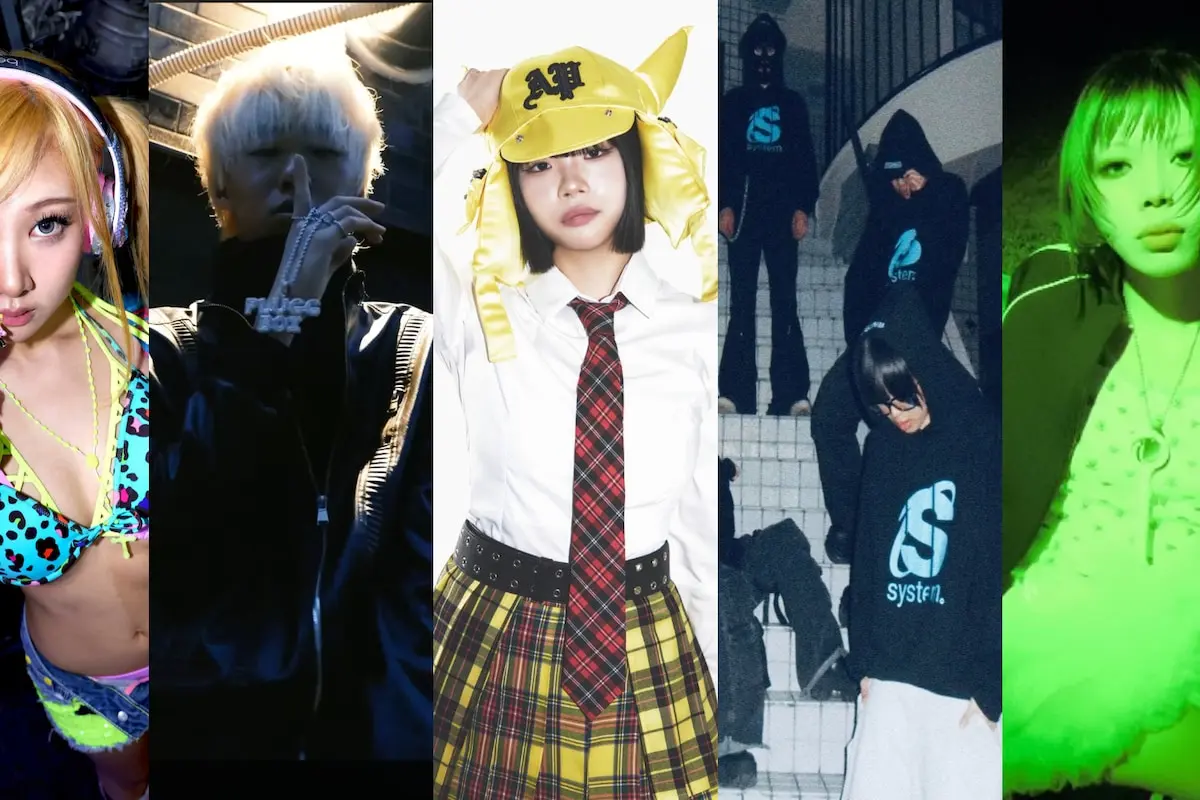
To fully grasp the scope of this revolution, one must examine the diverse artists spearheading the UG K-pop and underground electronic crossover. Below are five key entities defining the soundscape.
1. System Seoul
At first glance, the four-piece boy group System Seoul could easily pass for a traditional K-pop outfit. Signed to YG Plus (a subsidiary of BLACKPINK’s label, YG Entertainment), its four masked members—sn7, ycs, hawks, and MUNZi—sport vibrant hair colors and boast dedicated pages on NamuWiki, the Korean equivalent of Wikipedia.
However, hitting play reveals an entirely different reality. Their music sounds like Playboi Carti soundtracking a high-speed session of Dance Dance Revolution. Across their trilogy of SS-Pop albums released this year, hardstyle electronic beats, hyperpop glitch vocals, and pluggnb melancholia collide. While they sit closer to the corporate mainstream than others on this list, their output proves that even Korean mega-labels are scrambling to monetize the internet-addled brains of early-twenty-somethings.
2. The Deep
Alongside close collaborators and labelmates kimj and Effie, The Deep is the textbook archetype of the K-pop anti-hero. Famously referring to herself as a "K-Pop bitch," she embraces messy imperfections, actively steering her own production and music video direction. Her infectious electronic-pop songwriting has naturally caught the attention of major talent agencies, who frequently hire her to write for mainstream idols.
Globally, The Deep has forged vital inroads with international counter-part acts, collaborating with American sibling duo Frost Children and Japanese girl group F5ve. As a mainstay of Seoul Community Radio events, she occupies a space akin to Wiley during the formative years of UK grime.
3. Kirin
Telltale signs that an artist spent their entire adolescence online include a penchant for low-resolution aesthetics, an unironic love for vintage Instagram filters, and profound nostalgia for eras they never lived through. Kirin’s music videos check every single box.
Her 2025 single "Usotsuki" packages bizarre British pop motifs—such as a "Keep Calm and Carry On" t-shirt and a Union Jack halter top—inside a chaotic track that somehow fuses R&B with brostep. Kirin’s appeal lies in her ability to marry polished pop vocal delivery with a dizzying love for electronic music’s entire spectrum, seamlessly layering trance synths, bouncing donk bass, and baile funk rhythms within a single composition.
4. Kimmy Gone
Representing the heavier, rap-leaning side of the spectrum is 24-year-old Kimmy Gone. Having previously competed on the mainstream Korean hip-hop competition series Show Me The Money in 2022, she has since pivoted toward jagged, bit-crushed production.
Over the years, Kimmy Gone has collaborated with heavyweights of Korean hip-hop like Sik-K, EK, and Kid Milli. Her recent work highlights a fascinating global convergence: the rap lineage of Playboi Carti and the maximalist electronic legacy of Skrillex inadvertently colliding at the exact same hyper-distorted destination.
5. Pluggboi
Korean hip-hop has historically been almost as heavily corporatized as K-pop. Enter Pluggboi. True to his moniker, Pluggboi specializes in plugg music—a dreamy, atmospheric subgenre of trap born in Atlanta.
In tracks like "Sekai Banger," these southern US rhythms find a bizarre, synergistic alignment with contemporary Korean youth culture. The tracks frequently dissolve into sugary, technicolour digital distortion that evokes the interior of a PC Bang (a Korean LAN gaming cafe): multiple video game soundtracks bleeding into one another, cute chibi vocal samples, and heavily glitched-out visual aesthetics.
Future Outlook: Unchaining the Beast
The emergence of UG K-pop represents a profound full-circle moment for South Korean music culture. The relentless, market-driven aggression of early K-pop infrastructure successfully catapulted the nation to the forefront of global pop innovation, mastering the dark arts of mass-appeal catchiness and internet virality.
Now, as its biggest stars break free from restrictive contracts and a new wave of DIY creators bypass the gatekeepers entirely, this formidable musical beast is finally being unchained.
Much like the evolution of UK grime from the damp estates of East London, this new generation of Korean artists is proving that true cultural longevity cannot be manufactured in a corporate boardroom. By finding success entirely on their own terms, they have unlocked an unprecedented reservoir of creative potential—signaling that the most exciting chapter of South Korean music history is only just beginning.