Executive Overview
For the better part of a century, popular culture has promised the imminent arrival of the flying car—a seamless fusion of highway convenience and aerial mobility. While decades of concept art and speculative engineering have largely yielded disappointment, recent developments from the electric vehicle sector suggest a paradigm shift. Last week, Elon Musk unveiled the long-delayed Tesla Roadster 2 prototype, showcasing an array of radical capabilities that blur the line between terrestrial and aerospace engineering.
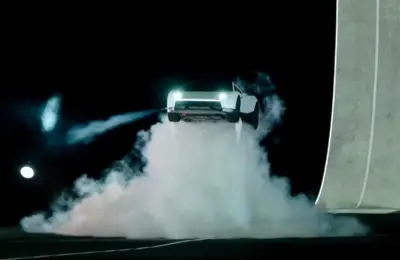
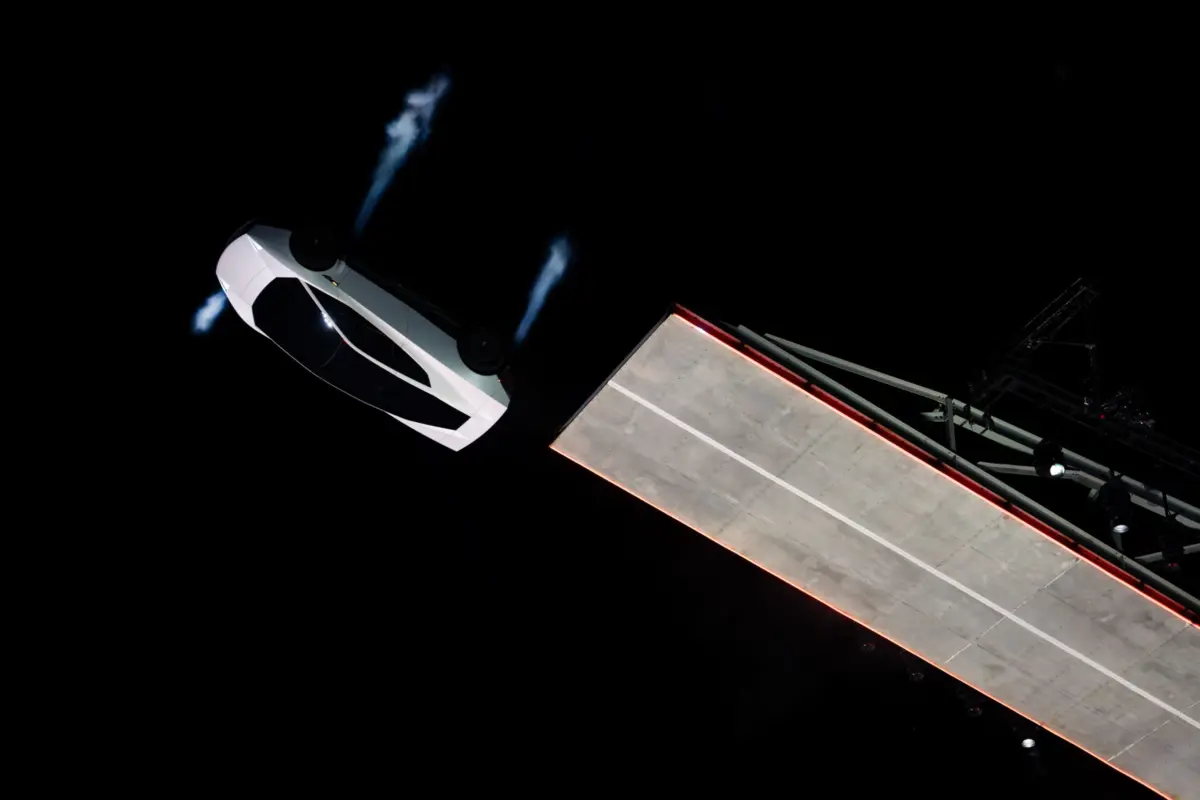
Beyond standard EV benchmarks, the Roadster 2 prototype demonstrated several feats previously relegated to science fiction: scaling a vertical wall, remaining glued to a surface completely upside down in a manner reminiscent of comic-book physics, leaping over an entire fleet of Tesla vehicles, and achieving a zero-to-sixty-miles-per-hour acceleration time of under one second.
These physics-defying demonstrations invite two immediate lines of inquiry. The first—whether human drivers should be entrusted with vertical and aerial mobility given their documented struggles with two-dimensional roadways—belongs squarely in the domain of traffic law, civil infrastructure planning, and the Federal Aviation Administration (FAA). The second inquiry, however, is purely empirical: How did the Roadster 2 prototype accomplish these maneuvers without violating the laws of classical mechanics?
Through a rigorous breakdown of friction, aerodynamic suction, rocket propulsion, and kinematic video analysis, this report investigates the underlying physics of Tesla’s latest engineering showcase. The findings reveal that while the vehicle’s stunts rely on legitimate, time-tested physical principles, translating them into a commercially viable, human-safe product remains an immense engineering hurdle.
Detailed Chronology: The Evolution and Unveiling of the Roadster 2
The journey of the second-generation Tesla Roadster is a masterclass in elongated development cycles and shifting industrial baselines. Originally announced to the public in November 2017, the vehicle was initially slated for a market release in 2020. Musk boasted at the time that the sports car would achieve zero to 60 mph in 1.9 seconds, travel 620 miles on a single charge, and feature a removable glass roof that could be stored in the trunk.
However, successive corporate priorities—ranging from scaling the production of the Model Y and navigating global supply chain disruptions to developing the long-delayed Tesla Semi and the autonomous Cybercab—pushed the Roadster’s production timeline further into the future. With each delay, Musk’s public statements regarding the vehicle’s capabilities escalated from ambitious to hyper-ambitious. By 2023 and 2024, references were frequently made to a "space-X package," hinting at cold-gas thrusters derived from aerospace technology.
The chronology culminated last week with a closed-circuit prototype demonstration that shocked automotive journalists and physicists alike. Rather than presenting a conventional sports car with improved battery chemistry, Tesla showcased a vehicle equipped with active aerodynamic systems and compressed-air propulsion channels.
The sequence of the demonstration was meticulously choreographed:
- The Vertical Wall Drive: The prototype navigated a high-banked, circular architectural feature, transitioning from a horizontal plane to a vertical wall and remaining inverted at the apex without losing traction.
- The Sub-Second Sprint: The vehicle executed a dead stop to 60 mph launch sequence completed in a fraction of a second—a threshold previously thought mathematically impossible for wheeled land vehicles relying solely on tire-road contact.
- The Aerial Leap: Utilizing short-duration thrust vectors, the prototype launched itself vertically off the ground, clearing the height of a parked Tesla Semi truck before landing safely on its suspension.
This escalation from a luxury electric sports car into a thrust-vector-enabled hybrid land-air vehicle marks a definitive turning point in the marketing and engineering philosophy of Tesla, trading traditional automotive classifications for aerospace-adjacent performance metrics.

Supporting Context & Metrics: The Physics Behind the Prototype
To understand how the Roadster 2 accomplishes these feats, we must move beyond marketing rhetoric and examine the fundamental laws of physics governing friction, pressure differentials, and momentum.
1. Driving Up a Wall: Mastering Friction and Normal Force
The mechanics of how a car negotiates an incline—let alone a vertical or inverted surface—rely entirely on the nature of static friction. When two surfaces, such as rubber tire treads and asphalt, interact, a resistive force prevents them from sliding relative to one another. This interaction is quantified by the static friction force ($F_f$), which depends on two primary variables: how hard the surfaces are pressed together (known as the normal force, $F_N$) and the material properties of the interacting surfaces (the coefficient of static friction, $mu$).
$$vecF_f le mu vecF_N$$
For standard rubber on dry asphalt, the practical maximum coefficient of static friction ($mu$) hovers around 0.6, occasionally reaching 0.9 with ultra-high-performance racing compounds. When a conventional car attempts to drive up an inclined plane, the gravitational force ($mg$) is divided into components parallel and perpendicular to the surface. As the angle ($theta$) of the incline increases, the perpendicular component decreases, which directly reduces the normal force ($F_N$) and, consequently, the maximum available frictional force.
[Standard Incline Mechanics]
         Gravity (mg)
              |
              v
       Car ------> [Incline Angle θ]
        ^
        |-- Normal Force (FN) [Decreases as θ approaches 90°]
Calculations demonstrate that with a standard friction coefficient of 0.6, a vehicle can safely navigate a maximum incline of roughly 31 degrees. Even under optimal laboratory conditions with a friction coefficient of 0.9, the theoretical limit caps out at approximately 42 degrees. A vertical wall (90 degrees) is entirely out of reach for a normal car because the gravitational force pulling the vehicle downward is no longer counterbalanced by a perpendicular normal force.
To defeat this limitation, a vehicle must artificially generate an extraordinary normal force. This is precisely where the Roadster 2 employs its first major innovation: integrated underside fans combined with active peripheral sealing flaps. By evacuating air from beneath the chassis, the vehicle creates a localized low-pressure zone.
Using fundamental fluid dynamics and the pressure equation ($F = P times A$), we can evaluate the feasibility of this suction. Assuming a target vehicle weight of 1,700 kilograms for the Roadster 2 and a ground-contact footprint area of approximately 2 square meters, we can calculate the necessary pressure differential against standard atmospheric pressure ($sim 10^5 text Newtons per square meter$).
To generate enough downward force to match the gravitational pull of a 1,700-kg vehicle (roughly 16,660 Newtons), the pressure beneath the chassis must drop to approximately 86 percent of standard atmospheric pressure. This pressure differential is well within the capabilities of modern centrifugal fan systems, though maintaining a continuous seal across varied road imperfections requires aggressive, real-time active aerodynamics.
2. The Mechanics of Sub-Second Acceleration
Achieving zero to 60 mph (26.8 meters per second) in under one second demands acceleration rates that dwarf standard gravity ($9.81 text m/s^2$). For a conventional automobile relying solely on tire friction, the maximum acceleration ($a$) is bounded by the coefficient of friction:

$$a = mu g$$
Assuming an optimal friction coefficient of 0.6, the maximum horizontal acceleration a standard car can achieve is roughly $5.88 text m/s^2$, which translates to a zero-to-sixty time of approximately 4.56 seconds. Even with specialized drag slicks and aerodynamic downforce generated at high speeds, mechanical friction alone cannot bridge the gap to a sub-second interval.
To break this physical ceiling, the Roadster 2 incorporates compressed-air thrusters—operating on the exact same mechanical principles as chemical rockets and simple balloon-propelled toys. When compressed air is violently expelled through a rear-facing nozzle, the gas acquires mass and velocity. By Newton’s Third Law of Motion, every action generates an equal and opposite reaction: as the vehicle’s internal systems force the air backward, the air exerts an equal and opposite forward force on the vehicle. This supplementary thrust bypasses the limitations of tire-to-road friction entirely.
3. Aerial Leaps and Kinematic Analysis
The most sensational aspect of the Roadster 2 demonstration was its ability to leap over a Tesla Semi truck. This maneuver utilizes vertical thrusters to momentarily overcome the Earth’s gravitational field. However, brief thrust durations present severe kinematic constraints. To achieve sufficient displacement in a fraction of a second, the vehicle must experience extreme vertical acceleration.
By applying video tracking analysis to the prototype’s jump over the 4-meter-tall Semi truck, physicists can map the vehicle’s vertical position as a function of time. Fitting a quadratic equation to the resulting position-time parabola yields an estimated vertical acceleration of approximately $98 text m/s^2$.
$$textEstimated Vertical Acceleration approx 98 text m/s^2 approx 10 , g$$
This figure represents an extreme physiological threshold of approximately $10 , g$—meaning the occupants would experience a force equal to ten times their normal body weight. While human beings with specialized training (such as fighter pilots and astronauts equipped with anti-G suits) can survive $10 , g$ forces for short durations, doing so is physically punishing, disorienting, and carries inherent medical risks, including blood pooling, greyout, or loss of consciousness. It is likely no coincidence that the prototype featured a robotic mannequin in the driver’s seat during this specific demonstration.
Official Statements & Industry Reception
The unveiling of the Roadster 2 prototype has generated intense debate across the automotive, aerospace, and academic engineering communities. Industry analysts are sharply divided over whether Musk’s latest presentation represents a genuine technological leap or an elaborate marketing distraction designed to maintain investor enthusiasm.
In his post-unveiling briefing, Elon Musk emphasized the convergence of automotive and aerospace design, noting:

"We are taking technologies that were previously restricted to SpaceX rockets and military aviation and integrating them into a consumer-accessible sports car. Physics is not a limitation; it is merely a set of rules we are learning to rewrite through software and active energy management."
Conversely, veteran automotive engineers and safety advocates have expressed profound skepticism regarding the commercial viability and regulatory compliance of thrust-vector-enabled passenger vehicles. A prominent independent automotive safety researcher remarked:
"Generating ten Gs of vertical acceleration and utilizing under-car suction fans to climb vertical structures transforms a passenger vehicle into an unregulated low-altitude aircraft. The National Highway Traffic Safety Administration and the FAA will have jurisdictional nightmares trying to classify a machine that transitions from highway driving to rocket-assisted leaping."
Aerospace physicists have similarly pointed out the severe thermodynamic and energetic penalties associated with compressed-air thrusters. Maintaining high-pressure gas reserves capable of delivering multiple high-thrust bursts requires heavy storage tanks, complex compressors, and significant energy consumption—all of which directly degrade the vehicle’s primary battery range and structural payload capacity.
Future Outlook: Commercial Reality vs. Engineering Spectacle
As the automotive industry looks toward the late 2020s, the Roadster 2 stands as a fascinating case study in the friction between visionary engineering and practical physics. While the prototype successfully demonstrated that rockets and suction fans can manipulate a car into defying traditional limits of traction and elevation, translating these circus-style stunts into a safe, reliable, and mass-producible consumer vehicle remains a monumental hurdle.
Key Milestones Required for Commercialization:
- Regulatory and Airspace Integration: Before any vehicle can legally execute aerial leaps or operate with active downward suction fans on public roadways, regulatory frameworks must be established to govern multi-axis vehicular motion. Insurance liability for accidents involving sudden vertical displacement will require entirely new underwriting models.
- Physiological Safety Limits: Sustaining $10 , g$ vertical accelerations is incompatible with general consumer adoption. Future iterations must either temper their performance parameters to remain within human tolerance limits (typically 2 to $3 , g$ maximum for untrained civilians) or restrict such modes exclusively to automated, track-only software profiles.
- Energy Efficiency and Thermal Management: The parasitic energy drain of running continuous underside vacuum fans and high-pressure pneumatic compressors significantly impacts overall battery efficiency. Breakthroughs in solid-state battery density and lightweight composite materials will be required to offset the dead weight of the auxiliary propulsion systems.
Ultimately, the Tesla Roadster 2 prototype has successfully re-ignited public imagination regarding the future of personal transport. Whether it paves the way for a new genre of high-performance hybrid vehicles or remains an engineering curiosity destined for the history books, it serves as a stark reminder of the immutable power—and occasional absurdity—of classical mechanics applied to modern machines.