Executive Overview
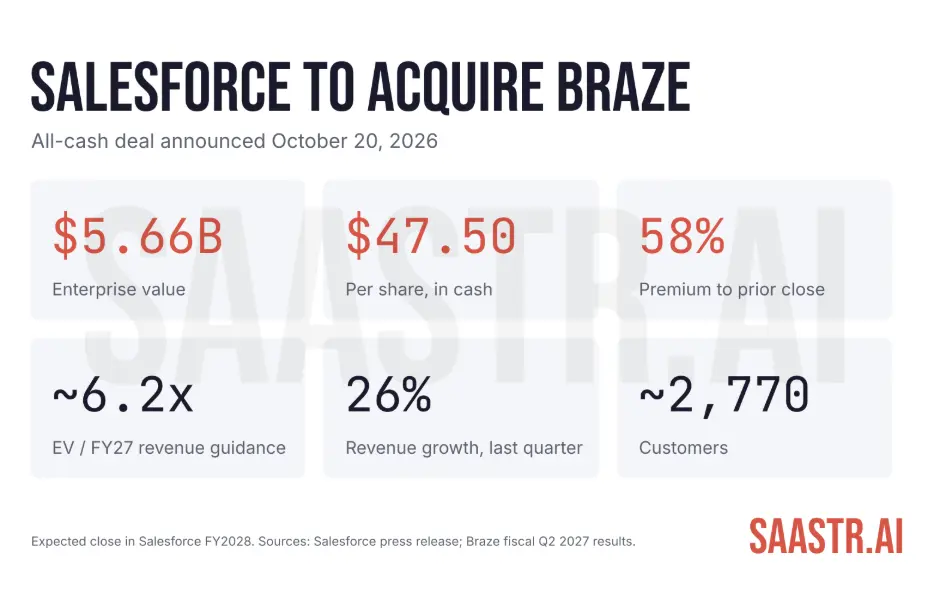
In a blockbuster move that has sent shockwaves through the enterprise software landscape, Salesforce announced its acquisition of customer engagement platform Braze for approximately $5.66 billion in enterprise value. Under the terms of the agreement, Braze Class A shareholders will receive $47.50 per share in cash—representing a staggering 58% premium over the company’s closing price of $30.04 just days prior.
The deal values Braze at roughly 6.8x its trailing twelve months (TTM) revenue of $834 million. This multiple stands in stark contrast to the depressed valuations plaguing the broader go-to-market (GTM) software sector, where public market investors have largely priced marketing tech companies at a modest 3x to 4x revenue.
For Salesforce, the acquisition is designed to directly address historical weaknesses in its Marketing Cloud ecosystem—specifically, real-time mobile and in-app engagement—while integrating high-value consumer brands like Canva, Instacart, Venmo, and Equinox into its expansive data and AI architecture. For startup founders, venture capitalists, and public market investors alike, the Braze transaction serves as a defining case study illuminating the profound valuation disconnect between public equity markets and strategic corporate buyers in the age of artificial intelligence.
Detailed Chronology & Deal Mechanics
The path to the Salesforce-Braze merger unfolded rapidly over a six-week window characterized by market volatility, strong operational execution, and aggressive corporate consolidation.
The September Earnings Beat and Subsequent Market Drop
On September 8, Braze delivered a strong quarterly earnings report that would typically have been celebrated by Wall Street. The company posted $227.2 million in quarterly revenue, marking a 26% year-over-year increase and beating consensus expectations by approximately $6.9 million. Braze also outperformed on earnings per share (EPS) and raised its full-year guidance.
Despite these positive operational indicators, Braze’s stock tumbled 25.1% by the end of the week. Public market investors fixated on moderating top-line growth rates and the fact that monetization from newly introduced artificial intelligence capabilities was not yet contributing materially to overall revenue. Wall Street largely chose to discount the company’s expanding profit margins and surging free cash flow in favor of macroeconomic anxieties surrounding AI disruption.
The Six-Week Turnaround to Acquisition
Rather than languishing in the public markets as a misunderstood asset, Braze’s underlying fundamentals caught the eye of enterprise software giants actively seeking to fortify their AI-driven customer experience suites. Just six weeks after its earnings dip, Salesforce swooped in with an all-cash offer valuing the company at $47.50 per share.
Faced with a choice between a public market valuation pegged at a mediocre multiple and a strategic acquisition price that represented a 58% premium, Braze’s board of directors accepted the deal. The transaction highlights a vital lesson for late-stage tech companies: while public markets often penalize software firms for decelerating growth, well-positioned strategic buyers are more than willing to pay a heavy premium for entrenched customer lists, robust data architectures, and verified cash-flow generation.
Supporting Context & Metrics: The MarTech Valuation Disconnect
To fully understand the significance of Salesforce’s 6.8x revenue payout for Braze, one must examine the broader financial ecosystem surrounding Go-To-Market (GTM) software in late 2026.

Public Markets vs. Strategic Buyers
As of October 2026, the public markets have taken a cautious, if not pessimistic, stance on marketing applications. Many prominent marketing tech platforms operate on usage-based pricing models—charging by contact, message, or seat. Public investors harbor deep concerns that generative AI agents will ultimately cannibalize seat counts and reduce the campaign-building workload those platforms rely on, pricing in this existential risk long before it registers on income statements.
Consequently, marketing software valuations have compressed significantly:
- HubSpot: Trading at ~3.1x trailing revenue (growing at 20%)
- Klaviyo: Trading at ~3.1x trailing revenue (growing at 26%)
- Monday.com: Trading at ~2.3x trailing revenue (growing at 22%)
- Adobe: Trading at ~3.8x trailing revenue
- Sprinklr: Trading at ~1.1x trailing revenue
- Salesforce (Parent): Trading at ~5.3x trailing revenue
Against this backdrop, the broader public B2B median sits at approximately 4.5x forward revenue. When Salesforce paid 6.8x revenue for Braze, it shattered the ceiling of the public peer group. Strategic buyers view these businesses through an entirely different lens: a company growing at 26% with nearly 2,800 enterprise customers and strong free cash flow is worth a premium because conglomerates like Salesforce can immediately cross-sell platforms like Data 360 and Agentforce into those accounts—synergies that public market metrics rarely capture.
Deep Dive into Braze’s Financial and Operational Health
Braze’s final quarters as an independent public company offer critical blueprints for scaling SaaS businesses efficiently:
- Disciplined OpEx and Margin Expansion: Braze decoupled its operating expenses from its top-line growth. While revenue grew 26% year-over-year, operating expenses rose by a mere 6% to $170 million. Non-GAAP operating margins improved by over 600 basis points year-over-year, with management guiding to an additional 400 basis points. This deliberate hiring restraint, supercharged by AI efficiencies, drove quarterly free cash flow to a record $21.7 million and left the company with $413.9 million in cash reserves—making it an immensely attractive acquisition target for an all-cash buyer.
- Upmarket Momentum and Net Retention: Dollar-based net retention settled at 110% overall, climbing to 112% for large customers (up 100 basis points sequentially). Recognizing that existing accounts alone could not fuel hyper-growth, Braze aggressively pushed upmarket. Customers contributing over $500,000 in annual recurring revenue (ARR) surged 28% to 361, up from 282. Total customer count expanded 15% to 2,789.
- The Professional Services Boom: Professional services and other revenue more than doubled, jumping to $19.6 million from $8.3 million a year prior—a staggering 136% growth rate that elevated services from 5% to roughly 9% of total revenue. This reflects a broader B2B trend: as enterprises deploy complex AI decisioning tools and autonomous agents, they require specialized, hands-on professional services to connect disparate customer data lakes and optimize models, creating a high-margin secondary revenue stream.
- Early AI Monetization: Paid adoption of Braze’s AI products reached roughly one-third of its large customer base, climbing 900 basis points from Q1 following the rollout of features like AI Operator. However, because AI was bundled into broader packages rather than isolated as a distinct growth-driving SKU, public investors gave the company little credit for the attach rate, illustrating the challenges founders face in communicating AI-driven value to Wall Street.
Official Statements and Industry Impact
The acquisition is part of a relentless 2026 acquisition spree by Salesforce, which has already announced or closed deals for Contentful, m3ter, Fin, Listen Labs, and Loops.
Salesforce intends to deeply integrate Braze into its Customer 360 framework, specifically bolstering Marketing Cloud. Historically, Marketing Cloud has dominated the enterprise email space but lagged behind competitors in real-time mobile push notifications and in-app engagement. By absorbing Braze, Salesforce instantly acquires a world-class mobile engagement engine and a coveted roster of digital-first consumer brands—including Canva, Instacart, Venmo, Equinox, Urban Outfitters, and Dairy Queen—that Salesforce historically struggled to win on its own.
Braze CEO Bill Magnuson confirmed that the company will continue building under the Braze banner, maintaining its product identity even as its underlying architecture feeds into the broader Salesforce ecosystem. Industry observers note that the success of this integration will hinge on how seamlessly Salesforce bridges its traditional enterprise cloud infrastructure with Braze’s agile, developer-friendly mobile infrastructure.
Future Outlook: What the Deal Means for Founders and the Enterprise Software Ecosystem
The Salesforce-Braze transaction establishes a vital precedent for the future of enterprise software exits:
- The Re-Evaluation of Strategic M&A: As public markets remain hyper-conservative and skeptical of software margins, late-stage tech companies may increasingly view strategic acquisitions as a superior alternative to initial public offerings. When public comps trade at 3x revenue, an IPO risks locking founders into a depressed valuation. Strategic buyers requiring proprietary data distribution networks are proving willing to pay double that multiple.
- The AI Attribution Dilemma: Braze’s journey proves that robust internal AI adoption is not enough to satisfy public market analysts if it does not immediately accelerate top-line growth metrics. Founders must carefully consider product packaging—deciding whether to bundle AI features into existing tiers or spin them out as distinct, high-margin SKUs with transparent reporting metrics.
- Operational Discipline as a Currency: Braze’s ability to grow revenue by 26% while limiting operating expense growth to just 6% transformed it from a standard SaaS growth story into a cash-generating powerhouse. In an economic climate where acquirers demand financial self-sufficiency alongside growth, capital efficiency remains the ultimate safeguard for technology executives.
Ultimately, Salesforce’s acquisition of Braze signals that while Wall Street may momentarily underappreciate the foundational infrastructure of modern marketing technology, industry titans recognize its indispensable value in orchestrating the future of customer engagement.