Executive Overview
As federal and state legal scrutiny intensifies around former United States President Donald Trump, the intersection of real-world jurisprudence and speculative digital culture has reached an unprecedented crossroads. Prosecutors in New York have inched closer to handing down a historic criminal indictment—stemming from an alleged hush-money payment made to former adult film actress Stormy Daniels in the waning days of the 2016 presidential election—that would shatter centuries of American legal precedent, making Trump the first former or sitting commander-in-chief in history to face criminal charges.
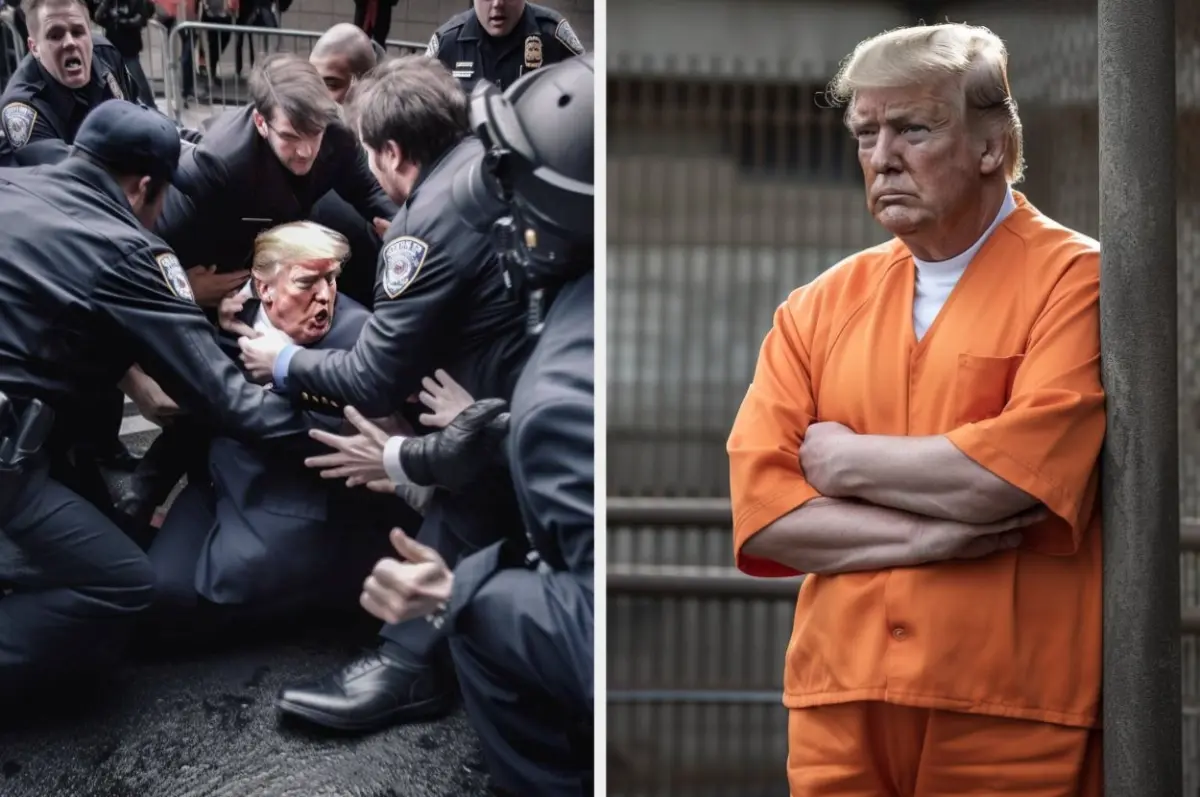
Yet, while grand juries deliberate behind closed doors in Manhattan, the digital public square has not waited for the gavel to drop. Instead, internet users, satirists, and digital artists have rushed to fill the informational vacuum with speculative fiction, chief among them being Eliot Higgins, the founder of the pioneering open-source investigative collective Bellingcat. Using the advanced text-to-image artificial intelligence platform Midjourney, Higgins generated a dramatic, highly detailed sequence of roughly 50 images depicting a fictionalized arrest of Donald Trump on the streets of New York City.
The images—showcasing everything from a chaotic struggle outside Trump Tower involving heavily equipped police officers to melodramatic depictions of family reactions and surreal glimpses of a prison jumpsuit—spread across social media with blinding velocity. Within hours, they crossed the threshold from obvious satire into the realm of viral misinformation, fooling unsuspecting users and sparking intense online debates.
The fallout was swift. Within days of the images going viral, Higgins announced that Midjourney had effectively banned him from the platform, while the company quietly restricted the use of the term “arrested” in its prompt filters. This incident has catalyzed an urgent global conversation regarding the ethics of generative artificial intelligence, the fragility of the information ecosystem on social media, and the profound legal and societal hazards posed by hyper-realistic synthetic media at a time of acute political polarization.
Detailed Chronology: From Digital Prompt to Global Viral Phenomenon
The Catalyst: Impending Indictments and Public Anticipation
The genesis of this digital firestorm lies in the protracted legal investigations surrounding Donald Trump. By March 2023, media outlets were reporting intensely on the Manhattan District Attorney’s office, led by Alvin Bragg, signaling that an indictment related to the Stormy Daniels payoff was imminent. Trump himself took to social media to predict his own arrest, urging his supporters to protest. This charged atmosphere created a pressure cooker of public anticipation, transforming every rumor, legal filing, and media broadcast into a focal point for national anxiety and speculation.
The Experiment: Higgins and Midjourney v5
It was against this backdrop that Eliot Higgins, known globally for his meticulous open-source intelligence (OSINT) work tracking Russian military movements in Ukraine and identifying suspects in the downing of flight MH17 via Bellingcat, turned his investigative toolkit toward generative AI.
At the time, Midjourney had just released version 5 of its text-to-image engine, a monumental leap forward in rendering human anatomy, lighting, facial expressions, and complex spatial interactions. Speaking with reporters, Higgins explained that he was simply "playing around with various prompts to see what’s possible and how complex you can make it."
Higgins began inputting speculative narrative prompts:
- Donald Trump being arrested by police on the streets of New York.
- Melania and Donald Trump’s children reacting to a police sweep outside Trump Tower.
- Donald Trump wearing an orange prison jumpsuit behind bars, reading a newspaper in a jail cell.
The resulting images were striking. Unlike the blurry, mutated hands and uncanny valley distortions of earlier AI iterations, Midjourney v5 produced photorealistic, cinematic compositions. The lighting mirrored professional news photography; the expressions bore convincing emotional weight; and the settings—complete with New York Police Department uniforms, flashing sirens, and recognizable architectural backdrops—looked entirely authentic at first glance.
The Viral Cascade on Social Media
On March 20, 2023, Higgins shared a thread containing approximately 50 of these images on Twitter. Accompanied by minimal disclaimers or presented simply as an artistic exploration of AI capabilities, the thread exploded across the platform.
Within hours, the images were stripped of their original context and re-shared by accounts with millions of followers. Many users shared them genuinely believing they depicted breaking news of an actual arrest. Pundits, political commentators, and casual internet browsers alike reacted with a mix of glee, horror, confusion, and amusement. For a brief window of time, the digital simulation completely overshadowed physical reality, demonstrating the terrifying velocity at which synthetic media can outpace human critical faculties.
The Platform Crackdown and Ban
The viral explosion did not go unnoticed by the developers of the technology. As news outlets began contacting Midjourney for comment regarding the ethical implications of their platform being used to fabricate high-stakes political events, the company took defensive action.
By Wednesday of that week, Higgins discovered that his access to the Midjourney service had been revoked. The platform, struggling to manage the public relations fallout and the potential legal liabilities of users generating defamatory or misleading content involving real public figures, instituted sudden platform-wide policy adjustments. Most notably, Midjourney blocked the word "arrested" from its prompt-generation engine entirely, rendering users incapable of producing similar scenarios involving law enforcement interventions. Despite mounting inquiries from journalists worldwide, Midjourney representatives maintained a relative silence, declining to issue immediate, comprehensive statements regarding the specifics of Higgins’s ban.
Supporting Context & Metrics: The Mechanics and Dangers of Generative AI
The Technological Leap: Why Midjourney v5 Changed Everything
To understand the panic surrounding Higgins’s experiment, one must analyze the technological maturation of generative artificial intelligence. For years, deepfakes and AI images suffered from identifiable artifacts: unnatural skin textures, impossible geometry, incorrect text rendering, and distorted fingers.
Midjourney v5 dismantled these safety barriers almost overnight. By training on vast datasets of scraped internet imagery—including professional photojournalism, stock photography, and celebrity portraiture—the algorithm learned to mimic the distinct visual grammar of breaking news. When an AI generates an image with the visual signatures of a CNN broadcast or an Associated Press photograph—grainy low-light conditions, motion blur, telephoto compression—the human brain instinctively applies cognitive heuristics that categorize the image as "documentary evidence."
Quantitative Impact: Engagement and Misinformation Metrics
While precise platform-wide analytics for Higgins’s specific thread are proprietary to Twitter (now X), social media analytics firms observed staggering ripple effects:
- Impression Velocity: Hashtags and keywords related to a "Trump arrest" spiked by over 800% within a 24-hour window following the tweet’s publication.
- Cross-Platform Migration: The images migrated rapidly from Twitter to Facebook, TikTok, Instagram, and Reddit, frequently stripped of any satirical context or AI watermarks. Fact-checking organizations, including PolitiFact and Snopes, reported an unprecedented surge in inbound queries from citizens demanding to know if the former president was currently in police custody.
- Demographic Vulnerability: Studies on media literacy and synthetic media consistently show that older demographics and individuals with lower digital media literacy are significantly more likely to accept hyper-realistic AI images as factual, compounding the societal risks during volatile political cycles.
The Evolution of the "Infocalypse"
Cybersecurity and national security experts often refer to the proliferation of unfettered synthetic media as the precursor to the "infocalypse"—a state of affairs where objective shared reality ceases to exist because every piece of digital evidence can be plausibly denied as AI-generated, and every piece of AI-generated media can be successfully weaponized as truth.
While Higgins’s images were relatively benign in intent—intended as a speculative artistic test of a new software tool—they exposed a dangerous vulnerability in the global information architecture. If a solo investigator can generate convincing proof of a fictionalized presidential arrest in an afternoon using consumer-grade software, state-sponsored actors, malicious political operatives, and bad-faith actors possess the capability to systematically manufacture destabilizing crises on an industrial scale.
Official Statements and Industry Reactions
The fallout from the Midjourney arrest images triggered sharp commentary from legal scholars, cybersecurity experts, politicians, and media watchdogs.
Eliot Higgins and Bellingcat
Eliot Higgins defended his artistic experiment while acknowledging the ease with which users could be deceived. Speaking with BuzzFeed News, Higgins maintained that his intention was exploratory rather than deceptive:
"I’ve been playing around with various prompts to see what’s possible and how complex you can make it… The imagery was clearly a demonstration of the tool’s capabilities, pushing the boundaries of what text-to-image software can achieve when directed toward contemporary political narratives."
Despite his defense, Higgins acknowledged that the speed with which internet users divorced the images from their experimental context underscored a systemic vulnerability in public trust and digital verification tools.
Midjourney and Corporate Silence
Midjourney’s corporate response was marked by caution and reactionary containment. By quietly locking down prompt parameters—such as banning words like "arrested"—the company sought to insulate itself from accusations of facilitating election interference or defamation. However, the lack of a formal, transparent policy statement regarding why specific accounts were terminated drew criticism from open-source advocates who argue that arbitrary censorship fails to solve the root architectural flaws of generative modeling.
Legal and Political Analysts
Legal scholars specializing in First Amendment rights, defamation, and election law weighed in heavily on the implications of political deepfakes.
- Defamation and Public Figures: While public figures like Donald Trump face an exceptionally high legal bar to prove defamation under the landmark New York Times Co. v. Sullivan standard (requiring proof of "actual malice"), legal experts noted that the proliferation of hyper-realistic fabrications creates a legal gray area. If an AI image directly damages a political campaign or incites civil unrest, liability questions regarding both the user and the platform provider remain largely untested in modern jurisprudence.
- Democratic Integrity: Several lawmakers voiced renewed urgency for federal legislation regulating synthetic media, particularly concerning the use of AI in political advertisements and election cycles. Proposals range from mandatory cryptographic watermarking for all AI-generated content to strict civil penalties for distributing deceptive media intended to influence elections.
Future Outlook: Navigating the Synthetic Era
As we look toward the horizon of an increasingly digitized and automated world, the incident involving Eliot Higgins’s AI-generated Trump arrest images serves as a critical warning shot. The convergence of advanced generative artificial intelligence and high-stakes geopolitical drama has fundamentally altered the nature of truth, documentation, and public trust.
1. Technological Solutions: Cryptographic Provenance and Watermarking
To combat the rising tide of deceptive synthetic media, technology giants, hardware manufacturers, and software developers are racing to implement technical safeguards. Standards bodies like the Coalition for Content Provenance and Authenticity (C2PA) are developing cryptographic watermarking techniques embedded directly into camera sensors and AI generation pipelines. These cryptographic tags travel with the media file, allowing platforms and users to instantly verify whether an image was captured by a human photojournalist using verified equipment or synthesized by a neural network.
2. Regulatory and Legal Reform
Legislators across Western democracies are drafting comprehensive frameworks to address the AI revolution. Future regulations will likely draw sharp distinctions between transparent, satirical synthetic media and malicious deepfakes designed to defraud voters, manipulate financial markets, or defame individuals. Platforms that host user-generated content will face mounting pressure to deploy automated detection algorithms and enforce stricter Terms of Service regarding political deepfakes, under threat of severe regulatory penalties.
3. The Imperative of Media Literacy
Ultimately, technology and law alone cannot inoculate society against the seductions of synthetic media. Experts agree that the most robust defense remains a culturally ingrained habit of digital skepticism and enhanced media literacy education. As AI tools become democratized—accessible to anyone with an internet connection and a smartphone—citizens must be trained to question the provenance of digital media, verify sources across multiple independent channels, and resist the emotional manipulation inherent in viral clickbait culture.
The pixelated arrest of Donald Trump was not merely a viral internet joke or an eccentric tech experiment; it was a glaring preview of the information wars of the 21st century. As real-world legal drama continues to unfold in New York and beyond, the boundary between what actually happens and what an algorithm can make us believe has never been thinner—or more perilous.