Executive Overview
Long before the era of generative artificial intelligence, generative crypto-scams, and Silicon Valley’s unyielding embrace of Donald Trump’s MAGA movement, a quiet alarm was being sounded from within the belly of the beast. In the 1990s, as the modern internet blossomed in a wave of utopian euphoria and techno-optimism, a cadre of insiders watched the landscape shift with mounting dread. Among the most prescient of these critics was Paulina Borsook, a California-based writer who had worked alongside the early wave of Bay Area software developers.
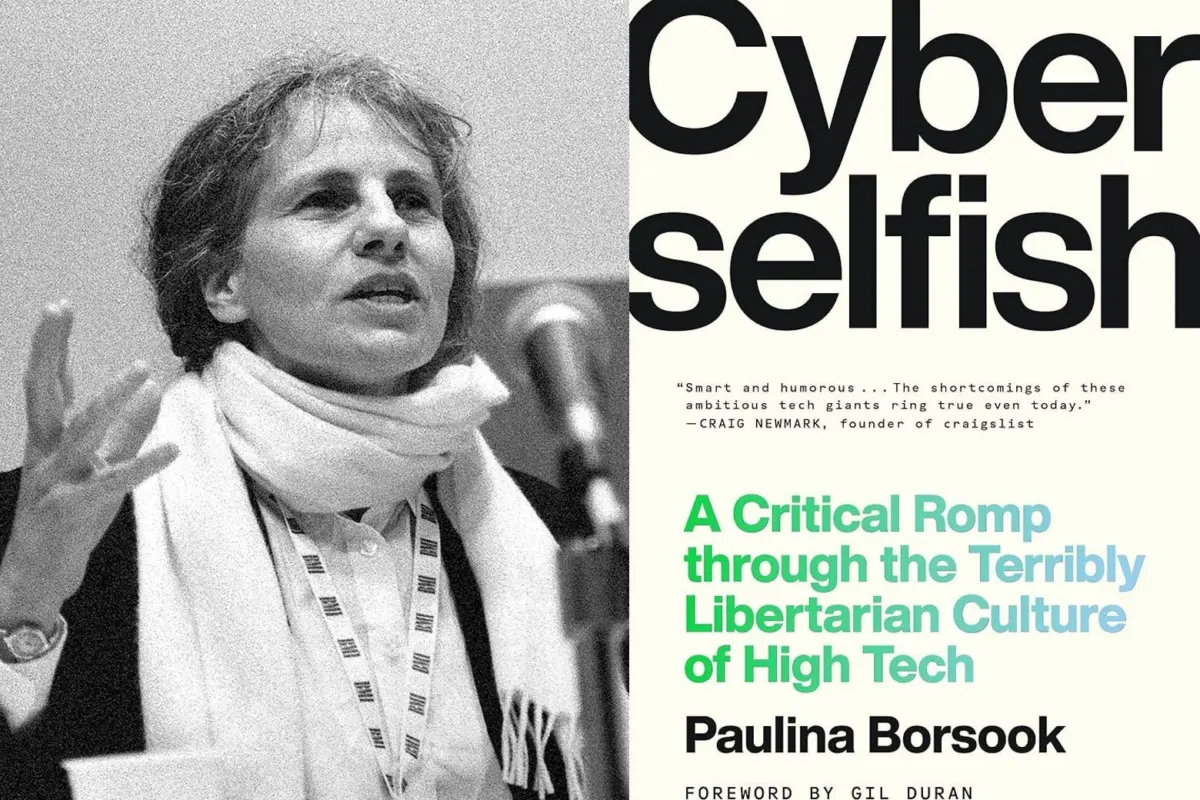
In 1996, Borsook published a blistering, polemical essay in Mother Jones titled "Cyberselfish." She later expanded the piece into a 2000 book, Cyberselfish: A Critical Romp Through the Terribly Libertarian Culture of High Tech. The work diagnosed a troubling ideological mutation: the rise of "technolibertarianism." Borsook warned that a new breed of global tech transplant—hailing from elite academic enclaves and lacking any grounding in civic infrastructure or historical context—harbored a deep hostility toward government, public institutions, and collective responsibility. They viewed themselves not as citizens participating in a democracy, but as self-anointed philosopher-kings destined to govern the rest of humanity through proprietary software and digital architecture.
Though initially overshadowed by the violent shock waves of the dot-com bust, Cyberselfish has experienced a staggering cultural and academic revival. As Silicon Valley’s political alignment shifts overtly to the right and public anxiety regarding the unchecked power of A.I. reaches a fever pitch, contemporary writers, critics, and scholars are dusting off Borsook’s work. They are discovering that her warnings were not merely prophetic—they were blueprints of the exact socio-political crises defining our current tech-dominated reality. Reissued by Tin House, Cyberselfish offers a terrifyingly accurate mirror to the modern technological landscape, prompting a profound re-evaluation of how a countercultural playground hardened into a tech-supremacist oligarchy.
Detailed Chronology: From 1980s Optimism to 90s Technolibertarianism
To understand the intellectual trajectory that produced Cyberselfish, one must retrace the transformation of California’s tech hub from a hippie-activist counterculture center into an international outpost for engineering prodigies.
The Shift in Tech’s Generational Ethos
In the 1980s, when Borsook first entered the Bay Area software ecosystem, the computing industry operated under a vastly different paradigm. The earlier generation of computer scientists and innovators intimately understood—and openly acknowledged—their debt to public investment and government research. Projects like ARPANET and technological milestones funded by entities such as Lockheed Martin were foundational to computing history. These early engineers recognized that their innovations rested on a bedrock of public infrastructure, tax-funded research, and institutional stability.
However, as the 1990s ushered in the commercialization of the World Wide Web, the demographic and ideological makeup of Silicon Valley shifted. A new wave of engineering talent arrived from across the globe, bringing with them a profound hostility toward governmental organization as a concept. Unlike their predecessors, these transplants had little understanding of, or appreciation for, public works, civic duties, or the social contract.
Fuelled by the explosive potential of commercial software and the early internet, these figures began to champion an insular philosophy. They fancied themselves intellectually and morally superior to the average citizen. Their ambition expanded beyond mere product development; they sought to build, manage, and govern new digital jurisdictions according to their own unilateral visions, entirely insulated from democratic oversight.
The Rise and Fall of Cyberselfish
During this pivotal era, Borsook worked as a regular contributor to Wired magazine, an iconic publication that celebrated technology as an evolving cultural phenomenon. While she appreciated the magazine’s initial openness to cultural critique, she watched with growing unease as the broader tech culture became increasingly dogmatic and corporate-aligned.
In 1996, her mounting frustrations culminated in the Mother Jones essay "Cyberselfish." The piece went viral by the standards of the 1990s web, giving voice to a rare skepticism amidst an ocean of unbridled techno-optimism. Recognizing the depth of the phenomenon, Borsook expanded the essay into her 2000 book, Cyberselfish: A Critical Romp Through the Terribly Libertarian Culture of High Tech.
Yet, the book’s release coincided precisely with the catastrophic dot-com crash of 2000. In the ensuing economic panic and market recalibration, cultural critiques of tech ideology were drowned out by the immediate financial fallout. Borsook struggled to find her footing in the literary and journalistic landscape of the subsequent decades, while the technology sector regrouped, consolidated immense capital, and quietly laid the infrastructural groundwork for the modern surveillance and platform economy.
Supporting Context & Metrics: The Cult Revival and Modern Techlash
For years, Cyberselfish existed primarily as an underground artifact—an obscure, out-of-print text passed around by academic researchers, media critics, and disillusioned technologists. Used copies commanded exorbitant prices on secondary platforms as a new generation of readers independently rediscovered its insights.
Academic and Cultural Resurgence
The catalyst for the book’s modern renaissance began in academic and critical circles. Scholars like the late David Golumbia, author of Cyberlibertarianism, referenced Borsook’s work, cementing its status as foundational literature in the critical study of digital culture. Tech writers across Substack, BlueSky, and mainstream journalistic outlets began invoking "That Damned Book"—Borsook’s affectionate nickname for her work—noting that her predictions regarding the anti-democratic, hyper-individualistic streak of Silicon Valley elites had manifested with horrifying accuracy.
This surge in demand ultimately prompted independent publisher Tin House to reissue Cyberselfish, bringing Borsook’s searing critiques back to bookstore shelves for a new era grappling with the social fallout of digital monopolies.
The Evolution of the "Techlash" and Workplace Activism
The cultural reckoning with Big Tech—often termed the "techlash"—evolved through distinct phases over the past decade. During the first Trump administration, internal dissent within major tech companies reached a fever pitch. Landmark employee actions, such as the Google walkout over mandatory arbitration, internal protests at Microsoft regarding ICE contracts, and whistleblower revelations at Uber, demonstrated a robust spirit of worker solidarity and ethical resistance.
However, this wave of internal activism faced a severe structural counter-offensive. Following massive industry-wide layoffs and corporate restructuring initiatives throughout Silicon Valley, companies systematically undermined worker organizing capabilities, rendering internal dissent significantly more muted. Despite these efforts, pockets of resistance persist, evidenced by ongoing worker letters and pushback against military and surveillance contracting at firms like Palantir.
Reflecting on these developments, Borsook offers a counter-intuitive perspective rooted in her 1990s experience:
"There was a workplace culture that wasn’t so uncommon throughout the ’90s—that usually, as long as you did your job, nobody cared what you thought about anything else, and work wasn’t the place to get political. I remember being very surprised and kind of unsettled by the fact that at Google, there were all these in-company bulletin boards where people would talk about politics… I had this reaction of: Your private life is your own."
Borsook also highlights a surprising historical contrast regarding workplace inclusivity. Drawing on conversations with female peers who navigated tech in the 1980s and 1990s, she notes that early computing environments were frequently more welcoming to women than subsequent decades proved to be. Without the modern industry’s performative obsession with "presenting masculinity" and narrow silicon-bro archetypes, early tech spaces often operated on a simple, meritocratic baseline: Can you do the job? Can we work with you?
Official Statements & Insights: A Conversation with Paulina Borsook
In an extensive interview reflecting on her newfound cult status, the evolution of Silicon Valley’s political alignment, and the modern artificial intelligence boom, Borsook unpacked the mechanics of contemporary tech supremacy.
On the Ignorance of Modern Tech Elites
When asked about the overt hostility and intellectual rigidity displayed by today’s tech leaders—who demand absolute ideological compliance and dismiss dissent with contempt—Borsook attributes the phenomenon to a profound lack of broad cultural and intellectual grounding:
"In the ’90s, you had a lot of people entering the scene who came from other places—by which I mean they’d actually read a novel that wasn’t Tolkien, they’d actually been to a museum and not just seen really bad CGI art, they had truly diverse backgrounds. I see much less of that now. You see people who started coding when they were in fifth grade, that’s all they’ve ever done, and they have no context or background to frame the other things they hear. These guys will say something that makes me think, If you had an actual grounding in biology, you wouldn’t say that. That’s what I’m often struck by—the appalling ignorance of these people."
Borsook argues that this insular worldview is underpinned by a rigid, spreadsheet-driven mentality that reduces all human experience to quantifiable metrics of efficiency:
"Suppose you have something that introduces art in schools. There’s no way to measure the satisfaction and joy that kid got from the art in the schools."
On Hiding the "A.I. Badge"
Commenting on recent cultural shifts where startup founders and tech workers actively attempt to rebrand themselves to avoid social stigma—such as hiring stylists in San Francisco to obscure their association with despised artificial intelligence projects—Borsook draws a parallel to her early reporting:
"I was reading some recent article about these two women from New York who come to San Francisco to be stylists for all the geeks there who can’t get dates… But this time, there’s a twist: The guys now are nervous about presenting themselves as being A.I. guys because they know how loathed it is. So they’re trying to have a presentation of self that doesn’t look like A.I. guy. I thought that was so interesting, that they’re hiding their party membership, as it were."
Future Outlook: Local Action in the Age of Technocratic Overreach
As society navigates the sprawling consequences of generative A.I., pervasive surveillance technologies like Flock cameras, and the unchecked expansion of energy-intensive data centers, the path forward can easily induce feelings of powerlessness. However, Borsook’s ultimate prescription for resisting technocratic overreach is resolutely grounded, local, and pragmatic.
Rejecting grand, abstract ideological declarations, she champions grassroots community engagement:
"I’m a big believer in local politics, in thinking globally and acting locally. There’s a data center coming, you do something about it. They want to put stupid A.I. in your kid’s third grade class, do something about it… You see that with the resistance to Flock cameras as well. In every place that’s local, you can do something about it, including vote. It sounds old-fashioned, but I’ve had a lot of success at being a local activist on different issues. I’ve been amazed at how much stuff—if you want to take the time and the care, and you’re not shrieky and shrill—you can get done."
Ultimately, the resurgence of Cyberselfish serves as both a historical vindication and a sobering warning. The ideological architectures driving modern technological authoritarianism—unaccountable corporate power, disdain for democratic governance, and the relentless commodification of human experience—were mapped out a quarter-century ago by a writer who simply looked at the tech elite and took them at their word. As contemporary society confronts the dark side of the digital revolution, Borsook’s enduring message reminds us that the first step toward reclaiming our civic future is recognizing the self-serving myths spun by those who seek to engineer it.