Executive Overview
In the rapidly evolving landscape of software engineering, the demand for high-performance, resilient, and developer-friendly application programming interfaces (APIs) has never been higher. As modern applications migrate toward microservices architectures, decoupled frontends (such as Flutter and React), and compute-intensive artificial intelligence workflows, traditional backend frameworks are increasingly tested to their absolute limits.
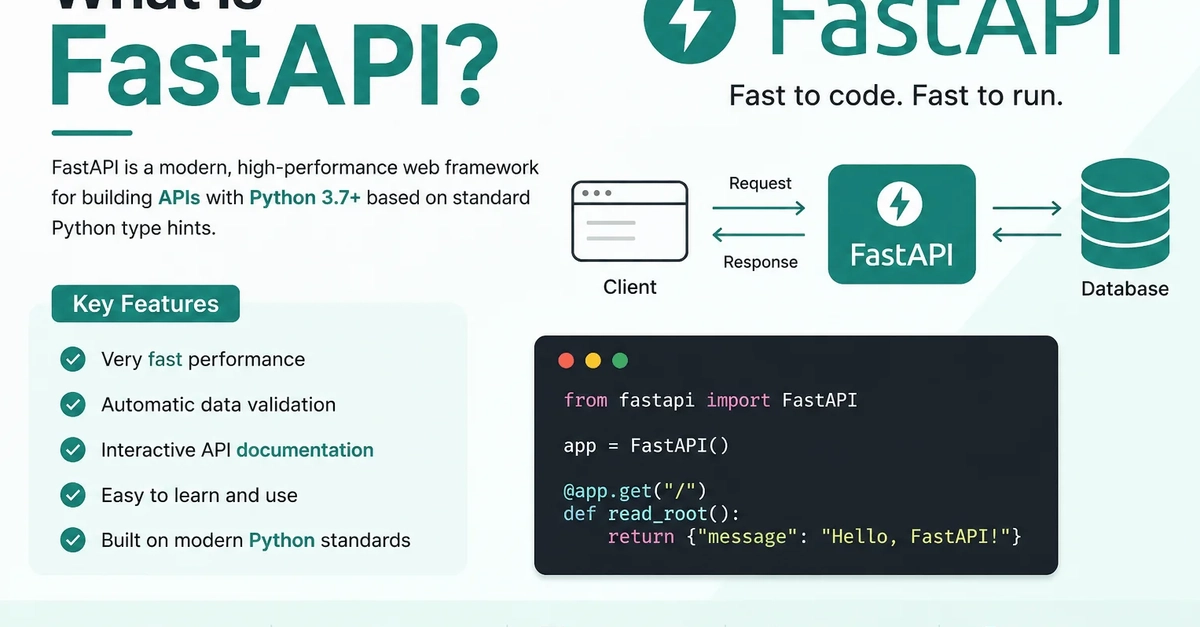
Enter FastAPI—a modern, high-performance web framework designed specifically for building APIs with Python 3.6+. Created by Sebastián Ramírez, FastAPI has rapidly transitioned from an emerging open-source project to an industry standard. It bridges the historical trade-off between development speed and runtime performance, leveraging Python type hints to deliver automatic data validation, native asynchronous programming support, and interactive, self-generating API documentation.
This comprehensive review explores the architectural foundations, key feature sets, comparative advantages, and structural dynamics that make FastAPI a dominant force in modern software development.
Detailed Chronology and Architectural Evolution
The Shift Toward API-Centric Architectures
Historically, Python web development was dominated by full-stack monoliths like Django and lightweight utility toolkits like Flask. Django, first released in 2005, provided an expansive "batteries-included" ecosystem featuring an integrated Object-Relational Mapper (ORM), admin dashboard, and authentication engines. While revolutionary for its time, Django’s monolithic structure can introduce unnecessary overhead when building stateless, decoupled APIs. Conversely, Flask offered minimal boilerplate and absolute flexibility, but placed the burden of manual request validation, routing configurations, and documentation generation squarely on the developer.
As the industry pivoted away from server-side rendered pages toward rich single-page applications (SPAs) and cross-platform mobile apps, developers required a specialized tool tailored exclusively for API engineering. FastAPI was engineered to fill this exact vacuum, combining the speed of modern ASGI (Asynchronous Server Gateway Interface) servers like Uvicorn with the rigorous data parsing guarantees of Pydantic.
The Underlying Request-Response Pipeline
To understand FastAPI’s performance advantages, one must examine its request-processing lifecycle. When a client application—such as a mobile frontend—dispatches an HTTP request to a FastAPI endpoint, the workflow follows a deterministic path:
- Client Request Transmission: An HTTP request (GET, POST, PUT, DELETE, etc.) hits a specified route URL.
- ASGI Server Handling: The underlying ASGI server captures the request and passes it to the FastAPI application instance.
- Pydantic Validation: FastAPI automatically checks incoming query parameters, path variables, and payload bodies against pre-defined Pydantic models. If the payload deviates from the expected schema, the framework immediately intercepts the request and returns a precise, structured JSON error response, eliminating manual defensive coding.
- Business Logic Execution: The validated data is injected directly into the designated Python function, where core application operations—such as executing business rules or calling external microservices—take place.
- Database Interaction: The application interfaces with persistence layers (frequently via asynchronous ORMs like SQLAlchemy coupled with PostgreSQL) to retrieve or persist state.
- Serialization and Response: The resulting data is serialized into JSON format and returned securely to the requesting client.
Supporting Context & Metrics: Core Features and Capabilities
FastAPI’s sustained adoption across enterprises and startups alike is driven by a distinct set of engineering capabilities designed to optimize developer velocity and runtime execution.
1. Asynchronous Programming Support (Async/Await)
FastAPI natively supports Python’s async and await syntax. Built upon Starlette for web handling and Pydantic for data validation, it can achieve performance metrics on par with NodeJS and Go. This asynchronous architecture is crucial for I/O-bound operations—such as querying remote databases, calling third-party REST APIs, or handling file streams—allowing servers to process thousands of concurrent connections efficiently without thread-blocking bottlenecks.
2. Automatic Interactive Documentation
One of FastAPI’s most celebrated developer-experience features is its zero-configuration documentation pipeline. By analyzing Python type hints and route annotations, FastAPI automatically generates and maintains interactive API documentation using Swagger UI (/docs) and ReDoc (/redoc). Developers and external consumers can inspect endpoints, review schema requirements, and execute live test requests directly within their browser without external testing suites like Postman.
3. Rigorous Type Safety and Validation
By enforcing Python type hints, FastAPI bridges the gap between dynamically typed Python code and statically checked API inputs. Consider the following implementation:
from fastapi import FastAPI
from pydantic import BaseModel

app = FastAPI()

class Product(BaseModel):
    name: str
    price: float
    quantity: int

@app.post("/products")
def create_product(product: Product):
    return
        "message": "Product successfully created",
        "product": product
In this architecture, type hints serve a dual purpose: they clarify code intent for human maintainers while supplying the framework with structural blueprints for automated validation and serialization.
4. Dependency Injection System
FastAPI features an intuitive, highly modular dependency injection system. This allows developers to encapsulate cross-cutting concerns—such as database session management, authentication tokens, permission checks, and shared rate-limiting logic—into reusable components. This modularity ensures codebases remain DRY (Don’t Repeat Yourself) and highly testable as projects scale.
Official Statements and Industry Adoption
Industry analysts and software architects frequently highlight FastAPI as a benchmark for modern Python tooling.
"FastAPI stands out because it doesn’t try to reinvent the wheel. By building upon proven standards like OpenAPI and JSON Schema, and leveraging the performance of Starlette and Pydantic, it provides an uncompromised developer experience that scales from simple microservices to complex enterprise architectures."
Enterprise adoption spans major technology sectors, particularly in domains requiring high-throughput data processing and machine learning operations (MLOps). Because data science pipelines are heavily anchored in Python, machine learning engineers frequently utilize FastAPI to wrap complex AI models—such as Large Language Models (LLMs) or computer vision networks—into robust, production-ready REST endpoints that can be consumed seamlessly by mobile and web frontends.
Future Outlook: The Next Horizon for FastAPI
As the software development ecosystem continues to evolve, FastAPI is positioned to play a foundational role in next-generation application design. Several key trends underline its future trajectory:
- Deepening MLOps Integration: With the explosive growth of generative AI and local model serving, FastAPI remains the de facto framework for exposing Python-based inference engines to production environments. Its native async capabilities make it uniquely suited to handle streaming responses from AI models.
- Enhanced Ecosystem Toolset: The community surrounding FastAPI continues to expand, yielding advanced extensions for authentication, asynchronous database migrations (Alembic integrations), and automated testing suites.
- Performance Optimization: Ongoing improvements within the underlying Pydantic v2 engine—which is partially written in Rust—have dramatically accelerated data validation benchmarks, ensuring FastAPI remains competitive against compiled backend languages.
Conclusion
FastAPI has fundamentally reshaped how developers perceive Python’s capabilities in backend engineering. By synthesizing high runtime performance, native asynchronous support, uncompromising data validation, and automated documentation into a unified, developer-friendly interface, it removes traditional barriers to entry for building robust services. Whether powering a high-traffic e-commerce platform, a cross-platform mobile application backend, or an enterprise-grade AI service, FastAPI offers an authoritative, future-proof foundation for modern software architecture.