Executive Overview
The rapid proliferation of Large Language Models (LLMs) across enterprise environments has delivered unprecedented capabilities to modern software engineering, but it has simultaneously introduced a massive operational blind spot. As organizations scale their adoption of generative AI, they rarely rely on a single vendor. Instead, modern architectures typically span multiple cloud providers—leveraging Google Cloud Vertex AI, Microsoft Azure OpenAI, and Amazon Bedrock alongside direct integrations with independent providers like Anthropic and OpenAI.
While this multi-cloud, multi-model strategy prevents vendor lock-in and optimizes for specialized model performance, it creates a labyrinth of administrative, financial, and security challenges. API keys proliferate unchecked across disparate repositories, development environments, and engineering teams. Tracking which application, department, or user consumes specific token volumes becomes an exercise in guesswork. When finance departments inevitably knock on engineering doors demanding granular cost accountability, organizations find themselves unable to map skyrocketing cloud bills back to individual product lines.
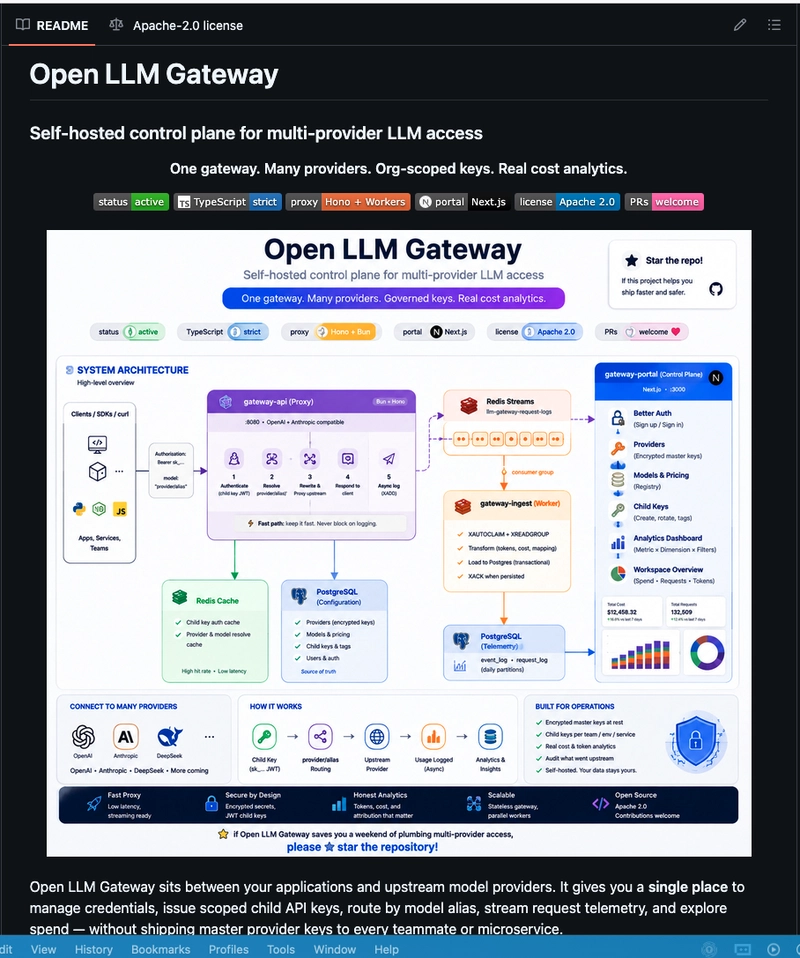
Enter the LLM gateway: a centralized proxy and control plane designed to sit between an organization’s applications and various AI providers. These gateways handle request routing, load balancing, fallback mechanisms, and, crucially, usage tracking and API key management.
However, as developers and organizations sought tooling to solve this problem, they hit a commercial roadblock. Existing solutions often lock critical enterprise features—such as Single Sign-On (SSO), organizational administration tools, and System for Cross-domain Identity Management (SCIM)—behind restrictive licensing walls and prohibitive seat caps.
Recognizing this gap in the market, developer Nelson Lin has introduced the Open LLM Gateway, a fully open-source, self-hosted LLM control plane and proxy featuring an inclusive Apache 2.0 license. By open-sourcing not just the core proxy engine, but the administrative user interface (UI) as well—completely free of arbitrary user seat caps or paywalled identity management features—this project represents a significant shift for engineering teams seeking robust, self-hosted AI governance without enterprise financial overhead.
Detailed Chronology: From Multi-Cloud Chaos to Open-Source Solution
The Genesis of the Problem
The journey toward the Open LLM Gateway began the way many infrastructure projects do: out of sheer operational necessity. In modern enterprise settings, engineering teams often operate in silos or rapidly spinning-up project squads. In Lin’s organization, this manifested as a decentralized sprawl of LLM integrations.
Developers deployed applications across Azure, AWS, and Google Cloud, each requiring distinct authentication credentials. Every project generated its own set of API keys. Initially, this friction-free autonomy accelerated prototyping and product delivery. However, as the engineering organization scaled, the lack of centralized visibility turned into an administrative nightmare.
Key management was entirely opaque. The team had no programmatic way to audit which API key belonged to which application, which team owned it, or whether it was deployed in a staging or production environment. More critically, token usage tracking was fragmented across multiple vendor dashboards, providing no unified view of consumption patterns.
The Financial Reckoning
The turning point arrived when the finance department initiated a routine budget audit. Faced with a rapidly climbing aggregate cloud bill, finance asked a deceptively simple question: Which specific products, teams, or applications are driving these substantial AI expenditures?

The engineering team could not provide an answer. Because requests were dispatched directly from fragmented applications to diverse cloud endpoints—each tracked under separate billing dashboards with varying metric formats—correlating API spend with business value was impossible. The organization was flying blind, realizing that unmanaged LLM scaling represented a direct threat to unit economics.
Evaluating Existing Alternatives
Recognizing the urgent need for a centralized traffic controller, Lin and his team evaluated existing solutions on the market, starting with LiteLLM, a widely adopted open-source tool designed to quickly spin up an LLM gateway.
While LiteLLM proved effective for initial bootstrapping, the team encountered architectural and licensing friction as their organization continued to grow. Specifically, they ran into commercial limitations regarding administrative tooling. In many popular gateway tools, features essential for scaling organizations—such as Admin UI SSO—are heavily restricted. For instance, free tiers often cap SSO access at a mere five users. Crossing that threshold forces teams onto expensive enterprise pricing tiers. Furthermore, advanced organizational administration controls and SCIM provisioning are frequently locked behind these same enterprise paywalls.
For a growing engineering team, encountering a license wall directly on the control plane created a philosophical and financial dilemma. Why should basic administrative security and user management be treated as an enterprise luxury item rather than a foundational infrastructure requirement?
Building and Releasing the Open LLM Gateway
Unwilling to accept restrictive seat caps or compromise on administrative visibility, Lin decided to build a custom solution tailored to the exact needs of modern engineering organizations. Rather than keeping the tool internal, the decision was made to open-source the entire stack under the permissive Apache 2.0 license.
Crucially, this release did not merely encompass the headless proxy backend; it included the administrative user interface as well. By making the full stack freely available, the project directly targeted the licensing bottlenecks that alienate growing teams. Released publicly via GitHub and supported by a dedicated project site (llm-gateway.io), the Open LLM Gateway established a new benchmark for open-source AI infrastructure accessibility.
Supporting Context & Metrics: The Mechanics of LLM Gateways
To understand the strategic value of the Open LLM Gateway, it is necessary to examine the architectural anatomy of modern LLM routing and the economic realities of enterprise AI adoption.
The Anatomy of an AI Control Plane
In a traditional web application architecture, API gateways (such as Kong, Envoy, or AWS API Gateway) manage incoming and outgoing traffic, handle rate limiting, enforce security policies, and manage authentication. LLM gateways perform a specialized variant of these functions tailored specifically to generative AI workflows:
- Unified API Translation: Different model providers (OpenAI, Anthropic, Google Gemini) utilize distinct JSON payloads, parameter naming conventions, and streaming protocols. An LLM gateway standardizes incoming requests into a unified format, allowing applications to swap underlying models seamlessly without rewriting application code.
- Credential Abstraction: Instead of embedding provider-specific API keys across dozens of microservices, applications send requests to a single internal gateway endpoint authenticated via local tokens. The gateway manages the actual master provider keys securely.
- Usage Metering and Auditing: By centralizing all traffic through a single proxy layer, organizations gain a single source of truth for token consumption, latency metrics, error rates, and cost attribution down to the individual request or department level.
The Economics of Enterprise AI and the "Seat Cap" Dilemma
As generative AI transitions from experimental playgrounds to core product infrastructure, cost containment has become a board-level priority. Unchecked API consumption can lead to "bill shock," where a rogue infinite loop in an agentic workflow or an unoptimized prompt template racks up thousands of dollars in token costs overnight.

Gateways solve this by providing centralized visibility. However, software vendors commercializing these gateways often rely on monetization models borrowed from traditional SaaS collaboration tools—specifically, charging per user seat or gating administrative controls behind enterprise tiers.
This creates a perverse incentive structure for technical infrastructure. An organization managing hundreds of microservices may only have a handful of engineers directly modifying gateway configurations, but they may have dozens or hundreds of developers, product managers, and auditors who require read-only access to usage dashboards, logs, and token analytics. Imposing a 5-user cap on SSO or administrative UIs forces growing startups and mid-market companies into difficult choices: either share admin credentials (a severe security risk) or pay enterprise licensing fees for infrastructure software that should ideally scale freely.
The Open LLM Gateway bypasses this dynamic entirely by decoupling infrastructure control from artificial commercial licensing walls.
Official Statements and Project Scope
To ensure clarity for prospective adopters, the project maintainers have been explicit about what the Open LLM Gateway is—and crucially, what it is not.
What the Project Is
- A Full-Stack Open-Source Control Plane: Includes both the high-performance proxy engine and the administrative web user interface licensed under the permissive Apache 2.0 framework.
- Seat-Cap Free: Completely eliminates user limits on Single Sign-On (SSO) and administrative access, allowing entire engineering and product organizations to inspect metrics and manage keys without licensing penalties.
- Self-Hosted: Designed for organizations that require strict data sovereignty, compliance, and control over their internal infrastructure by running the gateway within their own private cloud or on-premise environments.
What the Project Is Not
- A Replacement for Managed SaaS (Like OpenRouter): Organizations seeking a fully managed, hosted proxy service where infrastructure maintenance, uptime, and scaling are handled entirely by a third party will need to look elsewhere. The Open LLM Gateway is built for teams willing to self-host and manage their own infrastructure.
- A Lightweight Alternative with Artificial Limits: It is intentionally distinct from tools that offer limited free tiers for small teams; it is built from the ground up to support scaling organizations without forcing an upgrade to an enterprise tier for basic control plane features.
- Feature-Complete for Advanced Guardrails: The project maintainers transparently note that advanced enterprise features—such as granular real-time spend limits, content filtering guardrails, and automated fallback policies—are still under active development and are not yet fully production-ready in the current iteration.
Future Outlook: The Trajectory of Open-Source AI Infrastructure
The launch of the Open LLM Gateway highlights a broader, ongoing movement within the software engineering community: the pushback against proprietary lock-in for foundational developer tools. As artificial intelligence becomes the underlying operating system of modern software, the infrastructure supporting it must remain transparent, auditable, and economically viable for teams of all sizes.
Upcoming Roadmap Priorities
As the community rallies around the GitHub repository (https://github.com/Nelsonlin0321/llm-gateway), the roadmap focuses on addressing the current limitations noted by the creators. Key areas of development include:
- Advanced Guardrails and Content Filtering: Implementing modular middleware to scan incoming prompts and outgoing completions for PII (Personally Identifiable Information), toxic content, and prompt injection attacks.
- Granular Budget Enforcements: Building real-time programmatic spend caps that automatically throttle or reject API requests when a specific team, project, or API key approaches its financial threshold.
- Enhanced Multi-Cloud Routing: Expanding intelligent load balancing and automatic fallback mechanisms to seamlessly route traffic to secondary providers if a primary cloud region experiences an outage.
Conclusion
For engineering leaders grappling with multi-cloud AI sprawl, spiraling token costs, and administrative friction, the Open LLM Gateway offers a compelling alternative. By removing the financial barriers traditionally associated with enterprise-grade control planes, it empowers organizations to regain total visibility over their AI expenditures without compromising on security, scale, or autonomy. As the open-source community continues to contribute to its codebase, self-hosted AI governance is poised to become significantly more accessible to enterprises worldwide.