Executive Overview
When catastrophic natural disasters strike—such as massive earthquakes, devastating structural collapses, or severe industrial accidents—every passing minute exponentially decreases the likelihood of survival for those trapped beneath the rubble. Traditional search-and-rescue operations rely heavily on human personnel, highly trained canine units, and specialized machinery. In recent years, technological advancements have introduced small, agile search-and-rescue drones and micro-robots capable of penetrating tight spaces where humans dare not tread.
However, robotic engineering still struggles to replicate the supreme evolutionary agility of biological organisms. Nature has spent millions of years perfecting insects that can effortlessly navigate chaotic mazes of fractured concrete, twisted rebar, and shifting debris.
Enter a groundbreaking intersection of biology and advanced engineering: the "Paraborg." Developed through a collaborative research initiative between the University of Queensland (UQ) and the University of New South Wales (UNSW), the Paraborg is a pioneering cyborg insect designed not merely to locate disaster survivors, but actively to administer emergency first aid. While the prospect of receiving medical care from a cockroach might initially provoke a visceral, skin-crawling reaction, this innovative fusion of cybernetics and entomology could soon buy invaluable time for trapped victims, fundamentally transforming the landscape of emergency response.
Documented in a landmark research paper published in the prestigious journal Advanced Science, the Paraborg project marks a monumental leap forward. For the past two decades, bio-robotics researchers have experimented with cyborg insects primarily for "search and explore" missions. The UQ and UNSW team wanted to take the next evolutionary step, transitioning from passive reconnaissance to active medical intervention. By leveraging the astonishing physical payload capacity of the giant burrowing cockroach, scientists have engineered a dual-purpose cyborg fleet capable of remote navigation, visual assessment, and targeted drug delivery. If current trajectories hold, we may witness these living first responders deployed in actual catastrophe zones within the next five to ten years.
Detailed Chronology: From Concept to Cybernetic Reality
The creation of the Paraborg was not an overnight breakthrough; it represents the culmination of years of iterative bio-robotic experimentation. To understand the significance of the recent Advanced Science publication, one must examine the chronological steps the research team undertook to bring the project to fruition.
Selecting the Ideal Biological Platform
The foundation of any successful cyborg insect is the host organism itself. Previous iterations by various global laboratories have utilized beetles, Madagascar hissing cockroaches, and smaller flying insects. While the research team had previously developed cyborg beetles capable of scaling vertical walls, they quickly realized that those smaller platforms lacked the structural robustness and weight-bearing capacity required to carry advanced medical payloads.
For the Paraborg project, the researchers turned to the giant burrowing cockroach, a remarkable species native to northern Queensland, Australia. This armored insect is exceptionally large, measuring up to 87 millimeters (approximately 3.5 inches) in length and weighing up to 40 grams (1.4 ounces). Crucially, these giant cockroaches possess an extraordinary strength-to-weight ratio, capable of carrying payloads weighing up to 1.5 times their own body weight without experiencing catastrophic mobility fatigue.
Surgical Integration and Remote-Control Mechanics
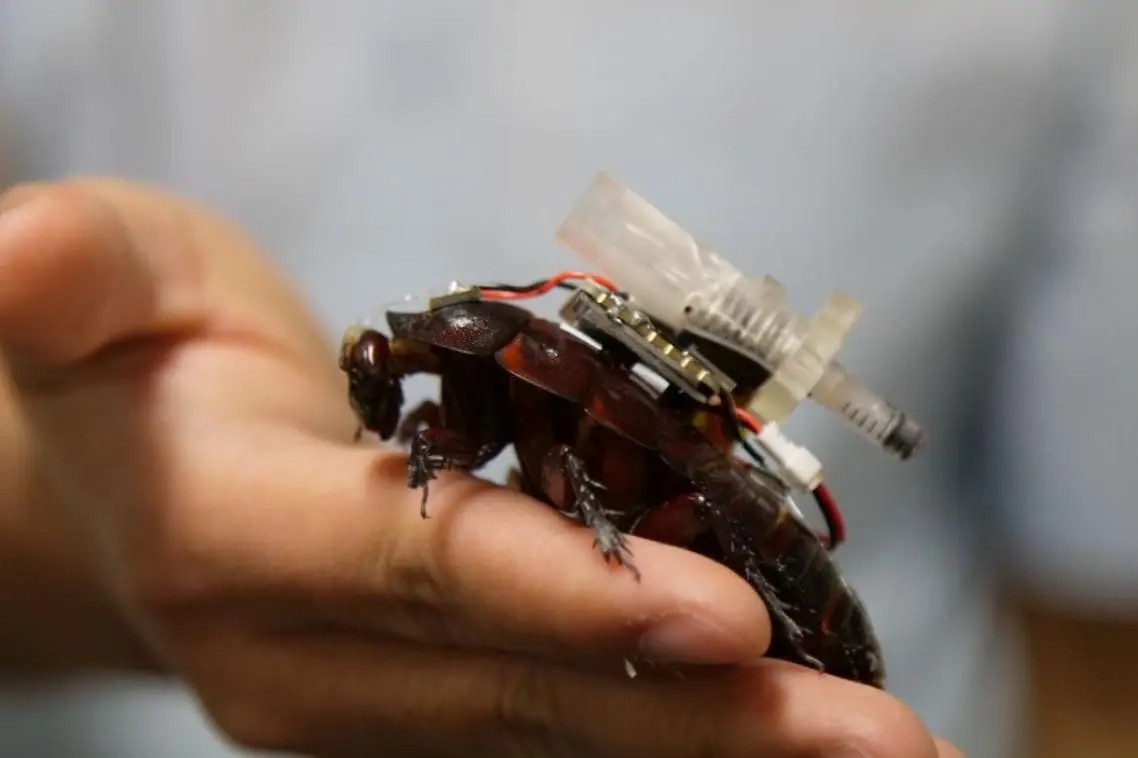
Transforming a living insect into a remote-controlled cyborg requires delicate, meticulous bio-engineering. The UQ and UNSW researchers anesthetized the giant burrowing cockroaches before surgically embedding microchips and microscopic electrodes into specific sensory regions of the insects’ anatomy: the antennae and the cerci.
- Antennae Integration: The antennae serve as the cockroach’s primary navigational feelers. By applying independent electrical stimuli to the left and right antennae, researchers can dictate the insect’s turning direction, effectively steering it left or right through complex paths.
- Cerci Integration: The cerci are a pair of protruding sensory appendages located at the rear of the abdomen, traditionally used by the insect to detect air currents and predators from behind. Researchers discovered that stimulating both cerci simultaneously successfully regulated the bug’s walking speed and forward momentum.
Through extensive trial and error, the team calibrated the electrical frequencies applied to these neural pathways, maintaining an optimal range between 10 and 40 hertz. They discovered that stimulating the tissue at frequencies exceeding 50 hertz caused rapid neural fatigue, rendering the controls ineffective over time. Once the experimental equipment was removed post-testing, the insects were able to live out their natural lives as normal, unharmed biological entities.
Developing Dual-Function Variants
Recognizing that a single insect cannot simultaneously carry every piece of specialized rescue equipment, the research team engineered two distinct functional variants of the Paraborg:
- The Reconnaissance Variant: Equipped with a lightweight, high-definition miniature camera, this cyborg cockroach is designed to scout ahead, transmit real-time video feeds of disaster zones, and assess the medical condition and exact positioning of trapped victims.
- The Medical Variant: Equipped with an automated injection mechanism, this version carries life-saving medications directly to the patient’s location.
The integration of the medical payload added roughly 15 millimeters to the insect’s overall height and approximately 17 grams to its total weight. Remarkably, biomechanical analysis confirmed that this added load did not significantly impair the cockroach’s natural gait or movement capabilities.
Supporting Context & Metrics: Engineering the Micro-Injector
The most ingenious engineering challenge of the Paraborg project was not merely steering the cockroach, but designing a reliable, lightweight mechanism capable of administering an intramuscular injection autonomously upon reaching the target.
Traditional electronic syringe pumps are far too heavy and power-intensive for an insect to carry. To circumvent this limitation, the research team devised a purely mechanical, chemical-reaction-driven injection system reminiscent of a classic childhood science experiment.
The Baking Soda and Citric Acid Propulsion System
The Paraborg’s automatic injection module operates via a compact spring-triggered system that shatters a physical barrier separating two distinct micro-chambers: one containing citric acid and the other containing baking soda.
When the barrier breaks, the two compounds mix, sparking a rapid chemical reaction—the exact same principle behind the classic baking soda and vinegar classroom volcano. This reaction produces a controlled volume of carbon dioxide gas. The expanding gas builds up pressure behind a plunger, forcing the syringe forward and successfully administering the medication.

Performance and Precision Metrics
To validate the efficacy of the system, the research team conducted rigorous controlled trials. A remotely controlled Paraborg was tasked with navigating a designated course from a starting point, maneuvering through three distinct checkpoints, and executing a simulated injection on a target.
The empirical results of these trials were remarkably promising:
- Close-Range Injection Success: When the injection mechanism was deployed within 150 millimeters of the target, the success rate peaked at approximately 95 percent.
- End-to-End Sequence Success: The success rate for completing the entire chronological sequence—from initial departure, navigating the multi-checkpoint course, to the final execution of the injection—stood at 72 percent.
Furthermore, the research team successfully demonstrated cooperative swarm behavior. In these multi-agent trials, one Paraborg utilized its onboard camera to locate and illuminate a simulated target, while a second Paraborg—outfitted with the injection mechanism—navigated to the exact coordinates to deliver the treatment. This collaborative division of labor highlights the immense scalability of the technology.
Official Statements and Expert Insights
The unveiling of the Paraborg project has sent ripples through the global robotics and emergency response communities, prompting reflection from the leading minds behind the innovation.
Tan Vo Doan, a prominent bio-robotics researcher at the University of Queensland and a primary author of the study, emphasized the philosophical shift represented by the project in an official press release:
"Cyborg insects have been designed for ‘search and explore’ missions for the past couple of decades. We wanted to take the next step."
Vo Doan underscored the strategic advantage of leveraging biological evolution over constructing entirely synthetic micro-robots from scratch. Rather than attempting to artificially manufacture complex locomotion systems capable of traversing unstructured, chaotic rubble, robotics engineers can harness the millions of years of evolutionary refinement embedded within insect physiology.
"Rather than building one robot to do everything, we can harness the natural strengths of different insects and equip them for different missions," Vo Doan explained.
The integration of disparate specialties—such as optical reconnaissance handled by one cyborg and pharmaceutical delivery handled by another—points toward a future where heterogeneous insect swarms operate in coordinated synchronicity during life-or-death crises.
Future Outlook: Challenges and the Roadmap to Deployment
While the empirical data and laboratory demonstrations of the Paraborg are undeniably promising, significant hurdles remain before these cyborg cockroaches can be deployed in active disaster zones.
Environmental Realism vs. Laboratory Control
The primary limitation of the current research phase is the controlled nature of the testing environment. The experimental trials took place on flat, predictable surfaces that failed to replicate the harsh, unpredictable realities of actual disaster sites. Real-world structural collapses feature extreme environmental variables, including jagged debris, powdery dust, wet mud, vertical drops, and shifting landscapes that can trap or disorient small organisms. Future research must rigorously test the Paraborg’s navigational resilience under heavy rubble simulations and dynamic climate conditions.
Ethical, Regulatory, and Public Perception Considerations
Beyond engineering challenges, widespread deployment of cyborg insects will face stringent regulatory scrutiny and public relations hurdles. The ethical treatment of animals—even invertebrates like cockroaches—remains a subject of intense academic discussion, although researchers emphasize that the integration processes are non-lethal, painless under anesthesia, and temporary. Furthermore, emergency responders and civilian populations must become accustomed to the visual reality of interacting with cybernetic insects during rescue operations.
The 5-to-10-Year Horizon
Despite these obstacles, the horizon for operational deployment is rapidly approaching. Tan Vo Doan and his colleagues at UQ and UNSW remain optimistic that with sustained funding, accelerated research grants, and expanded field-testing initiatives, a functional rescue team of cyborg insects could be ready for real-world deployment within five to ten years.
As climate change increases the frequency of severe weather events and urban populations continue to densify, the demand for innovative, high-agility rescue technologies has never been more urgent. By bridging the gap between advanced micro-electronics and nature’s most resilient survivors, the Paraborg project represents a breathtaking glimpse into the future of emergency medicine and disaster response—proving that sometimes, humanity’s greatest allies in a crisis come in the smallest, most unexpected packages.