Executive Overview
Are we standing on the precipice of a white Christian nationalist takeover in the United States? For Robert P. Jones, author, religion scholar, and founder of the Public Religion Research Institute (PRRI), the answer is a resounding yes. In his compelling and urgent new book, Backslide: Reclaiming a Faith and a Nation After the Christian Turn Against Democracy, Jones draws a chilling historical parallel that has sent shockwaves through religious and political circles alike: "This is our 1933," he writes, explicitly referencing the dark year when Weimar Germany crumbled beneath the weight of Nazi totalitarianism.
In the contemporary American landscape, panicked allusions to Nazi Germany have unfortunately become commonplace, frequently surfacing amid the polarized rhetoric of the Donald Trump years. However, Jones approaches this historical comparison from a deeply informed, highly specific vantage point. Having spent decades studying the sociology of religion—and drawing on his own upbringing as a Southern Baptist in the Deep South—he sees the current alliance between the modern political right and white Christian evangelicals not merely as political alignment, but as an acute spiritual and democratic crisis.
Jones’s central thesis is straightforward yet harrowing: the unchecked consolidation of religious authoritarianism, fortified by unwavering evangelical support for aggressive state policies like mass deportations and emboldened by overtly sectarian rhetoric from high-ranking government officials, represents an existential threat to American pluralism. Yet, Backslide is far from a counsel of despair. Instead, it functions as an urgent, prophetic call to action. Jones argues that just as religious passivity and complicity helped facilitate the rise of fascism in 1930s Europe, passive apathy among moderate and progressive white Christians today acts as an enabler of democratic erosion. By examining the structural convergence of faith, race, and politics, this article explores Jones’s harrowing diagnostic of modern American Christianity and maps out the potential pathways for democratic resistance.
Detailed Chronology: Learning the Hard Lessons of 1933
To understand the urgency of Jones’s modern framework, one must examine the historical precedent he invokes. In his book, Jones anchors his cautionary tale in the harrowing journey of German Lutheran pastor Martin Niemöller.
In 1933, the year Adolf Hitler assumed dictatorial control over Germany, Niemöller initially welcomed the Nazi regime, viewing it as a bulwark against the perceived moral decay of the Weimar Republic and the threat of atheistic communism. Like many conservative Christians of his era, Niemöller voted for the Nazi party in multiple elections and supported much of their early nationalist platform. However, as the regime’s true totalitarian and violent nature became impossible to ignore, Niemöller joined the Confessing Church, a movement of pastors resisting state control over religious doctrine.
His resistance came at a heavy price. In 1937, Niemöller was arrested by the Gestapo and subsequently imprisoned in the Dachau concentration camp, where he remained incarcerated until Allied liberation in 1945.
Reflecting upon his survival and the devastation of World War II, Niemöller famously identified 1933 not simply as the year his imprisonment began, but as the moment he realized how many precious years he had wasted supporting a murderous movement. Every day of his earlier political compliance felt, in retrospect, like a missed opportunity to avert an unimaginable humanitarian catastrophe.
Jones asserts that contemporary American Christianity is living through its own 1933. The convergence of uncritical white evangelical loyalty to the MAGA movement, the mainstreaming of Christian nationalist ideology within governing institutions, and the silent acquiescence of moderate believers mirror the fatal errors of Weimar-era German churches. The parallel serves as an uncomfortable mirror for American religious communities, pressing them to ask whether their current silence or passive compliance will similarly be judged by history as a squandered window to protect democracy and the integrity of their faith.
Supporting Context & Metrics: Data, Demographics, and the MAGA Monolith
To evaluate Jones’s claims objectively, one must turn to the rigorous empirical data compiled by PRRI over the last decade. As the leading research and polling think tank on American religion and politics, PRRI provides a sobering statistical baseline for the phenomenon of Christian nationalism.
The Evangelical Bloc and Immigration Policy
One of the most striking arguments in Backslide concerns the apparent absence of moral boundaries within white evangelical support for hardline administration policies. Pointing to extensive PRRI polling data, Jones notes that white evangelical attitudes toward undocumented immigrants have grown so extreme that constructing a policy "too brutal" for them to support has become nearly impossible.
When polled on draconian immigration measures—such as placing razor wire and water barriers designed to induce severe injury or drowning, or establishing mass internment camps—white evangelicals exhibit remarkably high levels of endorsement. This unyielding punitive posture stands in stark, paradoxical contrast to foundational biblical texts that explicitly command compassion for the widow, the orphan, and the stranger residing within the gates.
The Shifting Demographic Reality
Despite the cultural dominance of white Christian nationalism within the Republican Party, PRRI census data injects a crucial dose of demographic reality into the political discourse:
- Shrinking Share: White evangelicals now comprise only approximately 13% of the total U.S. population.
- Internal Uniformity vs. National Minority: While roughly 85% of white evangelicals align themselves unreservedly with the MAGA movement, this insular block represents a distinct minority of the broader American populace.
- Broad Rejection: Even when combining all Americans who express sympathy for a Christian nationalist worldview, the demographic footprint caps out at roughly three in ten citizens (30%).
This means that while Christian nationalism commands a supermajority among white evangelicals and the contemporary GOP, it is rejected by a margin of roughly two-to-one across the nation as a whole. According to Jones, the primary engine driving the political success of Christian nationalism is not raw demographic majority, but rather the pervasive apathy of the silent majority of Christians who find the movement abhorrent yet have failed to publicly organize against it.
Official Statements and Institutional Responses
The growing alarm surrounding Christian nationalism has not gone unnoticed by mainstream religious and political institutions. Across the country, cracks are beginning to form in the monolithic facade of American religious politics, signaling a tentative counter-movement.
Denominational Rebukes
In recent years, five major Christian denominations have either formally adopted or are actively drafting official theological statements condemning Christian nationalism. These denominational declarations serve a vital practical purpose: they provide local pastors and regional parishes with official theological cover to draw bright, unambiguous lines separating orthodox Christian teachings from ethno-nationalist political ideologies.
Emerging Political Voices
Historically, public expressions of faith within American politics—particularly within the Democratic Party—have been heavily concentrated among non-white leaders, such as the late Representative John Lewis, Representative Jim Clyburn, and Senator Raphael Warnock (pastor of Martin Luther King Jr.’s historic Ebenezer Baptist Church). However, a noticeable shift is underway.
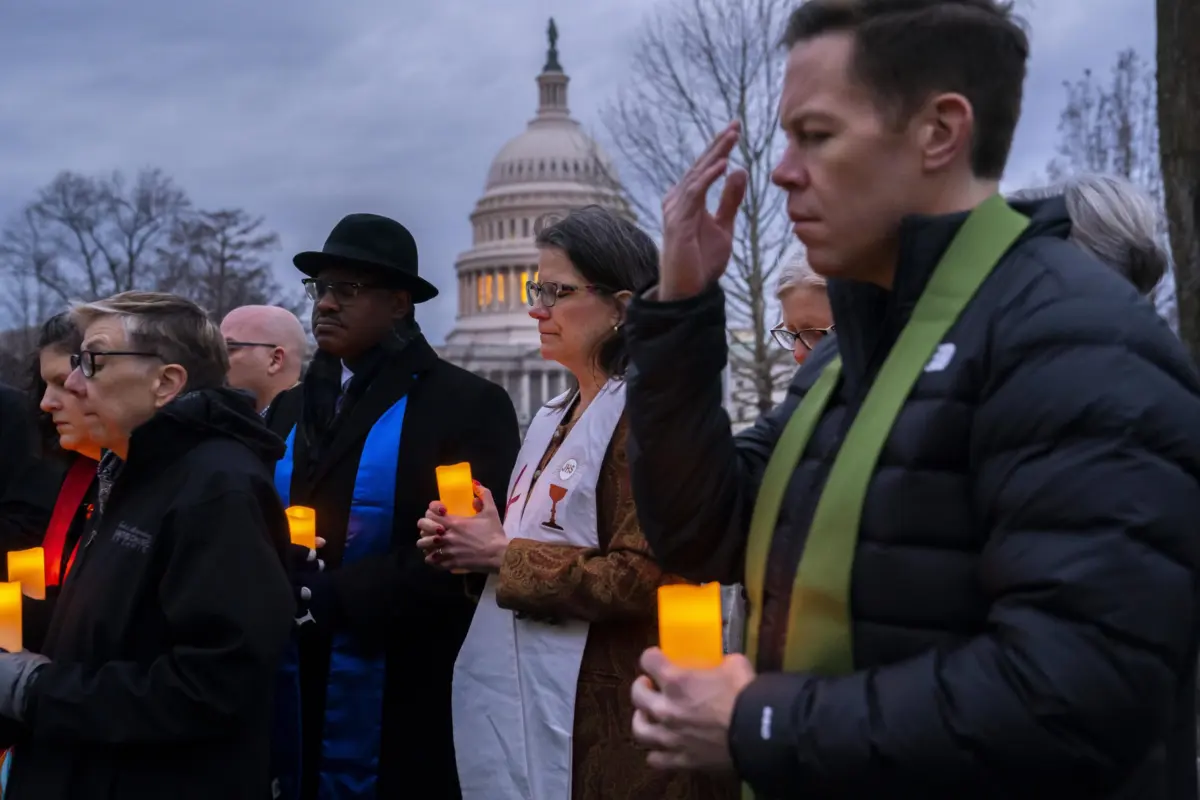
Political analysts have pointed to the rising national profile of figures like Texas state politician James Talarico, alongside a cadre of progressive and moderate religious candidates emerging from the Upper Midwest. In states like Iowa, Michigan, and Minnesota—where white mainline Protestant communities historically outnumber evangelical populations—religious leaders have stepped up to mount visible resistance. Notable examples include active clergy-led protests against ICE operations, humanitarian aid networks for undocumented families, and local diocese interventions that successfully blocked the construction of massive immigration detention centers near El Paso.
Future Outlook: A Playbook for Democratic Resistance
What, then, is the actionable roadmap for citizens and believers who wish to arrest this slide into religious authoritarianism? Jones outlines a pragmatic, clear-eyed strategy for the road ahead.
1. Abandon the "Fool’s Errand" of Persuading the Radicalized
Jones argues unequivocally that attempting to de-radicalize individuals who have spent a decade completely immersed in the MAGA worldview is a waste of time and energy. Those wholly wedded to political power, grievance, and authoritarian violence are beyond immediate persuasion. The correct response to this faction is not dialogue, but robust electoral organization, strategic resistance, and the mobilization of alternative power structures.
2. Cultivate the Divided Middle
Fertile ground for cultural and political persuasion exists within moderately leaning religious spaces. Unlike the near-monolithic uniformity of white evangelicalism, demographic groups such as white mainline Protestants, white Catholics, and Latino evangelicals exhibit deep internal divisions regarding the intersection of faith and nationalism. These contested spaces represent vital battlegrounds for reclaiming the public narrative of American Christianity.
3. Elevate a Public Alternative
The most urgent task for disillusioned or moderate Christians is stepping out of private discomfort and into public witness. For decades, many progressive and moderate Christians have quietly watched their faith traditions be hijacked by nationalist elements while remaining reluctant to speak up. Jones argues that if a pluralistic, inclusive version of Christianity is to survive in the United States, its adherents must make it a visible, vocal, and organized presence in public life.
4. A Sympathetic Separation from the Church
Importantly, Backslide is not a traditional proselytizing work aimed at coercing the "nones"—those millions of Americans who have abandoned institutional religion due to religious trauma, hypocrisy, or political alienation. Jones expresses deep empathy for those who have walked away from the church, admitting that he fully understands their grievances.
Instead, his message is directed toward those who, despite everything, remain tethered to the Christian tradition and feel a profound moral obligation to rescue it from ideological capture. This renewed, progressive expression of faith does not set itself in opposition to those who have left; rather, it finds common cause with them in the defense of a pluralistic, multi-racial democracy that centers human dignity, care for the vulnerable, and the absolute separation of church and state.
Conclusion
As America navigates turbulent political waters, Robert P. Jones’s warning serves as a historic touchstone. The comparison to 1933 is startling precisely because it highlights how easily democratic norms can be eroded when religious communities trade their moral integrity for temporal political power. Yet, the existence of a two-to-one national opposition to Christian nationalism—coupled with the nascent, courageous organizing of mainline clergy, local parishes, and everyday citizens—proves that the future remains unwritten. Whether American democracy successfully withstands this pressure test will depend largely on whether the silent majority of people of faith can find their voices before their window of opportunity closes.