Executive Overview
The boundary separating empirical reality from machine-generated fabrication has dissolved. For generations, the adage "seeing is believing" served as a foundational pillar of human trust, anchoring everything from courtroom evidence and journalistic reporting to historical archives and interpersonal communication. Today, that pillar is fracturing under the weight of generative artificial intelligence.
As advanced text-to-image models such as Midjourney, Stable Diffusion, and OpenAI’s DALL-E 3 achieve near-photorealistic fidelity, society finds itself navigating an unprecedented visual crisis. The implications stretch far beyond quirky internet memes or artistic experiments; they strike at the heart of democratic discourse, public safety, and institutional credibility.
"It has become increasingly challenging for the average human eye to distinguish between AI-generated and real photos," warns Andrey Doronichev, CEO and co-founder of Optic.xyz, a leading verification platform designed to detect synthetic imagery. "This has the potential to manipulate public opinion, undermine the credibility of news sources, and ultimately threaten the democratic process by promoting disinformation."
Doronichev’s warning is not hypothetical. Across the globe, high-profile synthetic images—ranging from fabricated arrests of political figures to staged geopolitical crises—have routinely duped millions of social media users, temporarily destabilized financial markets, and inflamed social tensions. In response to this digital deluge, a cottage industry of detection software has emerged, attempting to arm the public and institutions with countermeasures. Yet, these tools are locked in an escalating technological arms race against increasingly sophisticated generation algorithms.
Compounding this technological arms race is a systemic regulatory and structural failure across major social media platforms. Content moderation teams have been systematically hollowed out, verification systems have been commercialized and compromised, and corporate leadership has largely failed to enforce existing manipulated media policies. As the line between authentic journalism and synthetic propaganda blurs, the foundational question facing modern society is stark: How do we preserve a shared consensus on objective reality when anyone with a laptop can manufacture convincing lies in a matter of seconds?
Detailed Chronology: The Rapid Evolution of Generative Deception
To understand the current crisis of visual authenticity, one must trace the breakneck trajectory of generative adversarial networks (GANs) and diffusion models over the past half-decade. What began as nightmarish, easily identifiable digital artifacts has swiftly matured into hyper-detailed, commercially viable visual media.
Phase 1: The Era of the Uncanny Valley (2018–2020)
In the early days of deep learning-based image generation, synthetic media was largely confined to academic laboratories and specialized enthusiast communities. Tools relied heavily on GANs, which pitted two neural networks against one another to generate passable images of human faces, bedrooms, and cats.
During this period, the outputs were plagued by glaring anomalies. Faces frequently featured asymmetrical eyes, bleeding ears, warped backgrounds, and uncanny skin textures that screamed "machine-made." While deepfakes of public figures existed, they required massive computational power, extensive video datasets, and considerable technical expertise. The average internet user could easily spot the fakes through casual inspection.
Phase 2: The Diffusion Revolution and Consumer Democratization (2021–2022)
The paradigm shifted permanently with the advent of diffusion models. Instead of training networks to synthesize entire images at once, diffusion models start with random noise and iteratively "denoise" it based on natural language text prompts. This technological breakthrough drastically reduced computational requirements while exponentially increasing visual fidelity, coherence, and artistic control.
By mid-2022, platforms like Midjourney, DALL-E 2, and Stable Diffusion transitioned from closed beta testing into the hands of the general public. Suddenly, anyone capable of typing a sentence could command an artificial intelligence to render photorealistic scenes, historical events that never happened, or celebrities in impossible situations. The barriers to entry collapsed overnight, democratizing both creativity and the potential for large-scale deception.
Phase 3: The Mainstream Exploitation and the Verification Race (2023–Present)
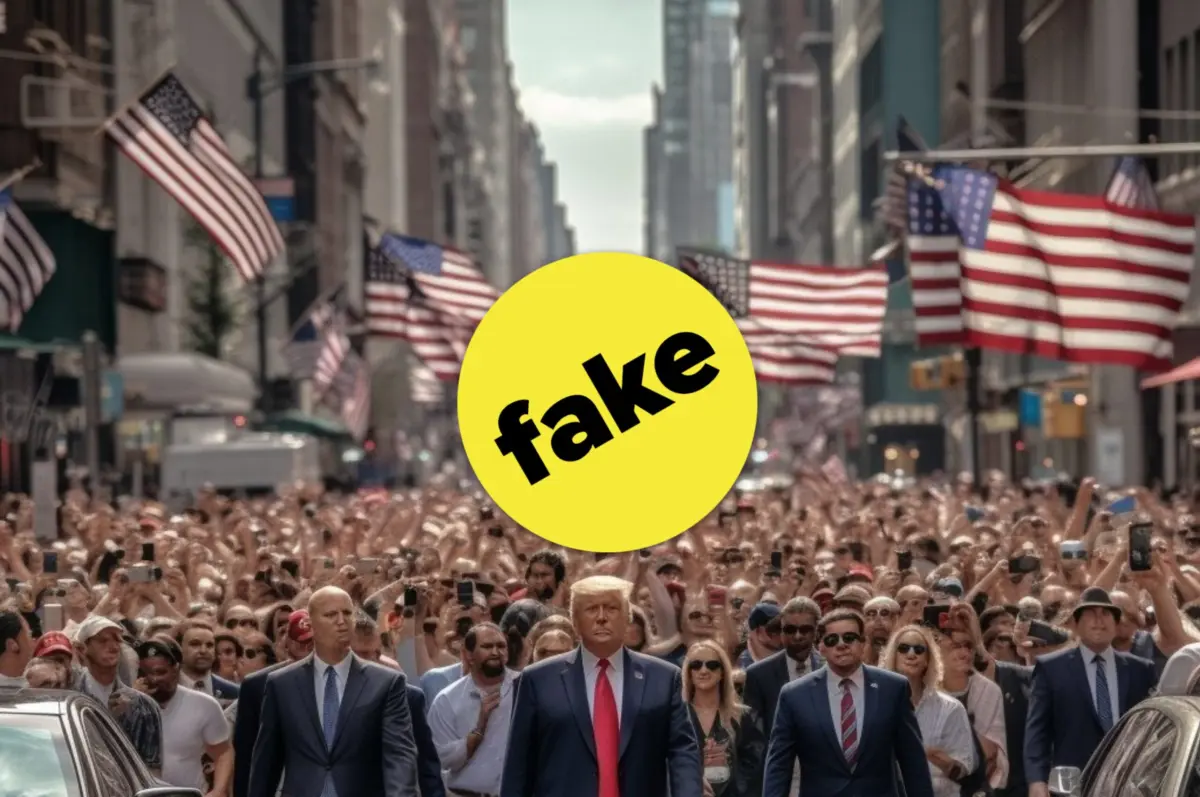
By 2023, generative AI had officially breached the mainstream information ecosystem. A series of watershed moments—including hyper-realistic viral images of Pope Francis wearing a Balenciaga puffer jacket, the purported arrest of Donald Trump, and fabricated explosions near the Pentagon—demonstrated the alarming velocity at which synthetic media could weaponize public imagination.
In response, a reactive ecosystem of AI detection tools sprang up. Platforms like Optic.xyz, Hive Moderation, and Truepic rushed to build classifiers capable of analyzing pixel-level artifacts, frequency distributions, and lighting inconsistencies. However, as generator developers released newer versions of their software (such as Midjourney v6 and DALL-E 3), these detection tools found themselves constantly struggling to keep pace, playing an endless game of technological catch-up.
Supporting Context & Metrics: The Anatomy of a Visual Infodemic
The proliferation of AI-generated imagery is not merely a qualitative shift in media creation; it is a quantitative tsunami reshaping global information flows.
The Scale of Production
According to recent industry analyses by venture capital firms tracking the generative AI landscape, billions of synthetic images are now produced globally every month. To put this in perspective, humans took roughly a trillion photos globally in the entire 19th and 20th centuries combined. Today, commercial text-to-image engines can eclipse that volume of visual creation in a matter of quarters.
A significant percentage of this output is benign—used by graphic designers, marketers, and hobbyists. However, threat intelligence firms note a concurrent, exponential spike in malicious or deceptive deployments. Phishing campaigns now utilize photorealistic AI-generated avatars for social engineering; political campaigns utilize synthetic grassroots imagery to manufacture artificial popular support; and bad actors systematically flood social platforms with noise to obscure genuine documentation of human rights abuses.
The Mechanics of Detection: Beyond the "Weird Fingers"
While automated forensic tools analyze metadata, pixel noise, and frequency domains, human observers are frequently left to rely on heuristic inspection. For months, internet sleuths relied on anatomical anomalies as telltale signs of synthetic origin.
As AI researcher and journalist observations frequently highlight, early generative models struggled intensely with human anatomy—consistently rendering hands with six or seven fingers, asymmetrical eyes, misaligned teeth, and chaotic background geometry. Furthermore, botched text rendering within images (where street signs or storefronts degenerated into alien gibberish) served as an immediate giveaway.
However, relying on these biological and structural telltales is becoming obsolete. Modern diffusion models incorporate sophisticated spatial reasoning and transformer architectures that render hands, text, and lighting with terrifying accuracy. "If the image looks too good to be true, it probably is," remains sound psychological advice, but it is an increasingly fragile line of defense against an increasingly convincing technological adversary.
Official Statements: Industry Leaders and Watchdogs Sound the Alarm
The systemic vulnerability of our information architecture has drawn severe warnings from civil society organizations, cybersecurity experts, and platform watchdogs.
The Regulatory Void and Platform Unpreparedness
Industry watchdogs argue that the entities responsible for maintaining public squares are fundamentally asleep at the switch. Kayla Gogarty, deputy research director at Media Matters for America, paints a damning picture of the current regulatory landscape.
"As there has been a recent rise of AI-generated media, it has become clear that platforms are unprepared for this moment in which fake images and misinformation could lead to real-world harm," Gogarty noted in an interview with BuzzFeed News.
Gogarty singled out Twitter (now branded as X) as an acute vector of vulnerability. Following Elon Musk’s corporate takeover, deep structural changes drastically altered the platform’s ability to police misinformation and verify authentic accounts.
"Particularly concerning is Twitter," Gogarty explained, "as Elon Musk has abandoned much of the platform’s content moderation, and it has become difficult to determine account credibility under the new checkmark policy."
Under legacy verification frameworks, blue checkmarks served as a rough heuristic for institutional authenticity, signaling that a journalist, politician, or organization had been vetted. The transition to a paid subscription model—where anyone can purchase verification status—has flattened the hierarchy of credibility, allowing bad actors to masquerade as legitimate news sources while pushing hyper-realistic synthetic propaganda.
The Technical Limitation of Detection
Even the architects of detection technology concede that software alone cannot solve the crisis. Andrey Doronichev of Optic.xyz emphasizes that detection is inherently reactive.
"None of these tools, including Optic, however, are foolproof," Doronichev admits. Because generative models learn directly from empirical data to mimic reality, every advancement in generation technology narrows the statistical distance between real and fake images. Eventually, synthetic media achieves a point of cryptographic or perceptual parity where deterministic detection becomes mathematically impossible without proactive watermarking standards embedded at the point of creation.
Future Outlook: Navigating the Post-Truth Horizon
As we look toward the horizon of digital media, the challenges posed by generative AI will only compound. The transition from static imagery to hyper-realistic, real-time video generation—exemplified by tools like OpenAI’s Sora—promises to elevate the stakes from fabricated photographs to entirely synthetic video broadcasts of events that never transpired.
If society is to avert a complete collapse of shared informational reality, a multi-layered, systemic intervention is required across technology, law, and journalism.
1. Cryptographic Provenance and Watermarking
The most viable long-term technical solution lies in establishing cryptographic standards for media provenance. Organizations like the Coalition for Content Provenance and Authenticity (C2PA) are working to embed tamper-evident cryptographic metadata directly into images and videos at the moment of capture, whether by digital cameras or AI generation software. When an image travels across the web, its entire lineage—from sensor to screen—can be cryptographically verified. Major camera manufacturers, software suites, and hardware developers must universally adopt these standards.
2. Platform Accountability and Policy Enforcement
Social media platforms must cease treating manipulated media as an afterthought. Merely possessing "synthetic media policies" is insufficient if enforcement remains erratic, under-resourced, or politically motivated. Platforms must implement automated provenance checks, clearly label verified synthetic media at scale, and restore robust trust-and-safety infrastructure capable of handling high-velocity disinformation campaigns.
3. Media Literacy and Institutional Journalism
In an era where visual evidence can no longer be taken at face value, the value of rigorous, verified, and transparent journalism increases exponentially. Consumers can no longer afford passive media consumption habits. As Doronichev and security experts advise, running suspect images through detection engines is a necessary stopgap, but the ultimate antidote to synthetic chaos is a return to trusted institutional reporting.
Until these systemic safeguards are fully matured and globally deployed, internet users must approach every striking visual with a healthy dose of skepticism. So, when scrolling through social media feeds and encountering emotionally charged or dramatic imagery, verify the source, run the assets through detection tools, and rely on established, accountable news sources. In the war for objective reality, vigilance is our only remaining shield.