Executive Overview
For nearly two decades, Tesla has operated as the undeniable pioneer of the modern electric vehicle (EV) revolution. Yet, when CEO Elon Musk took the stage in Texas for a characteristically theatrical live-streamed showcase, the spectacle on display was far less about the future of ground-bound transportation and much more about a radical corporate pivot. Musk introduced the long-delayed, highly anticipated new Tesla Roadster—a vehicle he hyperbolically claimed would "fly" using SpaceX-designed gas thrusters—while simultaneously declaring it would be the last manually drivable car the company ever builds.
Beneath the flashing lights, roaring crowds, and pyrotechnics lies a sobering corporate reality: the traditional automotive business model of manufacturing consumer EVs is no longer enough to satisfy Musk’s soaring ambitions or Tesla’s rapidly shrinking profit margins. Facing relentless global competition, the sunsetting of key vehicle lines, and the evaporation of lucrative regulatory credits, Tesla is drifting away from its identity as a mass-market carmaker.
Industry analysts, financial insiders, and close watchers of Musk’s empire increasingly view the theatrical integration of SpaceX technology into a Tesla product launch as the unmistakable opening salvo of a historic corporate maneuver. Get ready for the mother of all mergers: the absorption of Tesla into SpaceX to form a multi-trillion-dollar galactic mega-entity.
Detailed Chronology: From the Texas Spectacle to the Horizon of a Megamerger
The trajectory leading to this pivotal moment has been marked by decades of technological iteration, broken timelines, and high-stakes public relations campaigns.
Phase 1: The Cult of the Roadster and Early EV Dominance
Tesla’s corporate journey began with the original red Roadster, a sports car that proved electric vehicles could be fast, stylish, and culturally relevant. That vehicle’s ultimate PR milestone arrived in 2018, when Musk strapped his own personal red Roadster atop a SpaceX Falcon Heavy rocket, sending it into an endless solar orbit. For years, the narrative was straightforward: Tesla was an automotive disruptor scaling up production to convert the world to sustainable transport.
Phase 2: Stagnation in the Consumer Vehicle Sector
Following the rollout of the Model 3 and Model Y, Tesla’s product pipeline slowed dramatically. The company famously neglected to introduce an all-new, non-flying consumer vehicle since the launch of the unconventional Cybertruck in 2019. Worse yet, Tesla phased out production of its higher-priced luxury mainstays—the Model S sedan and the Model X SUV. This left the company dangerously over-reliant on just two aging platforms while global rivals closed the gap.
Phase 3: The Texas Reveal and the "Flying" Roadster
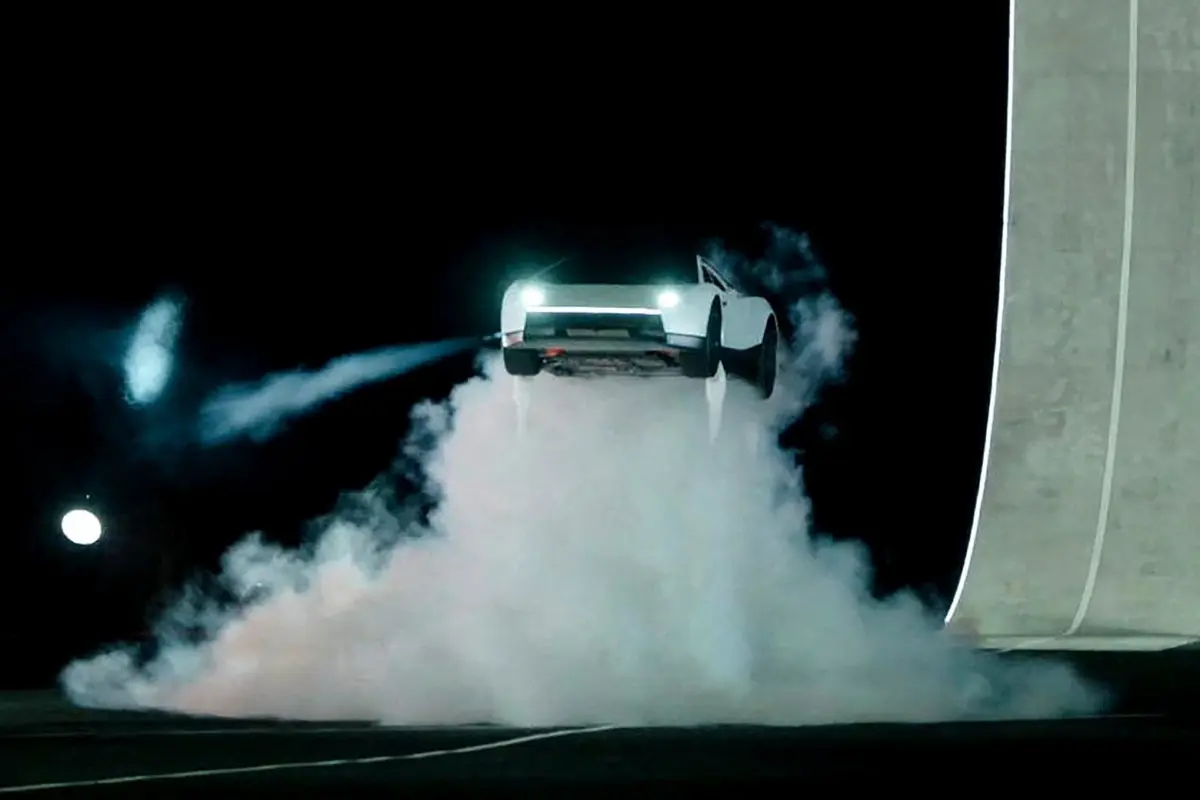
During the recent high-production-value event in Texas, Tesla erected a massive C-shaped ramp. The new Roadster scaled the curve, utilized a downforce-generating fan system to defy gravity momentarily, flipped in mid-air amidst a cloud of compressed air, and cleared a lineup of parked Tesla vehicles. Musk promised that the vehicle, equipped with SpaceX thrusters, would achieve 0 to 60 mph in a blistering 0.8 seconds.
However, the fine print reveals that customers will have to wait until at least 2028 for the privilege, with price tiers escalating from $50,000 for the "Performance" trim up to $250,000 for the "Thrust" version, and an invite-only "Rocket" tier. The vehicle was never meant to be a volume seller; it was a Trojan horse designed to bridge two distinct corporate universes.
Phase 4: The Convergence of Tesla and SpaceX
As analysts like Barclays’ Dan Levy have pointed out, speculation surrounding a Tesla-SpaceX merger has reached a fever pitch, with some predicting a deal could materialize before the end of 2026. Under such a structure, SpaceX—boasting immense capital-raising power and government defense contracts—would acquire Tesla, allowing investors to swap shares and creating a combined enterprise valued north of $3.5 trillion.
Supporting Context & Metrics: The Financial Imperative Behind the Pivot
To understand why Musk is orchestrating a merger and shifting away from standard car manufacturing, one must examine the numbers defining Tesla’s current fiscal landscape.
1. The Numbers Behind the EV Slowdown
For all the cultural noise surrounding its vehicles, Tesla delivered more than 1.6 million manually drivable cars in 2025, generating approximately $95 billion in revenue. On paper, these figures sound robust. Yet beneath the top line, profit margins are under severe strain.
2. The Loss of Regulatory and Tax Cushions
For years, Tesla’s profitability was heavily padded by the sale of zero-emission regulatory credits to legacy automakers—a multi-billion-dollar windfall. With regulatory frameworks shifting, the phasing out of federal EV tax credits in the United States, and growing consumer hesitation, those easy margins have dried up.
3. International Headwinds
Tesla has also faced brutal competition from Chinese automakers, particularly in the European market. Compounding these commercial challenges, Musk’s increasingly polarizing political alignments and public statements have alienated segments of the progressive and moderate consumer bases that originally built Tesla’s core customer loyalty, noticeably depressing European sales.
4. The Capital Demands of AI and Robotics
Tesla is currently pouring astronomical sums into artificial intelligence, autonomous data centers, and advanced machine learning to compete directly with titans like OpenAI and Anthropic. Furthermore, the development costs associated with Musk’s next-generation bets—the steering-wheel-free Cybercab robotaxi fleet and the $30,000 Optimus humanoid robots—require liquidity on a scale that selling moderately priced electric sedans simply cannot sustain.
Official Statements & Industry Perspectives
Elon Musk has never hidden his long-term playbook, though he frequently wraps his strategic pivots in showmanship and futuristic hyperbole.
During the Texas event, Musk framed the transition explicitly:
"What you see with your eyes, you will not believe! … This will be some crazy stuff."
By announcing that the new Roadster will be the last manually drivable car Tesla ever produces, Musk signaled that the era of human-piloted consumer vehicles is effectively dead within his corporate ecosystem. Instead, the focus has shifted entirely toward autonomy and labor replacement. Musk has publicly asserted that Optimus humanoid robots will eventually push Tesla’s market capitalization from its current $1.4 trillion to an astronomical $25 trillion. These robots are envisioned to perform everything from factory assembly line labor and lawn mowing to eldercare and, crucially, extraterrestrial infrastructure development.
Wall Street analysts have reacted to these shifts with a mixture of skepticism and calculated realism. Financial institutions note that selling millions of moderately priced EVs is a notoriously low-margin, high-headache enterprise. Traditional automotive executives have long wondered why Tesla willingly abandoned lucrative segments like large SUVs and conventional pickup trucks.
From Musk’s perspective, however, building consumer EVs was never the ultimate destination. It was merely the bootstrapping phase—a means to build global manufacturing capacity, secure public market capital, and develop the supply chains required to mass-produce fleets of Cybercabs and armies of Optimus units.
Future Outlook: The Dawn of a Galactic Mega-Entity
As Tesla phases out its traditional automotive identity, the horizon points toward an entirely unprecedented corporate structure.
The Cybercab and Robotaxi Economies
The immediate domestic future for Tesla-derived transit is entirely autonomous. The Cybercab fleet aims to replace private car ownership with an on-demand robotaxi service, drastically altering urban infrastructure, parking demands, and insurance models.
The Optimus Labor Force
Within the industrial sector, the deployment of Optimus robots promises to reshape manufacturing overhead. If Musk’s timeline holds, humanoid robots will assume dangerous and repetitive labor tasks across Tesla and SpaceX facilities, before eventually being commercialized for consumer and institutional markets worldwide.
Orbital Infrastructure and Beyond
The ultimate synergy of a Tesla-SpaceX merger unlocks frontiers previously confined to science fiction. Musk’s grand roadmap includes deploying orbital data centers launched by SpaceX rockets, harvesting uninterrupted solar energy in space to power terrestrial and extraterrestrial AI networks, and utilizing both autonomous fleets and humanoid robotics to support the colonization of the Moon and Mars.
Conclusion: A Legacy Carve-Out
The theatrical unveiling of the almost-flying Roadster was a nostalgic throwback to the early days of Tesla stagecraft—a carnival-barker performance designed to captivate headlines while masking a massive structural transition. For customers who placed deposits and investors who bankrolled the journey, the traditional "electric Toyota" era of Tesla is drawing to a close.
In its place rises a sprawling, multi-trillion-dollar galactic mega-entity that will make dystopian sci-fi conglomerates like the Weyland-Yutani Corporation look modest by comparison. Tesla as a car company is dead; long live the Musk empire.