Executive Overview
Launched in 2004 with a modest, two-year mandate to study the most violent and energetic electromagnetic explosions in the universe, NASA’s Swift Space Observatory has far exceeded its original design life. For more than two decades, this pioneering spacecraft has served as humanity’s primary sentinel for gamma-ray bursts (GRBs)—cataclysmic cosmic events that signal the death of massive stars or the merger of neutron stars. However, Swift’s remarkable journey is fast approaching a terminal phase. Lacking an onboard propulsion system capable of boosting its own orbit, the observatory has been locked in a slow, inexorable gravitational descent.
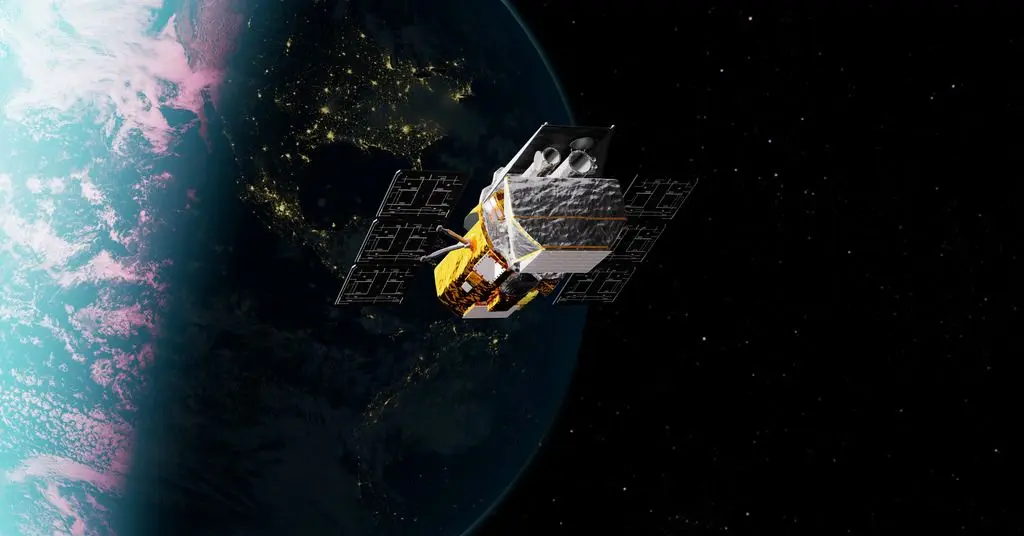
Faced with an accelerated timeline driven by extreme solar activity, NASA orchestrated a high-stakes, cinematic rescue mission. The plan relied on commercial ingenuity: partnering with aerospace innovator Katalyst Space Technologies to launch a specialized robotic servicer, dubbed LINK. The objective was to rendezvous with Swift, capture the aging telescope using advanced mechanical arms, and utilize LINK’s thrusters to lift the observatory to a safer, high-altitude operational orbit.
It was a bold, high-risk gamble—a race against time to save a scientific treasure that was never designed to be serviced in orbit. Unfortunately, reality intervened. Following persistent attitude control failures after its July 2026 launch, NASA officially canceled the primary rescue objectives. While LINK will still perform experimental proximity operations to gather vital data for future in-space servicing, Swift’s fate is sealed. The observatory is now projected to reenter Earth’s dense atmosphere and burn up before the end of the year, bringing a decorated chapter in high-energy astrophysics to a close.
Detailed Chronology: From Starlit Origins to Orbital Crisis
To understand the gravity of the recent decision, one must trace the timeline of Swift from its inception to its final, dramatic hours.
The Golden Years of Gamma-Ray Astronomy
When Swift lifted off from Cape Canaveral Air Force Station on November 20, 2004, astrophysicists hoped it would survive long enough to map hundreds of gamma-ray bursts. GRBs are fleeting phenomena—lasting anywhere from a fraction of a second to several minutes—that release more energy in a few seconds than our Sun will emit over its entire 10-billion-year lifespan.
Swift was engineered with a unique three-instrument payload: the Burst Alert Telescope (BAT) to instantly spot explosions, and the X-Ray Telescope (XRT) and Ultraviolet/Optical Telescope (UVOT) to rapidly pivot and study the afterglows. The mission revolutionized time-domain astronomy, proving that short gamma-ray bursts are produced by colliding neutron stars and directly linking these cataclysms to the detection of gravitational waves. What was supposed to be a brief, two-year assignment turned into a 22-year scientific odyssey.
The Invisible Enemy: Orbital Drag and Solar Fury
Because Swift operates in a low-Earth orbit (LEO) hundreds of kilometers above the surface, it is not entirely outside the envelope of Earth’s atmosphere. Though the air is extremely thin at these altitudes, residual gas molecules exert a persistent, microscopic drag on passing satellites. Every time Swift completes an orbit, it sheds a fraction of its kinetic energy, pulling it infinitesimally closer to the planet.
For nearly two decades, orbital decay followed predictable models. NASA engineers initially calculated that Swift could coast safely in orbit well into the 2030s. However, the Sun had other plans. Throughout 2024, our star entered a period of heightened activity associated with the peak of Solar Cycle 25. Intense solar flares and coronal mass ejections dumped massive amounts of energy into Earth’s upper atmosphere.
This energy caused the thermosphere to heat up, swell, and expand outward into space. As the atmosphere bloated, the air density at Swift’s altitude spiked. The increased drag dramatically accelerated the satellite’s descent. Updated trajectory models painted a grim picture: Swift would no longer survive into the next decade. Instead, its uncontrolled reentry was locked in for late 2026.
The Audacious Rescue Gambit
Realizing that the observatory was hurtling toward an early grave, NASA leadership evaluated their options. Decommissioning Swift meant losing a vital, still-functioning asset in the global network of multi-messenger astronomy. Rather than let the telescope perish quietly, the agency opted for a radical solution: a robotic satellite-salvage mission.
NASA contracted Katalyst Space Technologies to build and deploy LINK, a specialized commercial spacecraft equipped with advanced navigation sensors and robotic gripping mechanisms. The architectural concept was straightforward—intercept Swift, grapple its structural frame, and use external thrusters to elevate it to a stable orbital buffer zone.
Launch and Systemic Failures
The clock was ticking loudly when the LINK spacecraft successfully launched on July 3, 2026. Hopes were high that commercial agility could pull off an unprecedented rescue. Yet, space is unforgiving. Shortly after achieving orbit, LINK began experiencing severe malfunctions within its attitude control system (ACS)—the critical network of reaction wheels, star trackers, and thrusters responsible for maintaining spatial orientation and stability.
For weeks, engineers on the ground fought around the clock to diagnose the faults, upload software patches, and regain authoritative control over the spacecraft. Despite their best efforts, the ACS instability proved insurmountable for the high-precision maneuvers required to capture a non-cooperative, tumbling-prone target like Swift.
The Cancellation Announcement
On Wednesday, NASA made the difficult, pragmatic choice to pull the plug on the capture attempt, formally updating the mission parameters. In a public statement, agency leadership confirmed that LINK would abandon its capture and boost objectives.
Instead, the mission was pivoted to a risk-reduction demonstration. LINK will still approach Swift, utilizing the remaining operable systems to conduct advanced rendezvous, navigation, and close-proximity operations (RPO). By testing these capabilities in the crucible of real-world conditions, NASA and Katalyst hope to salvage technological insights that will pave the way for future commercial satellite servicing architectures.
Supporting Context & Metrics: The Anatomy of Low-Earth Decay
The challenges facing the Swift mission highlight broader, systemic issues currently confronting the global space community as low-Earth orbit becomes increasingly congested and unpredictable.
Low-Earth Orbit Atmospheric Dynamics
To appreciate why Swift could not save itself, one must examine the physics of orbital mechanics in the thermosphere. At altitudes ranging from 500 to 600 kilometers, the atmosphere is composed predominantly of atomic oxygen, nitrogen, and helium. While these particles are sparse compared to sea-level pressure, a spacecraft traveling at roughly 7.8 kilometers per second experiences them as a constant, abrasive wind.
+-------------------------------------------------------------+
|                ORBITAL DECAY MECHANICS                      |
+-------------------------------------------------------------+
| 1. High Solar Activity -> Thermosphere Heats & Expands      |
| 2. Increased Air Density at LEO Altitudes                   |
| 3. Constant Drag on Spacecraft Structure                    |
| 4. Loss of Kinetic Energy -> Altitude Drop                  |
| 5. Acceleration toward Uncontrolled Reentry                 |
+-------------------------------------------------------------+
When solar cycles ramp up, extreme ultraviolet (EUV) radiation from the Sun heats the thermosphere, causing it to expand upward like a balloon inflating. This brings denser layers of air to higher altitudes. Satellites caught in this expanded zone experience exponential increases in drag. Without onboard propellant reserves to periodically execute "station-keeping" burns—a luxury Swift never possessed—spacecraft in this regime are entirely at the mercy of space weather.
The Economics of Commercial In-Space Servicing
The Swift rescue attempt was never just about saving an old telescope; it was a proving ground for the nascent in-space servicing, assembly, and manufacturing (ISAM) industry. For decades, satellites have been treated as disposable consumer goods: once their fuel runs out, or their components degrade, they are abandoned to become space debris or allowed to burn up in the atmosphere.
The ability to dock with, refuel, repair, or reposition existing space assets represents a multi-billion-dollar paradigm shift. Companies like Katalyst Space Technologies are attempting to build the foundational infrastructure for an orbital economy where dead or dying hardware can be given a second life.
However, the failure of the LINK attitude control system underscores just how difficult close-proximity operations truly are. Docking with a satellite that was never designed with standardized grapple fixtures requires sub-centimeter precision, robust computer vision algorithms, and fault-tolerant hardware—standards that pushed current commercial capabilities to their absolute limits.
Official Statements and Industry Perspective
The decision to sacrifice Swift generated significant discussion within the aerospace community, balancing disappointment over lost science with pragmatic praise for calculated risk-taking.
NASA Administrator Jared Isaacman addressed the media and the scientific community, emphasizing that while the outcome was sub-optimal, the underlying philosophy of the mission remains sound:
"This is not the outcome we were working toward, but it does not change why this mission was worth attempting. The team moved with extraordinary speed to give Swift a chance to carry out more science while advancing capabilities America will need for satellite servicing in the future. We are going to learn everything we can from LINK’s rendezvous attempt and put those lessons to work on the missions that follow."
Isaacman defended the agency’s willingness to push boundaries, noting that technological advancement in the aerospace sector requires an appetite for ambitious failures:
"NASA should be willing to move quickly and take smart risks when the potential return is worth it, and that is exactly what we did with this mission."
Industry analysts have largely echoed these sentiments. While the loss of Swift marks the end of an era for gamma-ray astronomy, the lessons learned from LINK’s software anomalies and hardware struggles will directly inform upcoming commercial debris-removal and satellite-repair contracts slated for the late 2020s and early 2030s.
Future Outlook: The Final Descent and Legacy of Swift
With the rescue mission officially called off, attention now turns to the final chapter of the Swift Space Observatory.
The Inevitable Reentry
Without intervention, orbital decay will continue unchecked. As Swift dips deeper into the thermosphere, the drag force will increase exponentially. Eventually, the spacecraft will encounter the mesosphere and lower atmosphere, where extreme aerodynamic friction and thermal stress will take over.
During atmospheric reentry, the intense heat—reaching thousands of degrees Celsius—will cause the satellite to disintegrate. The vast majority of Swift’s structural components, instruments, and solar panels will vaporize or break apart long before reaching the ground. Because the descent rate depends heavily on daily fluctuations in solar weather, exact predictions regarding the time and geographic location of the final reentry remain uncertain, though NASA currently projects the event to occur before the close of the year.
A Lasting Scientific Legacy
Even as Swift prepares to light up the upper atmosphere, its scientific footprint is secure. Over its 22-year tenure, the observatory:
- Discovered and cataloged thousands of gamma-ray bursts, fundamentally altering our understanding of stellar evolution.
- Provided crucial early-warning alerts that allowed ground-based optical and radio telescopes worldwide to capture the fleeting afterglows of cosmic explosions.
- Played an instrumental role in multi-messenger astronomy by observing the electromagnetic counterparts to gravitational wave detections.
The Swift Space Observatory proved that spacecraft built with robust engineering and clear scientific purpose can achieve longevity far beyond their initial design warranties. Though its fiery descent will mark the end of its physical existence, the data it gathered, combined with the hard-won engineering lessons from the LINK rendezvous attempt, will guide astrophysicists and aerospace engineers for generations to come.