Executive Overview
In a decisive maneuver targeting the financial scaffolding of Russia’s wartime economy, the United Kingdom has levied sweeping economic sanctions against Cryptomus, an elusive and shape-shifting cryptocurrency platform. According to leading cybersecurity and blockchain intelligence firms, Cryptomus has operated as a primary conduit for illicit capital flows. The platform has routinely facilitated payments for ransomware gangs, international narcotics rings, darknet marketplaces, high-tech fraud, and specialized cybercrime services designed to bypass Western financial restrictions imposed on Moscow.
Announced on October 8, the U.K. Foreign, Commonwealth & Development Office targeted Cryptomus—which has previously traded under corporate aliases including Certa Payments and Xeltox Enterprises, and more recently mutated into a clone service called Heleket. The sanctions freeze any assets held by Cryptomus within British financial institutions and strictly prohibit U.K. companies and citizens from engaging in commercial or virtual interactions with the platform. Alongside Cryptomus, the U.K. government also clamped down on associated virtual payment networks, including VexPay, TokenSpot, and the Tsunami Payments service.
This regulatory blow represents a critical escalation in the ongoing global effort to dismantle underground financial networks that underpin state-sponsored and transnational cybercrime. Unlike previous monetary penalties—such as a record-shattering CAD $176 million fine issued by Canada in late 2025 that ultimately proved uncollectible—the U.K.’s designation of Cryptomus as a sanctioned entity aims to inflict operational death. By cutting off access to mainstream banking rails and enforcing strict compliance mandates across British jurisdictions, international authorities are signaling that chameleonic payment processors can no longer hide behind corporate shells, shell companies, and fictitious regulatory bodies.
Detailed Chronology: The Evolution, Rebranding, and Evasion Tactics of Cryptomus
Genesis and Early Operations (2022–2024)
Cryptomus burst onto the decentralized finance landscape in 2022, quickly establishing itself as a preferred checkout gateway for a vast network of illicit Russian cryptocurrency exchanges and underground websites hawking malicious tools. From its inception, the platform positioned itself as a convenient payment processor, but investigators quickly realized its utility extended far beyond legitimate e-commerce.
An exhaustive December 2024 investigation by cybersecurity journalist Brian Krebs, titled "How Cryptocurrency Turns to Cash in Russian Banks," exposed how Cryptomus served as a vital bridge converting digital assets into fiat currency for Russian entities. Behind the scenes, the platform’s parent company, Certa Payments, shared a registered address in Vancouver, British Columbia, with dozens of other foreign currency dealers and money transfer businesses. Physical inspections revealed that none of these businesses maintained a genuine operational presence at the location, marking it as a classic paper-company front.
The Canadian Crackdown and the Birth of Heleket (2025)
As scrutiny mounted, intelligence agencies and blockchain analytics firms began mapping the vast volumes of dirty money flowing through the platform. By April 2026, blockchain intelligence firm TRM Labs reported that Cryptomus had processed upwards of $7 billion in transactions since its 2022 launch. This staggering figure included funds tied to egregious criminal activities, such as vendors distributing child sexual abuse material (CSAM), terrorist financing networks, and international human trafficking rings.
In late 2025, Canadian authorities dropped the hammer on Cryptomus, issuing a historic CAD $176 million fine for severe violations of anti-money laundering (AML) and know-your-customer (KYC) regulations. Faced with regulatory ruin, Cryptomus instituted temporary, superficial KYC rules that caused its transaction volumes to temporarily crater. However, rather than complying with international law, the platform’s operators deployed a classic chameleonic evasion tactic: they launched a parallel, no-KYC processing service christened Heleket, allowing illicit transactions to resume unhindered while the original entity appealed the Canadian penalties.
The October 2026 U.K. Sanctions
Recognizing that administrative fines were entirely ineffective against a decentralized entity willing to simply rebrand, the United Kingdom stepped in with targeted economic sanctions on October 8, 2026. The impact was immediate. Within hours of the announcement, user support bots on Telegram—such as the Heleket support agent, which had previously denied any operational connection to Cryptomus—began alerting panicked users that the platform was suddenly unable to process transactions.

The U.K. action also marked a historic geopolitical milestone: blockchain analyst Richard Sanders noted that this is the first known instance of a "Five Eyes" nation (comprising Australia, Canada, New Zealand, the United Kingdom, and the United States) officially sanctioning a cryptocurrency enterprise incorporated within another member of the Five Eyes intelligence-sharing alliance.
Supporting Context & Metrics: The Scale of Illicit Processing
The sheer volume of capital moving through Cryptomus and its derivative entities paints a grim picture of how decentralized finance has been weaponized by criminal syndicates and sanctioned nation-states.
Data from Chainalysis and TRM Labs
According to a detailed analysis published by Chainalysis on October 8, 2026, the newly sanctioned platforms formed an essential backbone for Russia’s wartime economy:
- Surpassing Traditional Mixers: Chainalysis reported that Cryptomus and Heleket collectively received more illicit funds across tracked categories than traditional cryptocurrency mixing services present in their extensive datasets.
- Explosive Counterparty Growth: The number of illicit counterparties interacting with these payment hubs surged dramatically, peaking at over 900 unique illicit entities in a single month during late 2025.
- Multibillion-Dollar Turnover: Data compiled by TRM Labs revealed that Cryptomus processed more than $7 billion in cumulative transactions between 2022 and its enforcement milestones in 2026. This capital pipeline directly supported ransomware syndicates, darknet narcotics bazaars, and high-level financial fraud operations.
The Fiction of Regulation: The Western Sahara Connection
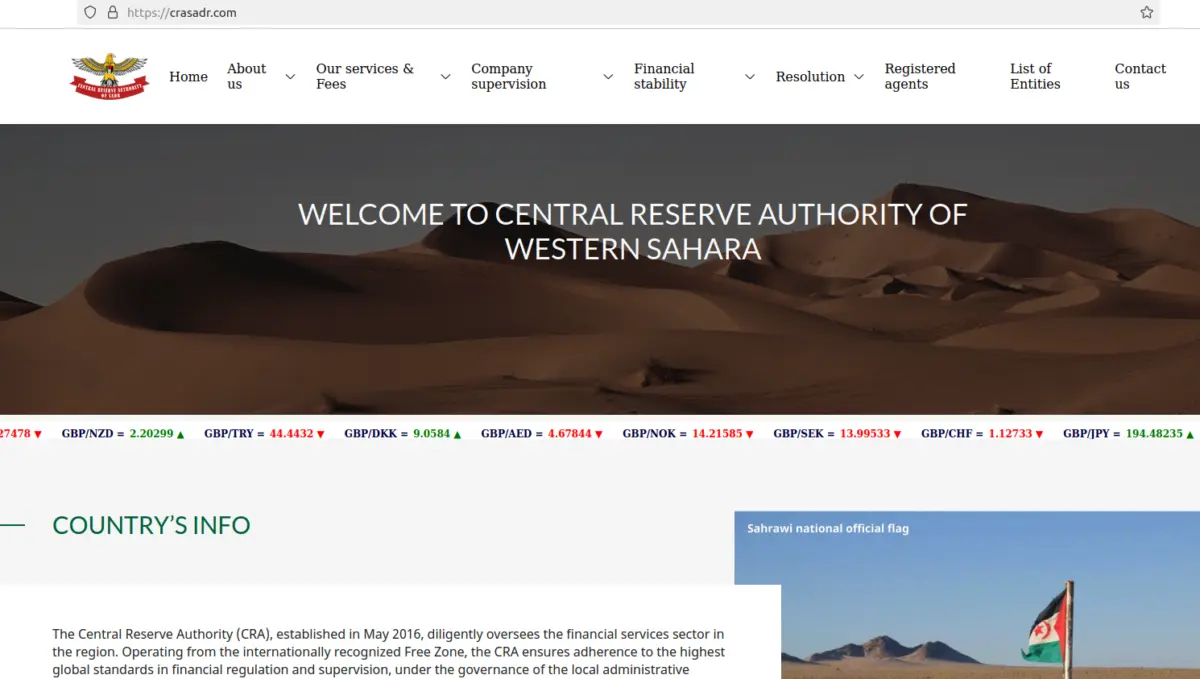
Perhaps one of the most bizarre and illuminating aspects of the Cryptomus investigation is the origin of its operational authority. Where do opaque, transnational crypto processors derive their legal legitimacy to offer international financial services? In the case of Cryptomus, the trail leads directly to a web of fake financial institutions overseen by a phony regulatory body positioned in a disputed territory.
Investigations into Certa Payments (Cryptomus’s parent company) revealed that its sole shareholder was a 25-year-old Ukrainian woman. Notably, she also headed several other corporate entities, including the WS Management and Advisory Corporation. This firm marketed itself as an exclusive regulatory body responsible for issuing licenses to cryptocurrency exchanges, foreign exchange brokers, and online gaming businesses incorporated in the Western Sahara—a disputed region in northwest Africa not widely recognized as a sovereign nation.
The regulatory front operated via the website crasadr.com, which claimed to represent the Central Reserve Authority of Western Sahara. This portal listed the entities supposedly awarded licenses for digital asset and foreign exchange operations. Furthermore, technical infrastructure mapping revealed that one of Certa Payments’ former domains (certa.website) shared a server with twelve other domains, including rasd-state.ws, tying the crypto payment processor directly to this elaborate bureaucratic illusion.
Official Statements and Expert Analysis
The international cybersecurity and blockchain analytics community has overwhelmingly praised the U.K.’s decisive intervention, emphasizing the fundamental difference between financial penalties and outright economic sanctions.
Richard Sanders, a veteran blockchain investigator who spent months mapping Cryptomus’s obfuscated payment infrastructure and interacting directly with its customer base, highlighted the strategic importance of the U.K. measures in a public statement:

"A fine doesn’t stop a cryptocurrency payment processor from processing payments. Sanctions kill the operation. The distinction matters."
Sanders underscored that while Canada’s CAD $176 million fine made headlines, it was ultimately uncollectible and toothless against an enterprise operating largely in the digital shadows. By cutting off access to British banking partners and criminalizing commercial engagement, the U.K. government effectively severed the platform’s access to legitimate global liquidity.
In its official blog post reacting to the sanctions, Chainalysis emphasized the systemic threat posed by these platforms:
"Cryptomus and Heleket have emerged as major payment hubs for illicit activity. The U.K. sanctions target the broader infrastructure supporting Russia’s wartime economy, cutting off the vital pipelines that allow sanctioned entities to convert digital assets into spendable wealth."
Future Outlook: The Global Crackdown on Unregulated Crypto Gateways
The sanctioning of Cryptomus, Heleket, VexPay, TokenSpot, and Tsunami Payments marks a watershed moment in cryptocurrency regulation. It demonstrates that Western governments are no longer content with merely penalizing domestic bad actors or issuing regulatory warnings that can be evaded through simple corporate rebrandings.
As blockchain analytics firms grow more adept at deanonymizing transaction flows, and as intelligence agencies coordinate across international borders, the runway for "no-KYC" payment processors is rapidly shrinking. The exposure of Western Sahara’s phony regulatory apparatus also serves as a stark warning to financial institutions and decentralized finance protocols alike: regulators are increasingly willing to peer behind complex corporate veils, shell companies, and fraudulent licensing schemes.
Moving forward, the death of Cryptomus under the weight of U.K. sanctions will likely serve as a blueprint for future enforcement actions. Cybercrime syndicates and sanction-evading nation-states will find it increasingly difficult to locate compliant banking partners willing to risk international isolation. While illicit actors will undoubtedly attempt to mutate into new corporate forms—just as Cryptomus morphed into Heleket—coordinated multilateral sanctions have proven that the digital underground can, in fact, be cornered, starved of liquidity, and systematically dismantled.