In a decisive escalation against the financial architecture underpinning cybercrime and Russian sanctions evasion, the United Kingdom has levied sweeping economic sanctions against Cryptomus, a notoriously elusive and frequently rebranded cryptocurrency payment platform. Announced on October 8, the British sanctions package targets Cryptomus—alongside associated virtual payment platforms VexPay, TokenSpot, and the Tsunami Payments service—for acting as a critical conduit for darknet markets, global ransomware operations, narcotics trafficking, and illicit financial services designed to bypass Western sanctions against Russia.
The U.K. restrictions freeze all assets held by Cryptomus within British financial institutions and strictly prohibit UK-based entities and individuals from engaging in any commercial or virtual business dealings with the platform. This enforcement action marks a watershed moment in international cybersecurity and regulatory compliance: according to blockchain intelligence experts, it is the first known instance of a "Five Eyes" intelligence-sharing nation (comprising Australia, Canada, New Zealand, the United Kingdom, and the United States) officially sanctioning a cryptocurrency operation formally incorporated within the jurisdiction of another Five Eyes partner.
Security researchers and blockchain analytics firms, including Chainalysis and TRM Labs, have long tracked Cryptomus as a foundational engine for the underground economy. Since its inception in 2022, the platform has facilitated billions of dollars in illicit transactions, serving as the checkout infrastructure of choice for dozens of Russian cryptocurrency exchanges, cybercrime service bureaus, and nefarious actors. Despite facing a record-shattering $176 million administrative penalty from Canadian regulators in late 2025—a fine that ultimately proved uncollectible—Cryptomus continually mutated, evading enforcement through shell companies, name changes, and the launch of unregulated parallel services.
Industry analysts emphasize that while administrative fines merely sting operations of this scale, binding economic sanctions have the power to dismantle them. This report provides an exhaustive examination of the Cryptomus enterprise, detailing its historical evolution, its staggering transaction metrics, the web of fictitious regulatory bodies linked to its operations, and the broader geopolitical implications of the U.K.’s landmark sanctions.
Detailed Chronology: Evolution of an Illicit Empire
The operational history of Cryptomus is a masterclass in corporate camouflage. Designed to absorb regulatory pressure and deflect law enforcement scrutiny, the platform has continuously shape-shifted through various corporate identities, legal facades, and parallel service offerings since it first emerged onto the digital underground in 2022.
2022–2024: The Rise of Certa Payments and Xeltox Enterprises
Cryptomus initially launched under corporate facades including Certa Payments and Xeltox Enterprises, presenting itself to the public as a standard, high-efficiency digital asset payment gateway. Behind this veneer, however, the platform was rapidly scaling into a primary monetization engine for the global cybercrime ecosystem.
Investigators tracking the platform’s early infrastructure uncovered a deeply suspicious corporate footprint. Cryptomus shared a physical address in Vancouver, British Columbia, with dozens of other foreign currency dealers and money transfer businesses—none of which maintained a genuine physical presence at the location. Despite these glaring red flags, the platform operated with relative impunity, onboarding Russian cryptocurrency exchanges and rogue websites hawking malware, stolen credentials, and illicit services.
Late 2025: The Canadian Record Fine and the Birth of "Heleket"
By late 2025, the mounting accumulation of illicit transactions caught the attention of Canadian authorities. Following exhaustive investigations into anti-money laundering (AML) violations, the Canadian government levied a record-breaking administrative monetary penalty of CAD $176 million against Cryptomus.
Rather than folding or submitting to regulatory compliance, Cryptomus chose adaptation. The platform formally appealed the massive fine while simultaneously launching a parallel, no-KYC (Know Your Customer) payment processing service branded as "Heleket."
While Cryptomus briefly instituted rudimentary KYC controls—which caused a temporary dip in its overall transaction volume—Heleket was engineered specifically to absorb displaced high-risk users and unverified illicit volume. Telegram support channels operated by Heleket agents routinely engaged in corporate gaslighting, publicly denying any structural or operational affiliation with Cryptomus despite overwhelming blockchain evidence tying the two entities together.
October 2026: The U.K. Sanctions Hammer Drops
The limitations of civil and administrative penalties became glaringly apparent as Cryptomus continued to process billions of dollars in high-risk funds despite the Canadian penalty. Recognizing that monetary fines do little to deter decentralized or cross-border payment processors operating in bad faith, the United Kingdom government intervened.
On October 8, the U.K. Foreign, Commonwealth & Development Office issued formal economic sanctions against Cryptomus and its corporate iterations, alongside sister platforms VexPay, TokenSpot, and Tsunami Payments. Within hours of the announcement, the disruption was instantaneous. Automated Telegram support bots utilized by Cryptomus and Heleket began issuing error notifications to users, confirming that the platform was suddenly unable to process transactions or clear pending cryptocurrency deposits.
Supporting Context & Metrics: The Scale of the Underground Economy
To understand why Cryptomus warranted a direct intervention by a Five Eyes government, one must examine the staggering macroeconomic scale of the illicit funds flowing through its infrastructure. Leading blockchain intelligence firms have quantified the platform’s footprint, revealing an enterprise deeply integrated into both transnational organized crime and state-sponsored sanctions evasion.
Tracing the Billions: TRM Labs and Chainalysis Data
In April 2026, blockchain intelligence firm TRM Labs published an exhaustive intelligence profile on Cryptomus. The findings revealed that the platform had processed more than $7 billion in cumulative cryptocurrency transactions since its launch in 2022. This volume was not merely tied to ordinary commercial friction; TRM Labs identified significant transaction flows associated with the worst tiers of the digital underworld, including:
Vendors distributing child sexual abuse material (CSAM).
Transnational terrorist financing networks.
Large-scale human trafficking operations.
Commercial ransomware cartels targeting Western critical infrastructure.
Furthermore, Chainalysis highlighted the systemic role Cryptomus played in bolstering Russia’s wartime economy. In an October 8 blog post detailing the U.K. sanctions, Chainalysis noted that Cryptomus and Heleket rapidly evolved into dominant payment hubs for illicit activity.
According to Chainalysis datasets, at their peak in late 2025, these services were receiving more illicit funds across tracked categories than traditional cryptocurrency "mixers"—protocols explicitly designed to obfuscate transaction trails. During this period, the number of distinct illicit counterparties transacting with Cryptomus surged to more than 900 in a single month, underscoring the platform’s central position as a clearinghouse for global cybercrime syndicates.
The Anatomy of the Sanctions Evasion Machine
Following the imposition of Western financial restrictions on Russian banking institutions in the wake of the 2022 invasion of Ukraine, Russian illicit actors and state-backed entities faced severe bottlenecks in repatriating funds or settling international accounts.
Cryptomus filled this vacuum by offering a seamless bridge between decentralized cryptocurrencies and traditional fiat currencies, particularly Russian banking rails. As detailed in extensive investigative reporting by KrebsOnSecurity in December 2024 ("How Cryptocurrency Turns to Cash in Russian Banks"), Cryptomus acted as the payment gateway layer for a web of underground Russian brokerages. These brokerages specialized in converting cryptocurrency extorted via ransomware or earned through darknet narcotics sales into clean rubles, effectively neutralizing the economic impact of Western financial sanctions.
Official Statements and Expert Analysis
The U.K. sanctions have elicited widespread commentary from the global cybersecurity, intelligence, and blockchain analysis communities, highlighting a fundamental shift in how Western governments intend to combat crypto-enabled crime.
Richard Sanders on the Superiority of Sanctions Over Fines
Richard Sanders, a veteran blockchain analyst and investigator who spent months mapping out the intricate payment architecture and operational nodes of Cryptomus, offered sharp insight into why the U.K. sanctions represent a fatal blow where Canadian administrative penalties fell short.
Writing on professional networks following the announcement, Sanders contrasted the two regulatory approaches:
"A fine doesn’t stop a cryptocurrency payment processor from processing payments. Sanctions kill the operation. The distinction matters."
Sanders noted that while Canada’s CAD $176 million fine generated significant headlines, it was ultimately unenforceable and uncollectible given the opaque legal structuring of the company. Because Cryptomus could simply ignore the administrative debt while spinning up alternative brands like Heleket, the financial penalty functioned merely as a costly business expense. By contrast, asset freezes and criminalizing business interactions under U.K. sanctions law effectively cut the platform off from global liquidity, liquidity providers, and legal banking infrastructure.
Chainalysis on Structural Infrastructure
In its official advisory, Chainalysis underscored that the U.K. action was not focused solely on a single bad actor, but rather on the broader, resilient infrastructure enabling Russian economic evasion:
"Cryptomus and Heleket have emerged as major payment hubs for illicit activity. Together, these services received more illicit funds across tracked categories than the mixers in our dataset, and the number of illicit counterparties surged to more than 900 in a single month in late 2025."
The Illusion of Legitimacy: Fake Regulators and Phantom States
One of the most bizarre and illuminating aspects of the Cryptomus investigation is the origin of its regulatory authorization. How does a platform facilitating billions in illicit transactions for Russian intelligence fronts and cybercriminals maintain a veneer of legal legitimacy? The answer involves a complex web of shell companies, fabricated financial institutions, and a phony regulatory body positioned within a disputed geopolitical territory in northwest Africa.
The Western Sahara Regulatory Fiction
Investigative deep dives into the corporate genealogy of Cryptomus revealed that the sole shareholder of its parent entity, Certa Payments, was a 25-year-old Ukrainian woman. Beyond heading Certa Payments, this individual also served as the director of several other corporate entities, most notably the WS Management and Advisory Corporation.
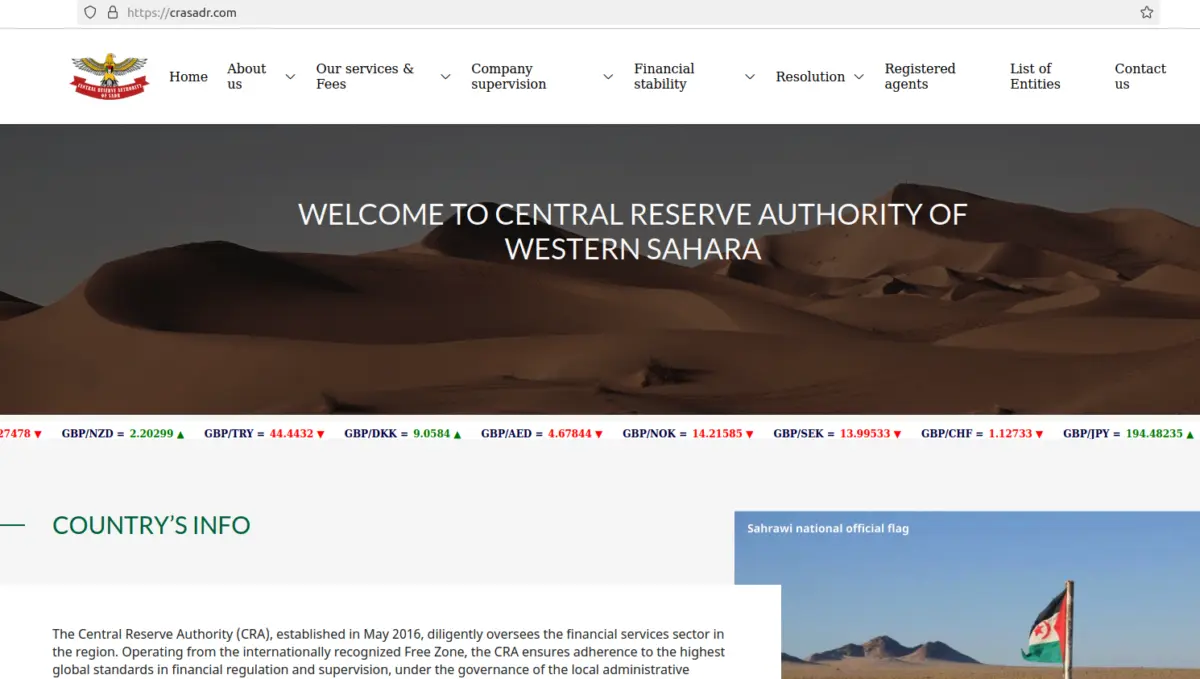
WS Management and Advisory Corporation positioned itself publicly as an exclusive, authoritative regulatory body responsible for issuing and overseeing licensing for cryptocurrency enterprises, foreign exchange (forex) brokers, and online gaming operators. However, there was a catch: this regulatory body claimed jurisdiction exclusively within the Western Sahara, a disputed region in northwest Africa not widely recognized as a sovereign nation by the United Nations or the international community.
The Digital Footprint: crasadr.com and rasd-state.ws
The operational nexus of this scheme was laid bare through domain and server infrastructure analysis. The regulatory body’s official portal—crasadr.com (operated by the Central Reserve Authority of the Western Sahara)—published registries of entities purportedly awarded official licenses for cryptocurrency and financial operations. Among the entities listed with official stamps of approval were the very payment processors fueling the Russian underground economy.
Further technical analysis of former Cryptomus web properties, such as certa[.]website, revealed that they shared hosting servers with a dozen other domains, including rasd-state[.]ws. This domain served as an informational portal for the purported Central Reserve Authority of Western Sahara, completing a bizarre loop where a phantom state in Northern Africa was utilized to grant regulatory credentials to a payment processor funneling ransom payments for Russian cybercrime syndicates.
Future Outlook: The End of the Road for Chameleonic Gateways?
The U.K.’s targeted sanctions against Cryptomus, Heleket, VexPay, TokenSpot, and Tsunami Payments signal a permanent evolution in the enforcement posture of Western governments against borderless cybercrime.
As blockchain analytics firms continue to map out illicit transaction graphs with granular precision, the days of evading accountability through rapid rebranding, shifting domain names, and exploiting jurisdictional loopholes are rapidly drawing to a close. While underground payment processors will undoubtedly attempt to birth new iterations in unregulated jurisdictions, the willingness of Five Eyes nations to cross jurisdictional boundaries and deploy binding economic sanctions creates an existential threat to shadow financial infrastructure.
For Cryptomus and its various incarnations, the U.K. sanctions represent an effective death sentence. By cutting off access to institutional banking partners, freezing liquid assets, and legally barring global compliance networks from touching their ledger, the international community has sent an unambiguous message: the shield of anonymity and corporate shell games has officially been shattered.