Executive Overview
In a decisive escalation against transnational cybercrime and the financial scaffolding supporting the Kremlin’s wartime efforts, the United Kingdom has imposed sweeping economic sanctions on Cryptomus, a notoriously elusive cryptocurrency payment platform. For years, Cryptomus—alongside its shifting portfolio of corporate facades and parallel spin-off services—has operated as a primary financial artery for illicit digital asset flows. According to leading blockchain intelligence firms, the platform has routinely funneled payments for global ransomware syndicates, darknet narcotics vendors, human trafficking rings, and child sexual abuse material (CSAM) networks, while simultaneously helping Russian state-backed entities bypass international economic isolation.
The U.K. Foreign, Commonwealth & Development Office action, enacted on October 8, freezes all assets held by Cryptomus within British financial institutions and erects a legal barrier prohibiting any U.K. corporate entity or citizen from conducting business with the platform. Alongside Cryptomus, the British government targeted a cluster of interconnected virtual payment processors, including VexPay, TokenSpot, and the Tsunami Payments service, signaling a coordinated international effort to dismantle the underlying infrastructure of the digital shadow economy.
This milestone enforcement action represents a turning point in how Western governments handle crypto-native illicit finance. While financial watchdogs have previously relied on monetary penalties—such as Canada’s record-setting CAD $176 million fine against Cryptomus—experts point out that fines alone are easily absorbed or ignored by unregulated entities operating across borders. By pivoting to full-scale economic sanctions, London has taken a tool traditionally reserved for state-sponsored terrorism and geopolitical adversaries and deployed it against a chameleonic criminal enterprise that weaponized corporate anonymity to siphon billions into the global underground.
Detailed Chronology: From Certa Payments to Heleket
The trajectory of Cryptomus is a masterclass in corporate evasion. Since its emergence in 2022, the platform has systematically reinvented itself through successive name changes, shell companies, and parallel ecosystems designed to outpace regulatory scrutiny.
2022–2023: The Birth of Certa Payments and Cryptomus
Cryptomus first materialized in the digital asset landscape under corporate names such as Certa Payments and Xeltox Enterprises. Operating with minimal operational friction, the platform rapidly established itself as the preferred checkout engine for dozens of Russian cryptocurrency exchanges, darknet storefronts, and specialized cybercrime-as-a-service providers. During its formative years, the platform occupied a modest Vancouver office suite—a shared address populated by dozens of other foreign currency dealers and money transfer businesses, none of which maintained a physical presence at the location.
2024: The Net Tightens and the Canadian Penalty
As transaction volumes surged into the billions, independent investigators and blockchain intelligence firms began exposing the platform’s systemic disregard for anti-money laundering (AML) and know-your-customer (KYC) mandates. A landmark December 2024 investigative report by cybersecurity journalist Brian Krebs mapped out how Cryptomus was serving as a critical bridge, transforming illicit cryptocurrency into fiat cash within Russian banking institutions.
The scrutiny culminated when Canadian financial authorities levied a historic CAD $176 million fine against Cryptomus for sweeping violations of anti-money laundering frameworks. Rather than complying, the platform’s operators launched an aggressive legal appeal while simultaneously engineering a contingency plan to ensure uninterrupted service for their criminal clientele.
2025: The Launch of "Heleket" and the No-KYC Pivot
Faced with mounting regulatory pressures and severe financial penalties in North America, Cryptomus briefly instituted rudimentary KYC measures, which caused a temporary dip in its transaction throughput. However, rather than cleaning up its operations, the enterprise launched Heleket—a parallel payment processing service designed explicitly to bypass compliance mandates and continue absorbing unverified, high-risk capital.
By late 2025, forensic data compiled by blockchain analytics firm Chainalysis revealed that the combined ecosystem of Cryptomus and Heleket was experiencing unprecedented growth. The number of illicit counterparties interacting with the services surged past 900 in a single month, outstripping the illicit inflows absorbed by traditional cryptocurrency mixing services monitored by blockchain analysts.
October 2026: The U.K. Drops the Hammer
The chameleonic lifecycle of the platform hit a brick wall on October 8, 2026, when the United Kingdom issued formal sanctions against Cryptomus and its affiliate platforms. Telegram support channels for the network immediately erupted in chaos, with users reporting frozen transactions and sudden operational shutdowns. Automated support bots confirmed that the platform was abruptly incapable of processing digital asset transfers, signaling that the U.K.’s designation had successfully severed its connections to legitimate global banking rails.
Supporting Context & Metrics: Scale of the Illicit Enterprise
To understand the necessity of the U.K. sanctions, one must examine the staggering scale of capital that flowed through Cryptomus and its derivatives. Industry-standard blockchain telemetry paints a grim picture of an industrial-scale clearinghouse for transnational crime.

Financial Volume and Composition
According to a comprehensive April 2026 threat intelligence report published by blockchain analytics firm TRM Labs, Cryptomus processed in excess of $7 billion in cumulative transaction volume since its launch in 2022. While a portion of this volume derived from legal or grey-market merchants, a disproportionate percentage was tied directly to catastrophic harms:
- Ransomware Extortion: Cryptomus served as a primary cash-out conduit for elite ransomware gangs seeking to launder extortion proceeds extracted from corporate and municipal victims worldwide.
- The War Economy: By positioning itself as a reliable liquidity provider for Russian exchange networks, the platform functioned as a vital financial bypass, enabling Russian state-linked actors to acquire sanctioned goods and services despite international banking restrictions.
- Heinous Crimes: TRM Labs identified significant transaction flows connected to the monetization of child sexual abuse material (CSAM) vendors, international human trafficking networks, and sanctioned terrorist financing operations.
Chainalysis Insights on the Wartime Shadow Economy
In its reaction to the U.K. sanctions, Chainalysis underscored that Cryptomus and Heleket were not merely isolated criminal payment processors, but foundational pillars of a broader wartime procurement infrastructure.
"Cryptomus and Heleket have emerged as major payment hubs for illicit activity," Chainalysis stated in an official briefing. "Together, these services received more illicit funds across tracked categories than the mixers in our dataset, and the number of illicit counterparties surged to more than 900 in a single month in late 2025."
This metric highlights a critical evolution in cybercrime economics: rather than relying exclusively on complex decentralized mixers (such as Tornado Cash) to obscure illicit funds, modern criminal syndicates increasingly rely on centralized, high-volume payment processors that masquerade as legitimate fintech startups while intentionally cultivating a blind eye toward compliance.
Official Statements and Industry Analysis
The international response to the U.K. sanctions has been overwhelmingly positive among cybersecurity professionals, though it has also sparked vital conversations regarding the legal frameworks governing cross-border digital asset enforcement.
The Superiority of Sanctions Over Fines
Blockchain analyst and investigator Richard Sanders, who spent months mapping out the labyrinthine payment infrastructure of Cryptomus and interacting directly with its operational ecosystem, emphasized the profound legal distinction between monetary fines and economic sanctions.
Writing on professional networks following the U.K. announcement, Sanders noted the inherent limitations of Canada’s earlier administrative penalty:
"A fine doesn’t stop a cryptocurrency payment processor from processing payments. Sanctions kill the operation. The distinction matters."
Sanders pointed out that because Canada’s CAD $176 million fine was ultimately uncollectible and unenforceable against an entity structured around shell companies and foreign nominees, it failed to halt the daily operations of the payment gateway. The U.K. sanctions, by contrast, carry immediate criminal liabilities for any British or international entity that attempts to clear transactions or maintain commercial ties with the designated parties, effectively choking off the platform’s access to global liquidity.
A Five Eyes Milestone
Furthermore, Sanders highlighted a unique jurisdictional milestone embedded within this enforcement action. The U.K. sanctions represent the first known instance of a "Five Eyes" intelligence-sharing nation (comprising Australia, Canada, New Zealand, the United Kingdom, and the United States) directly sanctioning a cryptocurrency enterprise incorporated within another Five Eyes jurisdiction—in this case, Canadian corporate filings associated with Cryptomus’s early entities. This cross-border friction exposes the vulnerabilities inherent in modern corporate registration systems, which can be easily exploited by bad actors to establish fraudulent legitimacy.
The Anatomy of a Phantom Regulator: The Western Sahara Connection
One of the most bizarre and illuminating aspects of the Cryptomus investigation is the origin of its corporate authority. How does a multi-billion-dollar cryptocurrency platform operating in plain sight derive the legal credentials to offer international financial services?

The Certa Payments Parentage
Deep-dive forensic accounting conducted during the 2024 investigations revealed that the sole shareholder of Certa Payments (Cryptomus’s parent company) was a 25-year-old Ukrainian national. Alongside her role at Certa, this individual served as the head of several other corporate entities, most notably the WS Management and Advisory Corporation.
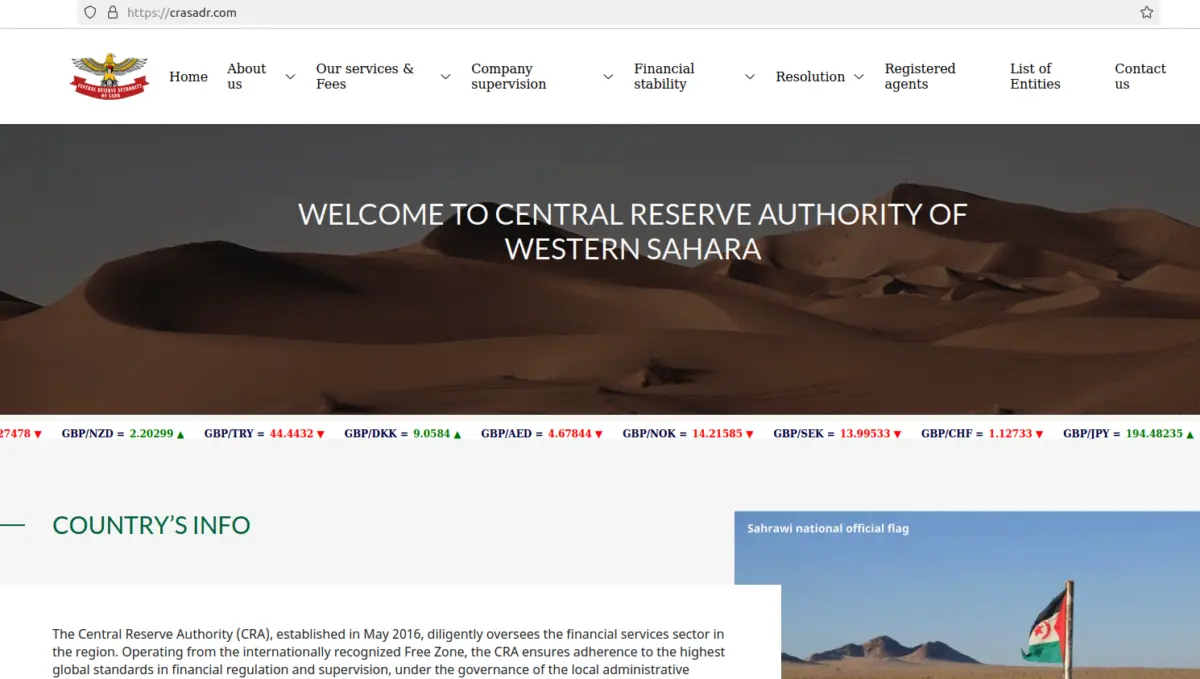
This advisory corporation presented itself to the world as an elite, exclusive regulatory body. Its sole mandate? Issuing official licenses for cryptocurrency exchanges, foreign exchange (forex) brokers, and online gambling platforms incorporated within the Western Sahara—a disputed territory in northwest Africa that lacks widespread international recognition as a sovereign nation.
The Phony Regulatory Apparatus
The primary digital storefront for this scheme operated via the domain crasadr.com, representing the purported Central Reserve Authority of the Western Sahara. This fabricated regulatory body aggressively pitched its services to international applicants, promising expedited bank account setup, corporate formation, and gaming licenses.
Investigative mapping exposed direct infrastructure links between these sham regulators and the payment processors. For example, former web domains utilized by Certa Payments (certa.website) shared hosting servers with no fewer than 12 other domains, including rasd-state.ws—the digital home of the Central Reserve Authority of Western Sahara.
By fabricating a regulatory authority within a legal vacuum, the operators of Cryptomus engineered a brilliant administrative sleight-of-hand: they created an internal compliance loop where unregulated entities were "licensed" by a nonexistent government, providing a veneer of legitimacy that was eagerly accepted by unsuspecting merchant partners and downstream payment gateways.
Future Outlook: The Road Ahead for Crypto Enforcement
The downfall of Cryptomus and Heleket serves as both a major victory for international law enforcement and a cautionary tale regarding the adaptability of cybercrime networks. As traditional financial intelligence units sharpen their tools, the battle lines of digital asset compliance are shifting rapidly.
1. The Death of the "No-KYC" Payment Gateway
The U.K.’s aggressive stance signals that underground payment processors can no longer hide behind shifting brand names, shell companies, or fabricated offshore regulatory bodies. Payment gateways that deliberately omit KYC verification to attract criminal capital are now squarely in the crosshairs of global intelligence agencies. Legal frameworks are increasingly treating willful non-compliance not merely as a regulatory infraction, but as active complicity in money laundering and state-sponsored sanctions evasion.
2. Adaptation by Cybercrime Syndicates
Even as Cryptomus and Heleket scramble to address frozen assets and severed server connections, threat intelligence analysts warn that the underlying demand for illicit payment processing has not disappeared. Cybercrime syndicates, ransomware operators, and Russian state procurement networks are already migrating toward decentralized finance (DeFi) protocols, peer-to-peer (P2P) fiat exchange networks, and privacy-centric stablecoins to replace the lost throughput of centralized processors.
3. The Imperative for Multilateral Cooperation
Ultimately, the Cryptomus saga demonstrates that combatting modern cybercrime requires unprecedented levels of international cooperation. No single nation’s financial watchdog—whether Canada’s enforcement divisions or the U.K. Treasury—can police a borderless digital asset ecosystem alone. The successful neutralization of Cryptomus required the combined efforts of blockchain intelligence providers (such as Chainalysis and TRM Labs), independent investigative journalists, and coordinated diplomatic sanction regimes.
As the digital asset economy matures, regulatory bodies will need to match the agility of criminal syndicates, moving swiftly from administrative fines to systemic asset freezes and targeted economic sanctions before illicit payment networks can successfully morph into their next corporate disguise.