Executive Overview
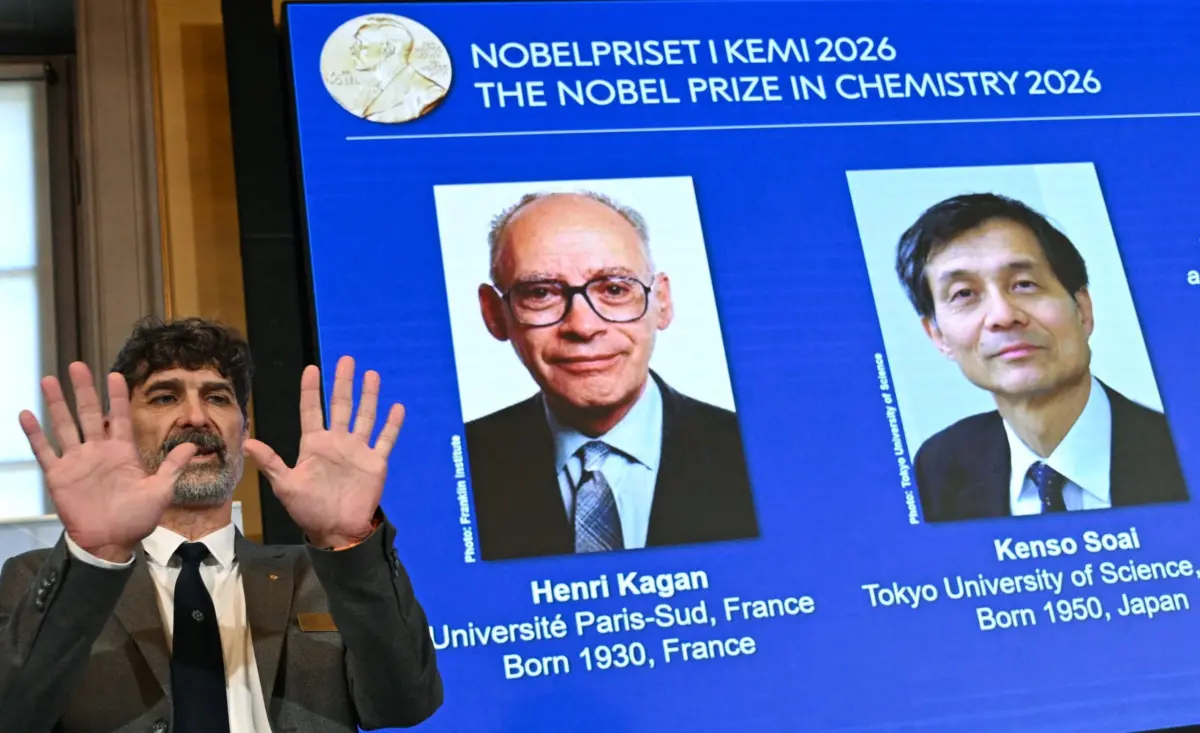
In a monumental breakthrough that bridges the gap between fundamental physics, organic chemistry, and the origins of biology itself, the Royal Swedish Academy of Sciences awarded the 2026 Nobel Prize in Chemistry to Henri Kagan and Kensō Soai. The laureates were recognized for cracking one of science’s most enduring enigmas: nature’s chemical asymmetry, a phenomenon known as homochirality.
For centuries, scientists have grappled with the perplexing reality that while laboratory syntheses naturally produce equal mixtures of mirror-image molecules, living organisms rely almost exclusively on just one version. Until now, replicating this absolute selectivity in a controlled synthetic environment remained an elusive holy grail. Kagan and Soai’s pioneering work—uncovering the "nonlinear effect" and engineering spontaneous absolute asymmetric autocatalysis—has fundamentally rewritten the playbook of molecular science.
This deep dive explores the mechanics of chiral molecules, the historical context of biological asymmetry, the revolutionary contributions of Kagan and Soai, and how their breakthroughs are transforming modern pharmaceutical manufacturing and biotechnology.
Detailed Chronology: From Pasteur’s Discovery to Nobel Recognition
The intellectual journey that culminated in the 2026 Nobel Prize spans nearly two centuries, punctuated by breakthroughs, theoretical models, and persistent laboratory frustrations.
[1848] Louis Pasteur discovers optical isomers using tartaric acid crystals.
  │
[1904] Willy Marckwald pioneers early asymmetric synthesis using chiral catalysts.
  │
[1953] Charles Frank proposes the mathematical model for autocatalysis and homochirality.
  │
[Early 1980s] Henri Kagan discovers the "nonlinear effect" in asymmetric catalysis.
  │
[1990s] Kensō Soai achieves the Soai reaction, proving asymmetric autocatalysis.
  │
[2003] Soai achieves 99.99% enantiomeric excess from a random starting fluctuation.
  │
[2026] Kagan and Soai are awarded the Nobel Prize in Chemistry.
1. The 19th-Century Foundation: Louis Pasteur and Optical Isomers
The story of chirality begins in 1848 with French chemist and microbiologist Louis Pasteur. While examining salts of tartaric acid derived from wine production, Pasteur noticed under a microscope that the crystals formed two distinct types of structures that were non-superimposable mirror images of one another. Using tweezers, he manually separated the two crystal types and discovered that solutions of each rotated polarized light in opposite directions—one to the left, one to the right.
This was the first empirical evidence of enantiomers: molecules that share identical atomic compositions and physical bonds but differ in their three-dimensional spatial orientation, much like a human’s left and right hands. Pasteur subsequently observed that living bacteria could consume one enantiomer while leaving the other untouched, hinting at a profound, fundamental link between molecular handedness and life itself.
2. Early Attempts and Marckwald’s Catalyst (1904)
Following Pasteur’s discoveries, generations of chemists attempted to replicate biological selectivity in the laboratory. The goal was twofold: to understand how nature achieved spontaneous asymmetry and to harness this process for synthetic chemistry. However, early experiments consistently yielded racemic mixtures—equal 50/50 quantities of both left- and right-handed variants.
At the dawn of the 20th century, German chemist Willy Marckwald made the first notable stride. Using a chiral catalyst, he managed to skew the reaction ratio slightly, producing a modest excess of one enantiomer over the other. While groundbreaking for its time, the shift was minuscule, and the dream of total control over molecular handedness remained out of reach.
3. Frank’s Theoretical Blueprint (1953)
In 1953—the same year James Watson and Francis Crick unraveled the structure of DNA—theoretical physicist Charles Frank published a seminal paper outlining the mathematical conditions required to achieve true homochirality. Frank proposed that three elements were mandatory:
- An asymmetric reaction capable of favoring one enantiomer over the other.
- Amplification of that initial imbalance.
- Autocatalysis, meaning the reaction must produce the very catalyst that drives it, creating a positive feedback loop.
In Frank’s model, a tiny initial stochastic fluctuation would multiply exponentially, causing one molecular variant to dominate the entire chemical landscape. For decades, Frank’s model remained purely theoretical—until Henri Kagan and Kensō Soai brought the mathematics into physical reality.
4. Kagan and the Discovery of the Nonlinear Effect (Early 1980s)
Henri Kagan revolutionized asymmetric catalysis by challenging a core assumption held by organic chemists. At the time, standard practice dictated that using a chiral catalyst composed of a 50/50 mixture of two molecular variants would yield a proportional, linear outcome in the final product.
Kagan questioned whether the metal atom at the heart of the catalyst interacted with just one enantiomer at a time or with both simultaneously. By analyzing catalytic systems, he deduced that mixing chiral components created three distinct combinations (A-A, B-B, and the hybrid A-B). He discovered that the mixed A-B catalytic species could profoundly suppress or alter reaction rates, thereby skewing the enantiomeric ratio of the final product in a non-proportional manner.
This discovery of the "nonlinear effect" provided chemists with an unprecedented tuning knob to manipulate reaction pathways, laying the groundwork for advanced stereochemical control.
5. Soai and the Realm of Autocatalysis (1990s–2003)
Inspired by Kagan’s insights and Charles Frank’s theoretical framework, Japanese chemist Kensō Soai set out to create a truly self-replicating asymmetric system.
In the 1990s, Soai experimented with a substance called 5-pyrimidylalkanol. He initiated a reaction where the product itself acted as the catalyst for its own creation. Starting with an enantiomeric excess of a mere 2 percent, Soai observed that the feedback loop amplified the advantage to 87 percent by the conclusion of the reaction.
The culmination of his life’s work arrived in 2003, when Soai engineered an experiment where the starting materials possessed no initial chiral orientation whatsoever. Through pure chance, microscopic fluctuations in the reaction container generated an infinitesimal excess of one enantiomer. Driven by autocatalysis, this random whisper of asymmetry was amplified exponentially. The final product achieved an astonishing 99.99 percent enantiomeric excess—effectively producing a single, pure molecular hand.
As the Nobel Committee remarked in its official press release, "Other than life itself, no one had previously achieved this feat."
Supporting Context & Metrics: The Mechanics of Molecular Handedness
To appreciate the weight of Kagan and Soai’s achievements, one must understand the profound implications of chirality in chemistry, medicine, and biology.
[Chiral Molecule Enantiomers]
       Left (S-form)               Right (R-form)
      ┌─────────────┐             ┌─────────────┐
      │  Therapy    │             │ Toxic/Ineff.│
      │  Effective  │             │ Side Effects│
      └─────────────┘             └─────────────> [Biological Target]
          (Fits)                     (Does Not Fit)
The Lock-and-Key Analogy
The Nobel Committee famously employed a locksmith analogy to illustrate the perils of molecular chirality:
"A locksmith can create two mirror-image keys, but only one of them fits the lock—and the lock can be damaged if your customers try to unlock it with the other key."
In biological systems, enzymes, receptors, and DNA strands act as complex locks. Enantiomers—designated as left-handed (S) or right-handed (R)—interact with these biological locks differently.
The Pharmaceutical Imperative
In drug development, homochirality is not merely an academic curiosity; it is a matter of profound clinical safety and efficacy.
- The Thalidomide Tragedy: The most sobering historical lesson regarding chirality involves thalidomide, a drug prescribed in the late 1950s and early 1960s to alleviate morning sickness in pregnant women. One enantiomer of thalidomide effectively treated nausea, but the mirror-image enantiomer caused severe, devastating birth defects.
- Modern Drug Synthesis: Today, regulatory agencies such as the US Food and Drug Administration (FDA) require rigorous testing of individual enantiomers. Being able to synthesize exclusively the therapeutic enantiomer—avoiding the separation of costly, inactive, or harmful mirror images—saves billions of dollars in pharmaceutical R&D and eliminates dangerous side effects.
Official Statements and Expert Analysis
The scientific community responded to the 2026 Nobel Prize announcement with widespread acclaim, highlighting the profound theoretical and practical implications of Kagan and Soai’s research.
-
The Royal Swedish Academy of Sciences:
"Henri Kagan and Kensō Soai solved one of nature’s most deeply guarded secrets. By explaining how minute non-linear catalysts operate and demonstrating absolute asymmetric autocatalysis, they bridged the chasm between lifeless organic chemistry and the homochirality foundational to living systems."
-
Dr. José María Andrés García, University of Valladolid (via SMC Spain):
"In addition to their practical interest, nonlinear effects are a very valuable tool for studying reaction mechanisms and the nature of catalytically active species. Kagan’s insights transformed how we view catalytic interactions, while Soai proved that the emergence of biological asymmetry is not an impossible statistical fluke, but a governed chemical reality."
-
Dr. Elena Rostova, Institute for Advanced Molecular Research:
"Before Soai’s 2003 breakthrough, creating homochirality from a racemic or non-chiral start felt like defying the laws of thermodynamic probability. They didn’t just build a better catalyst; they uncovered the generative grammar of molecular evolution."
Future Outlook: Where Chemistry Meets the Origins of Life
The awarding of the 2026 Nobel Prize in Chemistry marks not an endpoint, but a launchpad for future scientific exploration. The implications of Kagan and Soai’s work stretch across multiple disciplines:
1. Advanced Pharmaceutical Manufacturing
With the methodologies pioneered by Kagan and Soai, industrial chemists can now design catalytic systems that bypass the arduous process of chiral resolution (separating racemic mixtures after synthesis). This transition toward catalytic asymmetric synthesis promises greener, more efficient chemical manufacturing pathways with near-zero waste of inactive isomers.
2. Astrobiology and the Search for Extraterrestrial Life
Homochirality is widely considered by astrobiologists to be a universal biosignature. If life exists elsewhere in the universe—whether on the icy moons of Saturn or in the atmospheres of distant exoplanets—it is statistically expected to exhibit homochirality. Understanding the exact kinetic pathways of asymmetric autocatalysis helps scientists calibrate instruments aboard deep-space probes to detect amino acid and sugar handedness.
3. Origins-of-Life Research
For decades, biochemists puzzled over the chicken-and-egg dilemma of prebiotic chemistry: Did homochirality precede the formation of RNA and proteins, or did biological polymers enforce asymmetry after life emerged? Soai’s demonstration that microscopic physical fluctuations can cascade into absolute homochirality through simple autocatalytic feedback loops strongly supports the hypothesis that physical chemistry naturally seeded the asymmetric foundation necessary for terrestrial biology.
As laboratories around the world build upon the foundations laid by Henri Kagan and Kensō Soai, humanity moves closer to mastering the intricate, left-handed architecture of life itself.