Executive Overview
What began as localized walkouts over teacher shortages and chronic underfunding in French secondary schools has rapidly metastasized into a broad-based socio-political crisis. Over the past several weeks, France has witnessed an escalating wave of civil unrest that bridges generational and professional divides. Initially driven by students demanding a viable educational environment, the movement has grown to encompass powerful trade unions, working-class parents, and citizens squeezed by an unrelenting cost-of-living crisis.
This mobilization reached a critical juncture on the weekend of October 24, when tens of thousands of demonstrators converged on the streets of Paris. What started as a vibrant, carnivalesque display of collective hope and solidarity eventually devolved into a volatile confrontation with law enforcement, characterized by property damage, tear gas, and water cannons.
Through the lens of documentary photographer Chanel Victor—who captured the day’s rapidly mutating atmosphere on both color and black-and-white film—this report examines the multifaceted nature of the demonstrations. By exploring the trajectory of the Paris march, contextualizing the systemic grievances fuelling the unrest, analyzing the official responses from the French state, and evaluating the long-term political outlook, this article provides an authoritative investigative overview of a nation at a socioeconomic crossroads.
Detailed Chronology: Anatomy of a Paris Protest
Morning: The Optics of Hope and Solidarity
On the morning of October 24, the air in Paris was thick with anticipation rather than tear gas. Thousands of protesters gathered at the designated assembly points, creating a tapestry of French society rarely seen in single-issue demonstrations. High school students stood shoulder-to-shoulder with veteran trade unionists from the Confédération Générale du Travail (CGT), while parents pushed strollers alongside precarious gig workers and retirees.
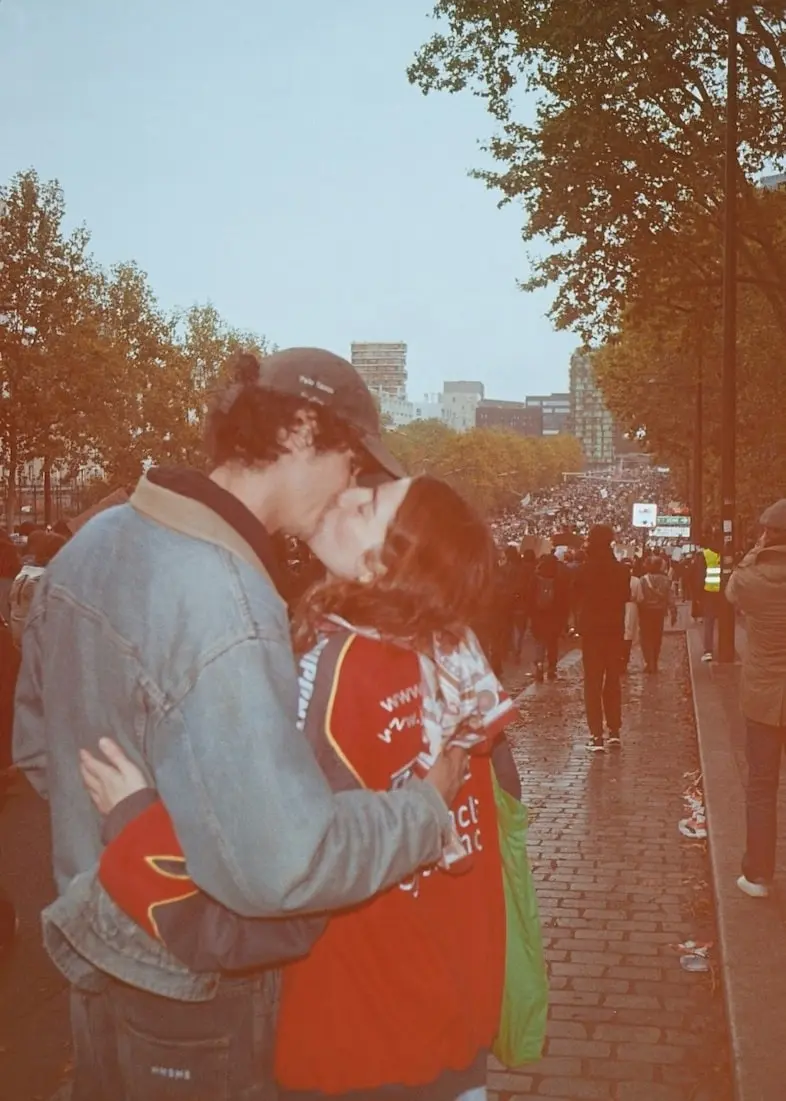
For photographer Chanel Victor, the early hours offered a vision of communal harmony. Working with color film, Victor sought to immortalize the buoyant energy that characterized the march’s inception.
"At first, it was very peaceful," Victor recalls. "People were celebrating, singing, and standing together. It felt almost like spending a day with a huge family."
The demonstration was animated by music, dancing, and homemade banners addressing everything from classroom ratios to skyrocketing inflation, stagnant wages, and the impending privatization of public services. It was a mobilization anchored in the defense of the French social model. Families with young children participated actively, transforming the boulevard into a space of intergenerational dialogue.
"A lot of it felt like it was for the youth, for their future and the future of France," Victor observes, noting that the underlying ethos was profoundly protective of the nation’s republican values of Liberté, Égalité, Fraternité, reinterpreted through a contemporary lens of economic survival.
Afternoon: The Threshold of Escalation
As the march progressed toward its symbolic termination point, the geographical compression of the crowd combined with lingering institutional frustrations to alter the collective psychology of the demonstration. As is frequently observed in contemporary French protest culture, the tail end of the march played host to autonomous, radical elements—frequently referred to as blocs autonomes or gilets jaunes-adjacent factions—who began engaging in aggressive tactics.
Reports emerged of projectiles, including stones and glass, being hurled at public infrastructure and security perimeters. The festive atmosphere began to fracture. Banners reading "Education in Danger" were juxtaposed against rising plumes of smoke, and the sound of acoustic instruments was steadily drowned out by police sirens and the percussive thud of crowd-control munitions.
Dusk: The Black-and-White Shift
Recognizing the rapid degradation of the operational environment, Victor made a deliberate artistic choice: she put away her color film and switched to black-and-white. This transition mirrored the psychological shift of the day itself—moving from the vibrant optimism of dawn to the stark, unforgiving monochrome of evening conflict.
As the confrontation intensified, law enforcement agencies deployed heavy-handed crowd-control measures, including volleys of tear gas and high-pressure water cannons, to disperse the remaining crowds. The visual narrative shifted abruptly from community solidarity to urban warfare.
"The colour images reflect the joy, the life, and the collective energy of the day," Victor explains. "The black-and-white images speak to something darker: the tension, the violence, and how the atmosphere changed toward the end."
For Victor, documenting both extremes was essential to preserving the historical truth of the event. She rejects the simplistic media narratives that often reduce such demonstrations to mere riots or, conversely, romanticize them as purely peaceful assemblies.
"A protest is never just one thing," she asserts. "It’s joy and anger, hope and frustration, people coming together and being pushed to their limits. I wanted the images to hold all of that."
Supporting Context & Metrics: The Root Causes of Unrest
To understand why thousands of citizens are willing to brave police cordons and tear gas in Paris, one must examine the compounding systemic crises plaguing contemporary France. The unrest on the streets is merely the symptom of a deeply engrained institutional and economic malaise.
The Educational Collapse
The spark that lit the current fire was struck in France’s classrooms. For years, teachers’ unions have sounded the alarm over chronic underfunding, decaying infrastructure, and an acute shortage of educators. According to data from the Ministry of National Education, nearly every academic district (académie) in France has faced severe recruitment shortfalls heading into recent terms, leading to thousands of unreplaced absent teachers, overcrowded classrooms, and the elimination of specialized support programs.
Students, traditionally overlooked in national macroeconomic debates, realized that their futures were being compromised by bureaucratic austerity. The walkouts that began in October were organized organically via encrypted messaging apps like Telegram and social media platforms like TikTok, bypassing traditional union hierarchies before eventually finding common cause with organized labor.
The Cost-of-Living Squeeze
While the school walkouts provided the initial momentum, the movement’s rapid expansion is directly attributable to France’s spiraling cost-of-living crisis. Inflationary pressures—exacerbated by geopolitical energy shocks and post-pandemic supply chain disruptions—have eroded household purchasing power.
- Energy Prices: Despite government tariff shields (bouclier tarifaire), gas and electricity prices have risen significantly over the past 24 months, disproportionately impacting rural and peri-urban commuters who rely heavily on automobiles.
- Housing and Food: Basic food items have seen double-digit percentage increases, while rental markets in urban centers like Paris, Lyon, and Marseille remain prohibitively expensive for working-class families and young professionals.
- Pensions and Labor Reforms: The lingering resentment from the contentious pension reforms pushed through by President Emmanuel Macron’s administration earlier this year has created a persistent backdrop of civil disobedience. The public perceives a government out of touch with the daily economic realities of ordinary citizens.
Official Statements and Institutional Response
The response from the French government and law enforcement authorities has been a delicate balancing act between acknowledging legitimate grievances and maintaining public order.
The Ministry of the Interior
Following the clashes in Paris, the Ministry of the Interior issued statements defending the actions of the police while condemning the violence perpetrated by rogue elements within the protest. Officials emphasized that while the right to demonstrate is a constitutionally protected freedom, the targeting of law enforcement officers and the destruction of public property cross a red line that the state cannot tolerate.
Interior Ministry spokespersons noted that several police officers sustained injuries during the weekend’s skirmishes and announced that dozens of arrests had been made for acts of violence and willful damage. The government has increasingly relied on pre-emptive policing strategies, including stringent bag checks, administrative lockdowns of specific transit hubs, and the deployment of specialized tactical units (Brav-M and CRS), to prevent sustained rioting.
The Ministry of National Education and Labor
In response to the student strikes, the Ministry of National Education has repeatedly pointed to ongoing recruitment drives and budgetary allocations designed to bolster the educational sector. However, critics argue these measures are too little, too late.
Labor leaders have accused the government of administrative tone-deafness, arguing that technocratic solutions fail to address the fundamental dignity of public service workers and educators. The inter-union coalitions (intersyndicale) have warned that unless the administration engages in genuine, good-faith negotiations regarding wage indexing and educational funding, the protests will not only continue but escalate into a general strike scenario reminiscent of historical French labor conflicts.
Future Outlook: Where Does the Movement Go From Here?
As France looks toward the winter months, the trajectory of this socio-political movement remains highly uncertain, yet pregnant with revolutionary potential. Several key factors will dictate whether the current wave of protests subsides or deepens into a structural threat to the Fifth Republic’s political stability.
1. The Strategy of Convergence (Convergence des Luttes)
The holy grail of French social protest is the convergence des luttes—the unification of disparate sectoral grievances into a singular, unstoppable force. We are currently witnessing a nascent version of this phenomenon. High school students, university faculties, transport workers, healthcare personnel, and energy sector employees are all experiencing parallel strains. If trade unions successfully coordinate rolling general strikes across these vital sectors, the economic disruption will force the government’s hand.
2. The Political Calculus of the Executive
President Emmanuel Macron’s administration faces a formidable dilemma. Having governed through successive crises—from the Gilets Jaunes movement to pension reform battles—the executive branch has cultivated a reputation for institutional rigidity. Bending to street pressure risks appearing weak; refusing to negotiate risks inciting further civil unrest. With a fragmented National Assembly and no reliable absolute majority, the government’s legislative maneuverability is severely constrained.
3. The Visual and Cultural Legacy
Art and documentation play an outsized role in shaping the historical memory of French social movements. Works like those of Chanel Victor—balancing the celebratory vitality of mass assembly with the grim reality of state suppression—do more than merely record history; they actively participate in it. They remind the public that revolutions and reform movements are complex, contradictory human endeavors born out of both love for community and rage against systemic injustice.
Ultimately, whether the demands of the students and workers are met or suppressed, the events of October 24 in Paris signal that the social contract in France is undergoing a profound renegotiation. The youth and the working classes have made it unequivocally clear: they refuse to inherit a future defined by systemic underinvestment and economic precarity. As long as those structural realities persist, the streets of France will remain a canvas for their resistance.