Executive Overview
The resurgence of retro-styled role-playing games has proven that modern gamers maintain a voracious appetite for nostalgia, provided it is served with contemporary polish. While Square Enix’s pioneering HD-2D engine has largely dominated industry discourse by breathing new life into classic, sprite-based Japanese role-playing games, a new contender is preparing to stake its claim on the subgenre. Enter Tianji: Shadow of the Ancients, an upcoming title from Taipei-based developer Justdan. Rather than recycling medieval European tropes or replicating pixel-art aesthetics, Justdan is crafting a distinctively mainland-Asian experience. Powered by Unreal Engine 5, the game marries traditional turn-based tactical combat with the rich, mystical lore of Chinese wuxia, historical Tang Dynasty aesthetics, and a unique visual identity that blends razor-sharp 2D chibi character models with traditional ink-wash art styles.
Scheduled for release in 2027 across Steam, PlayStation 5, and multiple generations of Nintendo hardware, Tianji: Shadow of the Ancients aims to bridge the gap between old-school pacing and modern quality-of-life expectations. This preview dives deep into the game’s mechanics, narrative foundations, technical architecture, and its potential to shake up the turn-based RPG landscape.
Detailed Chronology: The Journey of Shangguan Shuo
The narrative framework of Tianji: Shadow of the Ancients relies on time-tested storytelling pillars while introducing a unique Eastern cosmological framework. Players step into the boots of Shangguan Shuo, a martial artist whose life is upended early in the game by the antagonistic Xuanxin Order. In a classic inciting incident of the genre, Shuo is struck with severe amnesia—a narrative device that conveniently strips the protagonist of his powers while giving the player a blank slate to explore the world alongside him.
However, Shuo’s physical trauma is only the beginning of his troubles. As he regains consciousness, he discovers he is not alone in his own mind; a mysterious, disembodied voice whispers to him, continuously forcing him to question his identity, his past allegiances, and the very nature of his reality.
Unlike conventional fantasy settings powered by mana or spell books, the reality-adjacent world of Tianji operates on Qi energy. Deeply rooted in Eastern martial arts philosophy, Qi is conceptualized as the vital life force residing in all living things. In the universe of Tianji, practitioners do not simply cast spells; they manipulate and harness Qi leylines running through the world to manifest devastating mystical arts. This substitution of traditional magic with martial arts Qi manipulation lends the narrative a grounded, cultural authenticity while keeping the high-stakes combat fantasy intact.
Shuo’s quest to recover his memories and quiet the voice in his head quickly expands into a sprawling, continent-spanning journey. Along the way, he crosses paths with a colorful cast of companions—eager, if occasionally foolhardy, allies willing to throw themselves into turn-based combat on his behalf. Each companion brings a distinct personal backstory, unique combat abilities, and specialized non-combat skills that tie directly into the game’s progression systems.
Supporting Context & Metrics: Worldbuilding, Art Direction, and Combat Mechanics
A Visual Synthesis: Unreal Engine 5 Meets Ink-Wash Aesthetics
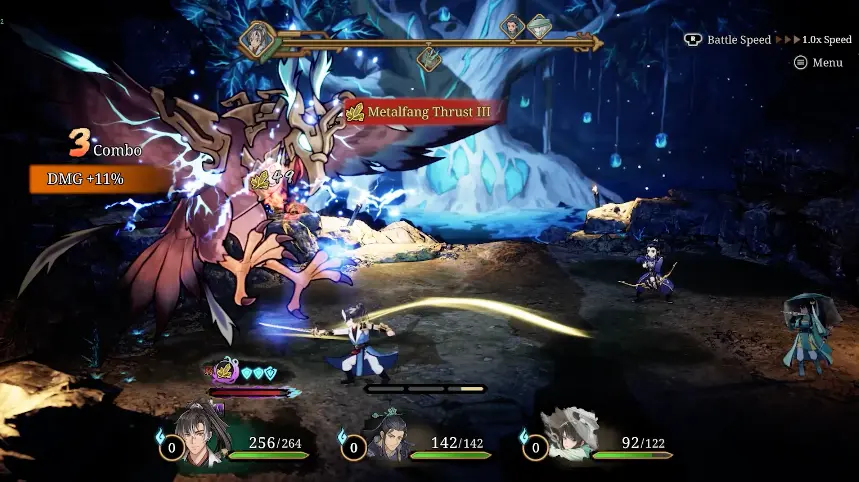
Aesthetic innovation is one of Tianji‘s most striking features. Eschewing the pixelated sprite aesthetic popularized by Square Enix’s HD-2D titles, Justdan has opted for razor-sharp, 2D chibi-style character models that directly reflect their more realistically proportioned key art. These models are far from static; they emote dynamically during in-engine cutscenes, injecting personality into the dialogue sequences.
The world itself is rendered via Unreal Engine 5, presenting a harmonious blend of smaller 3D villages, bustling towns, treacherous caves, dense forests, and sweeping mountain ranges. The fixed-distance tracking camera creates a distinct sense of scale, frequently utilizing depth-of-field effects to draw the player’s eye to the meticulously crafted environments. Furthermore, certain cutscenes seamlessly transition into an ink-on-canvas-inspired art style, echoing traditional Chinese landscape paintings and reinforcing the historical Tang Dynasty backdrop.
Combat Depth and Strategic Layering
While the game’s foundational mechanics will feel instantly familiar to veterans of turn-based RPGs, Justdan has implemented crucial modern accommodations to prevent the pacing from dragging. Recognizing that traditional turn-based encounters can occasionally test a player’s patience, Tianji includes a battle-speed multiplier (up to 2x normal speed) and an automated sweep mechanic. Once players outlevel lower-tier enemies in a given area, they can bypass the transition into combat entirely, instantly defeating weak foes to minimize unnecessary friction during exploration.
Beneath these quality-of-life additions lies a surprisingly deep combat and progression system:
- Vertical Skill Trees: Progression eschews superficial upgrades in favor of a branching, vertical skill tree that demands meaningful choices. Skills frequently combine across party members rather than remaining siloed to a single active character.
- Elemental Synergies: The combat heavily emphasizes elemental strengths and weaknesses tied to Qi attributes. Utilizing abilities like "Scattered Stars II"—which strikes random targets three times and triggers a free re-activation upon landing a critical hit—demonstrates the high ceiling for tactical synergy available later in the campaign.
- Companion Progression: Party members grow stronger the more they are utilized in active combat. Spending time with specific companions unlocks unique personal side stories and specialized utility skills, such as weapon enhancements, cooking stat-buffing meals at camp, or trading surplus inventory items for rare resources. This design philosophy encourages players to rotate their roster rather than relying indefinitely on a single, overpowered "A-team."
Exploration and Environmental Design
The overworld map is structured as an interactive piece of ink-wash art, crisscrossed by visible Qi leylines that dictate the flow of energy across the land. Ignoring the main quest marker yields traditional RPG rewards: wandering off the beaten path reveals hidden bosses, optional side quests, and secret dungeons tucked away in the mountain crags and hidden valleys.
Official Statements and Industry Insights
Speaking at a recent preview event hosted by BiliBili, the development team at Justdan emphasized their desire to honor classic JRPG traditions while carving out a distinct identity for Taiwanese and mainland-Asian game development.
Industry analysts have noted that Tianji: Shadow of the Ancients represents a growing trend of regional developers leveraging advanced technologies like Unreal Engine 5 to export culturally rich, historically inspired narratives to a global audience. By moving away from standard Western high-fantasy tropes and integrating authentic wuxia philosophies into a structured, turn-based framework, Justdan is positioning Tianji as a bridge between nostalgic gameplay sensibilities and contemporary storytelling.
Future Outlook and Platform Strategy
With a broad release window currently pencilled in for 2027, Tianji: Shadow of the Ancients has set its sights on a wide array of platforms, including Steam, PlayStation 5, and multiple generations of Nintendo hardware (encompassing both the current Nintendo Switch and its highly anticipated successor).
Releasing a niche, narrative-heavy turn-based RPG across such a diverse hardware ecosystem is an ambitious endeavor, particularly given that the title is still in its early developmental phases. However, the combination of striking visual direction, an intriguing amnesiac narrative rooted in Tang Dynasty mythology, and a combat system designed to reward active strategic engagement makes for a compelling proposition.
As development continues toward the 2027 launch, players who appreciate deliberate pacing, deep tactical skill trees, and gorgeous ink-wash aesthetics would do well to keep Tianji: Shadow of the Ancients firmly on their radar. If Justdan can successfully deliver on the promise of its early builds, this Taiwanese tribute to the classics may well chart a bold new course for the turn-based RPG genre.