Executive Overview
In a decisive move aimed at crippling the financial lifelines of the Russian wartime economy and transnational cybercrime syndicates, the United Kingdom has issued sweeping economic sanctions against Cryptomus.
A notoriously chameleonic cryptocurrency platform, Cryptomus has long operated as a major conduit for illicit payments. According to leading blockchain analytics firms and international security experts, the platform facilitates laundering for ransomware gangs, narcotics networks, darknet marketplaces, high-yield investment fraud schemes, and specialized cybercrime-as-a-service providers. By acting as a financial bridge, Cryptomus has systematically aided Russian entities in circumventing Western financial restrictions and sanctions.
The U.K. Foreign, Commonwealth & Development Office formally enacted the restrictions on October 8, freezing any assets held by Cryptomus within British financial institutions and strictly barring U.K. companies and citizens from conducting any commercial or virtual business with the platform. Alongside Cryptomus, the British government targeted several associated virtual payment rails and front services, including VexPay, TokenSpot, and the Tsunami Payments service.
While Canada previously levied a record-shattering CAD $176 million administrative fine against Cryptomus for sweeping anti-money laundering (AML) violations, cybersecurity and blockchain investigators have long argued that monetary penalties alone are insufficient against transnational cyber operations. By deploying full-scale economic sanctions, the United Kingdom has crossed a critical threshold, effectively criminalizing the platform’s infrastructure and signaling a united, aggressive front among Western allies to dismantle the dark-economy payment rails powering modern digital crime and state-sponsored circumvention.
Detailed Chronology: From Certa Payments to Heleket
The operational lifespan of Cryptomus is a masterclass in corporate evasion, regulatory dodging, and strategic rebranding.
Emergence and Early Growth (2022)
Cryptomus emerged onto the digital finance landscape in 2022. Initially incorporated under names such as Certa Payments and Xeltox Enterprises, the platform quickly positioned itself as a go-to payment processor for a vast ecosystem of illicit websites, underground Russian cryptocurrency exchanges, and cybercrime storefronts.
Behind the scenes, the company’s corporate paper trail pointed to a phantom presence. Investigators discovered that Cryptomus shared a designated Vancouver, Canada address with dozens of other foreign currency dealers and money transfer businesses—none of which maintained any physical footprint or actual operations at the location. Despite these red flags, the platform processed billions of dollars in untracked, high-risk cryptocurrency transactions.
The Canadian Crackdown and the Birth of Heleket (2024–2025)
As scrutiny mounted, global financial watchdogs began tracing the mechanics of how illicit cryptocurrency is routinely converted into hard cash within Russian banking channels. In December 2024, investigative reports detailed how Cryptomus served as a crucial clearinghouse for cybercriminal syndicates.
Following extensive regulatory pressure, Canadian authorities cracked down on the platform, culminating in October 2025 with a landmark CAD $176 million fine imposed against Cryptomus for egregious, systemic anti-money laundering violations.
Rather than paying the penalty or instituting rigorous compliance frameworks, Cryptomus chose evasion. The platform appealed the fine, weaponized its chameleonic nature by rebranding as Heleket, and launched it as a parallel service. Operating virtually unrestricted, Heleket continued to process massive volumes of high-risk transactions while openly flouting "know your customer" (KYC) protocols. When users attempted to interact with the platform following subsequent enforcement actions, they were met with sudden processing halts, while support agents on Telegram flatly—and falsely—denied any operational affiliation between Cryptomus and Heleket.

The U.K. Sanctions and the Five Eyes Precedent (October 2026)
The turning point arrived on October 8, 2026, when the United Kingdom formally sanctioned Cryptomus and its spin-off iterations.
Blockchain analyst and investigator Richard Sanders noted that the U.K. sanctions represent a historic milestone in international law enforcement: it is the first known instance of a "Five Eyes" nation (comprising Australia, Canada, New Zealand, the United Kingdom, and the United States) sanctioning a cryptocurrency operation incorporated within another Five Eyes jurisdiction.
Whereas Canada’s civil fine proved practically unenforceable and uncollectible due to the platform’s decentralized, offshore corporate structure, British economic sanctions fundamentally alter the equation. As Sanders emphasized in public commentary, "A fine doesn’t stop a cryptocurrency payment processor from processing payments. Sanctions kill the operation. The distinction matters."
Supporting Context & Metrics: The Scale of Illicit Processing
The sheer volume of capital flowing through Cryptomus and its derivative platforms has alarmed major blockchain intelligence and compliance firms. Data compiled across the web3 surveillance ecosystem reveals an enterprise operating on an industrial scale.
- Cumulative Volume: In April 2026, blockchain analytics firm TRM Labs published a comprehensive intelligence dossier revealing that Cryptomus had processed more than $7 billion in transactions since its inception in 2022.
- Beyond Financial Fraud: The $7 billion figure was not confined to routine gray-market currency exchange. TRM Labs and parallel investigators confirmed that Cryptomus infrastructure was routinely utilized to channel funds tied to abhorrent criminal sectors, including international human trafficking operations, terrorist financing networks, and vendors trafficking in child sexual abuse material (CSAM).
- The Surge in Illicit Counterparties: According to a detailed report published by Chainalysis on October 8, 2026, Cryptomus and Heleket firmly established themselves as the premier payment hubs for modern cybercrime. Chainalysis noted that these services collectively received more illicit funds across tracked categories than traditional cryptocurrency mixers. Most alarmingly, the number of distinct illicit counterparties interacting with the platform surged to more than 900 in a single month in late 2025.
- The KYC Impact: TRM Labs observed that Cryptomus transaction volumes temporarily cratered whenever the platform faced fleeting domestic pressures or attempted to implement superficial KYC rules. However, rather than cleaning up their customer base, the operators consistently pivoted—launching parallel no-KYC services like Heleket to recapture illicit market share and maintain fluid pipelines for Russian financial circumvention.
Official Statements and Industry Analysis
The international response to the U.K. sanctions underscores a unified growing consensus: unregulated, shadow cryptocurrency platforms are no longer viewed merely as technical compliance headaches, but as critical national security threats that directly sustain geopolitical adversaries.
Chainalysis on Wartime Economic Infrastructure
In their official post-sanctions assessment, Chainalysis emphasized that the U.K. government’s actions target the deeper, foundational infrastructure enabling Russia’s wartime economy to survive international banking blockades.
"Cryptomus and Heleket have emerged as major payment hubs for illicit activity," Chainalysis wrote. "Together, these services received more illicit funds across tracked categories than the mixers in our dataset… demonstrating that these platforms are not passive tech tools, but active, calculated enablers of systemic financial crime."
Richard Sanders on the Mechanics of Enforcement
Richard Sanders, who spent months mapping out the intricate payment architecture of Cryptomus and transacting directly with its customer base to expose its vulnerabilities, underscored why asset freezes and trade bans are the only language transnational cybercriminals understand.
By operating across multiple jurisdictions and changing corporate shells—from Certa Payments to Xeltox Enterprises, Cryptomus, and finally Heleket—the platform’s operators believed they were immune to traditional law enforcement. The U.K. Treasury’s Office of Financial Sanctions Implementation (OFSI), however, has effectively severed the platform’s access to Western liquidity, correspondent banking networks, and cloud/virtual service providers tied to British jurisdiction.
The Phantom Regulator: Tracing the Western Sahara Connection
One of the most bizarre and illuminating aspects of the Cryptomus investigation involves the pseudo-legal scaffolding the platform used to legitimize its operations. Where do illicit, chameleonic payment processors derive their apparent authority to offer international financial services?

The answer leads into an elaborate administrative mirage involving fake financial institutions overseen by a phony regulatory body positioned in a disputed territory that lacks widespread international recognition.
The Western Sahara Front
An in-depth investigation into Cryptomus’s corporate parent, Certa Payments, revealed that its sole shareholder was a 25-year-old Ukrainian woman. Alongside Cryptomus, she directed several other shell companies, including the WS Management and Advisory Corporation.
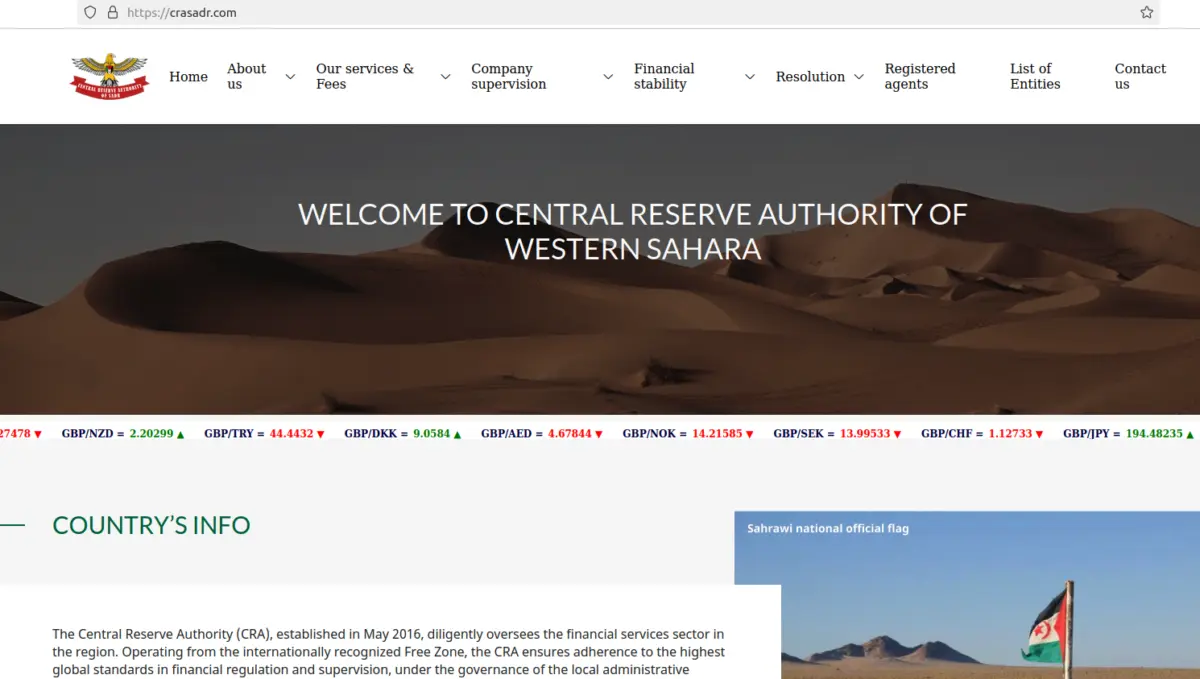
WS Management billed itself as an exclusive, authoritative regulatory body responsible for issuing and overseeing operational licenses for cryptocurrency exchanges, foreign exchange brokers, and online gaming businesses incorporated in the Western Sahara—a disputed region in northwest Africa.
The crasadr.com Discovery
The regulatory body maintained an official-looking web portal located at crasadr.com, which purported to represent the Central Reserve Authority of the Western Sahara. The site publicly listed the entities supposedly awarded formal licenses to operate digital asset and foreign exchange services.
Digital forensics exposed the cynical nature of this setup: historical domain analysis revealed that one of Certa Payments’ former operational sites (certa.website) shared a physical server domain block with 12 other distinct domains, including rasd-state.ws. This network acted as a self-contained administrative ecosystem, creating a closed-loop illusion of sovereign regulatory oversight designed strictly to dupe payment processors, compliance departments, and banking partners into believing Cryptomus was a legitimate, regulated entity.
Future Outlook
The United Kingdom’s economic sanctions against Cryptomus, Heleket, TokenSpot, and VexPay mark a definitive escalation in the global war against cyber-enabled financial crime.
As Western governments close the net around shell companies and phantom regulators operating from disputed territories or lax offshore havens, the operational landscape for cybercriminals is becoming increasingly hostile. While platforms like Cryptomus have repeatedly demonstrated an uncanny ability to mutate, rebrand, and spin off parallel no-KYC services in response to civil penalties, the application of criminal economic sanctions strips away their corporate veil.
Moving forward, blockchain intelligence firms, international law enforcement agencies, and financial regulators are expected to increase cross-border synchronization. The targeting of Cryptomus serves as a stark warning to other shadow payment processors: the era of hiding behind fictitious regulatory bodies and nominal shell companies to bankroll illicit Russian networks and global cybercrime is rapidly coming to an end.