In a decisive escalation against the financial architectures facilitating the Russian war economy and global cybercrime, the United Kingdom has formally issued sweeping economic sanctions against Cryptomus. Operating under a chameleon-like array of corporate identities—including Certa Payments, Xeltox Enterprises, and its latest iteration, Heleket—this cryptocurrency platform has functioned as a central conduit for laundering billions of dollars.
For years, Cryptomus has operated as a critical liquidity bridge for ransomware operators, narcotics rings, darknet vendors, fraud syndicates, and state-backed Russian financial entities seeking to bypass international Western restrictions. The U.K. Foreign, Commonwealth & Development Office’s intervention, announced on October 8, represents more than a routine regulatory penalty. By freezing domestic assets and barring British corporations from maintaining any business relationship with the platform, London has initiated a targeted disruption of a multi-billion-dollar illicit ecosystem.
Alongside Cryptomus, the U.K. government targeted several parallel virtual payment platforms, including VexPay, TokenSpot, and the Tsunami Payments service. Cybersecurity and blockchain intelligence firms have lauded the move, emphasizing a fundamental reality of modern digital crime enforcement: while administrative monetary fines can be absorbed or ignored by transnational illicit operators, economic sanctions strike at the structural operational capacity of networks designed to launder dirty money into clean fiat currency.
Detailed Chronology: From Certa Payments to Heleket
The trajectory of Cryptomus illustrates the agility with which modern cybercrime financial platforms evade law enforcement pressure through corporate restructuring, alias adoption, and jurisdiction-shopping.
Emergence and Early Expansion (2022–2024)
Emerging onto the digital landscape in 2022, the platform initially established its footprint under corporate banners such as Certa Payments and Xeltox Enterprises. Operating from behind obscure legal facades, Cryptomus quickly positioned itself as a favored payment processor for dozens of Russian cryptocurrency exchanges and underground websites hawking specialized cybercrime-as-a-service (CaaS) products.
As detailed in foundational investigations by security researchers, the platform’s corporate footprint early on included a registered address in Vancouver, British Columbia—a location it shared with dozens of other foreign currency dealers and money transfer businesses, none of which maintained a physical presence at the site.
The Canadian Crackdown and the Birth of "Heleket"
By late 2025, regulatory scrutiny caught up with the operation. Canadian authorities levied a record-shattering administrative monetary penalty of CAD $176 million against Cryptomus for severe anti-money laundering (AML) and know-your-customer (KYC) violations.
Rather than complying with Canadian regulatory frameworks, Cryptomus chose defiance. The platform appealed the massive fine, instituted superficial and short-lived KYC procedures that triggered a brief volume crash, and ultimately launched a parallel, no-KYC operational service known as Heleket. This rebranding allowed the criminal infrastructure to continue processing massive volumes of transactions unhindered, masking its continuity behind a new name while retaining its core clientele of ransomware gangs and darknet vendors.
The U.K. Sanctions and Operational Collapse (October 2026)
On October 8, the U.K. government severed the platform’s lifeline by imposing direct economic sanctions. The impact was instantaneous. Telegram-based support channels for both Cryptomus and its spin-off Heleket were quickly flooded with user complaints as automated processing bots and manual agents announced sudden system outages.
Despite overwhelming blockchain tracing data and corporate link analyses proving the direct lineage between Cryptomus and Heleket, support agents on encrypted messaging channels attempted to deny any affiliation. However, the legal reality of the U.K. sanctions rendered these denials immaterial: British banking rails, liquidity partners, and fintech intermediaries were instantly barred from interacting with the networks, effectively cutting the platform off from major Western fiat off-ramps.
Supporting Context & Metrics: The Scale of Illicit Volume
Independent blockchain analytics firms have spent years mapping the transaction graphs of Cryptomus, revealing an operation of staggering proportions.
Billions in Processed Illicit Volume
In April 2026, leading blockchain intelligence firm TRM Labs published a comprehensive analytical profile revealing that Cryptomus had processed more than $7 billion in cumulative transactions since its inception in 2022. The data exposed that the platform’s transaction ledgers were heavily intertwined with some of the most abhorrent corners of the digital underground, including vendors distributing child sexual abuse material (CSAM), state-aligned terrorist financing networks, and international human trafficking operations.
Chainalysis Findings on the Russian Wartime Economy
According to data compiled by Chainalysis, the U.K. sanctions target the core infrastructure underpinning Russia’s wartime financial evasion strategy. In an analytical briefing released alongside the sanctions announcement, Chainalysis noted:
"Cryptomus and Heleket have emerged as major payment hubs for illicit activity. Together, these services received more illicit funds across tracked categories than the mixers in our dataset, and the number of illicit counterparties surged to more than 900 in a single month in late 2025."
This metric highlights a crucial evolution in cryptocurrency crime: while decentralized mixers (such as Tornado Cash) have historically dominated headlines regarding illicit crypto flows, centralized, high-risk payment processors like Cryptomus have quietly absorbed vast quantities of criminal capital, acting as pseudo-banks for the eastern European digital underground.
Official Statements and Investigative Breakthroughs
The enforcement action against Cryptomus is notable not only for its financial scope, but also for the complex investigative work required to pierce its corporate veil. Richard Sanders, a veteran blockchain analyst and investigator who spent months mapping Cryptomus’s architecture and transacting with its ecosystem, highlighted the distinct advantage of sanctions over traditional fines.
Writing on professional networking platforms following the announcement, Sanders underscored:
"A fine doesn’t stop a cryptocurrency payment processor from processing payments. Sanctions kill the operation. The distinction matters."
Furthermore, Sanders noted that the U.K. sanctions represent a historic milestone in international law enforcement cooperation: they are the first known instance of a "Five Eyes" nation (comprising Australia, Canada, New Zealand, the United Kingdom, and the United States) officially sanctioning a cryptocurrency enterprise incorporated within the jurisdiction of another Five Eyes partner.
The Phony Regulator of Western Sahara
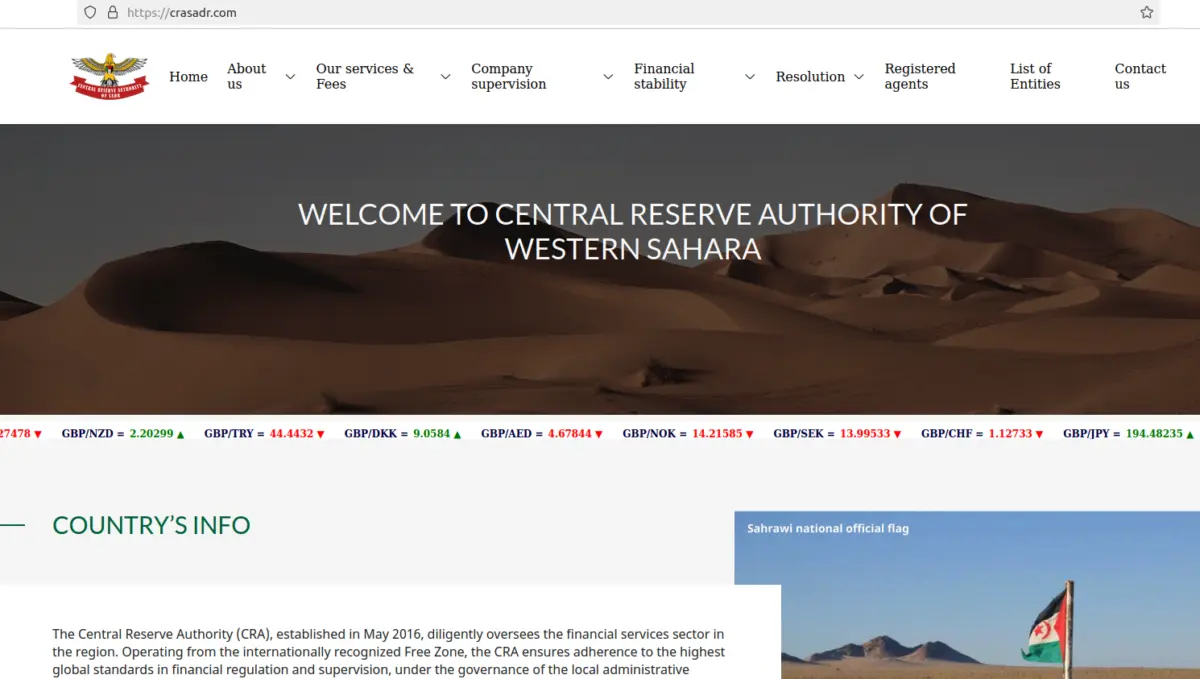
Perhaps the most bizarre dimension of the Cryptomus investigation—first uncovered during a December 2024 independent security investigation—involves how the platform derived its nominal regulatory legitimacy.
Investigators traced the sole shareholder of Cryptomus’s original parent company, Certa Payments, to a 25-year-old Ukrainian national. This individual simultaneously directed multiple corporate entities, including the WS Management and Advisory Corporation. This organization marketed itself as an exclusive, sovereign regulatory body responsible for issuing licenses to cryptocurrency exchanges, foreign exchange brokers, and online gaming platforms operating within the Western Sahara—a disputed territory in northwest Africa not widely recognized as an independent sovereign nation.
The regulatory body’s digital storefront, hosted at crasadr.com, explicitly offered assistance with corporate formation, offshore bank account setup, and high-risk licensing. Technical infrastructure analysis revealed that former Cryptomus registration domains shared server space with rasd-state.ws, a network hub tied directly to the self-proclaimed Central Reserve Authority of Western Sahara. By leveraging a regulatory framework anchored in a disputed, unrecognized geopolitical zone, the architects of Cryptomus engineered a synthetic layer of compliance designed to fool unsophisticated payment processors and banking partners into believing the platform operated under valid regulatory oversight.
Future Outlook: The Closing Net on High-Risk Payment Gateways
The coordinated international pressure against Cryptomus, Heleket, and associated platforms like VexPay and TokenSpot marks a turning point in how Western governments police the intersection of digital assets and state-sponsored sanctions evasion.
For years, high-risk cryptocurrency gateways exploited jurisdictional gaps, shell company formations, and fictitious regulatory bodies to launder trillions of rubles and illicit proceeds out of Western sight. The Canadian CAD $176 million fine demonstrated the financial penalties regulators are willing to impose, but the subsequent evasion tactics—such as the creation of Heleket—proved that monetary penalties alone are insufficient against determined transnational criminal syndicates.
By transitioning from civil monetary fines to criminal and economic sanctions, the United Kingdom has established a potent precedent. Freezing assets, cutting off access to international banking rails, and blacklisting secondary spin-off domains effectively forces these platforms out of the shadows and into operational collapse. As blockchain analytics firms continue to map the recursive topologies of darknet payment gateways, the runway for "chameleonic" crypto processors is growing dangerously short. The dismantlement of the Cryptomus-Heleket apparatus serves as a clear warning to other illicit payment providers: corporate rebranding and phantom regulators can no longer guarantee immunity in an increasingly integrated global regulatory landscape.